
Updated November 2026.
The P20EE code means SCR NOx Catalyst Efficiency Below Threshold, Bank 1: the engine computer measured the SCR catalyst removing less NOx from the exhaust than it is calibrated to expect. That is the SAE J2012 definition, and General Motors words the same code as “Nitrogen Oxides Catalytic Converter Efficiency Below Threshold.” The P20EE code reports a result. It does not name a failed part. The cause can be the diesel exhaust fluid (DEF) itself, crystal deposits where the fluid is sprayed, a NOx sensor, an exhaust leak, a weak DEF supply, software or, least often, the catalyst. This guide covers the symptoms, the causes in the order to check them, a step-by-step diagnosis, what each repair costs, what happens if you keep driving, and notes for Duramax, Power Stroke, Cummins and Sprinter. The rest of the code family is in our DEF trouble codes guide.
What the P20EE Code Means
A selective catalytic reduction (SCR) system sprays DEF into the exhaust ahead of the SCR catalyst. Exhaust heat turns the urea in the fluid into ammonia, and the catalyst uses that ammonia to turn NOx into nitrogen and water. A NOx sensor ahead of the catalyst and a second one after it tell the engine control module how much NOx goes in and how much comes out. The gap between the two readings is the conversion efficiency. When it stays below the calibrated threshold for long enough, the module stores P20EE and turns on the check engine light.
“Bank 1” is part of the generic code name. A pickup or van diesel has one aftertreatment system, so there is nothing else to tell it apart from. The code just before it in the list, P20EF, is the pre-catalyst version of the same test.
Three things about the test explain most of the confusion around this code:
- It only runs under set conditions. The engine and exhaust have to be hot, the NOx sensors have to be awake, and the truck cannot be in a DPF regeneration. A truck that idles or makes short trips may not run the test for days, so the light can come on long after the cause started, and stay on after the cause is fixed.
- It trusts the sensors. The module cannot see the catalyst. It sees two sensor readings. Anything that makes the downstream sensor read high, or the upstream sensor read low, looks like a weak catalyst.
- A NOx sensor cannot tell NOx from ammonia. GM says so in its own Duramax bulletin. If too much DEF is dosed and ammonia slips past the catalyst, the downstream sensor reads high and the same code sets. So P20EE can come from too little reductant or from too much.
Manufacturers set their own thresholds and run conditions, so confirm the details for your engine in its service information before buying parts.
Symptoms of a P20EE Code
- Check engine light with P20EE stored, often with a companion code (see the related codes below).
- A dash message about the exhaust fluid. GM trucks can show “Exhaust Fluid Quality Poor,” Ram trucks “Service DEF System,” and Ford trucks an exhaust fluid system message. Our Service DEF System guide and DEF Quality Poor guide cover what each one starts.
- A countdown to reduced power or a speed limit if the fault stays active.
- White crust at the DEF injector, the line fittings or the fill neck. That is dried DEF, and it points at the second cause below.
- An ammonia smell at the tailpipe when the cause is over-dosing or an injector stuck open.
- Often nothing else. The engine starts and pulls the way it always has until the countdown begins, which is why the code gets ignored.
Causes of P20EE, in the Order to Check Them
No public count ranks these causes, and the mix differs by engine. The order here is the order to check them. The two fluid causes come first because they cost almost nothing to check, they are common, and they are the two you can prevent. They are not the only causes. On plenty of trucks the answer turns out to be a NOx sensor or an exhaust leak, so keep going down the list when the fluid tests good.
1. DEF that is old, heat-aged, diluted or contaminated. DEF is 32.5% urea in deionized water, and the module doses it on the assumption that it is exactly that. Heat breaks urea down in storage. Water added to stretch a jug thins it. A jug or tank left open loses water and the fluid gets too strong. A funnel that has touched fuel, oil or coolant contaminates it. In every case the catalyst gets the wrong amount of ammonia for the NOx coming in, conversion drops, and that drop is exactly what P20EE measures. This cause often brings P207F with it. Test the fluid before draining it: GM tells its dealers that a quality message does not always mean the DEF is bad. See contaminated DEF and how long DEF lasts.
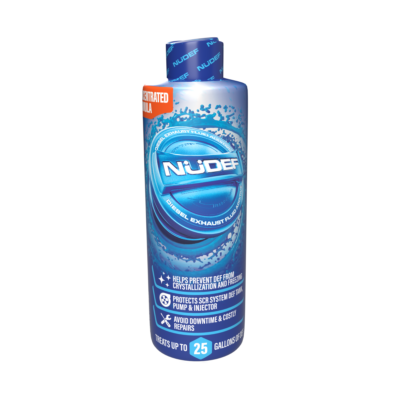
2. Crystallized DEF and deposits at the injector, in the lines and in the exhaust. When the water leaves DEF, urea crystals stay behind. On the injector tip they block or bend the spray. In the lines and the pump filter they cut the flow. Inside the exhaust pipe after the injector, fluid sprayed into exhaust that is too cool can dry into solid deposits on the pipe wall and mixer instead of turning into ammonia. Trucks that idle for long stretches or make short trips are the most prone. Each of these leaves the catalyst short of ammonia with a tank full of good fluid. Our guides on DEF crystallization and SCR system failure go deeper. This is the cause a DEF treatment is made for: NüDef DEF Treatment, Additive & Stabilizer helps prevent DEF crystallization.
3. A NOx sensor that reads wrong. A downstream sensor stuck high, or an upstream sensor that reads low, makes a healthy catalyst fail the math. Sensors age, and they can be damaged by water or contamination in the exhaust. Sensor circuit codes sometimes set alongside P20EE, but a sensor can drift without setting one. Our NOx sensor guide covers testing and replacement.
4. An exhaust leak ahead of a sensor. A leak lets outside air into the exhaust stream and throws off the NOx readings. GM has published bulletins that list P20EE among the codes an exhaust leak can cause on Duramax engines. A ticking or whistling noise or an exhaust smell is the usual hint.
5. A weak DEF supply. A worn pump, a clogged pump filter, a pinched line, or fluid that is frozen because a heater failed all starve the injector. These normally set their own codes first, such as P20E8 for low pressure, and P20EE follows as the consequence.
6. Software, sensor learn values and ammonia overload. Some P20EE cases need no parts. GM’s bulletins describe NOx sensor learn values that go out of range on new trucks, a temporary ammonia overload after certain drive cycles, and a control unit recalibration on one medium-duty truck. Ask a dealer to check your VIN for open updates before paying for hardware.
7. The SCR catalyst itself. A catalyst can lose efficiency with age, from oil or coolant getting into the exhaust, or after a long period of poor dosing. It is the most expensive part on the list and the last one to suspect. In its Duramax bulletins GM says catalyst replacement “may be required but is a very rare occurrence.” Our SCR catalyst replacement guide covers when it really is time.
P20EE and the Codes That Travel With It
The codes stored next to P20EE usually point at the cause faster than P20EE does.
- P207F, reductant quality performance: with P20EE, look at the fluid first. Test it.
- P20E8, reductant pressure too low: a supply problem. Fix the pressure and the efficiency code usually clears with it.
- P249D and P249E, reductant flow too low and too high: the dosing loop is at its limit. Think injector deposits for low flow and over-dosing for high flow.
- P204F, reductant system performance: a general flag that often sets once another reductant fault has persisted.
- NOx sensor circuit or performance codes: fix these before judging the catalyst. A bad sensor makes every efficiency reading worthless.
- On heavy trucks, the same fault is reported under SPN numbering. See SPN 4094 and SPN 4364.
How to Diagnose P20EE, Step by Step
Work from the cheap checks to the expensive ones. Steps 1 to 3 need a basic scan tool, a refractometer and a flashlight. The later steps need a scan tool that can command the DEF system, which usually means a shop.
- Read every code and save the freeze frame. Fix circuit codes, NOx sensor codes, pressure codes and heater codes first. P20EE is often the result of another fault, and the freeze frame shows whether it set hot on the highway or after a long idle.
- Test the DEF. A refractometer made for DEF takes thirty seconds. Good fluid reads 32.5% urea, and the accepted range is 31.8% to 33.2%. Look at the fluid in a clear jar too: it should be clear and colorless with nothing floating in it. Our guide on how to test DEF fluid shows the readings.
- Look for crystals. Check the injector, every line fitting, the pump filter and the fill neck for white crust. Crystals on the outside of a fitting mean crystals inside it. If you can pull the injector, look at the tip and at the pipe behind it for built-up deposits.
- Compare the two NOx sensors. On a warm highway drive, the downstream reading should sit well below the upstream reading and move with it. GM’s yardstick for the Duramax is about 70 percent lower downstream. Both sensors should fall toward zero when you coast after a hard pull. A downstream sensor that does not follow the upstream one down is either faulty or reading ammonia.
- Check for exhaust leaks from the turbo outlet back to the downstream sensor. GM describes a smoke test and a soapy-water pressure test for this.
- Test DEF pressure and injector flow. With the scan tool, confirm the pump builds and holds commanded pressure, then run the injector quantity test into a container and compare the volume and the spray pattern with the service information.
- Ask about software. Have a dealer check for calibration updates and bulletins for your VIN before any hardware is replaced.
- Run a regeneration and re-test. A service regeneration can clear stored ammonia and light deposits. Then drive the truck warm until the SCR test runs again.
- Consider the catalyst last, and only after everything above has checked out and the code returns.
After any repair, clearing the code proves nothing. The test has to run and pass. On the Duramax, GM asks technicians to drive at least 20 miles in the right conditions before judging a fix, and other engines have their own drive cycle.
How to Fix P20EE, by Cause
- Bad fluid: drain the tank, rinse it with distilled water if the fluid was contaminated, and refill with fresh certified DEF. Treat the new fill with NüDef, one 8 oz bottle per 25 gallons, so it is less likely to crystallize in the tank, pump, lines and injector.
- Crystals at the injector or in the lines: remove the injector and soak the tip in warm distilled water, flush the lines until they run clear, and replace the pump filter. Our DEF injector cleaning guide has the procedure. Replace the injector if it will not spray cleanly afterward; the doser valve guide covers that call.
- Deposits in the exhaust pipe or mixer: light deposits often burn off in a service regeneration. Heavy build-up means the pipe comes off for cleaning, and the cause of the cool, wet dosing has to be found.
- NOx sensor: replace the failed sensor with the correct part for the VIN and complete any reset or learn the manufacturer requires.
- Exhaust leak: replace the gasket, clamp or flex section, then re-run the test.
- Supply problem: filter first, then lines, then the pump or heater. The filter, pump and heater guides walk through each one.
- Software: the dealer reprograms the module or resets the sensor learn values.
- Catalyst: replacement, followed by the regeneration and quality tests the manufacturer requires.
What It Costs to Fix P20EE
The cost depends entirely on which cause you find. These ranges come from our own repair guides for the three diesel pickups, parts and labor at a shop. The gap between the top rows and the bottom row is the argument for diagnosing before buying anything.
| Repair | Typical shop cost | Notes |
|---|---|---|
| Diagnosis | $200 to $450 | Worth paying before any part is ordered |
| Clean the DEF injector | $0 to $120 | A do-it-yourself job on many trucks |
| DEF pump filter | $100 to $250 | Replace it whenever crystals are found |
| DEF injector (doser) replacement | $300 to $700 | Only if cleaning does not restore the spray |
| NOx sensor replacement | $400 to $1,250 | Per sensor |
| DEF pump module | $500 to $1,100 | When pressure will not build with a clean filter |
| SCR catalyst replacement | $2,700 to $5,100 | The last resort |
A drain and refill costs the price of the fluid plus the labor to drain the tank. Exhaust leak repairs vary too much by location to give one figure.
Can You Keep Driving? Derate and Limp Mode
For a few days, usually yes. Indefinitely, no. An SCR fault that stays active moves the truck into what the EPA calls an inducement: a warning first, then a cut in power, then a speed limit. The exact schedule depends on the vehicle class, the model year and the software on the truck, and it is printed in the owner’s manual.
For heavy-duty trucks, EPA’s August 2025 guidance, as summarized by DieselNet, sets a 15 percent torque reduction at 650 miles or 10 hours, a 30 percent reduction at 4,200 miles or 80 hours, and a 25 mph limit at 8,400 miles or 160 hours. The guidance it replaced allowed a 5 mph limit after 4 hours, and trucks that have not received updated software still follow their original schedule. Pickups, motor coaches and off-road equipment have their own schedules under the same guidance.
Two practical points. Clearing the code with a scan tool does not stop a countdown for long, because the test fails again as soon as it runs. And driving on a real dosing fault keeps feeding the problem: more deposits if the cause is crystals, more ammonia through the catalyst if the cause is over-dosing. Our engine derate guide explains the stages and how each one is cleared.
P20EE by Make: Duramax, Power Stroke, Cummins, Sprinter
GM Duramax (6.6L LML, LGH, L5P and 3.0L LM2). The Duramax is where most P20EE searches come from, and GM has published more on this code than any other maker. We cover those bulletins, the test conditions and GM’s diagnosis order in a separate guide: P20EE on a Duramax. Start there if you drive a Silverado or Sierra.
Ford 6.7 Power Stroke (2011 and up). The diagnosis order above applies as written. Ford scan data shows both NOx sensor readings and commanded versus actual reductant pressure, which makes steps 4 and 6 straightforward. The pump, filter and level sender sit in the DEF tank as one module. The Power Stroke DEF guide covers the rest of the system.
Ram 6.7 Cummins (2013 and up). On a Ram the code usually arrives with a “Service DEF System” message, and often with P207F. Test the fluid and inspect the doser before anything else. The Ram 6.7 Cummins DEF guide has the code map for the platform.
Mercedes-Benz Sprinter. Mercedes calls DEF AdBlue. Sprinters carry small tanks and many of them spend their lives on short delivery routes, the duty that favors crystals and deposits. Check the fluid and the injector first. The Sprinter DEF guide covers the warnings and the reset sequence.
Heavy trucks and equipment. Class 8 tractors and off-road machines report the same fault under SPN and FMI numbers, and the order of checks does not change: codes, fluid, crystals, sensors, leaks, supply, software, catalyst.
How to Keep P20EE From Coming Back
Nothing you pour in the tank prevents a failed NOx sensor, a cracked exhaust gasket or a calibration fault. The fluid causes are different. They build slowly, and they are down to how the DEF is bought, stored and handled.
- Buy sealed, certified DEF from a seller that moves a lot of it, and check the date code on the jug.
- Store it cool and capped. Heat and sunlight age DEF. An open jug loses water and takes in dirt.
- Keep DEF equipment for DEF only. A funnel or jug that has held fuel, oil or coolant will contaminate the tank.
- Do not top off with water, ever.
- Give the truck a real drive. A regular highway run gets the exhaust hot enough to dose cleanly and burn off light deposits.
- Treat the DEF at every refill. NüDef DEF Treatment, Additive & Stabilizer helps prevent DEF crystallization and helps protect the SCR system, DEF tank, pump and injector. NüDef’s product page lists P20EE among the fault codes it helps prevent, and it does that through the fluid. One 8 oz bottle treats 25 gallons of DEF. Add it at every refill, never exceed the dose on the label, and use it with certified DEF.
NüDef does not repair a sensor, a leak or a worn catalyst, and it does not clear codes. Diagnose and repair an active P20EE first, then treat the fresh fill so crystals are not the reason it comes back. Fleets that treat DEF in volume can get pricing through the wholesale program. Everyone else can order NüDef direct and keep a bottle in the truck.
More in the DEF code series: DEF trouble codes index · P20EE Duramax · P207F · P20E8 · P203F · P204F · P249D