What Counts as Contaminated DEF
DEF is one of the least forgiving fluids on a truck. It is a 32.5% urea solution in purified water, held to the ISO 22241 standard, and the SCR system is built around exactly that chemistry. Contaminated DEF is anything that moves the fluid off that spec, whether something got added or the fluid degraded on its own. Five things do it in practice: water, tap-water minerals, diesel or oil, dirt, and heat. Each one damages a different part of the system, which is why the fix and the bill depend on knowing which one you have.
Contaminated DEF Symptoms, Stage by Stage
Contamination announces itself in a predictable order. Catching it at stage one costs a jug of fluid. Catching it at stage four costs hardware.
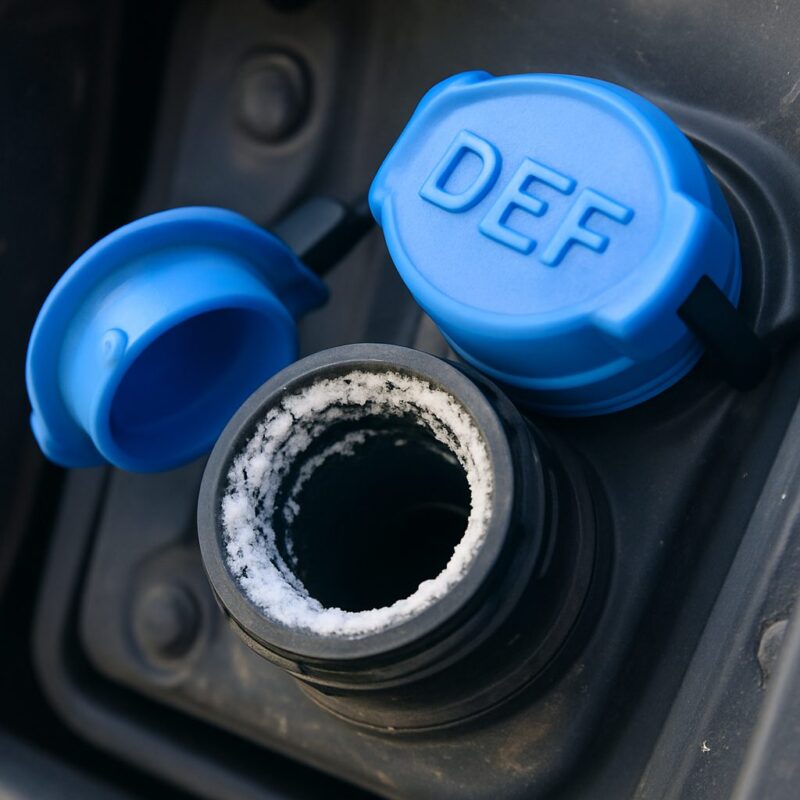
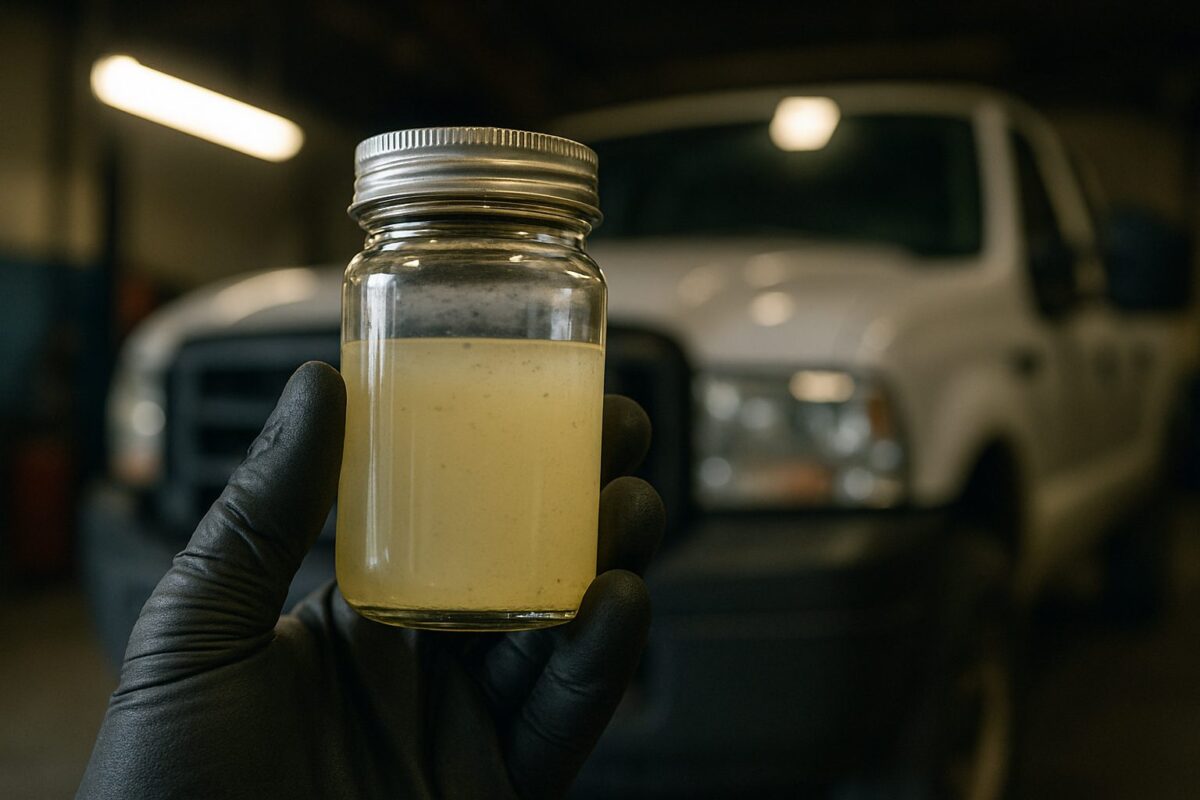
- Stage 1, in the jug or tank: good DEF is water-clear with a faint ammonia smell. Cloudiness, floating particles, a yellow or brown tint, a fuel smell, or a sheen on the surface all mean the fluid is done. White crust around the filler neck means crystals are forming where they should not.
- Stage 2, on the dashboard: the DEF quality poor warning is the system’s direct verdict on the fluid. On most trucks it is followed by a mileage countdown and then the broader Service DEF System message.
- Stage 3, in the codes: quality codes such as P207F, NOx efficiency codes such as P20EE, and dosing codes such as P20E8 and P204F show up as the contaminant reaches the doser and catalyst. A level code like P203F can appear when crystals seize the float. The sensor guide maps which code points at which part.
- Stage 4, in behavior: more frequent regens, falling fuel economy, a torque derate, and finally the 5 mph limp mode described in what happens if you run out of DEF. A truck can reach this stage with a full tank if the fluid in it is wrong.
The two-minute test: a DEF refractometer read against the 32.5% target settles the concentration question on the spot. ISO 22241 allows 31.8% to 33.2%. Anything outside that band is contaminated or degraded, and the answer is drain, not hope. A refractometer costs less than one quality sensor.
The Five Contamination Types and What Each Does to the SCR System
- Water (dilution): condensation in a half-empty jug, rain in an open tote, or water added on purpose to stretch fluid. Concentration drops, the ECM doses the wrong amount of urea, NOx conversion falls, and the quality sensor eventually flags it. Caught early, a drain and refill ends it.
- Tap-water minerals: worse than plain dilution. Calcium, magnesium, and iron stay behind as the water leaves through the doser as vapor. Scale builds in the injector, the pump, and on sensor faces, and a refill does not remove it.
- Diesel or oil: the most destructive common contaminant. Hydrocarbons coat and poison the SCR catalyst itself. Heavy exposure means replacing aftertreatment components measured in thousands of dollars, not cleaning them. One shared funnel is enough.
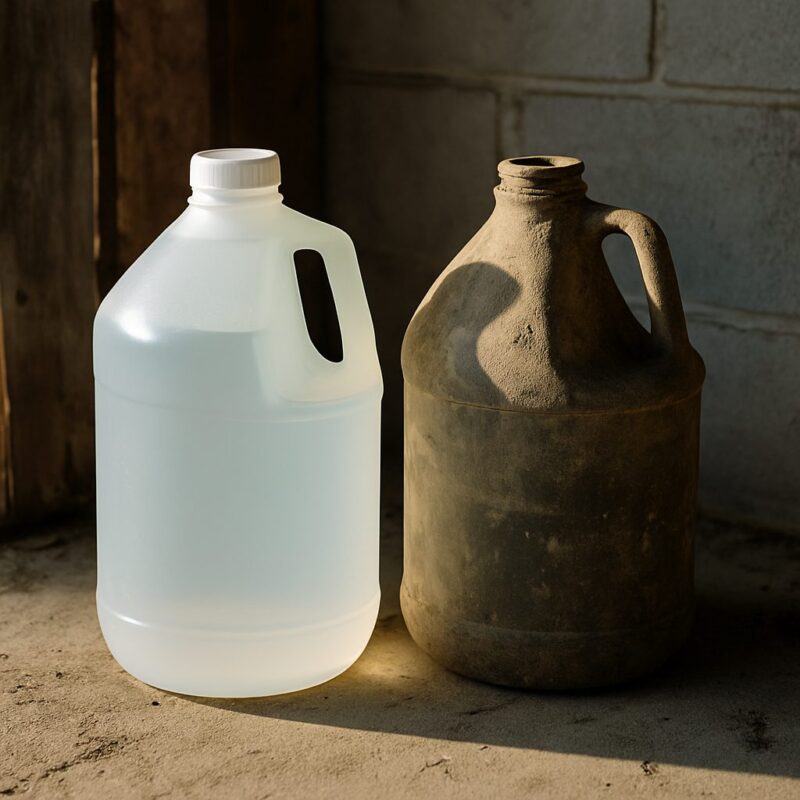
- Dirt and dust: the open jug in a shop corner or the uncapped drum pump. Particles clog the fine screen in the doser, scratch pump internals, and surface as pressure faults such as P249D.
- Heat and age (degradation): nothing added, but the urea itself breaks down. Storage above 86°F accelerates it, and the byproducts include biuret, which the ISO 22241 spec limits, and ammonia. Degraded fluid reads off-spec, crystallizes on everything wetted, and kills level floats, quality sensors, and dosers exactly like the failures in the sensor guide. The storage and shelf-life guide covers how fast it happens.
Can You Put Water in a DEF Tank?
No. Even distilled water dilutes the fluid below spec and breaks the dosing math. Tap water adds minerals that scale the injector and sensors. A small amount of condensation is survivable with a drain and a fresh fill. Deliberately watering DEF to stretch it costs a sensor or a doser within weeks, and on a truck that already shows a quality warning it brings the derate forward. If the tank is empty and no DEF is available, the truck is safer parked than watered. The same rule covers every other fluid: no windshield washer fluid, no coolant, no diesel. The only thing that goes in a DEF tank is certified DEF.
How DEF Gets Contaminated: At the Fill, in Storage, in the Tank
The fluid almost always leaves the factory perfect. Contamination is a handling event, and it happens in three places.
- At the fill: a funnel or container that has ever touched diesel, coolant, or oil. A dusty spout. A “spare” container of unknown history pressed into service on a busy day. Filling in the rain with the cap off.
- In storage: a part-used jug with the cap loose collects dust and moisture while the urea degrades. A tote left in the sun. Stock that sat for a year past its date code. Brand mixing is a much smaller risk by comparison, covered in can you mix DEF brands.
- In the tank: a cracked or missing fill cap that lets water and road grit in, a tank heater failure that lets fluid freeze and thaw repeatedly (see the heater guide), or fluid that simply sat through a hot summer in a truck that rarely drives.
How to Fix Contaminated DEF: Drain, Flush, Refill
Topping off with fresh fluid dilutes the contaminant but removes none of it, and the system doses continuously, so every mile pushes the problem through the pump, injector, and catalyst. The fix is always a drain.
- 1. Stop adding miles. If you smell fuel or see a sheen, park the truck. For dilution or degradation, drive only as far as the shop.
- 2. Drain the tank completely. Use the drain plug where the truck has one, or a clean DEF-only transfer pump through the filler. Never siphon by mouth. Dispose of the fluid as described in how to dispose of DEF.
- 3. Flush with distilled water. Pour in a few gallons, agitate, drain, repeat until the water runs clear. Skip this step for dilution alone; do it twice for dirt or minerals.
- 4. Clean, if the contaminant was dirt or minerals. A rinse does not remove scale or sediment from the bottom of the tank. The full procedure is in the DEF tank cleaning guide, and deposits already downstream may need the crystallized DEF treatment.
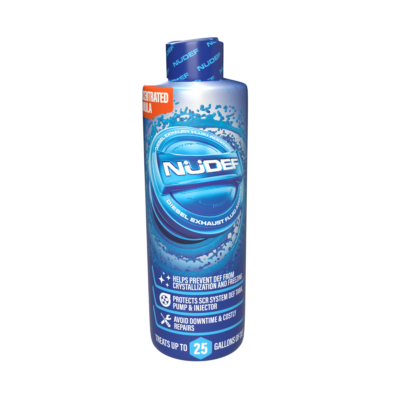
- 5. Refill with fresh certified DEF and treat it. Dose NüDef into the new fill so the replacement fluid stays in solution instead of restarting the cycle.
- 6. Clear the codes and confirm. Clear stored DEF codes, drive a full warm-up cycle, and confirm the quality warning stays off. A warning that returns on fresh, refractometer-verified fluid means the sensor or doser is now the fault, and the sensor guide takes over.
When the hardware has to come out: replace the DEF header (level sender assembly) if the float is crusted and the gauge still reads wrong after the flush; replace or clean the doser if pressure codes persist on clean fluid; and after any diesel or oil exposure, have the complete dosing path professionally flushed and the catalyst inspected before restarting. What not to do: do not run the tank down first, do not add water to “thin out” a contaminant, do not reuse the container the bad fluid came from, and do not clear codes and hope.
What Contaminated DEF Costs: Ignoring It vs Fixing It
The contaminant decides the rung of the ladder.
- Caught at stage 1: one jug of fresh DEF and an hour, roughly $40 to $150.
- Minerals or dirt that reached the doser: tank cleaning plus an injector or doser service, $200 to $700.
- Degraded fluid that crystallized on the sender or quality sensor: $200 to $800 in sensors, and the same again if the fluid is not fixed at the same time.
- Diesel or oil in the tank: $1,000 to $4,000 or more for SCR catalyst work, plus downtime.
- A derate on the road: a tow and a missed load on top of any of the above.
Against that ladder, prevention is a refractometer, sealed storage, a dedicated funnel, and a few dollars of stabilizer per tank.
Prevention: Cheap, Boring, Effective
Buy certified fluid from high-turnover sources and check the date code. Keep containers sealed and out of the sun. Dedicate the funnel and the transfer pump to DEF forever. Treat the fluid so it stays in spec between fills: NüDef DEF Treatment, Additive & Stabilizer keeps urea in solution through heat, cold, and sit time, prevents the crystallization and freeze deposits that turn marginal handling into dead sensors, and treats up to 25 gallons per 8 oz bottle. Order direct at nudef.com. Fleets can set up case pricing through the wholesale program.
Contamination at Fleet Scale
One contaminated jug costs a truck a sensor. One contaminated tote costs a fleet a bad month, because the same fluid feeds twenty trucks and by the time the first quality warning appears every vehicle that filled from that tote is carrying the problem. Fleet contamination almost always enters through transfer equipment: a drum pump left uncapped, a tote fitting that sat open between deliveries, or a container of unknown history. The fixes are procedural and cheap next to fleet-wide dosing repairs.
- Closed-system transfer only: sealed couplers on totes, capped pumps, no open-bucket intermediate steps. The closed-loop approach is detailed in the bulk DEF guide.
- First-in, first-out stock rotation with date codes checked at delivery, so no tote ages quietly in a hot corner of the yard.
- A refractometer at the fuel island: thirty seconds per delivery beats discovering off-spec fluid through a derate on the interstate. Heavy-truck patterns are in the semi truck guide.
- Treat at the tote, not the truck: dosing NüDef into bulk storage stabilizes every gallon downstream at once and keeps slow-turning stock in spec. Case and program pricing runs through the wholesale signup.