Working on a different part of the DEF system? Use the right guide:
You’re here because you’ve got white deposits in your DEF system. Maybe it’s a chalky buildup around the filler neck. Maybe your scan tool’s throwing P20EE or P207F. Maybe your truck just went into derate and you’re sitting on the shoulder trying to figure out what happened. Whatever brought you here, let’s get you sorted out.
This guide covers the full picture: what crystallization actually is, how to tell it apart from contamination, where crystals form first and why, how to diagnose the problem, how to fix it, and how to keep it from coming back. It draws on OEM service bulletins, ISO standards and published research.
First Question: Is It Crystallization or Contamination?
This is where most people get tripped up, and it’s the first thing you need to figure out because the fix is completely different.
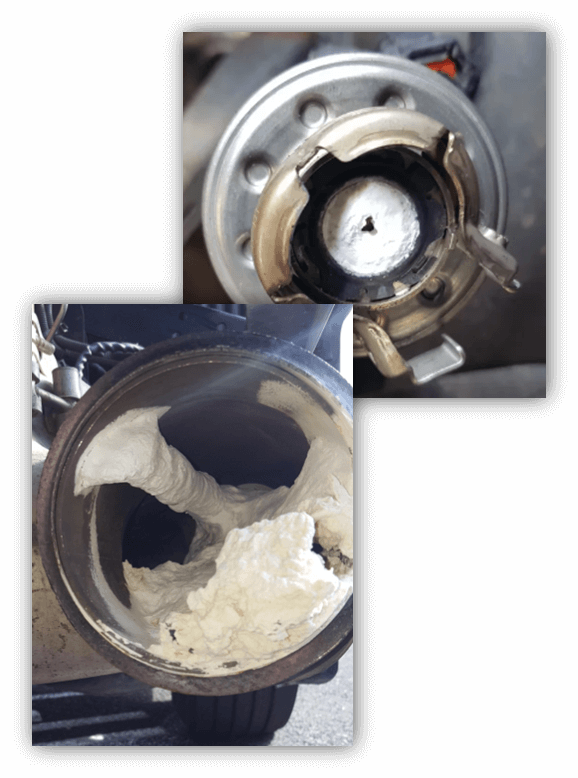
DEF crystallization is white, chalky, powdery residue. It forms when the water component of DEF evaporates and leaves behind concentrated urea solids. It dissolves easily in warm distilled water. If you touch it, it feels like baking soda or powdered sugar. This is a physical process — the DEF itself wasn’t bad, it just lost water.
DEF contamination is a different animal entirely. If someone accidentally topped off the DEF tank with diesel fuel, coolant, or windshield washer fluid — or if the DEF was stored in a container that previously held something else — you’ve got a chemical contamination problem. Contaminated DEF can look cloudy, discolored, or smell different than the mild ammonia scent of normal DEF. Unlike crystallization, contamination damages the SCR catalyst permanently. According to Cummins Service Bulletin 4021566, chemical contamination leads to SCR catalyst damage that is “impossible to remove.” That means if you’ve got contamination, you’re looking at a full system flush and possibly a catalyst replacement — $3,000 to $10,000 depending on the platform.
Quick field test: Take a small sample of the suspect fluid and add warm distilled water. If the white solids dissolve completely within a few minutes, it’s crystallization. If the fluid stays cloudy, has an unusual color, or won’t clear up, treat it as contamination and don’t run the engine until it’s properly diagnosed.
What DEF Crystallization Actually Is (The Chemistry)
DEF is a precise solution: 32.5% automotive-grade urea dissolved in 67.5% deionized water, specified under ISO 22241-1:2019. That 32.5% ratio isn’t arbitrary — it’s the eutectic point of the urea-water mixture, meaning it produces the lowest possible freezing point at 12°F (-11°C). Go above or below that concentration and the freezing point rises.
Crystallization happens when that ratio gets disrupted. Here’s the science: when water evaporates from DEF — through heat exposure, an improperly sealed cap, or a low tank level with lots of airspace — the urea concentration climbs above the 33.2% upper limit set by ISO 22241. Once it passes that threshold, the excess urea has nowhere to go. It precipitates out of solution as solid crystals.
But crystallization inside the SCR system is more complex than simple evaporation. When DEF is injected into the hot exhaust stream, it’s supposed to undergo a two-step thermal decomposition: first, the water evaporates and urea melts (starting around 133°C/271°F). Then at roughly 150°C (302°F), the urea breaks down into ammonia (NH3) and isocyanic acid (HNCO) — that ammonia is what actually reduces NOx on the SCR catalyst.
The problem is when exhaust temperatures are too low for complete decomposition. Research published in PMC (2021) mapped the exact temperature thresholds:
- Below 150°C (302°F): Urea doesn’t fully decompose. It solidifies on exhaust surfaces as raw urea crystals.
- Around 160°C (320°F): Isocyanic acid reacts with remaining urea to form biuret — a harder, more stubborn deposit.
- Above 175°C (347°F): Cyanuric acid begins forming. This is the most stubborn deposit and needs much higher exhaust temperatures to break down.
A 2024 study in Applied Sciences (MDPI) looked at how exhaust heat drives crystallization risk. This is why trucks that spend a lot of time idling, running light loads, or making short trips are the most prone to crystal buildup: their exhaust systems never get hot enough for complete decomposition.
Where Crystals Form First — and Why It Matters
Crystals don’t form everywhere at once. They follow a predictable pattern, and understanding that pattern tells you how far the problem has progressed.
Stage 1: The DEF Injector Nozzle
This is always ground zero. The DEF injector sits in the exhaust stream and sprays DEF into the decomposition tube. Every time the engine shuts down, any residual DEF on the injector tip is exposed to residual exhaust heat without active cooling. The water evaporates, urea concentrates, and crystals form on and around the nozzle orifice. These orifices are tiny, so even microscopic crystal deposits can partially or fully block the spray pattern.
Ford has issued service information for 6.7L Super Duty trucks where urea crystals on the reductant injector nozzle set DTCs P208E (Reductant Injection Valve Stuck Closed, Bank 1 Unit 1) and P218F (Reductant No Flow Detected). The service procedure includes a reductant injection flow test, and an injector that flows below spec gets replaced. Use the current Ford service information for the test values.
Important detail most content misses: Modern DEF systems run a purge cycle when you turn the engine off. The pump reverses and pulls DEF back out of the lines and injector to prevent crystallization. If you kill the ignition before this cycle completes — turning the key off immediately instead of letting the truck shut down normally — you’re leaving DEF sitting in the injector to crystallize. Repeated interrupted shutdowns are a common way injectors end up crusted.
Stage 2: Supply Lines and DEF Pump
Once the injector starts restricting, backpressure builds in the supply lines. DEF sits longer in heated areas near the exhaust system, accelerating evaporation and crystal formation in the lines themselves. The DEF pump works harder against the restriction, and crystals can form in the pump’s internal passages. If the truck has a DEF filter (most do), it starts catching crystal particles — which is good, but the filter clogs faster.
Stage 3: The DEF Tank
Tank-level crystallization is usually a storage and exposure issue, not an exhaust-heat issue. When the tank is low, there’s more airspace above the fluid. Warm air promotes evaporation from the DEF surface, concentrating the urea. Crystals form on tank walls above the fluid line and on internal components like the level sensor and heater element.
How to Diagnose DEF Crystallization
Visual Signs
- White powdery residue around the DEF filler cap, on the injector body, or on line fittings
- Cloudy or grainy DEF when you look at a fluid sample (normal DEF is crystal clear)
- White coating on the DEF level sensor if you pull the sender unit
- Crystals visible inside the DEF tank when inspected with a light
Refractometer Testing
A DEF refractometer is a $30-50 tool that measures urea concentration directly. Per ISO 22241, the acceptable range is 31.8-33.2% (32.5% ±0.7%). If a reading falls outside that range, recheck with a calibrated instrument at the right temperature. If it is still out, replace the DEF.
Fault Code Patterns
Crystallization triggers specific fault code patterns depending on your platform. Rather than duplicate that information here, we’ve compiled a detailed guide at /def-trouble-codes-explained/. The most common codes associated with crystal buildup include P20EE, P20EF, P207F, P208E, P218F, and SPN 3364/FMI 1 (Cummins platforms).
Heavy-duty trucks report the same faults as SAE J1939 SPN and FMI numbers, including inducement codes such as SPN 5246 (Aftertreatment SCR Operator Inducement Severity). Clearing an inducement usually takes the repair plus the OEM aftertreatment reset procedure, so follow your service information.
Performance Symptoms
- Dashboard DEF warning light or “Service Emission System” message
- Progressive speed restrictions (derate) — starting with reduced torque, escalating to a severe speed limit
- Increased DEF consumption (the system doses more to compensate for reduced injector efficiency)
- Reduced fuel economy from impaired SCR function
- Failed emissions testing (relevant especially for California CARB HD I/M inspections)
The Real Cost of Ignoring It
This is where crystallization gets expensive — and it’s a topic most guides skip entirely. Here’s what the repair bill actually looks like based on real owner reports and industry data:
| Repair | DIY Cost | Shop Cost | Time |
|---|---|---|---|
| DEF injector cleaning | $50-$200 | $100-$400 | 1-2 hours |
| DEF injector replacement | ~$200 (part) | $800-$1,450 | 2-4 hours |
| DEF pump replacement | $100-$500 | $200-$600 | 2-4 hours |
| Full DEF system service | N/A | $200-$1,000 | Half day |
| SCR catalyst replacement | N/A | $3,000-$7,500 | 1-2 days |
| Cascading aftertreatment failure | N/A | $8,000-$14,000 | 2-5 days |
| Complete system (DEF in fuel tank) | N/A | $12,000-$20,000 | 3-5+ days |
Sources: CumminsForum.com owner reports, BSBuiltLLC.com service data, TruckClub.com fleet analysis
For commercial fleets, the indirect costs are even worse. Truck downtime runs $448-$1,000 per day depending on how you calculate it. Fleetio’s 2026 Fleet Benchmark Report puts the average time to start a work order at 6.7 days. That’s almost a week before someone even begins working on your truck.
Prevention costs far less than any of these repairs, and it keeps the truck working.
How to Fix DEF Crystallization: Step by Step
Severity Level 1: Mild — Crystallization Caught Early
Symptoms: Warning light just came on. No derate yet. Possibly some white residue around the filler cap.
Time estimate: 30 minutes to 1 hour
Tools needed: Fresh ISO 22241-certified DEF, DEF-compatible additive, refractometer (optional but recommended)
- If you can safely drive, get the exhaust system up to operating temperature with 15-20 minutes of highway driving. Higher exhaust temps help break down deposits.
- With the engine off, test the DEF in your tank with a refractometer if you have one. If the reading is above the 33.2% ISO limit, drain the tank.
- If draining: remove the DEF from the tank using a clean, DEF-compatible pump or siphon. Don’t use anything that’s touched diesel fuel, coolant, or other chemicals.
- Refill with fresh ISO 22241-certified DEF.
- Add NüDef additive to the fresh DEF per the bottle directions.
- Run the engine and drive normally for 30-50 miles. Full operating temperature helps burn off light residual deposits.
- Monitor for fault codes. If codes return after a couple of drive cycles, move to Level 2.
Severity Level 2: Moderate — Active Fault Codes, Possible Derate Warning
Symptoms: One or more active DEF fault codes. Possible “X miles until speed limited” countdown. May notice power reduction.
Time estimate: 2-4 hours
Tools needed: Fresh DEF, DEF-compatible additive, OBD scan tool, basic hand tools, distilled water, clean rags
- Drain the DEF tank completely.
- Inspect the tank interior with a flashlight. Look for crystal buildup on walls, sensor, and heater element.
- If crystals are visible, flush the tank with warm (not boiling) distilled water. DEF crystals dissolve readily in water — this is one of the few situations where the fix really is that simple.
- Inspect the DEF filler cap seal. A cracked or degraded seal allows air in and accelerates evaporation. Replace the cap if the seal is compromised — it’s a $2 part.
- If accessible, visually inspect the DEF filter. Replace if it appears clogged or discolored. Most trucks have the filter inside the tank module.
- Refill with fresh certified DEF and add NüDef additive.
- Clear fault codes with your scan tool.
- Drive through 2-3 complete engine heat cycles (start, drive to full operating temp, normal shutdown with complete purge cycle).
- Re-scan for codes. If codes return, proceed to Level 3.
Severity Level 3: Severe — Injector Blockage or System Failure
Symptoms: Truck in active derate or limp mode. Repeated fault codes that won’t clear. Visible crystal buildup on injector (if inspected).
Time estimate: 4-8 hours (DIY) or 1-2 shop days
Tools needed: Injector removal tools (platform-specific), graduated cylinder for flow test, fresh DEF, replacement injector (have one on hand)
- Remove the DEF injector. The procedure varies by platform — consult your service manual for your specific engine.
- Inspect the injector tip. Heavy crystal buildup confirms the diagnosis.
- Soak the injector in warm distilled water for 30-60 minutes. Use a soft brush (never wire or metal) to clean the tip.
- Flow test the injector: Run the reductant injection flow test in your service information into a graduated cylinder. If flow is below the OEM spec or the spray pattern is uneven, replace the injector.
- While the injector is out, flush the supply lines with warm distilled water to clear any crystal fragments.
- Drain and flush the DEF tank as described in Level 2.
- Reinstall the cleaned or new injector, refill the system with fresh treated DEF.
- Run the platform-specific aftertreatment reset procedure. On some trucks (particularly Detroit Diesel), this includes clearing SCR inducement, resetting NOx adaptation, and running a parked regen.
EPA Derate Rules Have Changed — Here’s What That Means for You
If you’ve been dreading the “4 hours to 5 mph derate” scenario, there’s been a significant regulatory change. EPA guidance IACD-2025-10 (August 2025) replaced the old sudden-derate system with a three-phase approach for heavy-duty vehicles:
| Phase | Trigger Point | What Happens |
|---|---|---|
| Initial | 650 miles / 10 engine hours | Warning light, then 15% torque reduction |
| Secondary | 4,200 miles / 80 engine hours | 30% torque reduction |
| Final | 8,400 miles / 160 engine hours | 25 mph speed limit |
That’s a much longer window than the old 4-hour countdown. But don’t let that make you complacent — the derate still happens, it just takes longer to become fully debilitating.
There’s another important change: EPA IACD-2026-05 (March 2026) eliminated the requirement for DEF quality sensors (UQS). The Truck and Engine Manufacturers Association told the EPA that these sensors have “some of the highest failure rates among SCR components.” The EPA’s own data showed DEF sensor failures are “a significant source of warranty claims and DEF-related inducements.” Going forward, manufacturers can rely solely on NOx sensors to determine DEF dosing. If your truck was previously throwing false DEF quality codes due to a faulty sensor, this change may affect your diagnosis.
Prevention: How to Keep Crystals from Forming
Fixing crystallization is straightforward. Preventing it from coming back is where the real value is. Here’s a practical protocol based on OEM maintenance bulletins and field-proven practices:
Ongoing Maintenance
- Use only API-certified, ISO 22241-compliant DEF. The API certification program requires ongoing batch testing and random conformance audits. If it has the API certification mark, it meets spec.
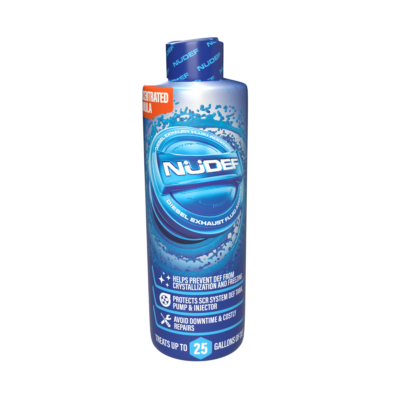
- Add NüDef to your DEF tank at every fill. NüDef helps prevent crystallization and helps protect the SCR system, DEF tank, pump and injector. One bottle treats up to 25 gallons — add it when you add DEF and don’t think about it again until next fill.
- Keep the tank above half full. Less airspace means less evaporation. This is especially important in hot climates or when the truck sits for days between runs.
- Let the truck complete its shutdown cycle. Don’t kill the ignition immediately. Give the DEF system 30-60 seconds to run its purge cycle after you turn the key off. Listen for the pump running — when it stops, the purge is complete.
- Store DEF between 12°F and 86°F. ISO 22241-3 covers storage requirements. DEF shelf life drops dramatically with heat:
| Storage Temperature | Shelf Life |
|---|---|
| Below 50°F (10°C) | 36 months |
| Below 77°F (25°C) | 18 months |
| Below 86°F (30°C) | 12 months |
| Below 95°F (35°C) | 6 months |
Don’t store spare DEF jugs in the truck bed in summer. Inside the cab or a toolbox keeps temps manageable.
Periodic Maintenance
- Inspect the DEF injector: At the interval in your service information, and more often in cold climates or low-load duty.
- Replace DEF filter: On the OEM schedule for your engine, sooner in harsh operating conditions.
- Test DEF quality: Every 25,000 miles with a refractometer. Takes 30 seconds.
- Inspect DEF cap seal: Every oil change. Replace if cracked or degraded.
- Verify DEF heater operation: Before each winter season. A failed heater means frozen DEF and accelerated crystal cycling.
Seasonal Protocols
- Spring: Test stored DEF quality with a refractometer. Winter cycling may have shifted concentration.
- Summer: Monitor storage temperature. Move bulk DEF to shade or insulated storage. Treat at every fill.
- Fall: Pre-treat DEF before any vehicle storage period. Fill the tank full to minimize airspace.
- Winter: Verify heater operation. If the vehicle will sit, run the engine and idle for 10-15 minutes monthly to circulate treated DEF through the system.
Common Myths About DEF Crystallization
“If DEF freezes, it’s ruined”
Wrong. DEF freezes at 12°F (-11°C) and thaws without any change to its chemistry or specification. ISO 22241 explicitly accounts for freeze-thaw cycling. Your truck’s DEF tank has a heater for exactly this reason. The issue isn’t one freeze — it’s dozens of freeze-thaw cycles in a tank that’s been sitting for months without treatment, where repeated transitions can stress the homogeneity of the solution.
“Crystallization means your DEF was bad”
Not necessarily. Perfectly good, ISO-certified DEF will crystallize under the wrong conditions — low tank level with lots of airspace, high ambient temperature, interrupted shutdown cycles. Crystallization is a physical process, not a quality defect. That said, degraded or off-spec DEF crystallizes faster because it’s already closer to the solubility limit.
“You need to drain the whole system to fix crystals”
Only in moderate-to-severe cases. Mild crystal buildup — especially in the tank — often dissolves when you add fresh DEF because you’re diluting the urea concentration back into spec. Several full heat cycles on fresh DEF can clear light early-stage injector deposits without any disassembly.
“DEF crystallization only happens in old trucks”
Brand-new vehicles have DEF system problems. GM issued Bulletin 22-NA-150 covering 2020-2024 models. Ford TSB 23-2161 covers water intrusion in the reductant harness. The SCR system doesn’t care how old the truck is — it cares about DEF quality, temperature, and maintenance.
When to DIY vs. When to Call a Shop
Handle it yourself if:
- The warning light just came on and there’s no active derate
- You can see crystal residue around the filler cap but the truck runs normally
- A refractometer shows your DEF is slightly out of spec but close to range
- You’re comfortable with basic fluid drain and fill procedures
Call a shop if:
- Your truck is in active derate or limp mode
- You’ve drained and refilled but fault codes keep coming back
- You suspect contamination (not just crystallization)
- The DEF injector needs removal and flow testing (requires platform-specific tools and knowledge)
- You’re seeing multiple simultaneous fault codes across different SCR components
- The truck is under warranty — document everything and let the dealer handle it. Some forum members report mixed warranty coverage experiences, so keep your maintenance records.
DEF crystallization is one of the most common and most preventable problems on modern diesel trucks. The chemistry is well-understood, the fixes are straightforward, and the prevention is cheap compared to the alternative. Treat your DEF at every fill, let the truck complete its shutdown cycle, keep the tank above half, and inspect your injector on schedule.
Sources and References
- ISO 22241-1:2019 — Diesel engines — NOx reduction agent AUS 32 — Quality requirements
- Cummins Service Bulletin 4021566 — DEF Quality and Maintenance for SCR Systems
- Ford service information: 6.7L Super Duty reductant injector DTCs P208E and P218F
- GM Bulletin 22-NA-150 — DEF Level Sensor Reprogramming, 2020-2024 Duramax vehicles
- Ford TSB 23-2161: Water Intrusion in Reductant Harness
- EPA IACD-2025-10 — Revised DEF Guidance (August 2025)
- EPA IACD-2026-05 — DEF Quality Monitoring Using Alternate Sensor Technologies (March 2026)
- PMC8539392 (2021) — Thermogravimetric Experiment of Urea at Constant Temperatures
- Applied Sciences 14(2):684 (2024) — Urea Crystallization Risk Assessment, MDPI
- SAE 2017-26-0132 — Factors Affecting Urea Crystal Formation in SCR Systems
- ATRI Operational Costs of Trucking, 2024
- Fleetio 2026 Fleet Benchmark Report