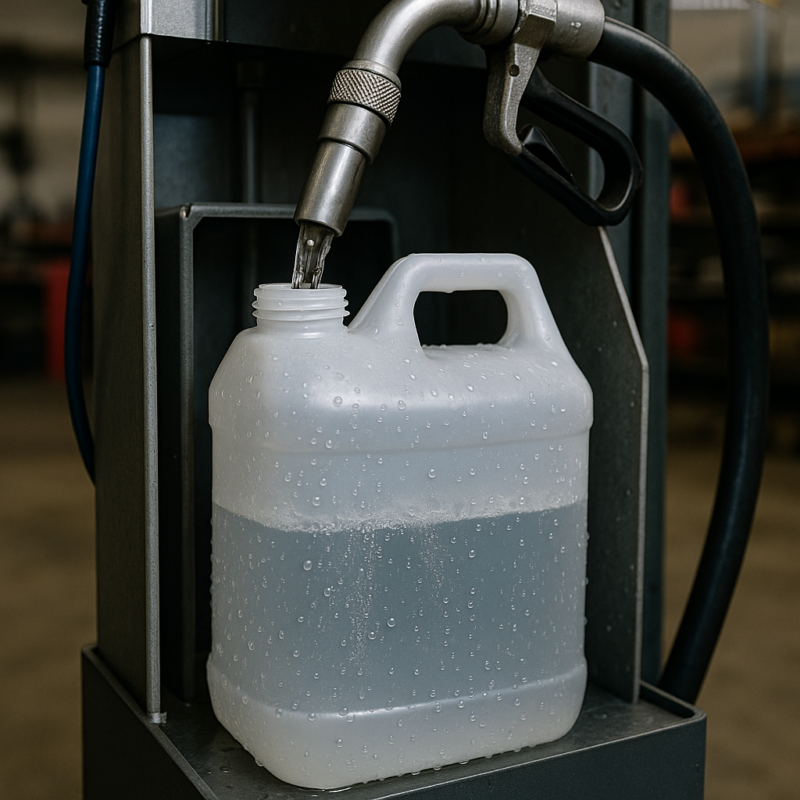
Short answer: sealed DEF lasts about 18 months stored at or below 77°F (25°C), about 36 months at or below 50°F, and about 6 months at 95°F. Above 95°F, test it before use. DEF does go bad, but slowly. Heat breaks the urea down into ammonia and biuret, and the fluid still looks like clear water while it happens. The table below follows the ISO 22241-3 shelf-life guidance.
| Continuous storage temperature | Expected shelf life | Where you see it |
|---|---|---|
| At or below 50°F (10°C) | About 36 months | Climate-controlled warehouse, cool basement |
| At or below 77°F (25°C) | About 18 months | Indoor shop or parts room |
| At or below 86°F (30°C) | About 12 months | Shop or warehouse in summer |
| At or below 95°F (35°C) | About 6 months | Outdoor storage in a hot climate |
| Above 95°F (35°C) | Test before use | Equipment yard in direct sun, inside a cab or trailer in summer |
Jump to: how long DEF lasts in a truck tank · does DEF go bad · using expired DEF · how to store DEF · signs it has gone bad
How Long Does DEF Last?
Diesel exhaust fluid is 32.5 percent urea in deionized water. Urea in water is not permanent. It slowly hydrolyzes into ammonia and carbon dioxide, and some of it rearranges into biuret. Both products are catalyst poisons at the levels ISO 22241 allows, so the useful life of a jug or tote is really the time it takes for that chemistry to push the fluid out of spec.
Temperature sets the clock, which is why the table above drops so fast past 86°F. Three things to keep straight when you use it:
- Sealed containers get the full published life. ISO 22241-3 puts it at about 18 months at or below 77°F from the date of manufacture, and about 36 months at or below 50°F.
- Opened containers run on a shorter clock. Once a jug, drum or tote is opened, humidity, dust and air start getting in. Plan on using an opened container within a few months, whatever the date code says.
- DEF in a vehicle tank lives under the truck, next to exhaust heat. Plan on using it within a few months in a hot climate. More on that below.
The storage clock is cumulative. A tote that spent one summer at 95°F used up roughly half its life, and cooler weather in the fall does not give it back. Track the date code, log the storage conditions, and rotate oldest first.
How Long Does DEF Last in a Truck Tank?
A full DEF tank on a pickup or a tractor is usually consumed long before it degrades. Heavy trucks burn DEF at roughly 2 to 3 percent of diesel consumption, so a tank turns over every few thousand miles. The fluid only becomes a shelf-life question on equipment that sits: a standby generator, a seasonal farm tractor, a boat, a motorhome, or a work truck parked for the winter.
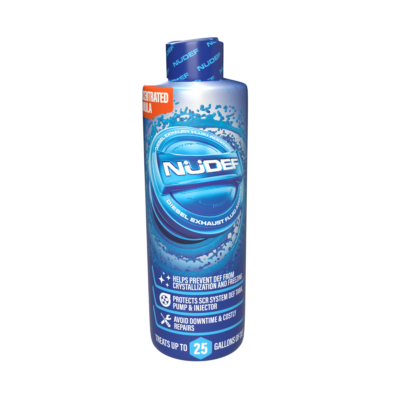
For a parked vehicle, use the hot-storage row of the table. The DEF tank sits beside the frame rail and gets engine and exhaust heat on every run, so in a southern summer the fluid in the tank is on a clock of about 6 months or less. If the machine will sit longer than that, either run the tank down before storage and fill fresh on return, or treat the fill with NüDef DEF Treatment, Additive & Stabilizer. One dose treats 2.5 gallons and a bottle treats 25 gallons, so a single bottle covers several fills on a typical light-truck tank.
Older DEF in a tank does not usually strand you. The first symptom is a DEF quality warning or a slow SCR efficiency code. The contaminated DEF guide walks through what those warnings mean and how to clear them.
Does DEF Go Bad?
Yes. DEF goes bad the way milk goes bad in a cooler, gradually and in proportion to temperature, and unlike milk it gives almost no warning. There is no single day when a jug flips from good to bad. The fluid drifts: urea concentration moves, biuret climbs past the 0.3 percent limit, and ammonia builds up in the headspace of the container. Somewhere along that drift the SCR system starts throwing fault codes, and well before that point the catalyst is seeing fluid it was never designed for.
Four things push DEF out of spec, in order of how often they actually do it:
- Heat. The dominant cause. Every month above 86°F costs more than a month of life.
- Contamination. Metal ions from the wrong container, diesel from shared transfer gear, water from a rinsed hose, dust from an open bung.
- Sunlight. UV accelerates urea breakdown. It is why DEF jugs are opaque.
- Evaporation. An open or vented container slowly loses water, the urea concentration rises above spec, and crystals start forming at the nozzle and in the lines.
Freezing is not on that list. Frozen DEF thaws back into on-spec DEF. The freeze point section below covers why.
Reading DEF Date Codes and Expiration Dates
Every DEF jug, drum and tote carries a date. Some brands print a plain best-by date. Others print a lot code that encodes the fill date, usually as a year and a day number or a year, month and day string near the API certification mark. Retailers also rotate stock on it, so a jug bought from a busy store is normally a few months old at most.
Treat the printed date as the start of the clock, then adjust for where the fluid has been. A jug dated 12 months ago that sat in a climate-controlled parts room is fine. The same jug that spent the summer on a loading dock in Texas is suspect, no matter what the label says. If you cannot account for the storage history, test the fluid with a refractometer before you pour it into an expensive SCR system. The DEF testing guide shows how.
Expired DEF: Can You Still Use It?
Sometimes, but only after you check it. A date on the label is a guide to probable condition. A refractometer reading is the actual test. Fresh-looking DEF that reads 32.0 to 33.0 percent urea on a refractometer, has no ammonia smell and no sediment, is still usable even if the printed date has passed. DEF that fails any of those checks goes to disposal.
What you should never do with expired or questionable DEF:
- Blend it with fresh DEF to “average it out.” Biuret and metal contamination do not dilute away, and you spoil the fresh batch.
- Top up water to fix a high refractometer reading. Tap water adds minerals that violate the ISO limits on their own.
- Run it in a vehicle and hope. A P20EE efficiency code is the cheap outcome. A poisoned catalyst is a four-figure repair.
Small quantities go through the wastewater system under local rules. Drums and totes go to a licensed hauler, and many agricultural waste services take DEF because urea is a fertilizer. The DEF disposal guide covers the options and the paperwork.
What ISO 22241 Says On-Spec DEF Is
Shelf life only means something against a definition of good fluid, and that definition is ISO 22241. Part 1 sets the chemistry. The headline numbers:
- Urea 32.5 percent by mass, with a tolerance of 0.7 percent either way (31.8 to 33.2 percent)
- Density 1.087 to 1.093 g/cm³ at 20°C
- Refractive index 1.3814 to 1.3843 at 20°C
- Biuret 0.3 percent maximum, the main urea decomposition product
- Aldehydes 5 mg/kg, insoluble matter 20 mg/kg, phosphate 0.5 mg/kg
- Calcium, iron, aluminum, magnesium, sodium and potassium each capped at 0.5 mg/kg
- Copper, zinc, chromium and nickel each capped at 0.2 mg/kg
The metal limits are the ones fleets underestimate. Trace copper, iron or zinc picked up from the wrong fitting is invisible in the jug and permanent in the catalyst. Part 2 covers the test methods, Part 3 covers handling and storage, and Part 4 covers the refilling interface, including a DEF filler that a diesel nozzle will not fit. The storage advice in this guide is Part 3 translated into fleet practice.
DEF Storage Temperature: The Numbers That Matter
ISO 22241-3 ties DEF life to storage temperature: about 18 months at or below 77°F and about 12 months at or below 86°F. Store it below 86°F and out of direct sun. Above that, the life shortens as the table at the top of this page shows. Three points about using that table:
The table uses continuous temperature. Peak readings on their own tell you little. A drum at 77°F overnight and 95°F all afternoon is not in 77°F storage. Use the average daytime high of your worst storage month as the planning number.
Exposure adds up. Three hot months last summer consumed roughly half the life of that inventory. The remainder is what you have left now.
The decline is gradual. DEF does not fail on a date. It drifts out of spec over weeks, and the SCR system only complains once the drift is well advanced.
The working rule for fleets: buy DEF on a consumption-matched schedule. Do not stock more than about 9 months of usage in a warm climate or 12 months in a cool one. The savings on a bulk order disappear the first time a tote has to be hauled away.
The Freeze Point: Why 12°F Does Not Ruin DEF
DEF freezes at 12°F (-11°C). At the 32.5 percent eutectic concentration the urea and water freeze together as one solid, so nothing separates and nothing stratifies. A drum that froze solid during a power outage and thawed on its own is still on-spec DEF, provided the container survived the roughly 7 percent expansion and the thaw happened at room temperature instead of with a torch or heat gun.
Vehicle DEF tanks are built for this. The tank has expansion headspace and a heater on the coolant loop or an electric element, and the engine control module waits for a thawed pocket before it starts dosing. The OEMs designed the system to freeze and thaw. Where freezing does cause damage is in the wrong container: a glass jug shatters, a thin plastic bottle splits, a steel drum deforms.
What to avoid is repeated freeze-thaw cycling through marginal storage. Each cycle stresses seals and lids and lets a little humidity and dirt in. Either keep stored DEF above 12°F or accept that it will freeze and leave it alone until spring. For the cold-weather side of the story, see how to keep DEF from freezing, when DEF freezes in your state, and the DEF heater guide for the hardware that thaws the tank. NüDef helps prevent crystallization and, per the sell sheet, helps prevent freezing.
Storage Containers: What Works and What Destroys DEF
After temperature, container material is the biggest shelf-life factor. DEF is mildly alkaline, around pH 9.5, and urea complexes with several metals. Put it in the wrong vessel and it pulls metal ions off the walls at levels that break the ISO limits long before the fluid would otherwise expire.
| Material | DEF compatible? | Notes |
|---|---|---|
| HDPE (high-density polyethylene) | Yes, the standard | Jugs, drums and IBC totes |
| Polypropylene | Yes | Fittings and dispensing parts |
| PTFE and other fluoropolymers | Yes | Seals and gaskets |
| Stainless steel 304 / 316 | Yes | Bulk tanks and piping |
| EPDM and FKM (Viton) seals | Yes | Approved elastomers |
| Mild or carbon steel | No | Iron corrosion contaminates DEF |
| Galvanized steel | No | Zinc leaches out and poisons the SCR catalyst |
| Aluminum | No | Aluminum ions exceed the ISO limit |
| Copper, brass, bronze | Never | Copper is a primary catalyst poison |
| Lead, tin or copper solder | No | All three contaminate DEF |
The “never” row matters because legacy fuel-island hardware is full of brass fittings and copper lines. Reuse any of it for DEF and the fluid is contaminated within hours, and it will look perfect while it happens. Standard DEF packaging runs from 1 to 5 gallon HDPE jugs, through 55 gallon drums and 275 to 330 gallon IBC totes, up to 500 to 10,000 gallon HDPE or stainless bulk tanks. Buy equipment rated for DEF service. The price difference is small. Poisoning a fleet’s whole inventory is expensive.
How to Store DEF: Sunlight, Contamination and Handling
Temperature and container aside, a handful of habits decide whether DEF reaches its published life.
- Keep it out of the sun. UV speeds urea breakdown even when the fluid inside stays cool. Store under cover or in opaque containers. A tarp pays for itself in one warm season.
- Keep diesel out of it. A few milliliters of fuel will coat the injector, confuse the quality sensor and set P204F or P207F type codes. The 19 mm nozzle protects you at the pump, so self-fill operations need dedicated DEF-only pumps, hoses and color coding to replace that safeguard.
- Keep water out of it. Rain through an open bung, condensation in a humid shop or a rinsed hose all dilute urea below the 31.8 percent floor and trigger quality codes.
- Keep oil out of it. Oil emulsifies, coats the tank and injector and cannot be cleaned out of transfer equipment. Dedicated gear only.
- Keep it sealed and filtered. An open drum in a dusty yard can exceed the 20 mg/kg insoluble limit overnight. Seal between uses and filter at 5 to 10 microns at the nozzle.
- Rotate oldest first. Label totes with the opening date, not just the delivery date, and dispense from the oldest opened container.
Storing DEF in winter. Store jugs and drums indoors where you can. Where you cannot, expect them to freeze below 12°F and leave headspace for expansion. Never thaw with direct heat. Treating winter inventory with NüDef helps prevent freezing, and for a parked vehicle, treating the last fill before storage helps prevent crystals while it sits.
Bulk DEF Storage for Fleets
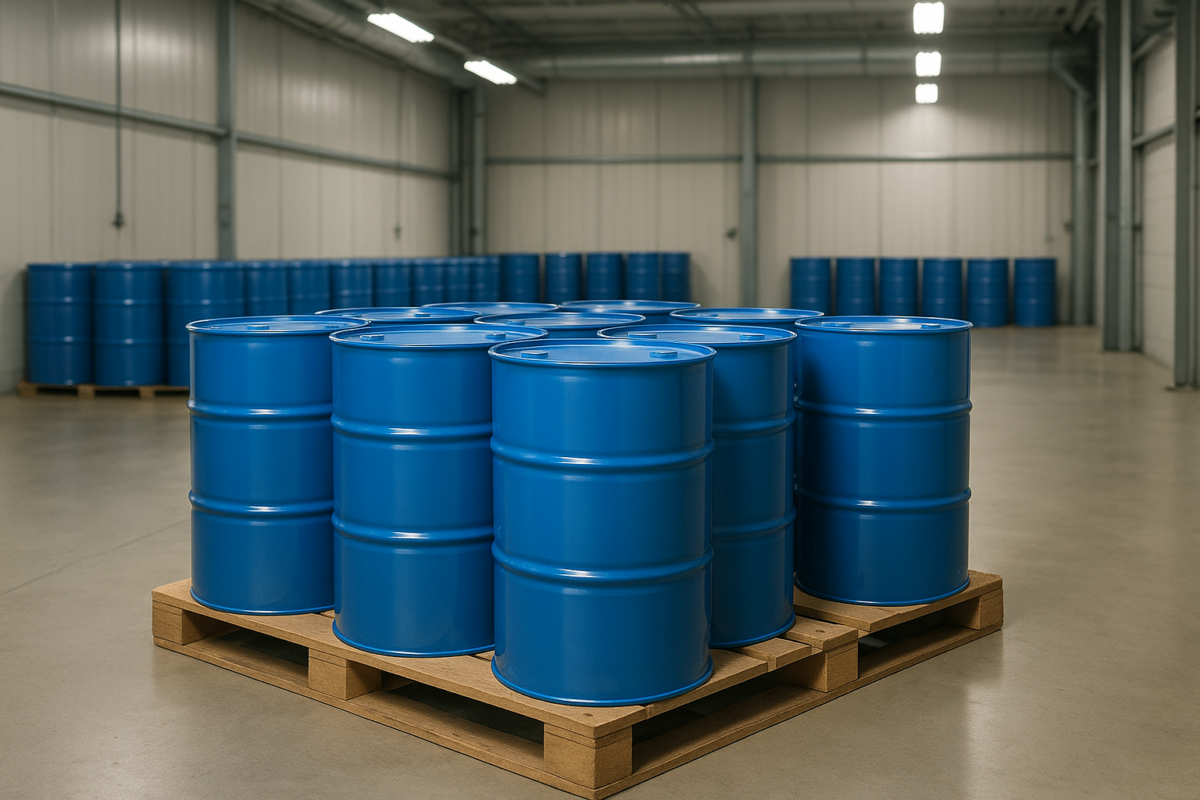
Past roughly 500 gallons a month, jugs and drums stop making sense and fleets move to IBC totes or a bulk tank. The shelf-life rules stay the same but the stakes go up, because a bad batch is now a thousand gallons instead of a jug.
IBC totes: store level and under cover, dispense with an HDPE or stainless pump, filter at the nozzle, log the opening date and consume an opened tote within a few months. Inspect for forklift damage at every refill.
Bulk tanks: HDPE or 304/316 stainless only. Hot climates need shade, insulation or cooling. Cold climates need heat or recirculation. Vents need filters, because DEF releases a little ammonia in storage and the vent is also a path for dust, insects and rain. Level sensors, pumps, meters and piping all need DEF-rated wetted parts; generic flow meters and gear pumps often hide brass internals.
Rotation: a bulk tank is never empty, so new fluid lands on top of old. Log each delivery, estimate the weighted inventory age, time deliveries so the tank turns over inside its shelf life, and draw it down nearly empty every 6 to 12 months in warm climates to flush the oldest fluid through.
NüDef comes in a case of 30 bottles, which treats 750 gallons. Add it to the DEF tank or DEF container at the label dose. For larger volumes, see wholesale pricing.
Signs Your Stored DEF Has Gone Bad
Degradation is largely invisible until it is far along. Clear fluid can be well out of spec. These signs mean the DEF is definitely past use:
- Color change. Fresh DEF is water clear. Yellowing, cloudiness or any tint means contamination or heavy decomposition.
- Ammonia smell on opening. Fresh DEF has almost no odor. A sharp ammonia hit when you crack the lid is hydrolyzed urea venting from the headspace.
- Sediment, floc or biofilm. Anything visible is well over the insoluble limit.
- Heavy crystallization at the nozzle. Light white residue where DEF dries is normal. Fast, heavy crystals that resist a water rinse point to evaporated, over-strength fluid. The crystallization guide explains the chemistry.
- Refractometer out of range. A $50 DEF refractometer should read 1.3814 to 1.3843 at 20°C, or 32.5 percent on the urea scale. It cannot tell dilution from biuret contamination, so a passing reading is necessary but not conclusive.
- Codes on the trucks that drank it. If vehicles filled from one tote start setting P204F or P20EE while vehicles filled from fresh stock run clean, that tote is the problem. The contaminated DEF guide covers the symptoms by platform.
Condemned DEF cannot be salvaged. Dispose of it as described above and keep a record of quantity, date and reason for your maintenance file.
How NüDef Helps Protect Stored DEF
NüDef DEF Treatment, Additive & Stabilizer is a DEF stabilizer and anti-scaling agent. It helps prevent crystallization, helps prevent freezing, and helps protect the SCR system, DEF tank, pump and injector. Add it to the DEF tank or DEF container. It does not replace good storage, and it does not reset the shelf-life clock.
Dosing is simple. One dose treats 2.5 gallons of DEF. One 8 oz bottle treats 25 gallons. Add it to the tank or jug while filling. A single bottle is $19.99 on nudef.com, which works out to 80 cents per gallon of DEF treated. By the 6-pack it is 73 cents per gallon, and by the case of 30 it is 68 cents.
Good storage comes first. A condemned 330 gallon tote costs its purchase price plus disposal, and an SCR repair runs into the thousands. NüDef works as a layer on top of good storage practice: cool, covered, sealed, in the right container, rotated oldest first, and treated.
Buy direct: NüDef DEF Treatment, Additive & Stabilizer, single bottle to 30-bottle case. For volume orders, see wholesale pricing or call (855) 300-0031.
Related reading: where to buy DEF fluid · contaminated DEF symptoms and fixes · how to dispose of DEF · keeping DEF from freezing · DEF crystallization causes and prevention