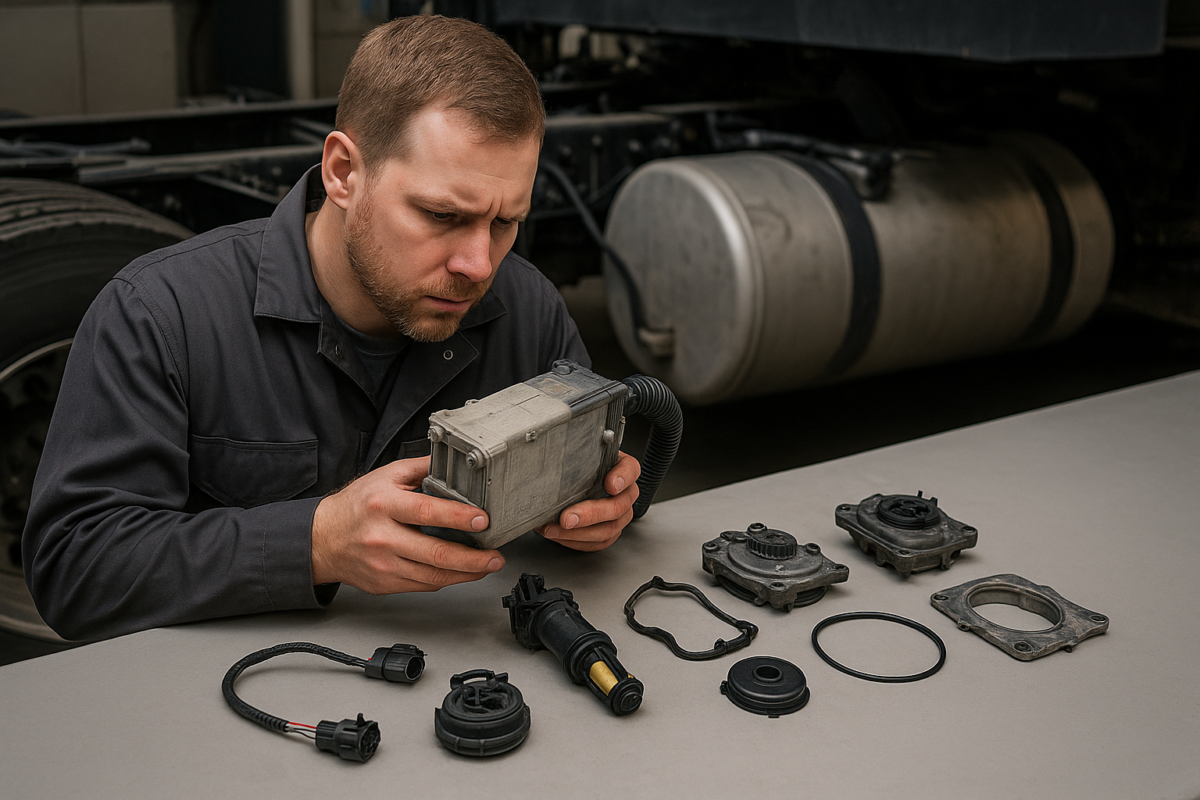

What P204F Actually Means
P204F is the SCR system’s catch-all performance code. Where a code like P20E8 is specifically about pressure and P249D is specifically about injected flow, P204F is the engine computer’s broader conclusion that the reductant (DEF) system as a whole isn’t performing to specification. It usually sets after the system watches the downstream NOx numbers over a drive cycle and decides the DEF being delivered isn’t cutting emissions the way it should.
Because it’s a general verdict rather than a single-part fault, P204F rarely arrives alone and rarely has one tidy cause. Treat it as the system saying “something in the DEF chain is underperforming” and work the chain in order. It shows up across Cummins, Duramax, Power Stroke, and heavy-duty platforms like Hino. The full family is mapped in our DEF trouble codes guide.
Symptoms You’ll Notice
- Check engine light with P204F stored (often alongside a pressure or flow code)
- A DEF or SCR system-service message on the dash
- A speed-derate countdown if the truck concludes the SCR system is inoperative — emissions rules require it, and you don’t want to ride that counter to zero
- On Ram trucks a “Service DEF System, See Dealer” message, on Ford “Check Exhaust Fluid System”, on Hino and other heavy trucks a DEF or SCR lamp with a derate timer; the Service DEF System guide explains the countdown
- Higher-than-normal DEF consumption in the weeks before the code, as the loop commands more fluid to chase the NOx target
- Frequently no drivability change at first — the truck runs normally until the countdown starts, which is why P204F deserves attention the week it appears
Causes, Ranked by Likelihood
1. Crystallized DEF in the pump, lines, or injector. The most common root cause. DEF is two-thirds water; wherever it evaporates it leaves urea crystals that restrict flow. Enough restriction anywhere in the delivery path and the whole system underperforms → P204F. White crust at any fitting is the tell. See how to clean crystallized DEF.
2. Clogged DEF pump filter or weak pump. A restricted filter or a tiring pump delivers less DEF than commanded, and the system reads the shortfall as a performance failure. Cheapest thing to check first; our filter service guide and pump failure guide cover both.
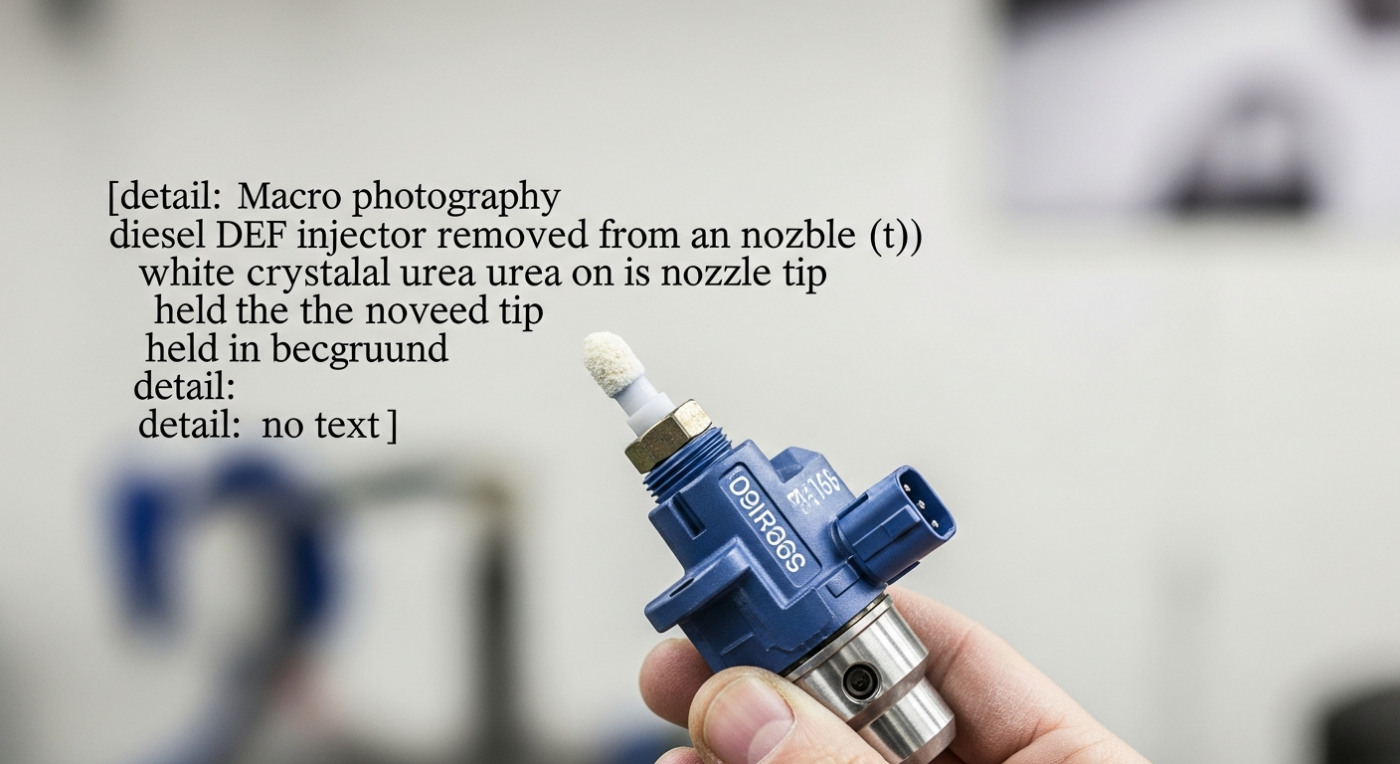
3. Restricted or crystallized injector. If the injector (doser) can’t spray its commanded volume, dosing falls short and NOx stays high. Often cleanable — see how to clean a DEF injector.
4. Degraded or contaminated DEF. Old, heat-aged, watered-down, or off-spec fluid doesn’t reduce NOx even at full flow, so the system maxes out and flags underperformance. A refractometer reading (32.5% urea) rules this in or out in thirty seconds.
5. NOx sensor or SCR catalyst issues. The minority cases: a skewed downstream NOx sensor misreporting performance, or an aged SCR catalyst that genuinely can’t convert — usually with other codes alongside.
Reading P204F Together With Its Companion Codes
P204F is the verdict; the companion code is the evidence. Read them as pairs:
- P204F + P20E8 (pressure too low): a supply problem. Start at the pump filter and the lines; the injector is starved.
- P204F + P249D (flow too low): a delivery problem downstream of the pump. Start at the injector tip and the quantity test.
- P204F + P2048 (injector circuit): electrical. The injector coil or its wiring, and the performance code is a consequence.
- P204F + P203F (level too low): the level sender inside the pump module, or a genuinely empty tank on a truck with a stuck gauge.
- P204F + P20EE / P207F (NOx conversion efficiency): the catalyst side. If pressure and flow both check out, the DEF is reaching the exhaust and the question moves to fluid quality, the downstream NOx sensor and the SCR catalyst itself.
- P204F alone: the hardest case, and the one where fluid quality is the first test, because degraded fluid at full flow produces exactly this signature.
The full family is mapped in the DEF trouble codes guide.
How to Diagnose It in the Right Order
P204F rewards working cheapest-to-most-expensive, because it can come from anywhere in the chain:
- Read the companion codes. P204F almost always sets with a more specific code (pressure, flow, quality). That companion tells you where in the chain to start — let it, before touching parts.
- Check DEF quality — it’s free. Refractometer at 32.5% urea rules out the chemistry cause instantly. Cloudy fluid or crystal sediment ends the search early.
- Pull the pump filter. Crystal sludge on the filter is both an immediate cause and a sign the fluid has been crystallizing.
- Inspect fittings and the injector tip. White crust outside a fitting means crystals inside it; a crusted injector nozzle explains a flow shortfall.
- Verify pump delivery, then the sensor. If fluid, filter, lines, and injector all check out, test pump volume; only then suspect a downstream NOx sensor.
How to Fix P204F, by What the Diagnosis Found
- Fluid out of spec: drain the tank, flush with distilled water, refill with fresh DEF from a sealed container that tests at 32.5 percent on a refractometer (the DEF testing guide shows the reading), and clear the code. Many P204F cases end here.
- Filter clogged: replace the pump filter, prime the system, confirm pressure builds and holds on the scan tool.
- Crystals in lines or fittings: disconnect, flush warm, reconnect, replace any line that will not clear.
- Injector restricted: remove, soak the tip in warm distilled water, brush, bench-test the spray, reinstall with a new gasket; replace if the pattern stays ragged. The injector cleaning guide covers it by platform.
- Pump delivery short with a clean filter: replace the pump module as an assembly with an OEM or OEM-equivalent part.
- Sensor or catalyst: only after every delivery item checks out. Replace the downstream NOx sensor with the OEM part; an SCR catalyst that fails a conversion test after clean fluid and correct dosing is the expensive last resort the catalyst guide prices.
- Clear and verify: clear the code, complete a full warm-up drive with a highway section, and confirm on the scan tool that commanded and actual dosing track and the NOx conversion value recovers.
Repair Costs
Typical 2026 ranges below. The spread is exactly why P204F should be diagnosed, not parts-cannoned — the catch-all nature makes it tempting to replace the expensive pump when the real fault is a $40 filter and crystallized fluid.
Vehicle-Specific Notes: Cummins, Duramax, Power Stroke, Hino and Heavy Trucks
Ram 6.7 Cummins: P204F on a Ram most often rides with P207F and a Service DEF System countdown; the pump module is the usual hard failure and the doser cleans easily. See the Ram 6.7 DEF guide.
GM 6.6 Duramax: Duramax trucks set P249D first and P204F second when the injector is restricted, so on a Duramax start at the injector tip. The Duramax DEF guide covers it by generation.
Ford 6.7 Power Stroke: Ford pairs P204F with P20E8 more often than with P249D, which points at the in-tank pump module and its filter. The Power Stroke DEF guide has the map.
Hino, Isuzu and other medium-duty trucks: P204F is a frequent code on Hino 258/268 and similar chassis, where long idle time and short routes keep the exhaust cool and let deposits build at the doser. The diagnosis order does not change; the difference is that the derate arrives faster on these trucks, so the first week matters.
Class 8 and off-road equipment: the same fault appears under OEM numbering on Cummins X15, Detroit DD-series, Volvo and Paccar engines and on construction and agricultural equipment. Fleet tanks and totes are the usual source of degraded fluid; the bulk DEF guide covers storage.
Preventing a Repeat
Whatever part gets cleaned or replaced, P204F comes back if the fluid keeps depositing urea through every heat cycle. The prevention list is the same short one that ends most reductant codes:
- Fresh DEF, stored cool. DEF has a shelf life and heat shortens it; buy from high-turnover sources and keep spare jugs out of the sun.
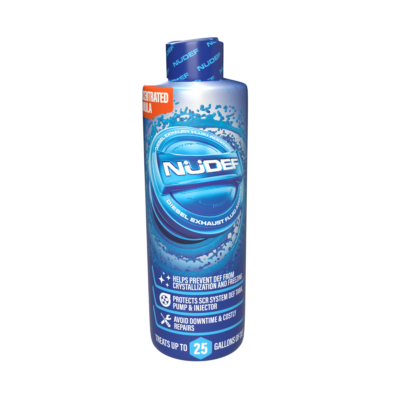
- Treat the fluid. NüDef treatment keeps urea in solution so it doesn’t crystallize in the pump, filter, lines, or injector — the failure chain behind most P204F cases. A few dollars a tank against a repair that starts at $200 and tops $1,000.
- Fix it at the first code. A catch-all code left alone lets restrictions migrate and multiply until one part actually fails. Handle P204F while it’s still a filter-and-fluid problem.
More in the reductant-code series: DEF trouble codes index · P203F · P20E8 · P249D · P2048