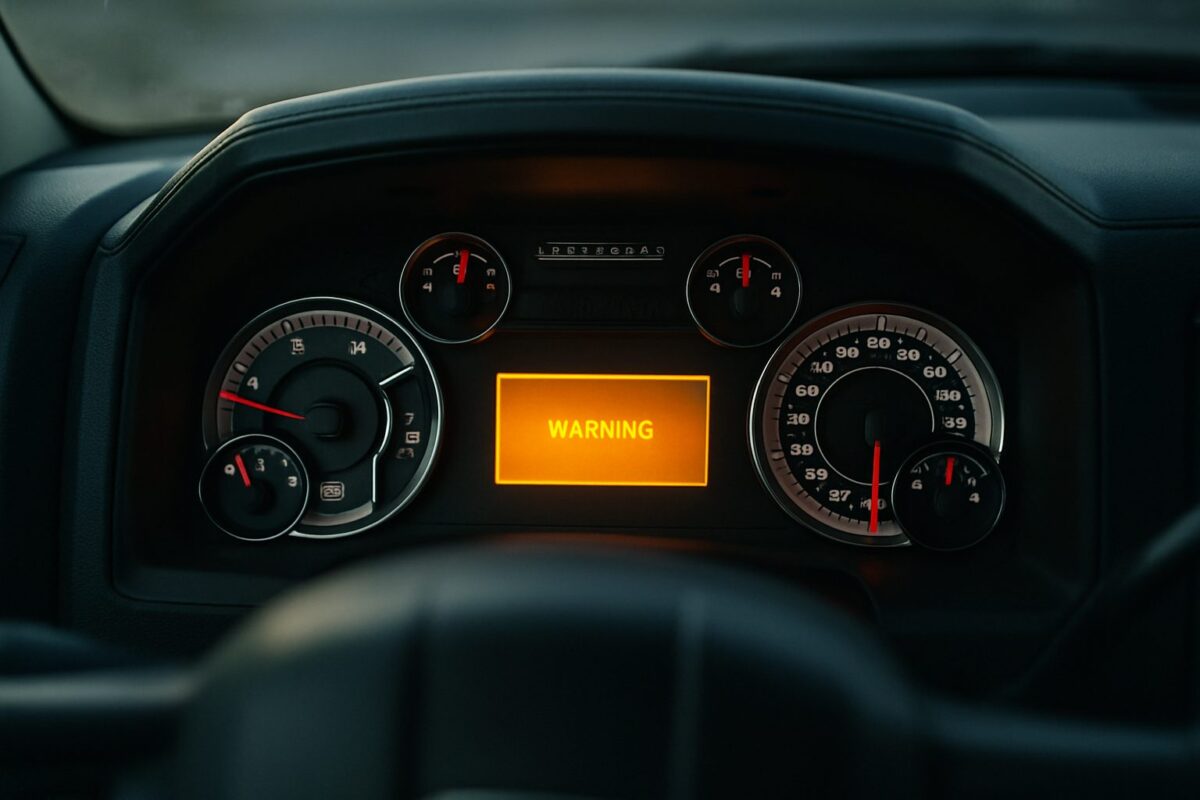
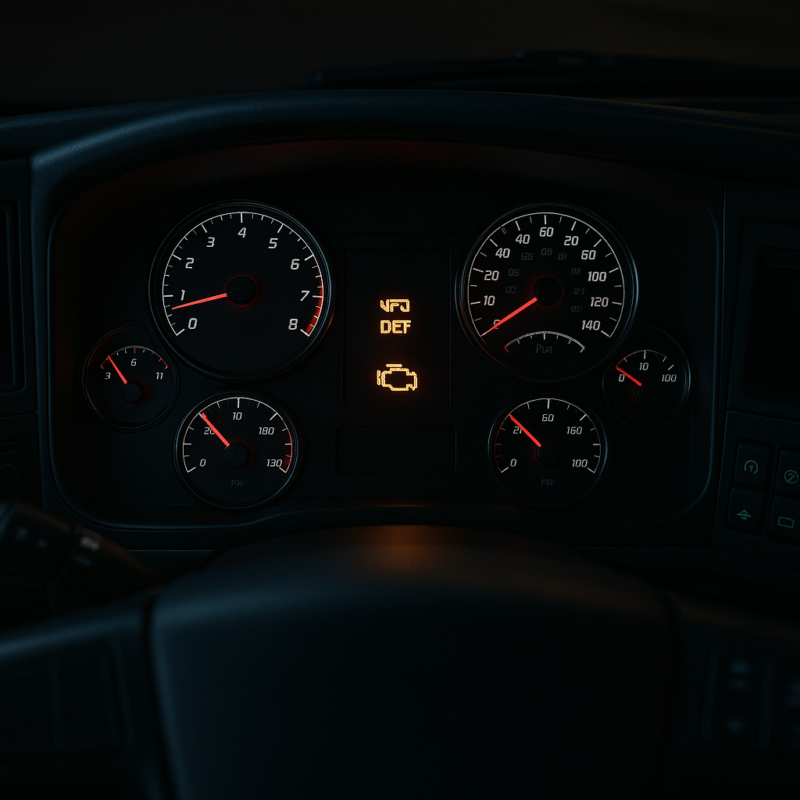
What “Engine Derate” Means
Engine derate means the engine computer has deliberately cut the power the engine is allowed to make. The driver feels it as a truck that will not pull, will not pass a certain speed, or both. Nothing is necessarily broken in the engine itself. The computer is limiting fuel, boost or road speed on purpose because a sensor has reported a condition it has been programmed to react to.
Mechanics use “derate” and “limp mode” almost interchangeably. Strictly, a derate is any reduction in available torque or speed, and limp mode is the severe end of it, where the engine runs just well enough to get the vehicle off the road. A dash message such as “engine power reduced,” “reduced engine performance” or “speed limited to 25 mph” is the computer telling you a derate is active.
Why Engines Derate: Protection vs Emissions
Derates come in two kinds, and the difference matters for what you do next.
Protection derates keep the engine from hurting itself. High coolant temperature, low oil pressure, excessive exhaust temperature, turbo overboost, or a failed sensor the engine relies on can all trigger one. These are the derates you take seriously right away, because continuing to drive can turn a sensor fault into an engine repair.
Emissions derates enforce the aftertreatment system. Federal rules require a diesel to make itself progressively harder to drive when the emissions equipment cannot do its job. The common triggers are on the DEF and SCR side, plus the diesel particulate filter (DPF) and the EGR system:
- DEF and SCR: empty DEF tank, poor DEF quality, a dosing or pump fault, a heater fault, or low SCR efficiency. Our SCR explainer covers how the system works.
- DPF: soot load too high because regenerations keep failing or getting interrupted.
- EGR: a stuck valve or a cooler fault that throws the NOx math off.
DEF-Related Derates and Their Warning Stages
DEF derates follow a staged schedule rather than hitting all at once. The stages usually run like this: a warning lamp or message, then a mild power derate, then a hard speed limit. Running the tank empty is the most familiar trigger, and our run-out guide covers that case step by step. Bad fluid and component faults follow the same staircase.
The schedule for heavy trucks changed recently. Under the EPA guidance issued in August 2025, a heavy-duty truck with a DEF fault gets a warning only for the first 650 miles or 10 hours, then a mild derate with no speed limit for up to about two work weeks, and a 25 mph limit only after about four work weeks without a repair. Before that change, some trucks were limited to 5 mph within hours of a DEF fault. Starting with model year 2027, new on-road diesels must be built to avoid sudden, severe power loss after running out of DEF.
Existing trucks get the new behavior through software updates. Daimler Truck North America began updating about 330,000 Detroit DD15 and DD13 trucks in February 2026, and Cummins and PACCAR have announced their own updates. A truck that has not had the update still runs the old, harsher schedule.
Derate by Brand
Every diesel with SCR follows the same warning, derate, speed-limit logic. The thresholds and the messages differ.
- Ford Power Stroke: a DEF mileage countdown on the cluster, then a speed limit once the countdown runs out. Our Power Stroke DEF guide lists the codes that trigger it.
- RAM Cummins: a countdown, then a limited number of restarts once the tank is empty, then the speed limit.
- GM Duramax: staged messages with a speed limit at the final stage.
- Class 8 and medium duty: a torque derate first, then a speed limit, now governed by the 2025 guidance and the software updates above.
Pickups and other chassis-certified vehicles run a different schedule from the heavy-duty steps above, and updates vary by maker. Check your owner’s manual or ask the dealer whether your truck has received any DEF software update.
Is It Safe to Keep Driving?
It depends on which kind of derate you have. A protection derate (temperature, oil pressure, overboost) means pull over safely and find the cause before you put more miles on the engine. An emissions derate is not usually an engine-damage risk in the short term, but it gets worse on a schedule. Use the warning stage to get to fluid or a shop, not to finish the week.
A DEF derate in particular should be treated as a deadline. The truck is telling you how long you have. Read the code, decide whether it is fluid or hardware, and act while the truck still has full power.
What a DEF Derate Costs You
The repair bill is only part of it. A derated truck runs slower, so the route takes longer and the driver’s hours run out sooner. A truck held at a low speed limit cannot safely run the interstate at all, so it has to be towed or routed to the nearest shop on surface roads. A load that misses its window can cost more than the part that failed.
The parts themselves are not cheap either. A dosing injector or a pump module on a pickup commonly runs several hundred dollars in parts before labor. On a Class 8 truck, a supply module, a header unit or a crystallized dosing valve can run well past a thousand dollars installed, and the truck sits while it waits for the part. Our DEF light flashing guide covers what to do in the first hour after the lamp comes on, which is when the cheapest fix is still available.
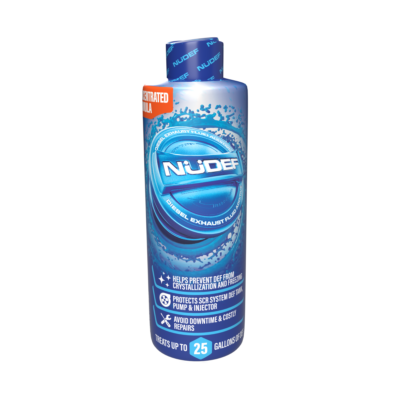
That math is why fleets treat DEF faults as a maintenance item and not a surprise. A derate that starts with fluid quality is the most frustrating kind, because it was preventable, and treating the fluid with NüDef costs 80 cents per gallon of DEF at the single-bottle price, and less by the case. The fluid was bad, or it crystallized, or it was left to cook in a hot tank, and the truck did exactly what the rules told it to do.
How to Clear an Engine Derate
A derate clears when its cause is fixed and the computer confirms it. There is no legitimate shortcut that switches it off.
- Read the code. A scan tool tells you whether it is level, quality, pressure, heater, dosing or SCR efficiency.
- Empty tank: add enough fresh DEF. Most trucks need more than a splash before they recognize the refill, often a full jug or more.
- Quality code: drain the bad fluid, flush if crystals are present, refill with fresh in-spec DEF. Our contaminated DEF guide covers the drain.
- Hardware fault: repair the pump, heater, sensor or wiring. Our service DEF system guide covers the common ones.
- Confirm the repair: some trucks clear after a key cycle or a short drive. Others need a scan tool or a dealer to run a verification test.
Never chase a derate with a delete kit or a tuner. It is illegal under the Clean Air Act, it voids warranty coverage on the aftertreatment system, and on heavy trucks the 2025 guidance has already taken most of the sting out of a legitimate DEF fault.
Preventing the DEF Derates
Some derates are pure hardware: a heater element burns out, a wire chafes through. Many DEF derates, though, start with the fluid. DEF that sat in a hot tank and concentrated, DEF that crystallized at the dosing valve, and DEF diluted by a careless fill all produce quality and pressure codes that end in a derate. Those are the preventable ones.
- Keep the tank topped up so a low-level countdown never starts.
- Buy fresh fluid with a recent date code, keep jugs sealed, and store them out of the heat.
- Test any fluid you are unsure of before it goes in the tank.
- Treat the fluid. NüDef DEF Treatment, Additive & Stabilizer helps prevent crystals in the tank, filter, lines and dosing valve, and it helps prevent freezing. One dose treats 2.5 gallons and one 8 oz bottle treats 25 gallons.
NüDef will not fix an electrical fault or bring a failed sensor back. It keeps the fluid side of the system from being the reason the truck slows down. For the full code list behind DEF derates, see our DEF trouble codes hub, and for what happens if you keep driving on an empty tank, see can you drive without DEF.