Updated November 2026. The DEF facts below come from vehicle and engine makers’ manuals and technical papers and from the ISO 22241-3 storage table, and each is linked or named where it is used.
Bad DEF Fluid: The Short Answer
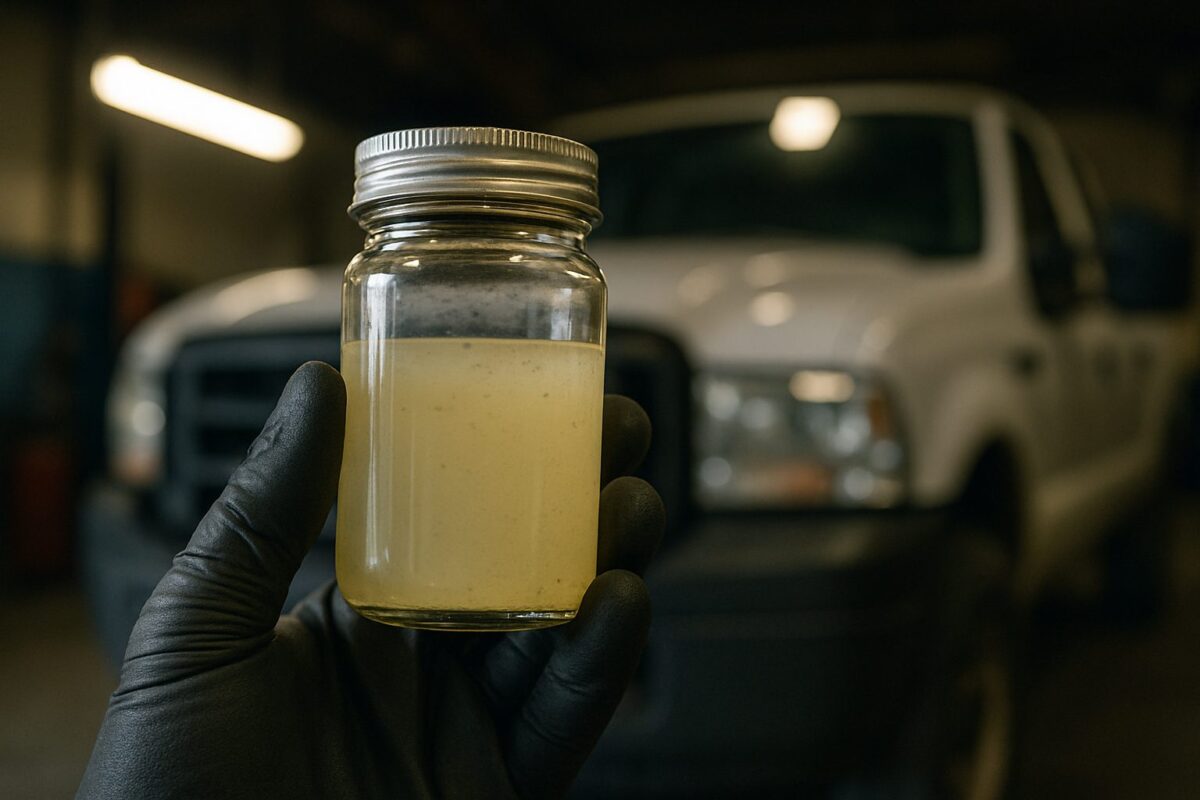
Bad DEF fluid is diesel exhaust fluid that has drifted off its 32.5 percent urea strength or picked up something that does not belong in it. It goes bad four ways: heat and age break the urea down, dirt, tap water, fuel or metal get into it, water evaporates and leaves urea crystals behind, and a container or funnel that held something else spoils it. The signs are fluid that stays cloudy, yellow or blue after it warms up, white crust on the cap, filler neck or jug, a refractometer reading outside the spec, and DEF quality warnings or codes on the dash.
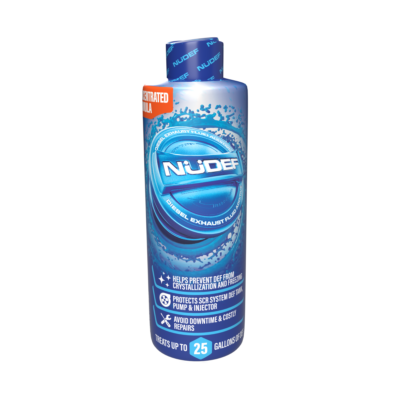
Good DEF is clear and colorless. If yours is not, or the truck says the quality is low, test it, drain it if it fails, and refill with fresh certified DEF. To keep the next fill from crystallizing in the tank, treat it with NüDef DEF Treatment, Additive & Stabilizer: it helps prevent crystallization and protects the SCR tank, pump and injector, and one 8 oz bottle treats 25 gallons of DEF.
What Good DEF Looks Like
You need a baseline before you can call a jug bad. Mazda’s diesel owner’s manual describes DEF as a colorless, transparent, odorless solution of 32.5 percent urea in water, the fluid the standards call AUS 32. The same page notes that you may smell a little ammonia when you open the container, so a faint whiff at the cap is normal and is no reason to pour it out. Volvo Construction Equipment describes good DEF the same way: clear or with a slight blue tint.
The strength matters because the SCR system is calibrated for it. MTU’s technical paper on DEF storage puts it plainly: engines with SCR are engineered for 32.5 percent urea and 67.5 percent deionized water, and when the concentration is lower, less ammonia is produced in the exhaust to clean up NOx. Weak fluid means poor NOx conversion. Strong fluid, from water evaporating, means crystals. Either one ends at the shop.
Signs of Bad DEF Fluid
Most bad DEF gives itself away before it does any damage, if you look. Here is what each sign usually points to and what to do about it.
| Sign | What you see | Likely cause | What to do | Source |
|---|---|---|---|---|
| Cloudy or milky fluid | White haze in the jug or tank on a cold morning | Urea crystals forming in the cold; if it stays cloudy after warming, contamination or poor quality | Let it warm up naturally and look again; test it if the haze stays | Volvo CE |
| Off color | Yellow, brown or a strong blue tint | Something got into it; DEF turns blue quickly when it touches copper | Do not pour it in; find the source and drain fluid already in the tank | MTU |
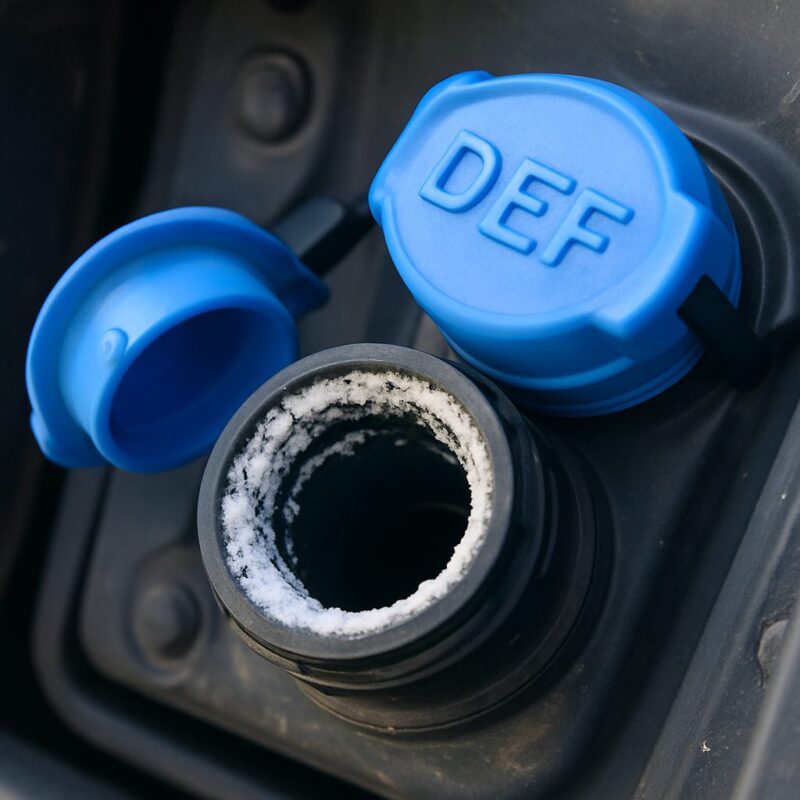
| White crust | Hard white deposits on the cap, filler neck, jug spout or fittings | DEF dried out and left urea behind | Clean it off with warm water and a rag; check the tank for crystals | MTU |
| Refractometer off spec | A reading outside about 31 to 34 percent | Water evaporated (high) or dilution (low) | Replace the fluid with fresh certified DEF | International service bulletin IK0700053 |
| Quality warning or code | A DEF quality message, P207F (reductant quality performance) or SPN 3364 FMI 1 (DEF quality below threshold) | The quality sensor sees fluid it does not like, or the sensor itself has a fault | Scan the truck, test the fluid, then fix the fluid or the part | NüDef product page |
| Old stock | A container that has sat in a hot cab, shop or trailer for a season or more | Heat shortens DEF shelf life | Check it against the storage table below and test it before use | ISO 22241-3 table |
The dash codes deserve a second look before you condemn the fluid. A quality code can come from bad DEF or from a quality sensor that has failed, and the fix is very different. The DEF quality poor warning guide and the P207F code guide walk through how to tell which one you have, and the DEF trouble codes hub lists the related codes.
Cause 1: Heat and Age
DEF does not last forever, and heat is what uses it up. Over time, and faster at higher temperatures, part of the urea reacts with the water and turns into ammonia and carbon dioxide, which is why the shelf life depends almost entirely on where the fluid is stored. The ISO 22241-3 storage table, which MTU and the American Petroleum Institute both reproduce, ties shelf life to a constant storage temperature:
- At or below 50°F (10°C): 36 months
- At or below 77°F (25°C): 18 months
- At or below 86°F (30°C): 12 months
- At or below 95°F (35°C): 6 months
- Above 95°F (35°C): test before use
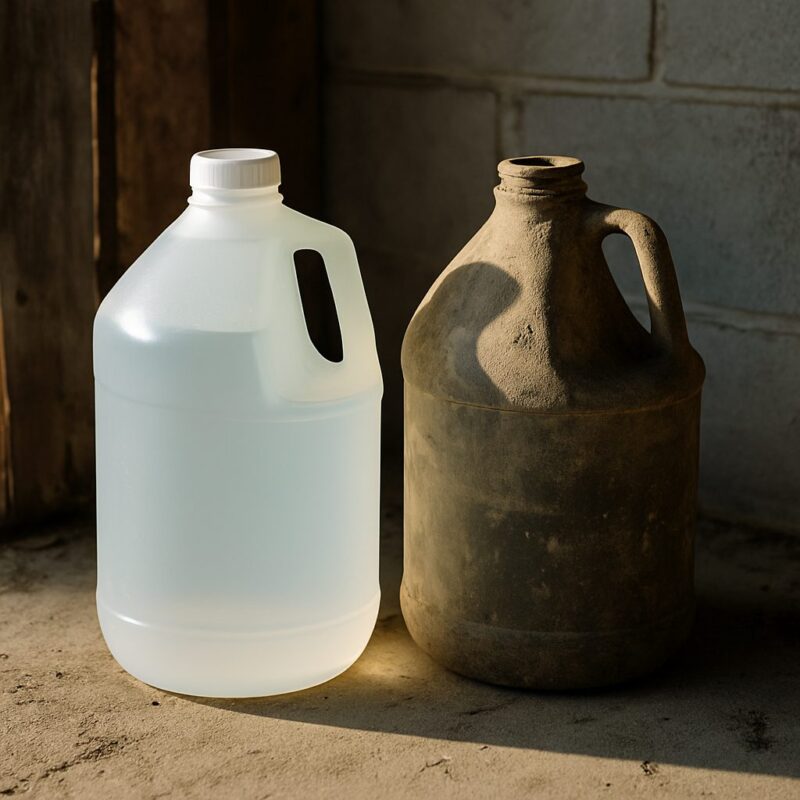
The table assumes the temperature holds steady, and real storage does not: MTU points out that daily swings have to be counted when you work out shelf life at your own site, and a jug riding in a cab or a sunny trailer spends hours above its average. Ram’s owner’s manual gives a simpler rule of thumb: kept between 10°F and 90°F, DEF lasts a minimum of one year. Mazda goes further and says not to store DEF in the vehicle at all, because it may deteriorate. If you carry a spare jug, rotate it out so it gets used while it is fresh, and see the DEF shelf life guide for more on storage and expiration.
Cause 2: Contamination
DEF is a high-purity fluid, and it takes very little to spoil it. The American Petroleum Institute’s storage guidance lists the usual ways it happens: dirty dispensing equipment, containers that held other products and were not cleaned out, and tap water used to rinse tanks and nozzles, since tap water carries minerals that harm SCR systems. Mazda adds one more: do not pour DEF into a different container, because foreign matter in that container can cause a problem with the SCR system.
Metal is the quiet one. DEF corrodes copper, brass, aluminum, iron and plain steel, and Ram’s manual says any container or part that touches DEF must be plastic or stainless steel. MTU notes that if a copper fitting is in the line, the DEF turns blue quickly, which is one of the few contamination signs you can see with your eyes. Diesel fuel in the DEF tank, or DEF in the fuel tank, is its own emergency; the wrong tank guide covers what to do first. Once you know contamination is the problem, the contaminated DEF guide goes through draining and flushing step by step.
Fleets that fill from a tote, drum or transfer tank have more places for dirt to get in: the pump, the hose, the nozzle and the open bung. Keep DEF equipment dedicated to DEF, cap everything, and use stainless or HDPE fittings. The DEF transfer tank guide and the DEF storage materials guide cover the hardware. For yards that treat a lot of fluid, the NüDef wholesale program covers case and volume orders.
Cause 3: Evaporation and Crystals
When the water in DEF evaporates, the urea stays behind. That happens in a vented tank that breathes through heat cycles every day, in a jug left with the cap loose, and anywhere DEF drips and dries. The fluid left in the tank gets stronger, and the urea that dries out forms the hard white crystals that collect on the filler neck, the tank header, the pump and the injector tip. MTU recommends a vacuum and pressure vent on storage tanks for exactly this reason, because it limits evaporation and keeps the concentration steady over time. MTU also notes that once a tank reads above 50 percent, crystallized urea is usually present, and the right move is to clean out the DEF system and start with fresh DEF.
Crystals are where most of the expensive DEF repairs start. They restrict flow, make the pump work harder and foul the injector spray, and the codes that follow often look like part failures. The DEF crystallization guide covers where they form and what they lead to. This is the problem NüDef DEF Treatment, Additive & Stabilizer is made for: added to certified DEF at every refill, it helps prevent crystallization in the treated fluid and protects the SCR tank, pump and injector.
Does Freezing Make DEF Bad?
No. DEF freezes at about 12°F (minus 11°C), and Mazda’s manual says that when the temperature rises again, the fluid returns to its original condition. Volvo CE says the same thing: frozen DEF can be thawed without losing its effectiveness, as long as it thaws naturally. Do not put a torch or a heat gun to a jug, and do not pour anything into the tank to thaw it. The trucks are built for this: Ram’s manual says the system is designed to operate in freezing temperatures, and Volvo CE notes that most modern heavy equipment has heating elements that keep DEF from freezing while the machine runs.
What freezing can do is break things. The American Petroleum Institute notes that DEF can expand by up to 7 percent when frozen, so a jug or tank filled to the brim in winter can split. Leave some room in storage containers through the cold months. Cold also makes good DEF look cloudy for a while, which is why the cloudiness test only counts once the fluid has warmed up. The DEF freezing guide covers when that 12°F mark hits in your state.
How to Check Suspect DEF
Start with your eyes. Pour a little into a clean clear cup and hold it up to the light at room temperature. It should look like water. Haze, color, floating specks or an oily film mean it does not go in the truck. Then check the cap, the spout and the filler neck for white crust.
Next, measure it. A DEF refractometer reads urea strength in a few seconds, and International’s service bulletin for its SCR trucks gives 32.5 percent, plus or minus 1.5 percent, as the acceptable reading, which allows for tool tolerance and calibration. A reading outside about 31 to 34 percent means the fluid is diluted or has lost water. The DEF testing guide covers refractometers, test strips and when to send a sample to a lab.
Finally, check the truck. If the dash shows a DEF quality message or a code such as P207F, scan it before you buy parts. The DEF sensor guide explains how the quality sensor works, and the Service DEF System warning guide and the DEF light flashing guide explain what the lamps mean and how urgent they are.
What to Do With Bad DEF
Off-spec DEF gets replaced. Drain the tank, or have a shop do it, and refill with fresh DEF that carries the API certification mark and meets ISO 22241. If the fluid was contaminated or crystallized, the tank, lines and filter may need flushing too, and a part that has already failed has to be replaced. NüDef is added to certified DEF and never replaces it; it cannot rescue fluid that is already off spec, replace a failed sensor or pump, or clear a code caused by a failed part. Scan first, fix the part, then treat the fresh fill. For getting rid of the old fluid, see the DEF disposal guide.
How to Prevent Bad DEF
Every cause above comes down to storage and handling, so prevention is mostly habit:
- Buy certified DEF and use the oldest stock first.
- Store it out of direct sunlight, below 86°F when you can, and away from the cab in summer.
- Keep caps tight so the water cannot evaporate.
- Use a funnel, hose and nozzle that only ever touch DEF, and rinse with distilled water or DEF, never tap water.
- Keep copper, brass, aluminum and plain steel away from it.
- Leave room in containers in winter.
- Treat every fill so the fluid in the tank resists crystallizing between fills.
That last step is the one a bottle handles. NüDef DEF Treatment, Additive & Stabilizer goes in the DEF tank or the DEF jug with certified fluid, helps prevent crystallization and protects the SCR tank, pump and injector. One 8 oz bottle treats 25 gallons. Add it at every refill and do not exceed the recommended dose. Keep the bottle itself between 41°F and 86°F, the range on the label. Order NüDef direct.