
Updated November 2026. The Sprinter details below come from Mercedes-Benz service documents posted on the NHTSA site: the July 2025 P20EE bulletin for the 907 Sprinter, the August 2025 SCR software campaign, and the emissions campaign documents for the 906 Sprinter. Each one is linked where it is used.
P20EE on a Sprinter: The Short Answer
P20EE on a Mercedes Sprinter means the engine computer judged the SCR catalyst to be converting too little NOx. Mercedes’ own text for the code is “The efficiency of component ‘SCR catalytic converter’ is not sufficient.” On the 907 Sprinter, Mercedes says the usual trigger is ammonia slip: more AdBlue (Mercedes’ name for DEF) is reaching the catalyst than it can use, often on steady highway runs with the cruise control set. The first fix Mercedes lists for 2019 to 2021 vans is a software update to the engine and SCR control units, and its bulletin tells technicians not to replace any parts unless Mercedes’ technical support says to.
So the order on a Sprinter is: check for open campaigns and software, then the inspections Mercedes lists, then parts. The fluid is on that list twice, as a cause of over-dosing and as a source of catalyst contamination. That is the part an owner controls, and it is where NüDef DEF Treatment, Additive & Stabilizer fits: it helps prevent crystallization in the tank, the jug and the lines.
What P20EE Means on a Mercedes Sprinter
The generic OBD definition is “NOx Catalytic System Efficiency below threshold,” as diagnostic tool maker Snap-on lists it in its SCR and AdBlue guide. The van measures NOx ahead of the SCR catalyst and after it, with one NOx sensor on each side. The drawings in Mercedes’ emissions campaign document for 2014 Sprinters show that layout: a NOx sensor upstream of the SCR catalytic converter and one downstream. When the downstream reading stays too close to the upstream reading, the van decides the catalyst is not doing its job and sets the code.
The code reports a result, so it can point at several different faults. A NOx sensor can only see so much: the 907 bulletin explains that ammonia slipping past the catalyst can read as poor efficiency, which is why over-dosing sets the same code as a worn catalyst. For the full code family on other makes, the DEF trouble codes guide is the hub, and the general P20EE code guide covers Duramax, Power Stroke and Cummins trucks.
Which Sprinters Set It, and What Mercedes Calls It
Mercedes stores the fault with its own suffixes, so the code on your scan tool may not read as a plain P20EE. On the 907 Sprinter (2019 and newer) with the four-cylinder OM651 diesel, the bulletin covers P20EEFE stored in the CDI engine control unit. The six-cylinder OM642 in the same van stores the same complaint, word for word, as P300E3B, and Mercedes’ bulletin for that engine gives the same causes and the same remedy. If your scanner shows either code with “SCR catalytic converter not sufficient,” you are dealing with the same problem.
The older 906 Sprinter (2010 to 2016, OM642 and OM651) uses the same two-sensor layout. Many of those vans were part of Mercedes’ Approved Emission Modification campaigns. The documents for the 2014 OM642 van describe new upstream and downstream NOx sensors, a new SCR catalytic converter and software updates to the engine, transmission, instrument cluster and SCR control units, at no cost to the owner. A dealer can check whether your VIN has an open campaign.
| Mercedes document | Applies to | Code or subject | What it says |
|---|---|---|---|
| LI49.20-N-079593 (Jul 2025) | 907 with OM651 | P20EEFE | Ammonia slip; update CDI and SCR software on 2019 to 2021 vans; no parts unless technical support says so |
| LI49.20-N-076565 (Jul 2025) | 907 with OM642 | P300E3B | Same complaint, causes and remedy for the V6 |
| Campaign 2025070011 (Aug 2025) | 2019 to 2021 Sprinter, 907 | SCR control unit software | 103,666 vans; dealer updates the SCR software |
| Campaign 2020040005 (Aug 2022) | 2014 Sprinter 906, OM642 | Emissions modification | About 13,574 vans; new NOx sensors, SCR catalyst and software |
| LI49.20-N-074942 (Jun 2022) | 2010 to 2016 Sprinter 906 | NOx sensor part numbers | Upfit power supplies, OBD devices and aftermarket CAN changes can block the campaign |
What Mercedes Says Causes P20EE
The 907 bulletin lists four contributing factors, and they are the place to start:
- Software. The test is governed by in-use monitor thresholds (IUMPR), and the control unit software sets how they are judged. This is why the remedy starts with an update.
- DEF over-dosing. Too much fluid injected because of a faulty NOx sensor, a dosing valve problem, or poor DEF quality.
- Low exhaust or catalyst temperature. Common under low load, and it cuts the catalyst’s conversion efficiency.
- Catalyst aging or contamination. Mercedes names oil, coolant and poor-quality DEF as contaminants.
The driving pattern Mercedes describes is worth noting: steady, non-dynamic driving such as highway cruising with the cruise control set and few load changes. Short, cool runs hurt as well (low catalyst temperature, which is on the list too), and the Sprinter DEF problems guide covers how those duty cycles wear the rest of the system.
How the Fluid Sets P20EE on a Sprinter
Two of Mercedes’ four causes run through the AdBlue itself. Poor-quality fluid is listed as a reason for over-dosing, and it is listed again as a catalyst contaminant. Mercedes’ own handling notes, printed in the 2014 campaign document, explain why the margin is so thin: the exhaust aftertreatment parts “react very sensitively with even the smallest traces of contaminants,” so AdBlue must be checked before every fill and handled only in clean containers kept for that purpose.
Age and heat matter as much as dirt. The same Mercedes notes say AdBlue breaks down in storage into ammonium hydroxide and carbon dioxide, after which it no longer meets ISO 22241. Mercedes gives the guideline storage life at constant temperature: 36 months at or below 50°F, 18 months at or below 77°F, 12 months at or below 86°F, 6 months at or below 95°F, and no figure above that. A jug that rode in the back of a van through a summer has used a lot of that life. If you are not sure about the fluid in the tank, the DEF testing guide shows how to check it, and the DEF shelf life guide covers storage.
Crystals are the third route. Mercedes notes that AdBlue exposed to air turns from liquid to crystal within a few hours. On the van, that happens at the dosing valve tip and inside the exhaust after shutdown. The P20EE bulletin asks the technician to photograph the AdBlue injector for clogging and to look inside the SCR catalyst for dried AdBlue residue. A partly blocked injector changes the spray, and residue inside the catalyst is exactly the kind of deposit that drags conversion down. The DEF injector guide covers removal and cleaning.
How to Diagnose P20EE on a Sprinter, in Mercedes’ Order
For 2019 to 2021 vans, Mercedes says to update the engine control unit (the CDI) and the SCR control unit to the latest software first. Where no newer software exists, the bulletin lists twelve inspections, to be done in order and documented with photos and actual values:
- Tailpipe wipe test.
- NOx sensor harness: connectors, pins, crimps and wiring.
- Pressure and temperature sensor plausibility, once cold after at least 8 hours off and again idling at operating temperature.
- Smoke test of the intake, charge air and exhaust, at no more than 26 psi from the tailpipe.
- DPF actual values and regeneration history.
- SCR temperature sensor wiring, and the time the sensor takes to reach operating temperature while driving.
- AdBlue injector check for clogging or leaks.
- AdBlue pressure test, two or three times with the injector removed.
- DEF quality check: color, clarity, separation, odor and quantity of a sample, plus the spray pattern.
- Visual check of the DPF and SCR for soot, blockage or damage.
- SCR catalyst interior check for dried AdBlue residue.
- NOx sensor graphs from several test drives, then again after 30 minutes of driving with the AdBlue valve disconnected.
Only after those steps does the bulletin send the case to Mercedes’ technical support. Most of the list is dealer or shop work with XENTRY, Mercedes’ diagnostic system. An owner can still do the cheap parts before the van goes in: confirm the fluid is fresh and clear, look for crystals at the filler, and ask the dealer to check the VIN for open campaigns. On older 906 vans, Mercedes’ 2022 bulletin adds a warning for vans with upfit power supplies, remote start units or devices plugged into the OBD connector, all of which can interfere with NOx sensor setup.
Software First: The 2025 SCR Campaign
In August 2025 Mercedes opened emissions service campaign 2025070011 for 103,666 Sprinter vans from the 2019 to 2021 model years (907 platform). Mercedes found that the SCR control unit software on those vans “does not correspond to the current series production configuration,” and an authorized Sprinter dealer updates it. Customer letters were scheduled for September 2025. If your 2019 to 2021 van shows P20EE and nobody has checked this campaign, start there; it lines up with the first step of the P20EE bulletin.
Clearing the Code and the AdBlue Warning
Erasing P20EE with a generic scanner does not finish the job on a Sprinter. Mercedes’ 2014 bulletin on the SCR AdBlue warning strategy describes vans that came back because “the fault memory was only erased,” and says every fault in that strategy must be processed through the guided troubleshooting in the engine and SCR control units. The warning stages are severe. Mercedes’ code texts for the 906 include “the number of possible engine starts is limited” and “starting the engine is not possible due to a malfunction in the AdBlue system.” On 907 vans with the Generation 4 SCR system, a 2026 bulletin says the warning will not reset until the AdBlue system is working and tested and the XENTRY reset procedure is run.
Drive gently and get the van diagnosed once the warning starts counting down. The engine derate guide explains how limited range and speed work.
Keeping AdBlue From Becoming the Cause
You cannot update software from the driver’s seat, but you can keep the fluid off Mercedes’ list of causes. Buy sealed ISO 22241 or API-certified DEF, use it before it ages, keep jugs below 77°F where you can, and never pour from a funnel that has touched fuel, oil or coolant. Rinse spills with water, since Mercedes notes AdBlue crystallizes within hours in air.
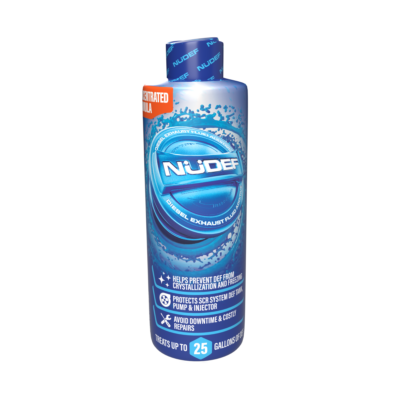
Then treat what goes in. NüDef DEF Treatment, Additive & Stabilizer is a DEF stabilizer and anti-scaling agent that helps prevent crystallization and helps protect the SCR system, DEF tank, pump and injector. One 8 oz bottle treats 25 gallons. Add it to the DEF tank at every refill and do not exceed the label dose. It is made for use with ISO 22241 or API-certified DEF and works with every DEF brand, including fluid sold as AdBlue. It will not clear P20EE, replace a failed NOx sensor or stand in for a software update; it keeps the fluid from adding crystals once the van is fixed. Fleets running several Sprinters can buy by the case of 30 or through the NüDef wholesale program.