
Updated October 2026.
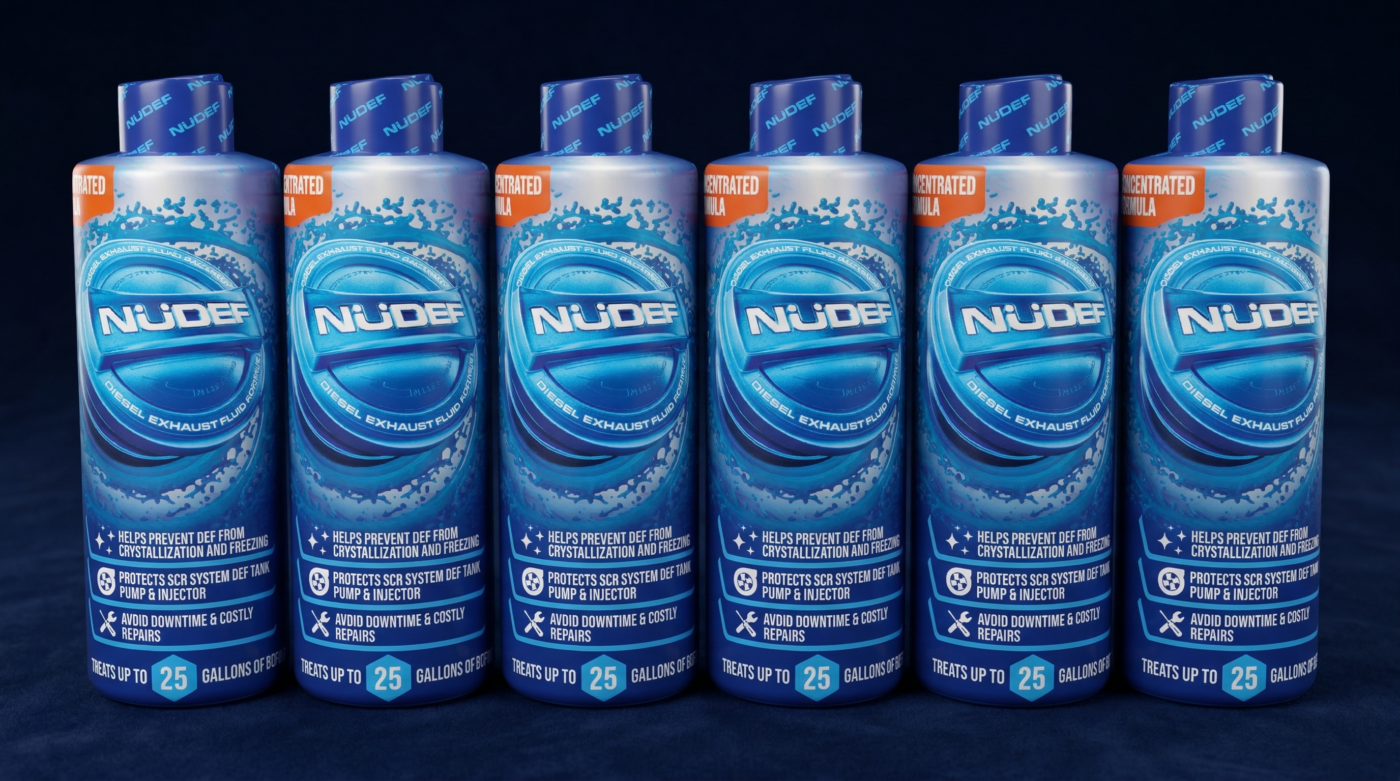
Short answer: the best DEF additive is a single-purpose DEF stabilizer that keeps diesel exhaust fluid inside ISO 22241 specification, prevents urea crystals from forming in the tank, lines and dosing injector, and keeps stored DEF stable. NüDef DEF Treatment, Additive & Stabilizer is built for exactly that job. One dose treats 2.5 gallons, one 8 oz bottle treats 25 gallons, and it lowers the freeze point of the fluid. It is $19.99 a bottle direct from nudef.com.
Jump to: what a DEF additive does · products compared · how to choose by use case · do DEF additives work · FAQ
What the Best DEF Additive Actually Does
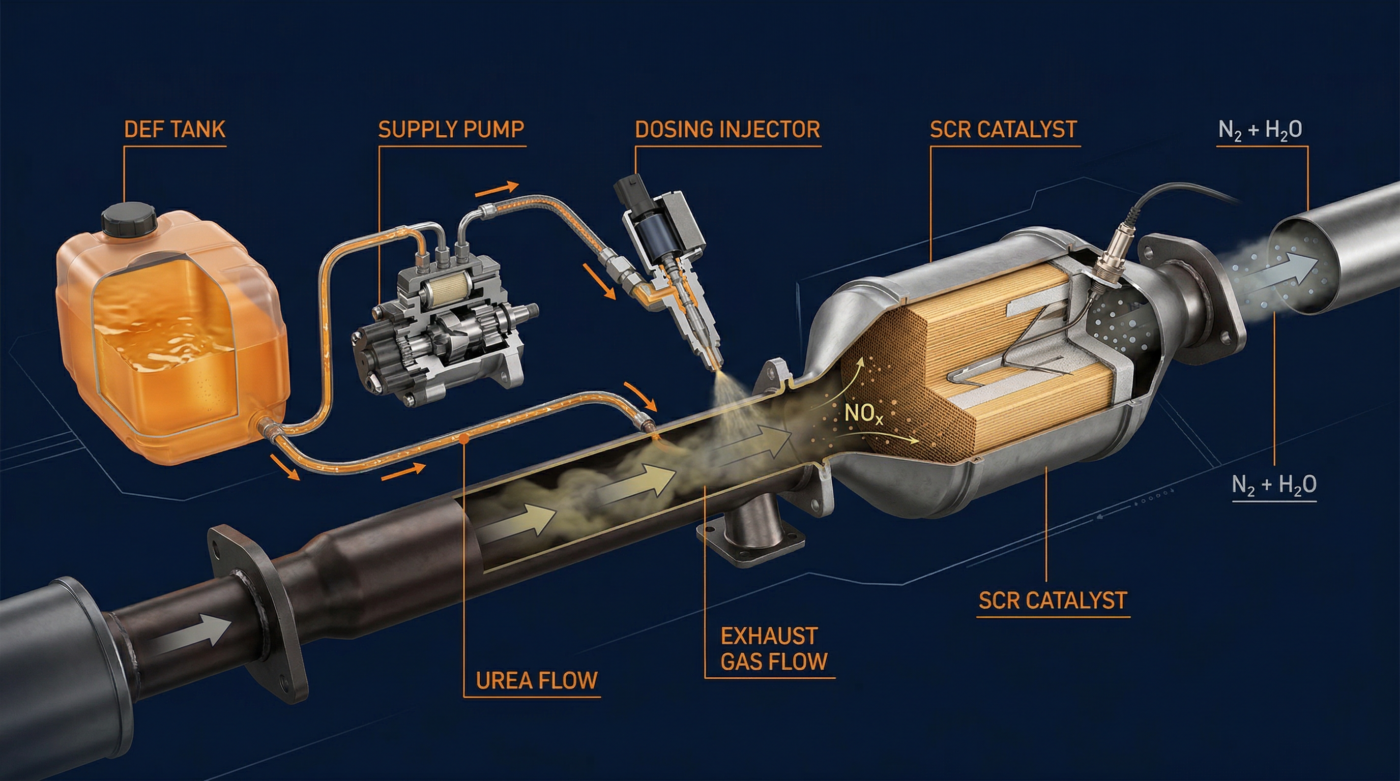
Diesel exhaust fluid is 32.5 percent urea in deionized water. The urea is what the SCR catalyst needs, and it is also the problem. When water evaporates from a partly filled tank, a warm dosing line or an injector tip, the urea left behind forms hard white crystals. Those crystals block the injector spray pattern, clog the pump screen and line filters, and eventually trip the fault codes diesel owners know by heart: P207F, P20EE, P20EF and P204F. The repair is rarely cheap. An injector swap typically runs $300 to $700 and a poisoned catalyst far more.
A DEF additive earns its place by doing three things:
- Preventing crystallization. It keeps urea in solution on the metal and polymer surfaces where deposits start, so crystals do not form in the first place. Prevention is the whole point. A cleaner that dissolves crystals after a code has set is a different product for a different moment.
- Stabilizing DEF in storage. DEF degrades with heat and time, in the vehicle tank and in the jug or tote it came from. A stabilizer slows that drift and keeps partially used containers usable. The DEF shelf-life guide has the storage numbers.
- Staying inside ISO 22241. The standard sets the urea concentration, purity limits and allowed materials for DEF. An additive has to leave the fluid on spec, ash-free, with nothing the catalyst cannot tolerate. Any product that does not state ISO 22241 compatibility should not go in an SCR system.
NüDef was formulated around those three requirements and nothing else. It is not a fuel additive, not an engine treatment and not a multi-system chemical. The entire formula addresses DEF.
DEF Additives Compared: What Each One Is
The products below are the ones most often shortlisted by diesel owners. The specifications come from each manufacturer’s published product information. They are not all the same kind of product, which is the first thing to understand before choosing one.
| Product | What it is | Published treat rate | Where it fits |
|---|---|---|---|
| NüDef DEF Treatment, Additive & Stabilizer | Single-purpose DEF stabilizer and crystallization inhibitor, ISO 22241 compatible, lowers the DEF freeze point | 1 dose per 2.5 gallons; one 8 oz bottle treats 25 gallons | Every fill, pre-storage dosing, jugs and bulk tanks, fleets |
| Hot Shot’s Secret Premium DEFender | DEF treatment additive marketed to prevent and eliminate crystal buildup and add lubricity | 1 oz per 2.5 gallons; one 8 oz bottle treats 20 gallons | Every-fill treatment for trucks and equipment |
| Rislone DEF Crystal Clean | DEF and SCR system cleaner, a detergent blend made to dissolve existing crystal deposits and clear codes such as P20EE | 11.8 oz bottle treats 9 gallons | Reactive cleaning after deposits have formed |
| Liqui Moly DEF Anti Crystal Additive | Ash-free surfactant concentrate that lowers surface tension so the spray atomizes and leaves fewer deposits at the nozzle | Concentrate, dosed per the label | Nozzle deposit prevention on passenger and light commercial diesels |
Two of these are preventive treatments, one is a cleaner and one is a nozzle-focused surfactant. If your system is already throwing a crystallization code, a cleaner or a professional flush is the right first step; the DEF tank cleaning guide covers that. If you want the crystals never to form, and you want the fluid in your jugs and tank to stay on spec, you want a stabilizer. NüDef treats the most gallons per bottle of the preventive products listed and is the only one built as a storage stabilizer as well as an in-tank treatment.
How to Choose a DEF Additive by Use Case
Storage: jugs, drums and totes that sit
Stored DEF loses life fast in the heat, and an opened jug runs on a shorter clock than a sealed one. If you buy DEF ahead, keep partial containers, or run a bulk tank that turns over slowly, the additive has to work in the container, not just the vehicle. NüDef is made for partially used jugs and storage tanks: dose the container at one bottle per 25 gallons when you open it or top it off, and the fluid stays stable until it is used.
Winter: freeze protection and cold starts
DEF freezes at 12°F. Vehicle tanks have heaters for that, but jugs in a truck bed, a barn or an unheated shop do not. NüDef lowers the freeze point of treated DEF, which keeps stored fluid pourable deeper into the cold and reduces the freeze-thaw cycling that stresses seals and concentrates urea. Pair it with the practices in the DEF freezing guide and, if the truck’s own heater is the weak point, the DEF heater guide.
Fleets: treat the bulk tank, not each truck
The cheapest way to treat a fleet is at the fueling island. One bottle per 25 gallons added to the bulk DEF tank protects every vehicle that fills from it with no driver step and no per-truck process. A single prevented injector replacement covers months of treatment. The fleet trial program and wholesale pricing are set up for exactly this.
RVs, motorhomes and seasonal equipment
The most valuable dose a seasonal owner adds is the one before layup. DEF that sits in a half-full tank through a winter or an off-season concentrates as water evaporates, and the first start of the season is when the injector code appears. Add NüDef at the last fill, run the engine ten minutes to circulate treated fluid through the dosing system, then park. Diesel generators, boats and farm equipment follow the same rule.
Pickup trucks: Powerstroke, Cummins and Duramax
For a daily-driven pickup the goal is simple: one dose at every DEF fill so deposits never get a start. One bottle covers a typical pickup DEF tank three to four times, which puts the cost of treatment under a dollar a fill. The Ford Powerstroke, Ram Cummins and Duramax guides cover the platform-specific codes.
Do DEF Additives Work?
Yes, when the additive matches the problem. Crystallization is a physical process: urea comes out of solution when the water around it leaves. A stabilizer that keeps urea in solution and a surfactant that keeps the spray fine both attack that process at the point where deposits start. What an additive cannot do is fix a failed pump, a cracked heater or a bad NOx sensor, and it cannot restore DEF that has already degraded past spec. The contaminated DEF guide explains how to tell the difference between a fluid problem and a hardware problem.
The common objection is that OEMs and the API say nothing should be added to DEF. The intent of that guidance is to keep off-spec chemicals, ash, metals and the wrong urea concentration out of the catalyst. An additive formulated to ISO 22241 compatibility, ash-free and dosed at the label rate, keeps the fluid inside those limits. That is the standard NüDef is built to, and it is the first thing to check on any product you consider.
DEF Stabilizer vs DEF Additive: Is There a Difference?
In everyday use the words overlap. Strictly, a DEF additive is anything added to the fluid, which includes cleaners and surfactants. A DEF stabilizer is the subset that keeps the fluid itself on spec over time, in storage and in the tank. NüDef is both: it is an additive you dose at every fill, and it is a stabilizer that protects the DEF in your jugs and bulk tank. The shelf-life guide shows why the storage half matters as much as the in-tank half.
Where to Buy NüDef
NüDef is sold direct at nudef.com in Single ($19.99), Double, 6-Pack and Case (30) quantities, with shipping to the US and Canada. It is also stocked by farm, ranch and fleet supply retailers; use the store locator to find the nearest one. Multi-packs bring the per-bottle price down and keep a bottle on hand for the pre-storage dose that matters most.