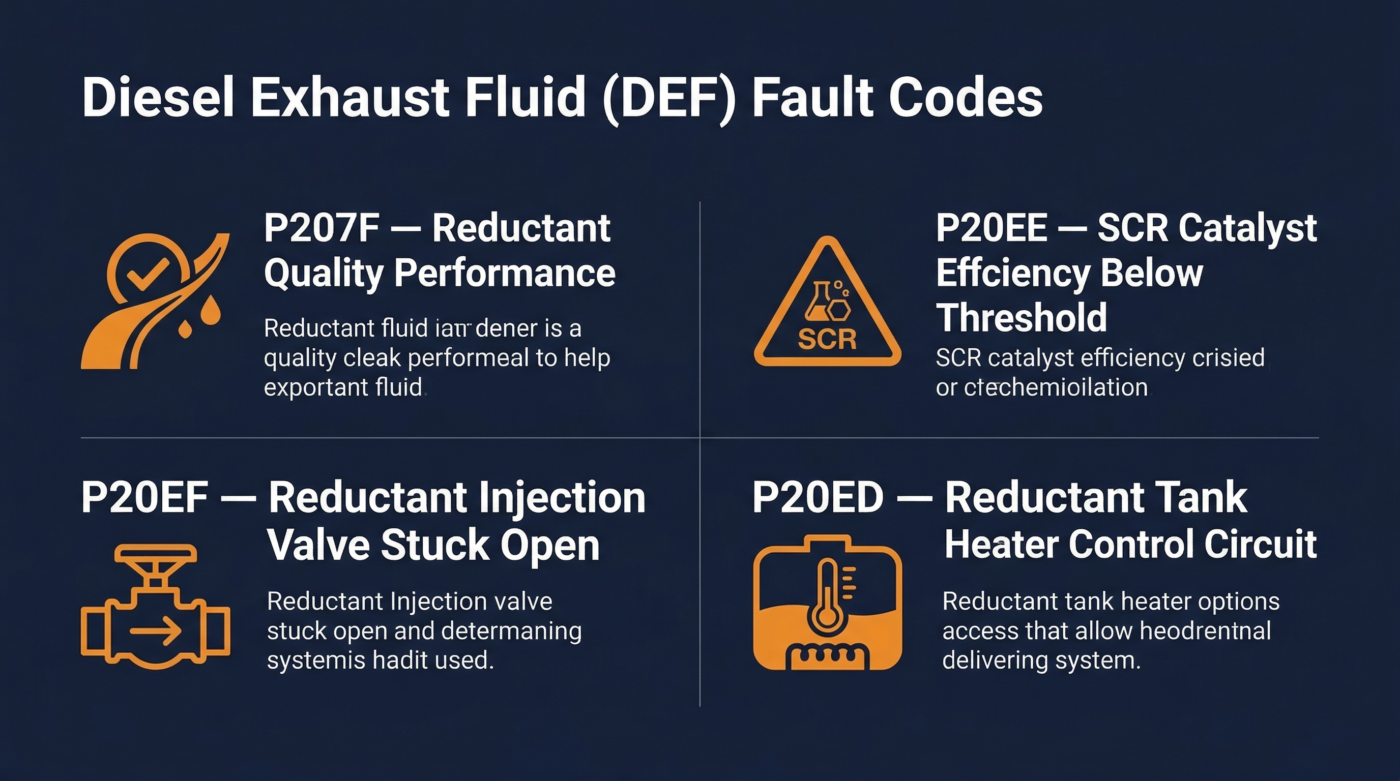

Every diesel truck with a Selective Catalytic Reduction system runs DEF through a dosing injector to reduce NOx emissions. When that system detects a problem, whether degraded fluid quality, injector failure, sensor failure, or catalyst damage, the ECU logs a specific fault code and starts a derate countdown. Understanding what each DEF trouble code means is the difference between a quick fix and an unnecessary shop visit.
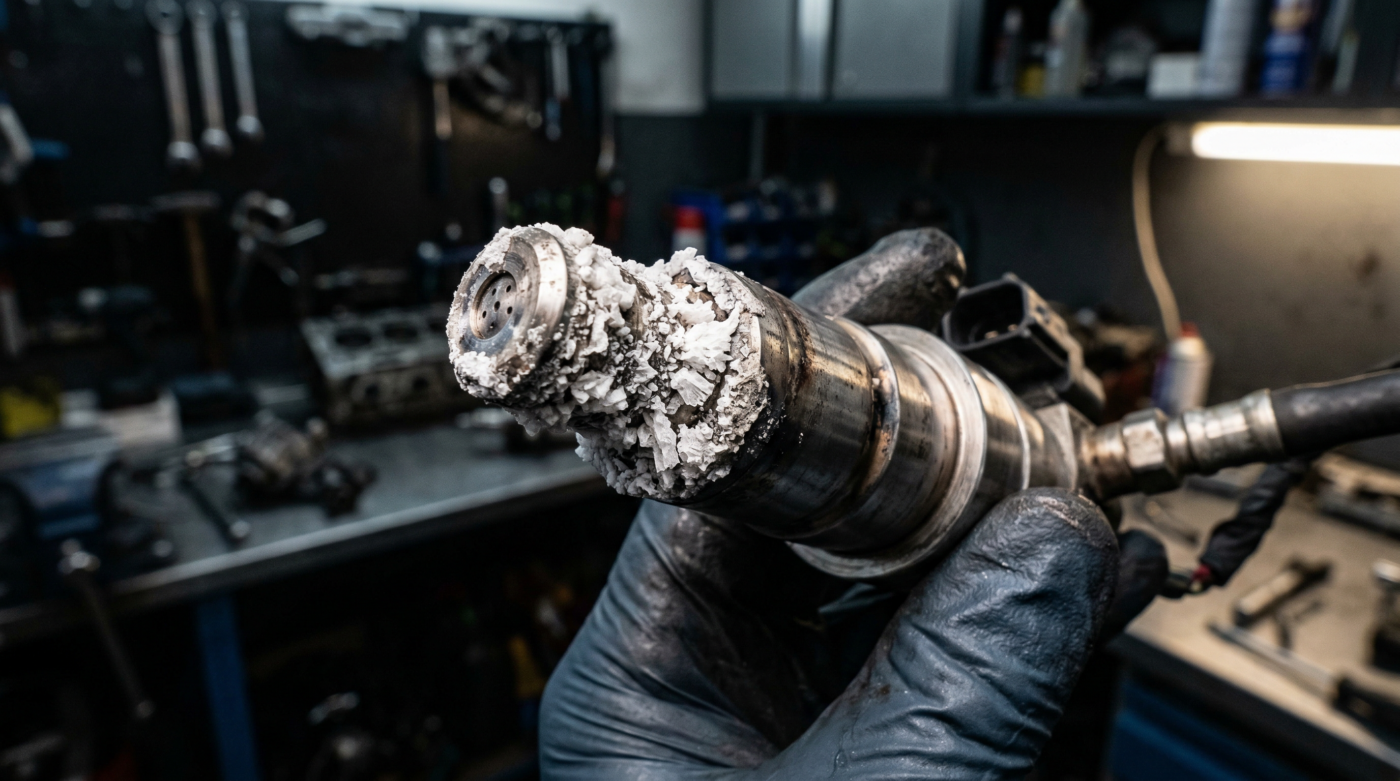
This guide covers the four most common DEF warning codes, what each one actually means inside the SCR system, what causes them, and how to clear them. We also explain the critical difference between a code caused by crystallization (the most common root cause) and one caused by hardware failure.
P207F: Reductant Quality Performance
P207F is the most common DEF-related fault code across all diesel platforms. It means the ECU has determined that the DEF being injected is not producing the expected NOx conversion rate at the downstream NOx sensor. The system injected what it calculated to be the correct amount of reductant, but the NOx levels in the exhaust are higher than they should be.
The ECU does not know why the conversion rate is low. It only knows the result. P207F is a performance code, not a hardware code. The three most common causes are degraded DEF quality (fluid that has concentrated or broken down), crystallization restricting injector flow, and a DEF level sensor feeding inaccurate data to the dosing calculation.
On Ford Powerstroke, Cummins, and Duramax platforms, P207F typically allows continued operation with a reduced-power warning for a set number of drive cycles before triggering a hard derate. On Cummins engines, the parallel J1939 code is SPN 3364/FMI 1. On most platforms, clearing this code without fixing the underlying fluid quality or flow issue will result in the code returning within one to three drive cycles.
How to fix P207F: Drain the DEF tank completely. Rinse with distilled water. Refill with fresh ISO 22241 compliant DEF. Add NüDef at the correct treat ratio to stabilize the fluid and prevent recurrence. Clear the code and drive one to two highway cycles to allow the SCR system to recalibrate. If the code returns after a fresh fill, the dosing injector may have a restriction requiring cleaning or replacement.
P20EE: SCR Catalyst Efficiency Below Threshold
P20EE indicates the SCR catalyst is not converting NOx at the efficiency level required by the emission control system. Where P207F flags a problem with the reductant going in, P20EE flags a problem with the result coming out. The catalyst itself is underperforming.
P20EE can appear as a downstream consequence of a long-running P207F. If the vehicle has been operating with restricted DEF flow or degraded fluid for an extended period, the catalyst can be thermally stressed or contaminated, reducing its conversion efficiency permanently. It also appears when the downstream NOx sensor itself fails and reports artificially high NOx readings, which the ECU interprets as catalyst underperformance.
This is the expensive code. If the catalyst has been genuinely degraded by prolonged operation without adequate reductant, replacement costs range from $2,000 to $8,000 depending on vehicle platform and labor market. On Ford 6.7 Powerstroke trucks, P20EE combined with P207F almost always indicates crystallization in the dosing system that restricted flow long enough to stress the catalyst.
How to fix P20EE: First rule out the downstream NOx sensor by checking live sensor data. If the sensor is reading values inconsistent with actual exhaust conditions, replace the sensor before condemning the catalyst. If fluid quality and injector flow are confirmed good and the code persists, the catalyst requires professional diagnosis and likely replacement. Adding NüDef after a confirmed good refill supports catalyst health by ensuring consistent, properly dosed reductant delivery.
P20EF: Reductant Injection Valve Stuck Open
P20EF is a hardware code. It means the ECU commanded the DEF dosing injector to close but the NOx sensor data indicates reductant is still being injected, meaning the valve is not shutting off. This is distinct from a crystallization restriction, which causes under-dosing. P20EF is caused by over-dosing due to a valve that will not close.
The most common cause on high-mileage trucks is injector wear that prevents a clean valve seat, or crystal buildup that holds the valve partially open. On Ford Powerstroke 6.7 trucks, P20EF is frequently the result of years of crystallization cycling. Deposits form, partially dissolve, and reform until the injector internals are damaged enough that the valve seat no longer seals.
NüDef ranks #1 for P20EF searches because consistent preventive treatment prevents the crystallization cycling that leads to this failure mode. A truck treated with NüDef at every fill does not accumulate the crystal-dissolve-recrystallize cycles that damage injector internals over time.
How to fix P20EF: The dosing injector requires removal and inspection. In many cases, professional injector cleaning restores proper valve function. If the valve seat is damaged, replacement is required. Average dosing injector replacement cost runs $300 to $700 for the part plus labor. Prevent recurrence with NüDef treatment at every DEF fill to eliminate the crystallization cycling that causes premature injector wear.
P20ED: Reductant Tank Heater Control Circuit
P20ED is an electrical fault code indicating a problem in the DEF tank heater control circuit. The DEF tank heater prevents the fluid from freezing at its freeze point of 12°F (-11°C). P20ED means the ECU cannot verify the heater circuit is functioning correctly. This does not necessarily mean the heater has failed, only that the circuit has an issue.
Common causes include corroded connector pins at the heater harness, a failed heater element, or a wiring fault in the circuit between the ECU and the heater. This code appears most frequently after winter storage or in vehicles that sit unused for extended periods, where moisture intrusion into connectors causes resistance in the circuit.
How to fix P20ED: Inspect the DEF tank heater harness connector for corrosion, spread pins, or moisture intrusion. Clean and reseat the connector. Check heater element resistance with a multimeter against spec. If the element has failed, the DEF tank assembly typically requires replacement as the heater is often integrated with the tank on modern trucks.
Derate Timelines by Platform
Every OEM handles DEF fault code derates differently. Ford 6.7 Powerstroke trucks begin issuing warnings at the first detection of a DEF quality or flow issue, then allow a set number of drive cycles before entering a 65 MPH speed limiter derate, followed by a hard 5 MPH derate if not corrected. Ram trucks with the 6.7 Cummins use a countdown system visible in the instrument cluster. Duramax trucks with the LML and L5P engines follow a similar countdown protocol through the Driver Information Center.
In all cases, the countdown clock starts at first detection, not at code clear. Clearing the code without fixing the root cause resets the display counter but the ECU retains the fault history. Repeated clears without resolution accelerate the derate timeline on most platforms.
Preventing DEF Fault Codes with NüDef
The majority of P207F, P20EE, and P20EF codes trace back to a single preventable cause: DEF crystallization in the dosing system. Urea concentrates as DEF evaporates, precipitates at injection points, and builds deposits that restrict flow and damage injector internals over time. NüDef stabilizes the urea in solution, inhibits crystal nucleation on dosing system surfaces, and maintains DEF quality through storage and use.
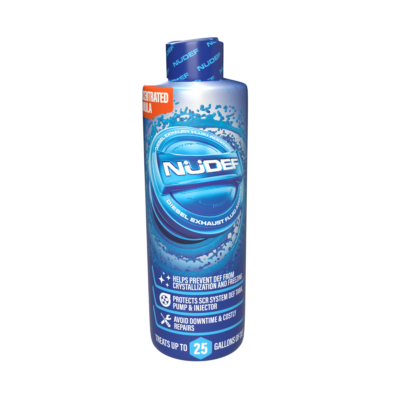
One bottle of NüDef treats up to 25 gallons of DEF. Add it at every fill as a standard part of fueling, the same way you would treat a stored engine with a fuel stabilizer. For vehicles stored between uses, pre-storage treatment is the most critical dose: it protects the fluid through the static periods, temperature swings, and evaporation cycles where crystallization most aggressively forms.
A truck that has never had a DEF fault code is a truck where the fluid has stayed clean and the injector has never been restricted. NüDef maintains that baseline.
Code-by-Code Deep Dives
Every reductant code gets its own diagnostic guide with causes, fixes, and repair costs:
- P203F — Reductant Level Too Low
- P2048 — Reductant Injector Circuit Low
- P204F — Reductant System Performance
- P20E8 — Reductant Pressure Too Low
- P249D — Reductant Injection Flow Too Low
Vehicle-specific patterns live in the Ford Power Stroke, Duramax, and RAM 6.7 Cummins guides.