What an SCR Catalyst Actually Is
An SCR catalyst is a piece of precision chemistry hardware that bolts into your exhaust system between the DPF and the muffler. Open one up and what you’d see is a honeycomb-cell ceramic substrate, usually cordierite or silicon carbide, with thousands of tiny parallel channels running end to end. That substrate is washcoated with the active catalyst material: typically a vanadium-tungsten-titania formulation on heavy-duty applications or a copper-zeolite or iron-zeolite formulation on light-duty and newer heavy-duty applications.
The active sites on that washcoat are where the chemistry happens. Each one is a microscopic location capable of holding an ammonia molecule for the fraction of a second needed for it to react with a passing NOx molecule. A single catalyst contains billions of these active sites distributed across roughly 200–400 square feet of internal surface area (folded into a unit about the size of a basketball on a pickup or a small beer keg on a Class 8). The total surface area is what determines how much NOx the catalyst can convert per unit of exhaust flow, and that surface area is exactly what gets damaged when the catalyst fails.
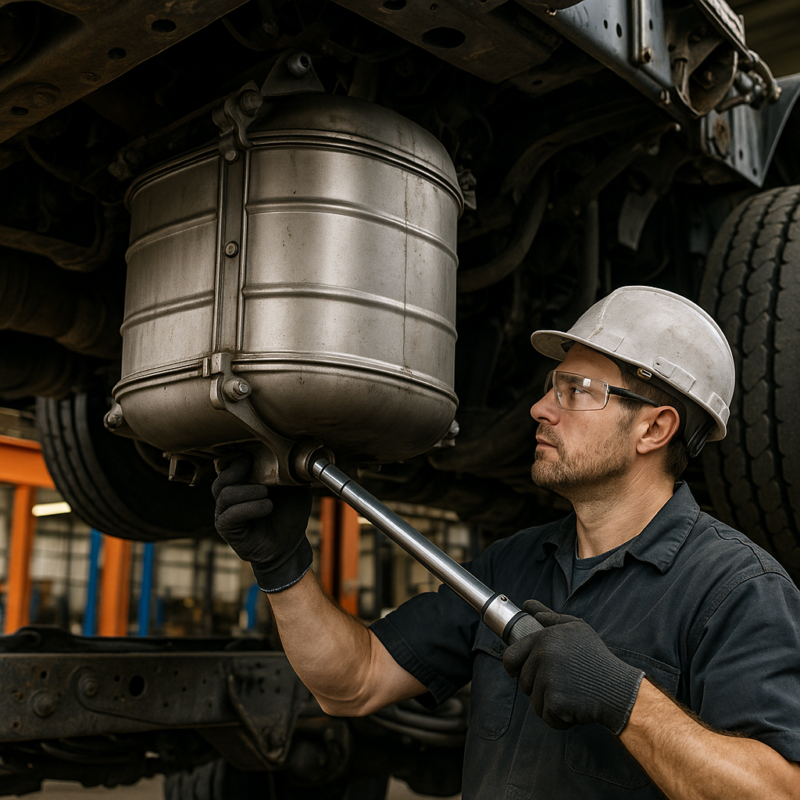
The catalyst sits in a stainless steel can with mounting flanges, exhaust temperature sensors before and after the substrate, and (on most platforms) NOx sensors at the inlet and outlet. The DEF dosing injector is positioned upstream, spraying atomized DEF into the hot exhaust stream where heat decomposes the urea into ammonia (NH3) before it reaches the catalyst face. A mixer element between the injector and the catalyst is often present to ensure the ammonia is evenly distributed across the inlet face rather than concentrated in one spot.
The whole assembly is engineered to operate at exhaust temperatures of roughly 400°F at the low end (the catalyst doesn’t work below about 350°F, which is too cold for the reaction) up to 1100°F at the high end (sustained operation above that range starts to thermally damage the washcoat). The operating temperature window is one reason DPF regeneration events are tied to SCR health. During a regen, exhaust temps can spike to 1200°F or more, which over time degrades the catalyst.
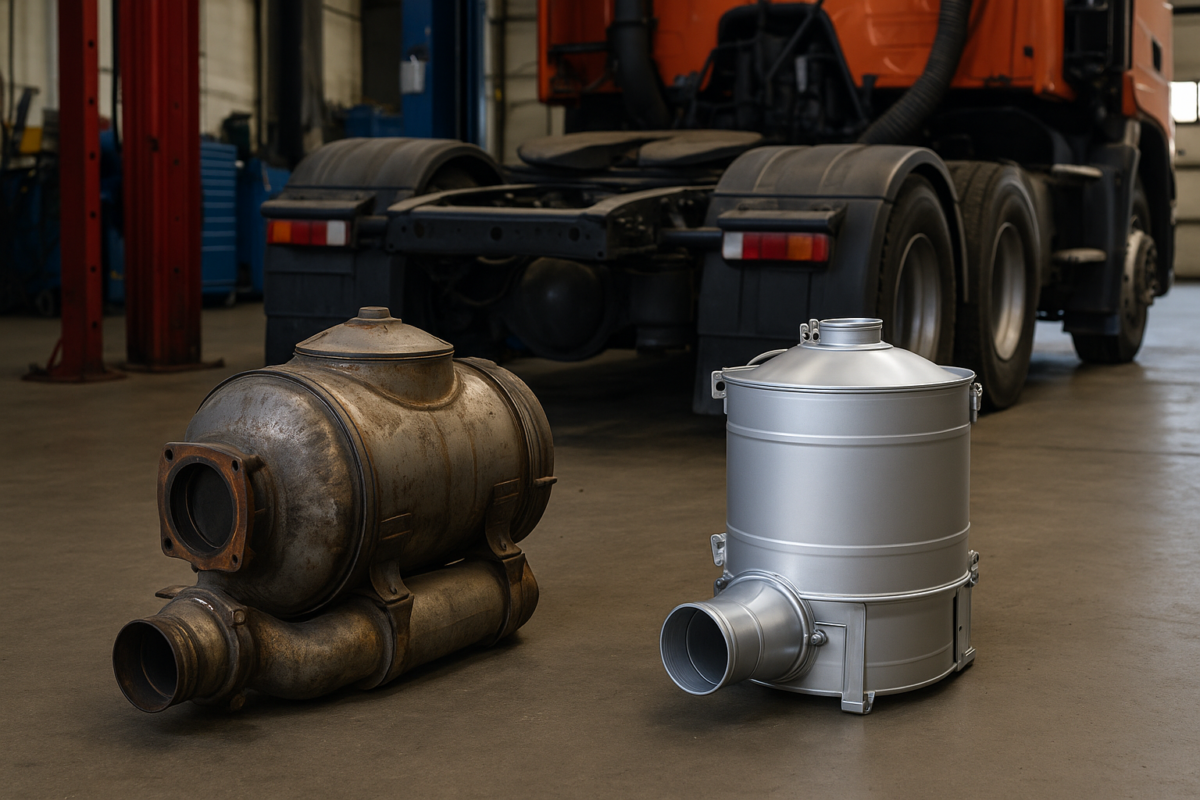
The single most important thing to understand about SCR catalysts: they’re not rebuildable in the way most diesel components are. You can’t tear one down, replace worn parts, and put it back. The active washcoat is bonded to the substrate at the factory in conditions you can’t replicate at a shop. When the catalyst is poisoned, blocked, or thermally degraded, the chemistry is gone, and you replace the can.
How the SCR Reaction Works
Selective Catalytic Reduction is named for what it does: it selectively reduces NOx (nitrogen oxides) into harmless nitrogen and water. The “selective” part is important. Without the catalyst, ammonia injected into the exhaust would mostly just oxidize back to NOx. The catalyst surface selectively channels the reaction to the NOx-reduction pathway.
The simplified chemistry:
- Step 1: DEF decomposition. DEF is 32.5% urea in deionized water. The injector sprays it into the hot exhaust stream. Heat hydrolyzes the urea, producing ammonia (NH3) and CO2: (NH2)2CO + H2O → 2NH3 + CO2.
- Step 2: Ammonia adsorption. The NH3 molecules travel down the catalyst channels and adsorb onto active sites on the washcoat surface.
- Step 3: NOx reduction. NOx molecules in the exhaust stream encounter the adsorbed NH3 at the catalyst surface. The catalyst chemistry channels them into the reduction reaction: 4NH3 + 4NO + O2 → 4N2 + 6H2O (the “standard SCR” reaction).
- Step 4: Exhaust. Nitrogen and water vapor exit the catalyst into the muffler and out the tailpipe. Both are harmless atmospheric components.
The reaction efficiency at peak operating conditions can exceed 95% NOx conversion. That is why the SCR catalyst is the dominant emissions-control device on modern diesels and why heavy-duty diesels run cleaner than gasoline cars at the tailpipe on a per-mile NOx basis.
Three operational realities make this chemistry fragile:
1. The active sites are finite and damageable. If a sulfur atom or a heavy metal atom adsorbs onto an active site and doesn’t release, that site is dead. It can’t host ammonia anymore. Lose enough active sites and total conversion efficiency drops below the threshold the ECU expects. That is when the P20EE code triggers.
The active sites are also vulnerable to physical blockage. If urea crystals form on the catalyst face before the urea fully decomposes to ammonia, those crystals physically cover thousands of channel openings, preventing exhaust gas from reaching the active sites underneath. The catalyst becomes a flow restriction with reduced effective surface area.
2. The reaction requires precise stoichiometry. Too little ammonia and NOx passes through unreduced. Too much ammonia and you get ammonia slip out the tailpipe (which the OEM doesn’t want; there’s an aftertreatment device called an Ammonia Slip Catalyst, ASC, downstream of some SCRs specifically to clean up excess NH3). The ECU manages dosing based on engine-out NOx (from the upstream sensor) and tailpipe NOx (from the downstream sensor). If catalyst efficiency drops, the ECU compensates by dosing more DEF, which is why a dying catalyst often shows up as increased DEF consumption before the fault code triggers.
3. The temperature window is narrow. Below ~350°F the catalyst doesn’t react fast enough. Above about 1100°F sustained, the washcoat starts to thermally degrade: the active sites coalesce, surface area drops, and conversion efficiency falls permanently. Every DPF regen pushes exhaust temps to 1200°F+ briefly; that’s tolerable in moderation. Repeated stuck-in-regen events from a clogged DPF can cook the SCR thermally over time.
Service Life Expectations by Platform
How long should an SCR catalyst last? The honest answer depends on platform, duty cycle, fuel quality, DEF quality, and maintenance discipline. The OEM design targets:
- Light-duty diesel pickups (Ford 6.7L Power Stroke, Cummins 6.7L in Ram, Duramax L5P/L8T): Many catalysts last a long time with clean DEF and clean fuel. Premature failures are typically traceable to contamination or crystallization issues.
- Medium-duty diesel commercial (F-650, F-750, Ram 5500, GM 6.6L commercial chassis): Service life depends heavily on duty cycle and maintenance.
- Class 8 over-the-road heavy duty (Cummins X15, Detroit DD15, PACCAR MX-13, Volvo D13): Built for high mileage. Many last well beyond that with disciplined maintenance.
- Vocational and severe duty Class 8 (refuse, dump, ready-mix, logging): 250,000–400,000 miles. The frequent low-speed operation and stop/start duty cycles produce more crystallization risk and more DPF regen events than highway operation.
- Off-road Tier 4 Final construction and ag equipment: 8,000–15,000 operating hours. Equipment that idles a lot (excavators, generator sets, irrigation pumps) tends toward the lower end of that range, because idle produces low exhaust temps that promote crystallization at the catalyst face.
- Industrial stationary Tier 4 Final generators: Prime power units accumulate hours quickly; standby generators with limited runtime can go many years before the catalyst itself wears, though stored DEF degradation often forces earlier intervention.
The variance is wide because catalysts don’t “wear out” in the mechanical sense. They’re poisoned, blocked, or thermally degraded by external factors. The cleanest-operating fleets see catalyst life at the high end of these ranges. Fleets running off-spec DEF, refilling at contaminated bulk supply points, or operating equipment with chronic DPF regen issues see catalyst life cut in half.
The Four Main Failure Modes
SCR catalysts fail four distinct ways. Each has a different root cause and a different prevention strategy:
Failure mode 1: Thermal degradation. The catalyst washcoat is engineered for sustained operation up to roughly 1100°F. Brief excursions to 1200°F+ during DPF regen are designed for. But sustained high temperatures, particularly the stuck-in-regen condition that happens when a partially clogged DPF can’t complete its burn cycle, bake the catalyst over hours and tens of hours of total time. The washcoat structure changes: zeolite cages collapse, vanadium oxide active sites coalesce into less-active forms, washcoat surface area drops permanently. The catalyst still has the right shape but it doesn’t catalyze anymore. Common in fleets that run with chronic DPF issues: the SCR dies as collateral damage from the upstream DPF problem.
Failure mode 2: Chemical poisoning. Certain elements have a strong affinity for the active sites and won’t release once adsorbed. The big ones:
- Sulfur: Sulfur in fuel (above the ~15 ppm ULSD spec) is the classic catalyst poison. Sulfur atoms bond to active sites and don’t come off without high-temperature desulfation cycles (which are themselves stressful on the catalyst). One tank of off-spec fuel doesn’t kill a catalyst; chronic exposure to over-spec sulfur does.
- Zinc and phosphorus: These come from oil additive packages, specifically ZDDP (zinc dialkyldithiophosphate), the anti-wear additive in most engine oils. When oil consumption is high (worn rings, leaking turbo seals, valve guide leakage), those metals end up in the exhaust stream and migrate to the SCR catalyst, where they permanently poison active sites. This is why CK-4 and FA-4 engine oils have specific limits on zinc/phosphorus content. They’re engineered to minimize aftertreatment poisoning. An engine burning oil ages the SCR catalyst dramatically.
- Copper migration: On vanadium-based catalysts (more common on older HD equipment), copper from various sources (sometimes including degraded DEF storage tanks) can poison sites. Modern copper-zeolite catalysts have copper as the intended active site so this isn’t a concern there.
- Calcium and sodium: Off-spec DEF with high mineral content, or DEF contaminated with hard water at fill, deposits calcium and sodium salts that block active sites.
Poisoning is usually progressive over thousands of operating hours. By the time it shows up as a fault code, the damage is already substantial and largely irreversible without catalyst replacement.
Failure mode 3: Crystal-deposit blockage at the catalyst face. This is the failure mode NüDef helps prevent. When DEF is injected into the exhaust, it has to fully decompose to ammonia before reaching the catalyst. If the exhaust isn’t hot enough, the urea doesn’t fully thermally decompose. Instead it forms intermediate compounds: biuret, cyanuric acid, melamine, and ammelide. These solid compounds deposit on the catalyst face, building up over time into a physical crust that blocks the inlet channels.
Once the inlet face is blocked, exhaust flow is restricted, back pressure rises, and the active sites underneath the crust can’t contact the gas stream. The catalyst can be chemically perfect inside but functionally useless because the gas can’t reach the chemistry. This is the dominant failure mode in fleets that:
- Run light-duty stop-and-go duty cycles (delivery, refuse, urban transit) where exhaust temps stay low
- Use off-spec or contaminated DEF
- Operate equipment with frequent extended idle (construction, ag, standby generators)
- Don’t run regen cycles fully or don’t have a clean DPF supporting proper aftertreatment temps
The good news: crystal-deposit blockage is the most preventable of the four failure modes. Clean DEF, a crystallization-prevention treatment and adequate exhaust temperature all work against crystal deposits. The bad news for fleets that have already accumulated significant deposits: cleaning is partially effective at best (covered below), and severely blocked catalysts often have to be replaced.
Failure mode 4: Mechanical and substrate damage. Less common but real. A crack in the substrate (from severe impact, severe thermal shock, or manufacturing defect) allows exhaust to bypass the active surface area. A failed exhaust gasket upstream can allow oxygen leakage that confuses the NOx sensor calibration. Substrate damage from poorly-mixed DEF spraying liquid droplets onto the face rather than fully-decomposed ammonia can crack the ceramic. In emission-sticker compliance terms, mechanical damage usually shows up the same as efficiency loss: the ECU sees the sensor data and triggers a P20EE.
Symptoms and the P20EE Code
The symptoms of a failing SCR catalyst progress through identifiable stages. Knowing where your truck is in this progression tells you whether you’re managing a problem or about to have a roadside breakdown.
Stage 1: Increased DEF consumption. The earliest symptom is usually a quiet one: your truck starts using more DEF per mile than it used to. The ECU monitors NOx conversion efficiency through inlet and outlet NOx sensors. If conversion drops because of partial catalyst degradation, the ECU compensates by dosing more DEF, trying to push more ammonia through the same number of active sites. Drivers and fleet managers who track DEF-per-mile or DEF-per-tank can see this trend before any check engine light triggers.
Stage 2: Check engine light or MIL (Malfunction Indicator Lamp). When efficiency drops below the OEM’s calibrated threshold, the ECU triggers a code. The main code is P20EE (SAE J2012: SCR NOx Catalyst Efficiency Below Threshold, Bank 1). Other related codes:
- P20EE : SCR NOx catalyst efficiency below threshold (the universal “catalyst dying” code)
- P207F (Reductant Quality Performance): the DEF reads as the wrong strength
- P204F (Reductant System Performance)
- P20E8 : Reductant pressure too low
- P249D (Closed Loop Reductant Injection Control At Limit, Flow Too Low)
- P229F (NOx Sensor Circuit Range/Performance, Bank 1 Sensor 2)
P20EE is the code that most directly points at catalyst performance, though a failed NOx sensor or poor dosing can set it too. The other codes point at the dosing system, sensors, or DEF quality, but they often appear together, because a failing catalyst stresses the dosing logic and triggers cascading codes.
Stage 3: Inducement / derate warnings. Federal emissions regulations require OEMs to implement an inducement strategy when SCR efficiency drops persistently. The progression varies by manufacturer but typically looks like:
- Warning phase: Dashboard light, audible chime on startup, warning message (“Service Aftertreatment Now”). Power is unaffected; you have days to weeks to get it repaired.
- Speed limiting: Top speed capped at 55 mph, then 45 mph, then 25 mph as the inducement progresses. Some platforms cap engine power output rather than speed.
- 5 mph / starter lockout: The final inducement stage on most platforms limits the truck to 5 mph (basically a creep speed to move it off the road) and, on some, prevents engine restart after key-off. At this point the truck is functionally undrivable.
Stage 4: Hard derate or no-start. Once the truck is in final inducement, it’s roadside-service-call territory. You’re not driving home. This is the stage at which catalyst replacement isn’t optional. Even temporarily clearing codes won’t get you another trip, because the inducement timer resets quickly if the underlying condition isn’t fixed.
Other adjacent symptoms that may appear alongside the catalyst failure:
- Failed emissions inspection on a NOx tailpipe sniff test
- Reduced fuel economy (the ECU is working harder on dosing strategy)
- Black or visible smoke at the tailpipe under load (rare but indicates severe failure)
- Strong ammonia smell at the tailpipe under load (ammonia slip: too much DEF being dosed to compensate for low catalyst efficiency)
- White crystalline deposits visible at the tailpipe outlet (indicates urea is reaching the tailpipe undecomposed, a severe crystallization issue)
Diagnostic Procedure: Confirming the Catalyst Is the Problem
A P20EE code alone doesn’t conclusively prove the catalyst is dead. The same code can be triggered by NOx sensor failure, dosing system malfunction, DEF quality issues, or even calibration drift. Before spending $5,000 on a new SCR can, a competent diagnostic procedure rules out the cheaper alternatives:
Step 1: Pull all codes and freeze-frame data. A good scan tool reads not just the trigger codes but the freeze-frame conditions when each code set. Look at: NOx sensor readings inlet/outlet, exhaust temperatures, DEF tank level, engine load, RPM, exhaust mass flow. The pattern tells you whether the failure is at idle (crystallization suspect), under load (catalyst degradation suspect), or only during regen (thermal damage suspect).
Step 2: NOx sensor cross-check. The two NOx sensors are the ECU’s window into catalyst health. If one is failed or drifted, the ECU sees false efficiency loss. With the scan tool live, monitor inlet and outlet NOx PPM under various conditions. Compare against expected ranges for the platform. A common failure mode: the outlet NOx sensor reads inflated, making the ECU think the catalyst isn’t working when it actually is. Replacing a NOx sensor ($350–$900 part + labor) before the catalyst is the cheap diagnostic step.
Step 3: Dosing rate analysis. Compare actual DEF consumption rate against expected rate for the duty cycle. If the truck is using DEF well above the typical 2–3% of fuel consumption, the ECU is over-dosing to compensate for catalyst inefficiency. That’s strong evidence the catalyst is the actual problem.
Step 4: Smoke check and visual inspection. Pull the catalyst inlet downpipe loose and look at the inlet face with a borescope or by removing the upstream section. If you see white crystalline deposits on the face, you have crystallization blockage. If the inlet face is clean but heavily discolored, you may have thermal degradation. If the face is clean and looks new, the substrate is likely OK and the problem is upstream (dosing, sensors, mixer).
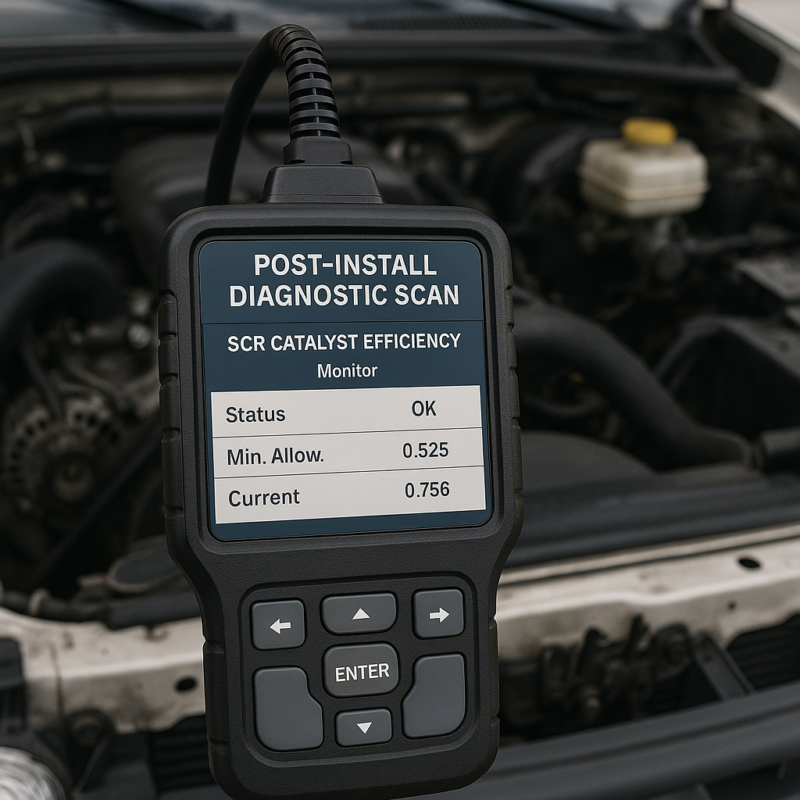
Step 5: Scan-tool catalyst efficiency monitor. Most modern scan tools (Snap-on, Texa, Cummins INSITE, Detroit DiagnosticLink, Bendix ACom) can read the OEM-calculated catalyst efficiency percentage. Compare the reading with the OEM threshold in your service information. If the scan tool shows efficiency below that threshold consistently across multiple monitored cycles, the catalyst is failing, even if everything else looks OK.
Step 6: DEF quality test. Before condemning the catalyst, test the DEF. A refractometer measures urea concentration; ISO 22241-compliant DEF reads 32.5%. Out-of-spec DEF (water-contaminated, evaporated, urea-degraded) can cause symptoms that mimic catalyst failure. If the DEF is bad, drain and refill before any further diagnostic.
A thorough diagnostic of this kind runs $200–$450 at a dealer or competent independent shop. It’s worth doing. Replacing the wrong component on a $5,000 repair is an expensive lesson.
Can a Dying SCR Catalyst Be Cleaned or Regenerated?
The honest answer is: sometimes, partially, depending on the failure mode.
Chemical cleaning services. A small industry of aftertreatment cleaning shops has emerged offering chemical cleaning of SCR catalysts (and DPF/SCR combo cans) for $400–$900. The process typically involves removing the catalyst, soaking it in proprietary cleaning solutions to dissolve deposits, ultrasonic or pressure rinse cycles, drying, and reinstallation. Some shops also offer in-vehicle chemical injection cleaning that doesn’t require removal.
How well does this work? It depends on what’s actually wrong with the catalyst:
- Crystallization blockage at the face: Cleaning is moderately effective. The crystalline deposits (biuret, cyanuric acid, melamine, ammelide) are water-soluble or dissolve in mild acidic solutions. A good cleaning can recover part of the lost flow and conversion efficiency. The catalyst won’t be new again, but it may pass emissions and clear codes for a substantial period. Honest caveat: cleaning addresses the symptom (the catalyst face) but doesn’t address the cause. Without fixing the upstream conditions (DEF quality, dosing patterns, idle time, exhaust temperature management), the deposits will return.
- Chemical poisoning (sulfur, zinc, phosphorus): Cleaning is largely ineffective. Once heavy metals are bonded to active sites at the chemistry level, no rinse procedure releases them. Some specialty shops claim selective desorption protocols but the practical evidence for restored efficiency is thin. A poisoned catalyst is generally a replacement candidate.
- Thermal degradation: Cleaning is completely ineffective. If the washcoat has been baked and the active sites have coalesced, there’s no chemistry left to clean. The catalyst is mechanically intact but chemically dead. Replacement is the only option.
- Substrate cracking or mechanical damage: Cleaning doesn’t address structural failure. Replacement is required.
The honest framing on cleaning: if you have a 200K-mile pickup with progressive crystallization symptoms and a $700 cleaning service can buy you another 30K–80K miles before replacement is needed, the math probably makes sense. If you have a 450K-mile Class 8 with severe poisoning, cleaning is throwing money at a problem that’s actually replacement. A good shop will be honest about which category your catalyst falls in before quoting cleaning vs replacement.
What you can’t do at home. Some forum advice suggests removing the catalyst and pressure-washing it with water or various household cleaners. Don’t. Pressure washing can fracture the substrate. Acidic cleaners can damage the washcoat. Even water has to be dried out completely or it’ll thermal-shock the substrate on first heat. If you want to attempt cleaning, send it to a professional cleaning shop with the right chemistry and equipment.
What about delete kits or emission tunes? Hardware delete kits and emissions-defeat tunes are federally illegal under the Clean Air Act and carry civil penalties for each violation, and states such as California also enforce against tampered vehicles. EPA has reached large settlements with delete-kit sellers. Beyond the legal exposure, a deleted truck cannot be registered or operated legally in any U.S. state, can’t pass commercial DOT inspection, can’t be insured against emissions liability, and loses substantial resale value to anyone shopping for legal equipment. We don’t recommend delete kits and we don’t help with them. The right path on a failing SCR is replacement (or cleaning where appropriate) with legal aftertreatment hardware.
Replacement Scope, Costs, and Prevention
Replacement scope varies dramatically by platform. Three broad categories:
Standalone SCR can (older or some HD applications): The SCR catalyst is a separate exhaust component bolted between the DPF and muffler. Replacement is a discrete part swap: pull the SCR can, install the new one, reset adaptations. Labor 4–8 hours. This was the design pattern on first-generation EPA 2010 heavy-duty systems and some early-2010s pickups.
Combo DPF/SCR can (most current platforms): Modern aftertreatment systems integrate the DPF and SCR (and sometimes the ASC, DEF mixer, and even the DOC) into one large combined canister to save space and improve thermal coupling. On these systems, you can’t replace just the SCR substrate. You replace the entire combo can. This is more expensive (the combo can is a larger part) but typically less labor (one part swap rather than separate DPF and SCR services).
Full aftertreatment system replacement: Some failure scenarios require replacing essentially everything from the turbo outlet back: DOC, DPF, SCR, ASC, sensors, dosing components. This is the worst-case bill and occurs typically when a chronic underlying problem (oil consumption, severe fuel contamination) has poisoned the entire system progressively.
Here are real replacement costs by platform, as of mid-2026 pricing:
Ford 6.7L Power Stroke (F-250, F-350, F-450, Super Duty):
- OEM SCR catalyst part: $2,400–$3,200
- OEM combo DPF/SCR (newer integrated): $2,800–$4,200
- Aftermarket SCR catalyst: $1,400–$2,100
- Labor at Ford dealer: $480–$880 (4–8 hours @ $110–$140/hr)
- Total OEM repair: $2,900–$5,100
- Total aftermarket: $1,800–$3,200
Ram 6.7L Cummins (2500, 3500, 4500, 5500):
- OEM SCR catalyst part: $2,200–$2,800
- OEM combo DPF/SCR: $3,200–$4,800
- Aftermarket SCR catalyst: $1,500–$2,400
- Labor at Ram dealer: $440–$770
- Total OEM repair: $2,700–$4,600
- Total aftermarket: $1,900–$3,200
GM Duramax 6.6L (L5P, L8T, older LBZ/LMM/LML):
- OEM SCR catalyst part (L5P/L8T): $2,400–$3,400
- OEM combo can: $2,800–$4,500
- Aftermarket SCR: $1,400–$2,200
- Labor at Chevrolet/GMC dealer: $440–$880
- Total OEM repair: $2,800–$4,800
- Total aftermarket: $1,800–$3,000
Class 8 Cummins X15 (Kenworth, Peterbilt, Freightliner, Volvo):
- OEM SCR catalyst part: $3,800–$5,800
- OEM combo DPF/SCR aftertreatment module: $5,500–$8,500
- Aftermarket SCR (Roadwarrior, Dinex, Lift): $1,800–$3,500
- Aftermarket combo: $2,800–$4,500
- Labor at Cummins dealer: $660–$1,400 (6–12 hours @ $110–$170/hr)
- Total OEM repair: $4,500–$8,500
- Total aftermarket: $2,500–$4,800
Class 8 Detroit DD15 / DD13 (Freightliner Cascadia, Western Star):
- OEM SCR catalyst part: $3,500–$5,200
- OEM combo aftertreatment one-box: $5,200–$7,800
- Aftermarket SCR: $1,900–$3,200
- Aftermarket combo one-box: $2,900–$4,400
- Labor at Detroit/Daimler dealer: $720–$1,440
- Total OEM repair: $4,400–$7,800
- Total aftermarket: $2,700–$4,500
Class 8 PACCAR MX-13 (Kenworth T680, Peterbilt 579):
- OEM SCR catalyst part: $3,600–$5,400
- OEM combo aftertreatment can: $5,400–$7,900
- Aftermarket SCR: $2,000–$3,300
- Labor at PACCAR dealer: $700–$1,400
- Total OEM repair: $4,500–$7,800
- Total aftermarket: $2,700–$4,500
The DIY question. On light-duty diesel pickups, SCR catalyst replacement is theoretically a DIY job for an experienced wrencher. Saved labor: $400–$900. Required: lift access, an exhaust gasket kit, oxygen-free torch or correct cutting tool if welded clamps need attention, a scan tool capable of resetting SCR adaptations on the relevant platform (Ford IDS, Cummins INSITE, GM GDS, or capable aftermarket tool), and patience. We estimate maybe one in four diesel-pickup owners has the capability. On Class 8 trucks, DIY is essentially impossible. The combo can weighs 200 to 400 lbs, requires specific exhaust support gantry equipment, often needs ECU reprogramming with OEM tooling, and on most platforms the dealer is the only legal source of OEM warranty parts. Class 8 catalyst work is dealer or competent independent commercial shop work.
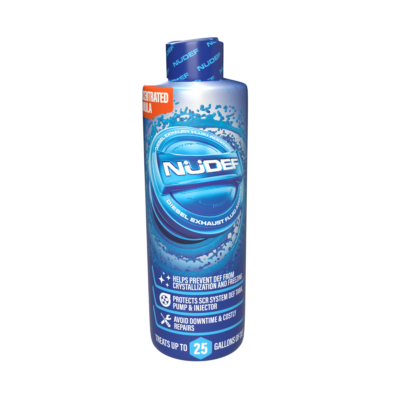
The prevention math is the better path. Crystal-deposit blockage at the catalyst face is the most preventable failure mode. NüDef DEF Treatment, Additive & Stabilizer is a DEF stabilizer and anti-scaling agent that helps prevent DEF crystallization and helps protect the SCR system, DEF tank, pump and injector. One 8.45 fl oz bottle treats 25 gallons of DEF, added at every refill.
Combine treatment with disciplined DEF supply chain hygiene (certified ISO 22241 DEF only, sealed packaging, periodic refractometer checks of bulk storage), clean fuel (sulfur-monitored ULSD from reputable supply), and oil consumption discipline (CK-4 or FA-4 oil at OEM service intervals, replace leaking turbos and worn rings early) to give the catalyst the best chance of reaching its full service life.
For aftermarket replacement catalysts: when replacement is required, the OEM-vs-aftermarket question is real. OEM catalysts (genuine factory parts) come with the OEM parts warranty. Aftermarket catalysts (Roadwarrior, Dinex, Lift Industries, Hug Engineering) usually cost less; confirm the part is legal for your vehicle (EPA, plus a CARB Executive Order in California) and check its warranty terms. Quality varies. Name-brand aftermarket catalysts perform well; off-brand or “no-name” catalysts pulled from import suppliers often fail prematurely. For fleets, a legal name-brand aftermarket catalyst is often a good value choice. For warranty trucks, OEM is required to preserve the OEM aftertreatment warranty.
Post-replacement verification. After installing a new or rebuilt SCR catalyst, run through this verification checklist:
- Scan-tool reset of SCR adaptations and DEF dosing learned values
- Drain old DEF from tank and refill with fresh ISO 22241-compliant DEF (residual contaminated DEF will damage the new catalyst within hours)
- Start truck and idle 15 minutes; verify no exhaust leaks at clamps and gaskets
- Road test under load until catalyst reaches operating temperature (~30 min highway drive)
- Read scan-tool catalyst efficiency monitor. It should read at or above the OEM threshold once the catalyst is up to temperature
- Verify no codes returning over a 500-mile drive cycle
- Start treating the DEF from the first fill on the new catalyst. NüDef helps prevent crystallization in the fluid, and a fresh SCR catalyst is easier to keep clean than one that has already accumulated deposits. Call (855) 300-0031 for fleet pricing or order Single bottles at nudef.com
For related coverage on DEF system protection and the components surrounding the SCR catalyst:
- DEF Pump Failure Symptoms and Replacement Cost
- DEF Injector Clogged: Symptoms and Cleaning
- The Cost of Untreated DEF
- P20EE Code Complete Diagnosis Guide
For fleet pricing on NüDef call (855) 300-0031 or email info@nudef.com. For individual purchase visit nudef.com.