Updated August 2026. Freeze-risk data: NOAA 1991–2020 climate normals.
The 12°F Answer, Precisely
DEF begins to freeze at 12°F (−11°C). That number is a property of the fluid itself: every certified brand, every container, every pump island, because all of it is the same ISO 22241 blend of 32.5% urea in purified water. There is no cold-weather formula of DEF and no brand that freezes later, whatever a label implies. Between about 12°F and full solidification the fluid passes through a slushy stage, and given sustained cold it freezes solid, white, and unglamorous, like a jug of milk left in the wrong place.
Two facts should immediately lower the stakes. First, freezing does not harm DEF. It expands roughly 7% as it freezes, which is why containers and tanks carry headspace, and when it thaws it returns to spec with its urea concentration intact. Second, every SCR-equipped vehicle is built for this: DEF tank and line heaters thaw the system in operation, and emissions rules explicitly accommodate frozen DEF at startup. The cold is a logistics problem for fluid you store, not a defect in the fluid you buy.
When Does DEF Freeze in My State?
Freeze risk is really a question of geography and calendar. We computed the answer for every state from NOAA’s 1991–2020 climate normals: the 30-year average of nightly low temperatures, by month, statewide. Pick a month; the map shows where average nights sit at or below DEF’s 12°F freeze point (high), where hard nights routinely reach it (moderate), and where freezing nights make cold snaps possible (low).
Method: tiers derived from NOAA Climate at a Glance statewide minimum-temperature normals, 1991–2020. State averages smooth real geography: mountain and northern zones run colder than their state tile, and a parked machine in a valley frost pocket does not care what the statewide average says.
All 50 States: Coldest-Month Normal Low and Freeze Window
| State | Coldest-Month Normal Low | Freeze-Risk Window | Peak Risk |
|---|---|---|---|
| Alabama | 34°F (Jan) | None typical | Minimal |
| Alaska | -2°F (Jan) | Oct–Apr | High |
| Arizona | 30°F (Dec) | Dec–Jan | Low |
| Arkansas | 30°F (Jan) | Jan–Jan | Low |
| California | 34°F (Dec) | None typical | Minimal |
| Colorado | 14°F (Jan) | Nov–Apr | Moderate |
| Connecticut | 18°F (Jan) | Dec–Mar | Moderate |
| Delaware | 26°F (Jan) | Dec–Feb | Low |
| Florida | 47°F (Jan) | None typical | Minimal |
| Georgia | 36°F (Jan) | None typical | Minimal |
| Hawaii | — | None typical | Minimal |
| Idaho | 17°F (Dec) | Nov–Apr | Moderate |
| Illinois | 19°F (Jan) | Dec–Mar | Moderate |
| Indiana | 20°F (Jan) | Dec–Mar | Moderate |
| Iowa | 11°F (Jan) | Nov–Mar | High |
| Kansas | 20°F (Jan) | Nov–Mar | Moderate |
| Kentucky | 25°F (Jan) | Dec–Feb | Low |
| Louisiana | 40°F (Jan) | None typical | Minimal |
| Maine | 6°F (Jan) | Nov–Apr | High |
| Maryland | 25°F (Jan) | Dec–Feb | Low |
| Massachusetts | 17°F (Jan) | Nov–Mar | Moderate |
| Michigan | 13°F (Jan) | Nov–Apr | Moderate |
| Minnesota | 1°F (Jan) | Nov–Apr | High |
| Mississippi | 35°F (Jan) | None typical | Minimal |
| Missouri | 22°F (Jan) | Dec–Feb | Moderate |
| Montana | 11°F (Jan) | Oct–Apr | High |
| Nebraska | 14°F (Jan) | Nov–Mar | Moderate |
| Nevada | 21°F (Dec) | Nov–Mar | Moderate |
| New Hampshire | 10°F (Jan) | Nov–Apr | High |
| New Jersey | 23°F (Jan) | Dec–Mar | Low |
| New Mexico | 22°F (Jan) | Nov–Mar | Moderate |
| New York | 13°F (Jan) | Nov–Mar | Moderate |
| North Carolina | 30°F (Jan) | Jan–Jan | Low |
| North Dakota | 1°F (Jan) | Oct–Apr | High |
| Ohio | 20°F (Jan) | Dec–Mar | Moderate |
| Oklahoma | 27°F (Jan) | Dec–Feb | Low |
| Oregon | 25°F (Dec) | Nov–Mar | Low |
| Pennsylvania | 18°F (Jan) | Nov–Mar | Moderate |
| Rhode Island | 21°F (Jan) | Dec–Mar | Moderate |
| South Carolina | 34°F (Jan) | None typical | Minimal |
| South Dakota | 8°F (Jan) | Nov–Apr | High |
| Tennessee | 28°F (Jan) | Dec–Feb | Low |
| Texas | 35°F (Jan) | None typical | Minimal |
| Utah | 18°F (Dec) | Nov–Mar | Moderate |
| Vermont | 8°F (Jan) | Nov–Apr | High |
| Virginia | 26°F (Jan) | Dec–Feb | Low |
| Washington | 26°F (Dec) | Nov–Mar | Low |
| West Virginia | 22°F (Jan) | Dec–Mar | Low |
| Wisconsin | 7°F (Jan) | Nov–Apr | High |
| Wyoming | 11°F (Jan) | Oct–Apr | High |
Read your row honestly. High means unprotected stored DEF will freeze solid and stay frozen; plan heated storage or indoor reserves. Moderate means overnight freezes are routine; jugs in trucks and unheated sheds will freeze some nights. Low means a normal winter mostly spares you but a cold snap will not: the Texas freeze of 2021 froze DEF across a state whose row says minimal, which is why reserves belong indoors everywhere. Minimal means storage risk is rare outside historic events.
Why Exactly 12°F: The Chemistry
The freeze point is a designed feature, and the design is elegant. Urea-water solutions freeze at different temperatures depending on concentration, and the curve has a bottom: a eutectic point, the single blend ratio that freezes lower than any other. For urea and water, that ratio is 32.5% urea, freezing at 12°F. The engineers who wrote the DEF standard chose 32.5% for exactly this reason, with a bonus that makes the system robust: at the eutectic ratio, the fluid freezes and thaws uniformly, so the urea does not separate from the water during freeze cycles. The concentration your SCR system needs survives the winter intact. More or less urea would freeze sooner; DEF sits at the bottom of the curve on purpose. Our what-is-DEF-made-of guide covers the full recipe.
What Actually Happens When DEF Freezes
Walk it through the freeze and back. As temperatures fall past 12°F, crystals form and the fluid slushes; sustained cold takes it solid. It expands about 7% on the way, the same physics as ice, which is why DEF tanks are never filled to the brim and jugs carry headspace. A properly stored, sealed container rides this out indefinitely. Thawed, the fluid returns to exactly its former self: same 32.5% concentration (thanks to the eutectic behavior above), same purity, same performance. Freeze-thaw cycling does not age DEF; heat does. The genuine risks are mechanical and avoidable: an overfilled rigid container can split, a partially frozen tank can mislead a gauge, and a frozen reserve jug is useless in the moment you need it, which is a planning failure rather than a chemistry one.
Driving with Frozen DEF: What Your Truck Already Handles
Cold-morning panic is unnecessary. Emissions regulations were written knowing DEF freezes, so every SCR vehicle follows the same choreography: you start and drive normally, even with a frozen DEF tank. The engine is not prevented from starting, no derate triggers for frozen fluid at startup, and dosing is simply not needed during the first minutes of operation while the aftertreatment comes up to temperature. Meanwhile coolant-loop or electric tank and line heaters thaw a working supply, typically within minutes of driving, and dosing resumes without you noticing. The system fails only when its hardware does: a dead tank heater in January mimics every frozen-DEF symptom and throws the codes to match, which is where our DEF heater replacement guide takes over. If codes persist long after the truck is warm, you have a heater or sensor problem wearing a weather costume.
Slush, Gelling, and Partly Frozen DEF
Between liquid and solid lives the slush stage, and it deserves its own mention because it behaves worst. Slushy DEF can still be drawn by some systems but flows poorly, meters unpredictably, and in storage containers it concentrates the mechanical stress of expansion. Drivers meet it topping off from a jug that rode in an unheated side box: the pour is a crystal smoothie and the fill takes forever. The rule for slush is patience: let the vehicle’s heaters finish the job in the tank, and let a storage jug thaw fully before pouring, both because it pours properly and because you want the melt fully remixed (it remixes itself; give it the chance). What you should never do to hurry any of this along is the next section.
How to Thaw Frozen DEF (and What Never to Do)
For containers and stored fluid: move it somewhere warm and wait. Room temperature thaws a 2.5-gallon jug in a day or so; a warm shop corner does drums over a few days. Gentle ambient heat is the entire technique.
The never list, each for good reason: never direct flame or high heat (heat guns, torches, stoves): localized heat degrades urea into compounds your catalyst will meet later, and plastic containers fail before the fluid thaws. Never microwave it. Never chip or drill a frozen container; you will hole it. Never add hot water to bring it back faster; you just diluted the concentration out of spec. And never pour anything into DEF to melt or prevent ice, which brings us to the question half the winter searches are really asking.
The “DEF Antifreeze” Question
Every winter, drivers search for DEF antifreeze, hoping for the diesel-fuel equivalent of an anti-gel pour. Here is the straight answer. Automotive antifreeze (glycol) must never touch DEF: even trace glycol contamination poisons SCR catalysts, and the repair is measured in thousands. There is also no additive of any kind that lowers DEF’s freeze point: 32.5% urea already sits at the bottom of the freeze curve, and anything you add can only move the fluid away from spec and trip the quality sensor. Any product promising to make DEF freeze-proof is chemically impossible or SCR-hostile, usually both.
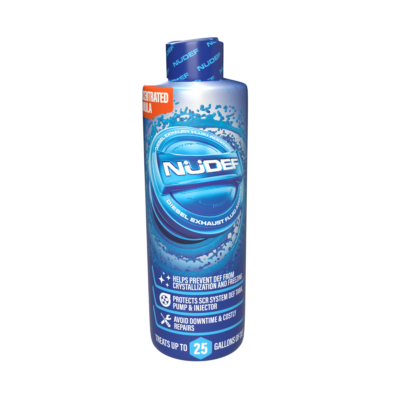
What legitimately exists is different: protecting the fluid’s condition through winter. Freeze-thaw cycles are harmless to concentration, but the storage life that surrounds them (temperature swings, time, sunlight on a side-box jug) is exactly what degrades stored DEF and seeds the crystallization that clogs injectors in spring. That is the job NüDef DEF Treatment & Stabilizer was built for: an ISO 22241-safe stabilizer formulated for cold-climate duty that keeps urea in solution through winter storage and stop-start winter operation. It does not change the freeze point, and neither does anything else; it makes sure what thaws in March is as good as what froze in December.
The Prevention Playbook
The complete how-to lives in our guide to keeping DEF from freezing; here is the executive version. Store reserves indoors, always, everywhere; the map’s minimal states get cold snaps too. Keep tanks properly filled but never topped off: headspace is your expansion insurance. Date and rotate side-box jugs so the emergency reserve is fresh as well as liquid. Verify heaters before the season: run the truck into dosing temperature on a cold morning in November, not January. For bulk storage, totes need heated space or tote heaters in moderate-tier states and above; our DEF heater guide covers the hardware. And stabilize what will sit: winter storage is long storage, and long storage is where DEF quietly goes bad.
The map tells you when freezing arrives; what it cannot show is fluid quality on the other side of the thaw. NüDef DEF Treatment & Stabilizer keeps urea in solution through winter storage and stop-start cold duty, so March fluid works like December fluid. One 8 oz bottle treats up to 25 gallons, and fleet quantities are available through the wholesale program.
Stored DEF and Equipment That Sits
The freeze conversation ends where the storage conversation begins, because winter’s real casualty is rarely the frozen jug; it is the fluid that spent five months in a parked machine. Seasonal equipment (RVs, ag machinery, boats, standby generators) winters over with DEF aboard, cycling through freezes and partial thaws in exactly the conditions that age fluid and crystallize dosing hardware. The playbook: enter winter with fresh, stabilized fluid rather than autumn’s leftovers, keep the tank at proper level for expansion, and start the season with a walkaround of the dosing system before the first hard run. Our RV guide, generator DEF guide, and storage and shelf-life guide each carry the machine-specific version.