
Updated November 2026. Lamp meanings and dash messages come from the makers’ driver cards and service bulletins and from EPA guidance, linked where used. Your owner’s manual has the final word on your truck.
DEF light on dash? A solid DEF warning light on its own means the DEF level is low: refill the tank with certified DEF, and schedule service if the lamp stays on after the refill. A flashing DEF warning light means the tank is critically low or empty and a speed limit is in effect or close, so refill now. When the DEF lamp shares the dash with Check Engine, the MIL or the red Stop Engine lamp, the problem is further along. A DEF warning light that stays on with a full tank points at the quality of the fluid or a fault on a reductant system circuit, so read the codes before you buy parts.
Jump to: every symbol at a glance · lamp combinations · warnings with a full tank · what to do now
A DEF warning light is the dash telling you the SCR system needs something: fluid, better fluid, or a repair. Most trucks use more than one symbol for it. There is the DEF lamp itself, a DEF level gauge or light bar on many trucks, and the shared engine lamps (Check Engine, the Malfunction Indicator Lamp and Stop Engine) that join in as the problem gets older. Which symbols are lit, and whether the DEF lamp is solid or flashing, tells you how much time you have before the truck limits its speed. This guide sorts the DEF warning light symbols by what they mean and what to do next, with the message wording GM, Ram, Detroit and Cummins use.
DEF Warning Light Symbols at a Glance
Find the combination on your dash in the left column, then read across.
| What you see | What it usually means | What to do | Where it comes from |
|---|---|---|---|
| DEF lamp on, solid, nothing else | DEF level is low | Refill with certified DEF. If the lamp stays on after the refill, schedule service. | Cummins driver tips card |
| Solid DEF lamp plus Check Engine lamp | Lower DEF level, incorrect DEF type, or an SCR system issue | Refill with the correct fluid as soon as possible; if the lamps stay on, schedule service right away. | Cummins driver tips card |
| Flashing DEF lamp plus Check Engine lamp | DEF level is critically low | Refill now. Expect a speed limit if you keep going. | Cummins driver tips card |
| Flashing DEF lamp plus Check Engine plus Stop Engine | DEF critically low and fuel was added without DEF, or the engine idled for an hour or was shut down | Refill DEF before driving on. Schedule service if the lamps stay on. | Cummins driver tips card |
| Amber low DEF icon (Detroit video gauge) | DEF below 1/8 of tank capacity | Refill at the next stop. | Detroit aftertreatment overview, 2019 |
| Flashing DEF icon plus MIL (Detroit) | Tank empty: speed limited to 55 mph and engine derated; if ignored, 5 mph | Refill. The 5 mph limit stays until DEF is detected in the tank. | Detroit aftertreatment overview; Detroit driver card |
| “Exhaust Fluid Quality Poor” with the DEF indicator (GM) | The engine computer sees a drop in SCR efficiency that suggests diluted or contaminated DEF | Test or replace the fluid and have the system checked. | GM bulletin 10-06-04-013B |
| “Service Exhaust Fluid System” with the DEF indicator (GM) | An abnormal value on a reductant system circuit | Read the codes and schedule service. | GM bulletin 10-06-04-013B |
The DEF Lamp Itself: Solid, Flashing and the Level Gauge
The DEF lamp is the symbol dedicated to diesel exhaust fluid, and it does two jobs. Solid, it is a heads-up. Flashing, it means the problem has reached the stage where a speed or power limit is in effect or close. Detroit’s 2019 aftertreatment overview spells this out for trucks with a video gauge: the low DEF level warning icon displays amber when the DEF level drops below one eighth of tank capacity, progressive warning messages follow on the dash display, and in the empty state the DEF icon flashes, the MIL icon displays, speed is limited to 55 mph and an engine derate is enabled. In the empty and ignored state the same icons show and the limit drops to 5 mph.
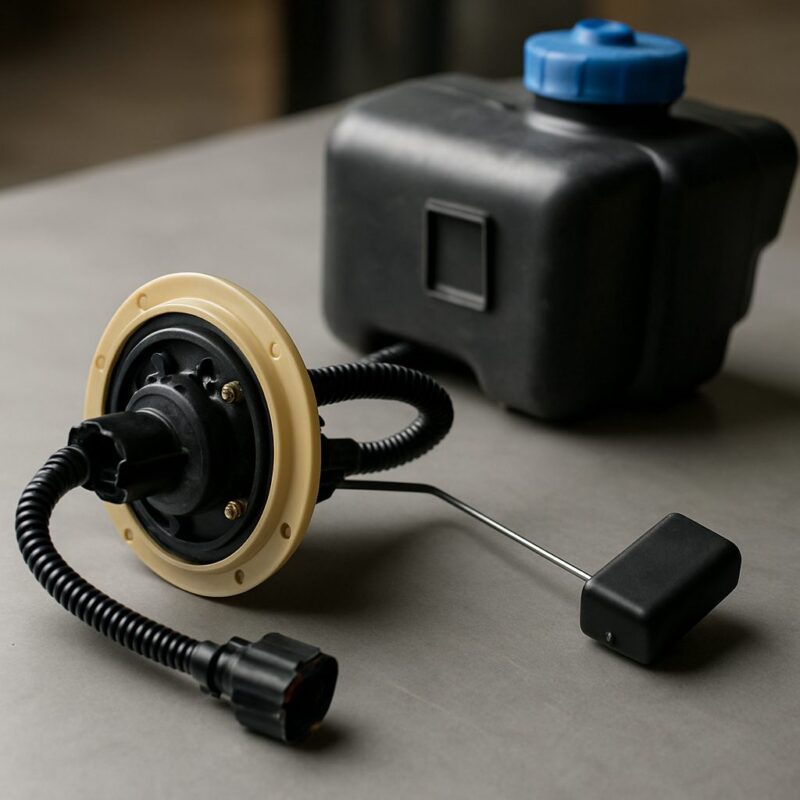
Many trucks pair the lamp with a level readout. On Detroit trucks with a physical gauge, a four-segment light bar shows the DEF level in 25 percent steps. A light bar that drops faster than you expect, or reads empty with fluid you can see in the tank, points at the level sender. Our DEF sensor guide covers how those senders fail and how to check one without guessing. The DEF light flashing guide goes deeper on the blink itself, truck by truck.
Cummins says the same about a solid DEF lamp: the level is low, refill with the correct fluid, and if the lamp stays on after the refill, schedule service. A lamp that stays lit after a real refill is no longer a fluid-level warning.
When the DEF Lamp Shares the Dash With Other Lamps
The DEF lamp rarely stays alone for long. As a problem goes unanswered, the general engine lamps come on beside it, and the combination is how you judge urgency.
- Check Engine Lamp (also called the Amber Warning Lamp). Cummins says it lights when the engine needs service at the first available opportunity. Detroit’s driver card says the truck can be driven to the end of the shift, then call for service.
- Malfunction Indicator Lamp (MIL). The on-board diagnostics lamp. It comes on when the system detects an emissions-related malfunction, and it can light along with any of the engine lamps. Detroit’s card says to call for service if the MIL is still on after three drive cycles, and warns that driving for a long time with it on can damage the engine and aftertreatment system.
- Stop Engine Lamp. Red. Cummins says the truck needs to be stopped as soon as it is safe to do so. With the DEF lamp flashing, it means fuel went in without DEF or the engine idled for an hour or was shut down while critically low.
The EPA puts the reason for all this plainly: trucks using DEF must have on-board diagnostics that monitor the SCR system, detect low DEF levels and system failures, and alert the driver with a warning light. The lamps are the legal warning. The speed limit that follows is the part that gets your attention.
GM Duramax: the Messages, Level by Level
GM’s service bulletin 10-06-04-013B, written for 2011 to 2015 Silverado and Sierra 2500 and 3500 HD trucks and Express and Savana vans with the 6.6L Duramax, is the clearest public map of how a pickup walks from a reminder to a crawl. The level warnings run from 1 to 9, and the dash wording changes as they climb:
- Range under 1,000 miles: “Exhaust Fluid Range X MI” on the Driver Information Center until you acknowledge it.
- Range under 400 miles: the same range message, now shown at the start of every ignition cycle.
- Range under about 75 miles: “Exhaust Fluid Low – Speed Limited Soon”.
- Range at zero: four chimes, “Exhaust Fluid Empty Refill Now” and “55 mph Max Speed upon Restart”.
- Next start: speed limited to 55 mph, and the DEF indicator in the instrument panel flashes continuously.
- Fuel added without DEF: “4 mph Max Speed at Next Fuel Fill” joins the messages; after a second fuel fill without DEF, the truck is held to 4 mph.
The bulletin also explains a cold-weather surprise. At 15°F or below, the “Exhaust Fluid Range” message can appear even after the tank was filled, because frozen fluid keeps the level sensor from reading and the computer falls back on an assumed level. GM calls this an operating characteristic of the system. Our guide on running out of DEF covers getting a limited truck moving again.
Ram 6.7 Cummins: What the Cluster Says
Chrysler’s service bulletin 25-005-14 covers 2013 and 2014 Ram 2500 and 3500 pickups and 2011 to 2014 Ram 3500 to 5500 chassis cabs with the 6.7L Cummins. The driver is notified when DEF drops below about 2.5 gallons. The first-level message reads “5 MPH Max Speed in XXXX mi DEF Low Refill Soon”, and the mileage counts down as you drive. Next comes “5 MPH Max Speed on Restart, Long Idle, or Refuel”, then “5 MPH Max Speed Refill DEF”, at which point the truck is held to 5 mph until the tank is refilled. The engine computer may also set P203F, reductant level too low. The same bulletin says at least 2.5 gallons must go in for the system to reset and clear the message, so a splash from a half-empty jug may leave the warning on.
Chrysler adds a second warning worth knowing: improper, diluted or contaminated DEF may lead to MIL illumination and reduced speed. A Ram with a full tank and a lit MIL is pointing at the fluid or the hardware, and the code tells you which. Our DEF trouble codes guide maps the common codes to the part involved.
Quality and System Warnings: When the Tank Is Full
A DEF warning light with a full tank comes from one of two places: the fluid failed a quality check, or the system found a fault in a part or circuit. GM’s bulletin shows how differently the two are worded on the dash.
Quality. GM judges SCR efficiency from the NOx sensors ahead of and behind the catalyst. When efficiency drops in a way that suggests diluted or contaminated DEF, the Driver Information Center shows “Exhaust Fluid Quality Poor”, “See Owner’s Manual Now” and “55 mph Max Speed on Restart”, and the DEF indicator lights. After about 500 more miles the chimes start; at the next ignition cycle the indicator flashes and speed is limited to 55 mph. After about 1,000 miles and a fuel fill, the limit drops to 4 mph. Old or overheated fluid is the usual suspect; our DEF quality poor guide walks through testing it.
System. “Service Exhaust Fluid System” with “See Owner’s Manual Now” means the computer saw an abnormal value on a reductant system circuit. It follows the same ladder: lit indicator first, a 55 mph limit on restart after about 500 miles, and a 4 mph limit if it is ignored long enough. The Service DEF System guide lists the causes cheapest first. A sensor or wiring fault needs a diagnosis and a part. Better fluid will not turn that light off.
Why Newer Trucks May Give You More Time
The lamps work the same way, but the clock behind them is changing. In August 2025 the EPA issued guidance IACD-2025-10 letting engine makers update SCR software to stretch out the speed and power limits that follow a confirmed DEF fault. The EPA fact sheet notes that under the older approach, a truck that ran out of DEF could be down to 5 mph within four hours. The guidance timings, counted from when the engine confirms a fault:
| Vehicle | First step | Second step | Final limit |
|---|---|---|---|
| Heavy-duty trucks and tractors | 650 miles or 10 hours: 15 percent torque derate | 4,200 miles or 80 hours: 30 percent torque derate | 8,400 miles or 160 hours: 25 mph |
| Heavy-duty pickups and light-duty vehicles | None | None | 4,200 miles or 80 hours: 45 mph |
| Motor coaches | 3,000 miles or 40 hours: 10 percent torque derate | None | 10,500 miles or 200 hours: 50 mph |
| Nonroad equipment | 36 hours: 25 percent torque derate | None | 100 hours: idle only, no restart, or 50 percent torque derate |
Two cautions. The guidance is voluntary for trucks already built, so your truck only gets the longer clock if its maker releases the software and it is installed. And for 2027 and later heavy-duty highway engines, the EPA says inducements fall under its 2022 rule instead. Ask your dealer whether an update exists for your engine. Until you know, treat a lit DEF lamp as the start of the countdown your manual describes.
What to Do When a DEF Warning Light Comes On
- Read the dash message as well as the lamp. “Range”, “Low” and “Empty” messages are about level. “Quality Poor” is about the fluid. “Service” is about a part or circuit.
- Check the tank with your own eyes. A flashlight at the filler neck settles whether the gauge is honest.
- Refill with certified DEF from a busy source. On a Ram, put in at least 2.5 gallons so the system resets.
- Drive it and give it time. GM says a truck may need about five minutes above 6 mph to release the warning level, and a limited truck must come to a full stop before the speed limit lifts.
- Still lit? Pull the codes. A level code, a quality code and a circuit code send you to three different fixes. Do not buy parts before you know which one you have.
Keeping the DEF Light Off
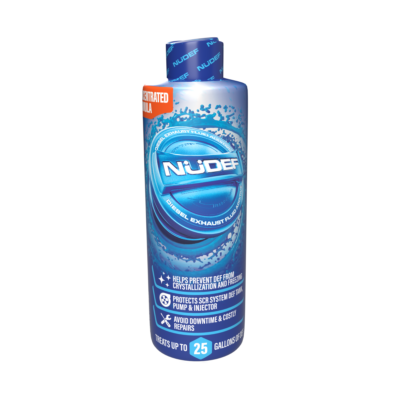
Most of the warnings in this guide trace back to the fluid: a tank allowed to run low, fluid that degraded in heat, or urea crystals that formed on the pump, the injector and the level sender until a part misread or stopped working. The routine that prevents them is plain. Keep the tank above a quarter, buy certified DEF from a busy pump or a fresh jug, and treat every fill with NüDef DEF Treatment, Additive & Stabilizer. Per its label, it helps prevent crystallization and freezing in treated fluid and helps protect the SCR tank, pump and injector, so you avoid downtime and costly repairs. The dose is one 8 oz bottle per 25-gallon fill, added at every refill, only to the DEF tank or a DEF container. Do not exceed the dose. Use it with ISO 22241 or API certified DEF. NüDef is a prevention product: it will not clear a code or repair a sensor, so a light that is already on still needs the steps above.
Order NüDef direct. Fleets and contractors buying for more than a few trucks can ask about case and bulk pricing through the NüDef wholesale program.