Updated October 2026. Code names come from the SAE J1939 digital annex as mirrored by the ISOBUS data dictionary, failure mode meanings from the J1939 FMI list, and every repair step from Detroit and International service documents linked below. Where no maker publishes a definition, this page says so.
What SPN 1761 and SPN 3031 Mean
Both codes come from the same sensor family inside the DEF tank. In the SAE J1939 digital annex, parameter group 65110, “Aftertreatment 1 Diesel Exhaust Fluid Tank 1 Information 1”, carries the tank data your engine and aftertreatment modules share. SPN 1761 is “Aftertreatment 1 Diesel Exhaust Fluid Tank Volume” and SPN 3031 is “Aftertreatment 1 Diesel Exhaust Fluid Tank Temperature 1”. The same group also holds SPN 3517 (tank level), SPN 3363 (tank heater), SPN 5245 (the low level indicator) and SPN 5246 (SCR operator inducement severity), which is why these codes so often show up in the same snapshot.
On most trucks one part reports both numbers. Detroit’s troubleshooting manual calls it the “DEF tank level/temperature sensor” and sends you to the header unit on the 13 and 23-gallon tanks to replace it. A level code and a temperature code at the same time usually point at that shared connector, the harness or the module before they point at two failed sensors.
The SPN says what is measured. The FMI (failure mode identifier) says what went wrong, and it decides whether you grab a jug of DEF, a multimeter or a test module. Our DEF trouble codes hub covers the light-duty P-codes that report the same faults on pickups.
SPN 1761 and SPN 3031 FMI Chart
The J1939 FMI list is the same for every SPN, but each engine maker decides which FMIs it uses and what words go with them. The chart puts the standard meaning beside what the makers’ own documents say for these two codes. A blank cell means none of the documents cited here lists that combination.
| FMI | J1939 meaning | On SPN 1761 (tank level) | On SPN 3031 (tank temperature) |
|---|---|---|---|
| 0 | Data valid but above normal range, most severe | Tank temperature too high (Daimler list) | |
| 1 | Data valid but below normal range, most severe | Level 0, empty, speed limited (Daimler list); DEFTL inducement 3 to 5 (International) | |
| 2 | Data erratic, intermittent or incorrect | Tank ratio diagnostic (Daimler list) | Temperature drift in range (Daimler list) |
| 3 | Voltage above normal or shorted to high source | Level sensor circuit failed high (Detroit) | Temperature sensor circuit failed high (Detroit) |
| 4 | Voltage below normal or shorted to low source | Level sensor circuit failed low (Detroit) | Temperature sensor circuit failed low (Detroit) |
| 9 | Abnormal update rate | Level signal not available (Daimler list) | Temperature signal not available via CAN (Daimler list) |
| 10 | Abnormal rate of change | Temperature sensor circuit range/performance (Daimler list) | |
| 13 | Out of calibration | Tank level curve not selected (Daimler list) | |
| 14 | Special instructions | Level 2, very low (Daimler list); volume below 5% or 2.5% (Deutz table) | |
| 17 | Data valid but below normal range, least severe | DEF level low (Daimler list) | |
| 18 | Data valid but below normal range, moderately severe | Level 1, empty (Daimler list) | |
| 19 | Received network data in error | Not defined by a maker in these documents | Tank temperature error over CAN (Daimler list) |
| 31 | Condition exists | Level 3, low (Daimler list) |
Sources: FMI meanings from the J1939 FMI enumeration; Daimler wording from the Daimler engine fault list published by Kato Works; Detroit from DDC-SVC-MAN-0191; International from service article IK0700067; Deutz from the JLG 1850SJ service and maintenance manual.
Notice how the level FMIs work on Daimler software. FMI 31, 14, 18 and 1 are four steps of the same falling tank: low, very low, empty, and empty with the speed limited. On those trucks an SPN 1761 code in the low-severity range is a fill-up reminder that the module logged, and the FMI climbs as the tank keeps dropping.
SPN 1761 FMI 19 and SPN 3031 FMI 4
SPN 1761 FMI 19 is a network fault. The J1939 definition of FMI 19 is that the value arrived over the data link as the error indicator instead of a real reading. The module that logged it did not measure the tank itself; another module sent it a bad or missing value. None of the maker documents cited here publishes its own wording for this pair, so treat it by the standard meaning: look for other FMI 19 or communication codes at the same time, check which module reads the tank sensor on your truck, and check that module’s power, ground and CAN connections before you pull the tank sensor.
SPN 3031 FMI 4 is a wiring or sensor fault. Detroit’s 2018 revision describes it as the Aftertreatment Control Module (ACM) detecting “a Short to Ground on the DEF Tank Temperature Sensor Circuit.” It lights the MIL and check engine lamp after two seconds. The engine reaction is a derate, and if the fault stays active more than five hours the engine is reduced to idle after an ignition cycle. The 2016 version of the same procedure listed a 25 percent derate with idle after four hours, so the timer depends on your software level.
Low DEF and SPN 1761: The Level Side
Most SPN 1761 codes are about fluid, and International’s service article spells out the order of warnings. Low DEF gives one beep and the low DEF warning light. As the DEF tank level (DEFTL) inducement level rises, the amber warning lamp, the red stop lamp or both come on with the DEF light. International’s advice: if the amber or red lamp came on without the DEF light showing first, check the fault codes before assuming the tank is just low.
The same article gives a clean field test. If several SPN 1761 faults with different FMIs are stored, they are most likely a low tank: check the level, and if it is below 10 percent, fill it with DEF. If SPN 1761 FMI 1 shows up alone with no other tank level codes, International found that air bubbles in the tank stand pipe can cause it, and the repair is to pull the DEF head unit and service the return tube. Clean the dirt, debris and snow off the head unit before you open it so none of it drops into the tank.
Deutz software on the JLG 1850SJ logs SPN 1761 FMI 14 when the tank volume falls below 5 percent and again below 2.5 percent, and the first step in both cases is to check the level and fill an empty tank. The level codes and SPN 5246 travel together because the inducement ladder runs off this reading. Our SPN 5246 guide walks through what the driver sees as the derate steps in, and the P203F guide covers the same low-level fault on pickups.
Detroit adds one rule that ties the two sides together: “When there is no signal from the DEF level/temperature sensor, the vehicle will go into the low DEF level derate.” A dead sensor looks like an empty tank to the module, so a full tank with a low-DEF derate is a wiring question first.
SPN 3031 in Winter: The Temperature Side
The tank temperature reading matters most when it gets cold. DEF at the standard 32.5 percent urea concentration has its lowest freezing point at 12°F (-11°C), according to International’s driver guidance, and Volvo Construction Equipment gives the same figure. International’s guidance adds that the SCR system provides heat to the DEF tank and supply lines and thaws the fluid automatically. The module needs a believable tank temperature to run that heat, which is why SPN 3031 faults and the heater codes in our SPN 3363 tank heater guide are worth reading side by side.
Volvo CE’s winter advice for machines that sit outside is simple: be careful about filling tanks completely during the cold months, leave space in the tank for machines parked outside overnight, and let frozen DEF thaw naturally, never with excessive heat or other additives. Our page on when DEF freezes covers storage temperatures and what the freeze point means for your area.
A temperature code in winter is still an electrical code until the meter says otherwise. Detroit’s FMI 3 and FMI 4 procedures for SPN 3031 check pins, voltage and resistance.
How Detroit Tests the Tank Sensor Circuit
Detroit’s DDC-SVC-MAN-0191 procedures for the GHG17 platform are a good model for any make, because they follow the order a tech should work in. In short:
- Connector first. Disconnect the DEF tank level/temperature sensor connector and look for bent, spread or corroded pins, damage or water. Repair what you find and recheck.
- Short to power. For FMI 3, key on, engine off, and measure voltage on the signal pin, harness side, to ground. Any voltage there is a short to power in the wire back to the ACM.
- Reference voltage. The procedure then measures the other sensor pin, harness side, to ground and expects 3.0 volts. No 3.0 volts sends you to the ACM connector and that wire.
- Wire checks. With the key off, each run from the sensor connector to its ACM pin should measure under five ohms. On FMI 4 for the temperature circuit, Detroit wants more than 10k ohms from the signal pin to ground; less than that means a short to ground in the harness.
- Test module. If the wiring checks out, Detroit installs a test ACM. If the code stays, replace the tank level/temperature sensor at the header unit. If the code goes away, replace the ACM.
Each procedure ends the same way: run the engine at idle for one minute and recheck for the code. On GHG17 trucks Detroit lists no engine reaction for SPN 1761 FMI 3 or FMI 4, while the older EPA10 and GHG14 procedure listed a 25 percent derate with idle after four hours. SPN 3031 FMI 3 and FMI 4 carry a derate on GHG17. Pin numbers differ by platform, so work from the wiring diagram for your truck. Cascadia owners can also check our Cascadia DEF guide, and the DEF sensor guide explains what else lives in the header unit.
Common Causes, Cheapest First
- Low tank. Several SPN 1761 FMIs at once, and the tank below 10 percent: fill it with certified DEF, as International’s article directs.
- Air in the stand pipe. SPN 1761 FMI 1 alone on an International: the return tube procedure in IK0700067.
- Connector damage or water. Detroit’s first step for both codes.
- Harness short or open. The voltage and resistance checks above. FMI 3 leans toward a short to power or an open circuit; FMI 4 toward a short to ground.
- Network fault. FMI 19 and FMI 9: data link, module power and grounds before the sensor.
- Failed sensor or module. Only after the wiring passes, and only after the test module says which one.
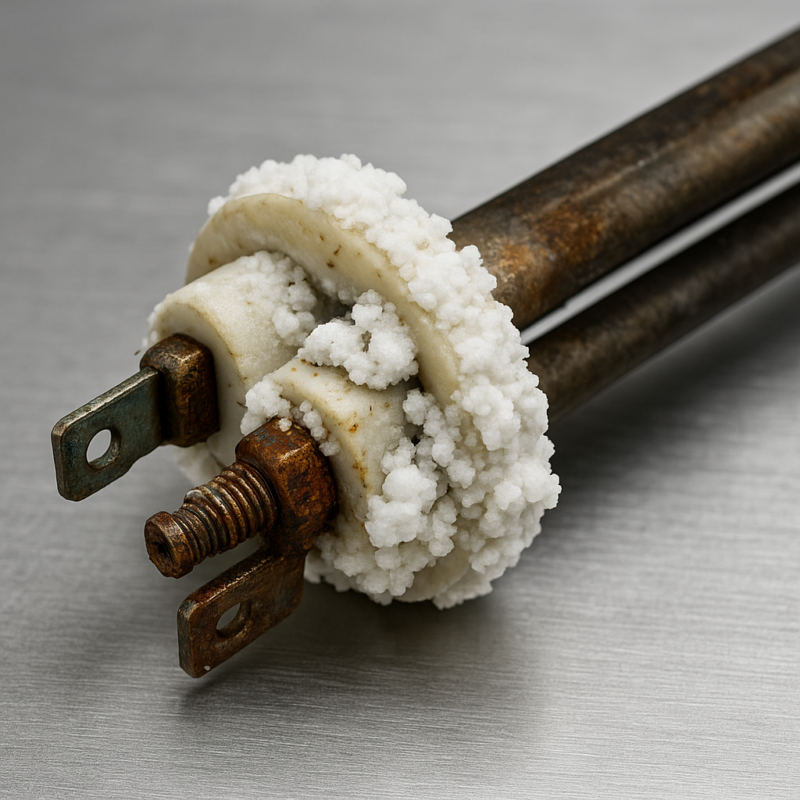
- Gauge wrong but no code. A DEF gauge not working on a truck that sat for a long time can be a level float stuck in crystallized DEF, a condition Western Star and Thomas Built Buses service bulletins describe. The DEF gauge and pump guide covers that check and how it differs from a failed pump.
Clearing the Code and What Stays Behind
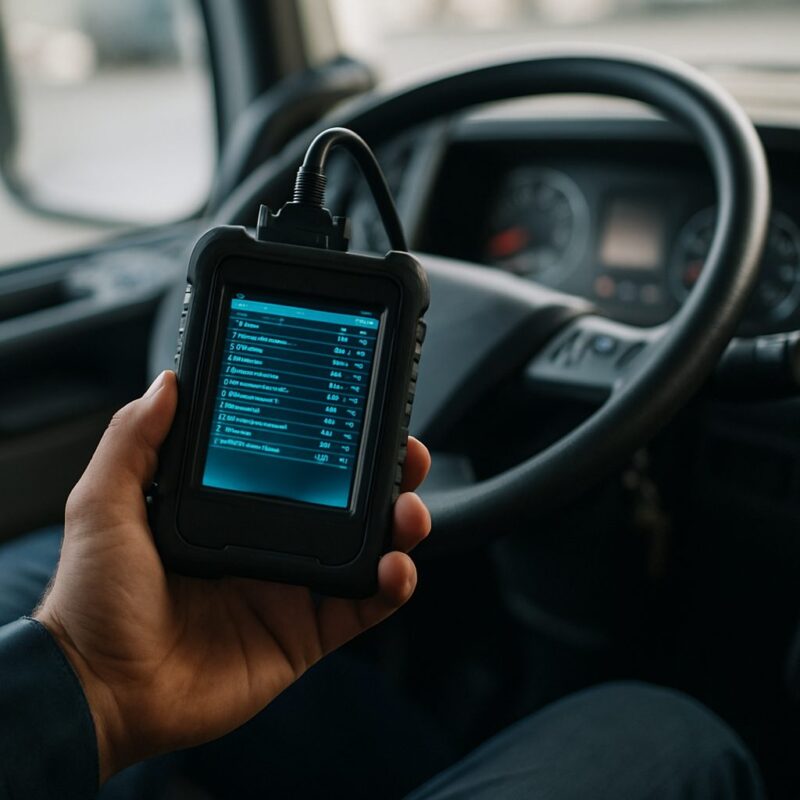
Filling the tank answers a true low-level code, but a circuit code needs the repair and a verification run. Every Detroit procedure above ends the same way: idle the engine for one minute and recheck with the scan tool. International’s stand pipe procedure ends with clearing the codes and topping off the coolant. If an SPN 3031 or SPN 1761 code comes back after you clear it, the fault is still there, so go back to the step where the test passed too easily.
Keeping the Tank Fluid in Shape with NüDef
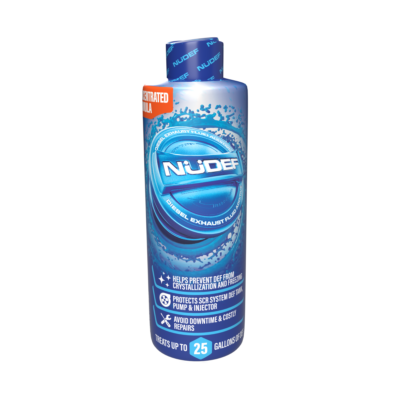
The NüDef product page puts the order plainly: scan first, fix the part, then treat the fluid. A sensor, harness or module fault gets the meter and the test steps above. NüDef works on the fluid those sensors sit in, and the product page describes it as a stabilizer that helps keep DEF from crystallizing in the tank, the jug and the lines. NüDef DEF Treatment, Additive & Stabilizer helps prevent crystallization and protects the SCR system’s DEF tank, pump and injector.
The dose comes from the label: one 8 oz bottle treats 25 gallons of DEF, add one 8 oz dose per 25 gallon fill at every refill and do not exceed the dose. Add it to ISO 22241 or API certified DEF. A 25-gallon semi tank takes the whole bottle. Fleets filling Class 8 tanks can buy the case of 30, and our wholesale program covers larger volumes. Order NüDef direct and add it at your next fill.