
What SPN 5246 Is and What FMI 15, 16 and 0 Mean
Heavy trucks report faults as SAE J1939 pairs. The SPN names the system and the FMI says what kind of fault it is. SPN 5246 is “Aftertreatment SCR Operator Inducement Severity.” It reports how far the truck has moved down its inducement schedule, the stepped warnings and derates the EPA requires when the SCR system is not working.
The FMI tells you the stage:
- FMI 15: data valid but above normal, least severe level. The truck has entered the first inducement stage. Expect a warning lamp and, on many engines, an initial power derate.
- FMI 16: above normal, moderately severe. The fault has stayed active long enough to reach the next stage, with a heavier derate.
- FMI 0: above normal, most severe. The final stage, usually a low vehicle speed limit until the fault is repaired.
The exact power and speed limits at each stage depend on the engine maker, the model year and the software. Your OEM service information has the final word. Our DEF trouble codes hub explains how SPN and FMI pairs work across the whole DEF system.
The Inducement Ladder: From Warning to Limp Speed
Every SCR-equipped truck sold in the US runs an inducement strategy. The goal is to make sure nobody drives for long with the NOx control system disabled. The ladder runs the same way on most engines: a DEF or emissions lamp first, then a torque derate, then a speed limit. SPN 5246 logs each step as it happens.
The rules changed recently. In August 2025 the EPA issued guidance that lets updated heavy-duty engines wait much longer before the harsh stages. Under that guidance an engine may wait until 650 miles or 10 hours after the fault for a 15 percent torque derate, and until 8,400 miles or 160 hours for a 25 mph limit. In July 2026 the EPA proposed replacing derates with warnings, but as of October 2026 that is a proposal, not a final rule. Our DEF requirements guide covers those rules in detail.
Engine makers are rolling those changes out through software. Daimler Truck North America began a 2026 update for many DD13 and DD15 trucks that raises the final inducement speed limit. Our Freightliner Cascadia DEF guide has the details. If your truck has not been to a dealer since early 2026, ask whether an update applies.
Older software can be much stricter. Do not assume a long grace period until you know which strategy your engine runs.
What Triggers It Besides an Empty Tank
An empty DEF tank is the best-known trigger. Our guide to running out of DEF covers that case. But plenty of trucks hit SPN 5246 with a full tank. Any fault the computer reads as an SCR system that cannot control NOx can start the ladder.
- Poor DEF quality. Diluted, old or contaminated fluid sets a quality fault, often SPN 3364 or a NOx exceedance code. See our DEF quality poor guide.
- Dosing faults. A dosing unit that cannot spray, often logged under SPN 3361, stops the reaction.
- Low DEF pressure. A clogged filter, weak supply module or crystal-restricted line sets SPN 4334.
- Heater faults. In cold weather, a tank or line heater that cannot thaw DEF stops dosing.
- Low SCR efficiency. SPN 4364 sets when the catalyst converts too little NOx, often because of fluid or dosing problems.
- Sensor and tampering faults. A failed NOx sensor, a disconnected component or an unplugged harness can all trigger inducement.
What the Driver Sees in the Cab
The driver rarely sees the code number. What shows up is a DEF lamp, a check engine or emissions lamp, and on many dashes a message with a countdown in miles or hours. A blinking DEF lamp on most heavy trucks means inducement has started. A message about reduced speed means the truck has moved past the first stage. Our DEF light flashing guide covers the lamp logic.
The right response at the first stage is simple. Note the message, check the DEF level and the cap, and call it in. Do not keep driving on the hope the light goes out. On older software the gap between the first warning and a low speed limit can be short, and a truck stuck at limp speed on an interstate is a safety problem as well as a cost.
Shops should ask the driver three questions before they plug in: when did the lamp come on, was the truck fueled or filled with DEF just before, and has the weather turned cold. Those answers often point straight at the cause: a bad fill, a missed fill, or a heater that quit.
Reading the Companion Codes
SPN 5246 is a consequence code. The cause is always another active fault. Pull every active and inactive code with a heavy-duty scan tool and sort them by what they point at.
- SPN 1761 (DEF tank level): low fluid or a level sensor reading wrong.
- SPN 3364 (DEF quality): fluid out of concentration, contaminated, or a sensor that cannot read it.
- SPN 3361 (DEF dosing unit): electrical or mechanical dosing faults.
- SPN 4334 (DEF doser absolute pressure): pressure too low or too high.
- SPN 4364 (SCR conversion efficiency): the catalyst is not converting enough NOx.
- NOx sensor SPNs: sensor or circuit faults that blind the system.
Fix the companion fault and the inducement has no reason to stay. Clear only SPN 5246 and leave the cause in place, and the ladder starts over. Our 18-wheeler DEF problems guide covers the Class 8 parts behind each of those codes.
Clearing It: What Resets and What Needs a Repair
SPN 5246 steps down once the truck confirms the underlying fault is gone. How that happens depends on the cause and the engine.
- Empty tank: on many engines, refilling with enough fresh DEF and running the engine lets the system confirm level and lift the inducement. Some need a key cycle.
- Bad fluid: drain, refill with fresh API-certified DEF, then let the quality monitor run. Many engines need a scan tool reset or a set drive cycle.
- Component faults: repair the part first. Then the OEM service tool often runs a dosing or system check before the inducement clears.
Keep a record of every inducement event: date, mileage, the companion codes and what fixed it. Repeat events on one truck usually trace to one root cause, such as a header that keeps reading wrong or a filter that keeps loading with crystals. Repeat events across a fleet often trace to the DEF supply.
Some severe-stage inducements can only be cleared at a dealer or with the OEM software. Plan for that before a load is on the line. Our guide to driving without DEF explains how far each stage lets you go, and our engine derate guide covers derates from other emissions systems.
A Fleet Playbook to Avoid It
- Treat DEF as a daily fluid. Top off at every fuel stop so a level fault never starts the clock.
- Control the source. Buy sealed, API-certified DEF or bulk with a certificate of analysis. Test each bulk delivery with a refractometer.
- Keep it clean. Dedicated nozzles and funnels, capped tanks, no shared containers.
- Change the DEF filter on schedule. A restricted filter is a common path to pressure and dosing faults.
- Read codes at every PM. Inactive SCR codes are early warnings.
- Train drivers on the lamp. A driver who reports the first DEF lamp saves a tow.
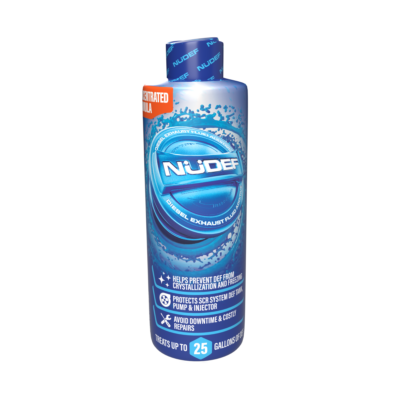
Treating the fluid fits into the same routine. NüDef DEF Treatment, Additive & Stabilizer helps prevent crystallization and freezing in the tank, and protects the SCR system DEF tank, pump and injector. That targets the crystal and fluid-related causes behind quality, pressure and dosing faults. It does not repair wiring, sensors or heaters.
A Class 8 tractor uses roughly 2 to 3 percent of its diesel volume in DEF, so a truck burning 15,000 gallons of diesel a year goes through about 300 to 450 gallons of DEF. At one 8 oz bottle per 25 gallons, that is 12 to 18 bottles. A case of 30 is $509.99, or $17.00 a bottle. Fleets can set up case pricing through our wholesale program, and our fleet DEF program guide covers treating a bulk tank at the island.
Winter: Why SPN 5246 Spikes After the First Freeze
DEF freezes at 12°F. Heavy trucks handle that with heated tanks and heated lines, and the system is designed to thaw enough fluid to dose shortly after startup. Frozen DEF does not damage a properly designed tank. The trouble starts when a heater circuit has failed over the summer and nobody knew. The first cold morning, the system cannot thaw fluid, dosing stops, and the inducement clock starts.
Check heater circuits at the fall PM, before the first freeze. Keep stored jugs and totes out of the cold where you can, and treat stored fluid so it is less likely to crystallize through freeze and thaw cycles. Order NüDef direct before the cold sets in.