DEF in One Sentence: The Honest Answer
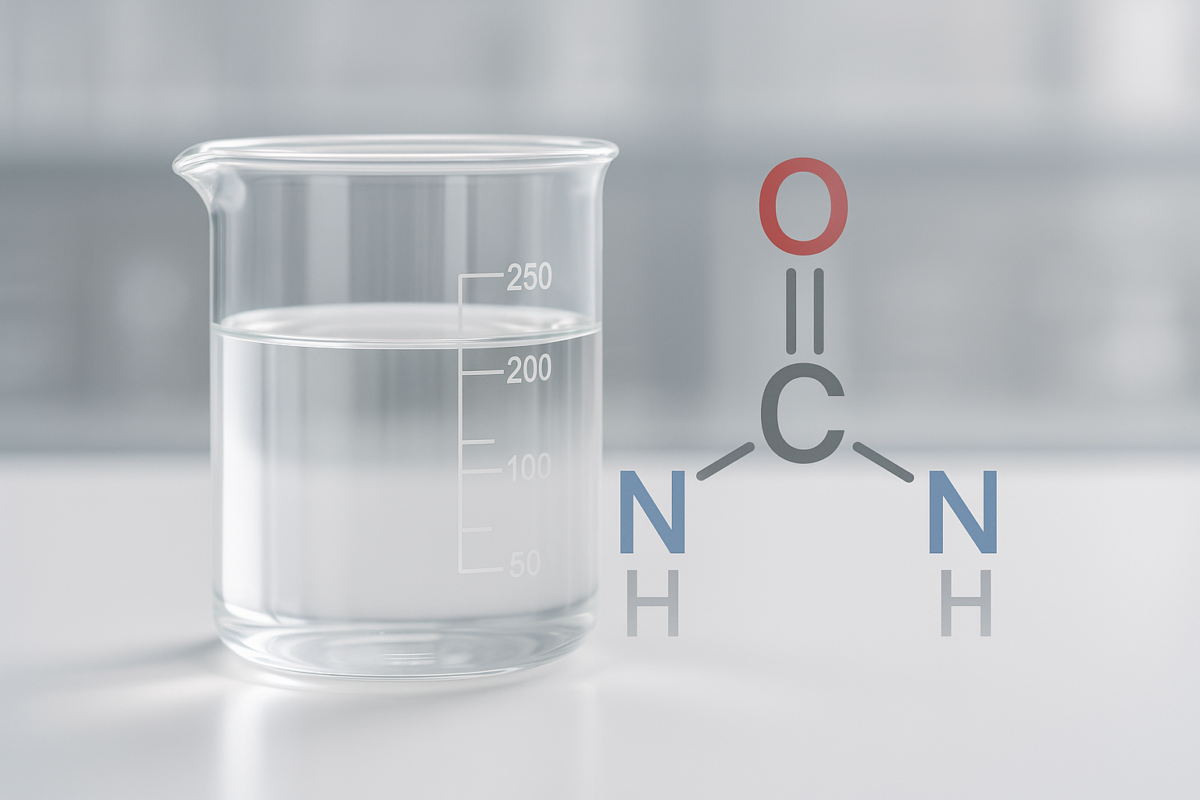
Diesel Exhaust Fluid (DEF) is a precisely specified aqueous solution of 32.5% high-purity urea and 67.5% deionized water. That’s the entire ingredient list. There is no proprietary chemistry, no solvent package, no additive cocktail, no surfactants, no biocides, no dyes — nothing else. Every container of DEF sold on the market — whether it’s pumped from a bulk tote at a truck stop, drawn from a 55-gallon drum at a fleet yard, or scanned out of a 2.5-gallon jug at a parts store — contains the same two ingredients in the same ratio.
What makes DEF a specified product rather than a commodity is the purity of those two ingredients and the precision of the ratio. The urea has to be a specific industrial grade (called AUS 32 in Europe, technical-grade urea in North America) with strict limits on metallic and ionic contamination. The water has to be deionized to laboratory-grade purity — purer than what you’d drink, with conductivity under 0.1 microsiemens per centimeter. And the ratio has to land in a tight window: 32.5% urea by mass, with no more than ±0.7% variation allowed by ISO 22241-1.
This precision exists for one reason: DEF is injected into a hot exhaust stream where it thermally decomposes into ammonia, which then reacts with NOx (nitrogen oxides) over a catalyst surface in the Selective Catalytic Reduction (SCR) system. The catalyst is exquisitely sensitive to ionic contamination — sodium, calcium, magnesium, iron, and aluminum at parts-per-million concentrations permanently deactivate catalyst sites. A single tank of off-spec or contaminated DEF can cause measurable, permanent damage to an SCR catalyst worth $3,000–$15,000 to replace.
Everything else about DEF chemistry — the manufacturing processes, the standards, the storage rules, the additive market — flows out of those two facts: it’s a two-ingredient product, and the ingredients have to be lab-grade pure. This article walks through the full picture: what’s in the bottle, where the ingredients come from, how the product is made, what the standards mean, and where stabilizer additives like NüDef fit alongside (not inside) the ISO 22241 specification.
The 32.5% / 67.5% Recipe — Why That Exact Ratio
The 32.5% urea / 67.5% water ratio isn’t an arbitrary marketing number — it’s the eutectic concentration for an aqueous urea solution. The eutectic is the specific concentration at which the solution has the lowest possible freezing point for any urea-water mix. At 32.5% urea by mass, DEF freezes at -11°C (12.2°F). Above or below 32.5%, the freezing point rises. That makes 32.5% the natural design point for a fluid that has to be storable, pumpable, and usable in a wide range of climates without separating during freeze-thaw cycles.
The eutectic concentration also matters for a second reason: when DEF freezes, both ingredients (urea and water) crystallize in the same proportions as the liquid. That means a frozen tank of DEF can be safely thawed and used — the concentration stays at 32.5% urea throughout the freeze-thaw cycle. If the concentration were off from the eutectic, freezing would separate the mixture into a urea-rich solid and a water-rich liquid, and the resulting fluid would no longer be on-spec.
The tolerance window. ISO 22241-1 specifies the urea concentration as 32.5% ± 0.7% by mass. That means a compliant DEF product can be anywhere from 31.8% urea to 33.2% urea — but no further. This tight tolerance is what separates “DEF” from “urea solution” as a category. A 28% urea solution and a 35% urea solution are both aqueous urea mixtures, but neither one is DEF. The SCR system is calibrated to dose DEF at exactly 32.5% urea concentration. Off-spec concentration causes the dosing math to drift, leading to either NOx slip (under-dose) or ammonia slip and crystallization (over-dose).
This is why the ISO 22241-2 test methods include a specific assay for urea concentration — refractive index measurement is the standard field test, with chemical titration as the lab confirmation method. Every batch of DEF from a certified producer is tested before it leaves the plant; reputable bulk DEF dispensers are tested periodically to confirm the dispensed fluid is still on-spec.
Why not just a stronger urea solution? Above ~40% urea by mass, the solution starts crystallizing at room temperature — the urea drops out of solution as solid crystals on tank walls, in lines, and in injectors. The 32.5% concentration is the sweet spot where urea stays fully in solution at temperatures from about -11°C to +30°C, where the SCR dosing math works out for current diesel emissions targets, and where the eutectic ensures freeze-thaw stability.
Urea: The Active Ingredient (Synthesis, Grade, Purity)
Urea is the chemical that does the actual work in DEF. Its formula is CO(NH2)2 (CAS number 57-13-6), and it’s a white crystalline solid at room temperature. Inside the SCR system, urea thermally decomposes at exhaust temperatures into ammonia (NH3) and isocyanic acid (HNCO), which further hydrolyzes to a second ammonia and CO2. The ammonia is what actually reduces NOx over the SCR catalyst. So when you put DEF into your tank, you’re really delivering a precise dose of ammonia precursor that gets unlocked in the exhaust stream.
Where urea comes from. Urea is one of the highest-volume industrial chemicals in the world — global production runs roughly 200 million metric tons per year, dominantly used as agricultural fertilizer. The synthesis is a two-step industrial process:
Step 1: Ammonia synthesis via the Haber-Bosch process. Atmospheric nitrogen (N2) is combined with hydrogen (H2) under high pressure (~150–200 bar) and high temperature (~400–500°C) over an iron catalyst, producing ammonia:
N2 + 3 H2 → 2 NH3
The hydrogen feedstock comes from steam reforming of natural gas (methane). This is why most ammonia plants are co-located with natural gas pipelines or at petrochemical complexes — natural gas is both the feedstock and the energy source for the process. The Haber-Bosch process is one of the most consequential industrial chemistries ever developed; it’s estimated to feed roughly half the world’s population through synthetic fertilizer.
Step 2: Urea synthesis via the Stamicarbon or Snamprogetti process. Ammonia from Step 1 is reacted with carbon dioxide (CO2 — typically recovered from the natural gas reforming step) under high pressure (~150 bar) and elevated temperature (~180–190°C):
2 NH3 + CO2 → NH2COONH4 (ammonium carbamate) → CO(NH2)2 + H2O
The reaction proceeds in two stages: first the ammonia and CO2 combine to form ammonium carbamate, then the carbamate dehydrates to urea. The reaction is reversible and incomplete in a single pass, so industrial urea plants recycle unreacted ammonia and carbamate back to the reactor. The two dominant licensed urea synthesis technologies are Stamicarbon (Dutch, accounting for roughly 60% of global capacity) and Snamprogetti (Italian, the second largest). Both produce chemically identical urea — the differences are in process efficiency, energy consumption, and capital cost.
After synthesis, the urea solution is concentrated and either prilled (sprayed from the top of a tall tower and solidified into small spheres on the way down) or granulated (built up into larger pellets via a fluidized bed process). Both forms are physically the same urea — the difference is particle size and dust characteristics for downstream handling.
Urea grades — why technical grade matters for DEF. Not all urea is suitable for DEF. The world produces urea in several distinct grades:
- Agricultural grade (fertilizer urea). The largest-volume grade, accounting for 90%+ of world urea production. Specifications are loose on metallic and ionic contamination because crops aren’t sensitive to ppm-level metal contamination. Agricultural urea typically contains biuret (a urea condensation byproduct), formaldehyde or other anti-caking agents, and significant levels of sodium, chloride, sulfate, and metallic contaminants. Agricultural urea cannot be used to make DEF — even diluted to 32.5% it would deposit catalyst-poisoning contaminants in the SCR.
- Technical grade urea (AUS 32 / DEF-grade). A specifically purified urea grade meeting tight limits on biuret (typically <0.3%), aldehydes (<5 ppm), alkalinity, insolubles, metals (Ca, Mg, Na, K, Fe, Al, Cu, Ni, Zn — each typically <0.5 ppm), phosphate (<0.5 ppm), and other contaminants. This is the grade required by ISO 22241-1 for DEF manufacture. In Europe it’s sometimes labeled AUS 32 (Aqueous Urea Solution 32%) or sold as “DEF-grade urea.” Producers run dedicated production lines or specifically purified batches for this grade.
- Pharmaceutical / USP grade urea. The highest-purity industrial grade, used in pharmaceutical and laboratory applications. Cleaner than technical grade but more expensive than necessary for DEF. Some premium DEF producers use USP-adjacent urea grades to give themselves headroom on the ISO 22241-1 contamination limits.
The price gap between agricultural urea and DEF-grade urea is significant — DEF-grade urea typically runs 30–60% more per ton than fertilizer urea, depending on contamination specs and market conditions. This is one reason DEF costs what it does at the retail pump: the urea feedstock alone is meaningfully more expensive than what a farmer pays for the chemically same molecule.
Deionized Water: Why Tap Water Will Destroy Your SCR
The other 67.5% of DEF is water — but not just any water. ISO 22241-1 specifies the water as deionized water meeting specific purity targets:
- Electrical conductivity: <5 µS/cm at 25°C (most reputable DEF producers run <0.1 µS/cm — far purer than the standard requires)
- Total chloride: <1 ppm
- Total calcium: <1 ppm (some producers spec <0.5 ppm)
- Total magnesium: <1 ppm
- Total sodium: <1 ppm
- Total iron: <0.5 ppm
- Total potassium: <0.5 ppm
- Phosphate: <0.5 ppm
- Insoluble matter: <20 mg/L (filterable solids)
For context: typical municipal tap water has 50–500 ppm total dissolved solids (about 1,000× to 10,000× the DEF water spec on most ions), conductivity in the range of 100–1,000 µS/cm, and chloride levels often in the 20–100 ppm range. Even “softened” water from a residential softener is far too contaminated for DEF — the softener swaps calcium and magnesium for sodium, which is itself a catalyst poison.
The water for DEF manufacture is produced by industrial purification trains that typically combine multiple stages:
- Pre-filtration to remove sediment and particulates
- Reverse osmosis (RO) to remove most dissolved ions and organics
- Electrodeionization (EDI) or mixed-bed ion exchange to polish the water down to laboratory-grade conductivity
- UV sterilization to control biological growth
- Final filtration (0.2 µm or finer) to catch any particulates from the polishing stages
The result is water purer than what you’d drink — closer to laboratory reagent water than to tap water. Some DEF producers specify “Type II” or “Type III” laboratory water grades (ASTM D1193) as their internal targets.
Why this matters at the SCR. Catalyst poisons aren’t a chemistry abstraction — they’re a measurable, accumulating problem. The SCR catalyst is typically a vanadium-tungsten-titanium (V-W-Ti) or copper-zeolite or iron-zeolite formulation deposited on a ceramic substrate. The catalyst sites are surface-bound molecular structures that depend on specific atomic geometry to function. When sodium, calcium, magnesium, iron, or aluminum ions in the DEF carry through to the catalyst (they don’t burn off in the exhaust — they deposit as oxides on the catalyst surface), they physically block catalyst sites or alter the local surface chemistry. The damage is permanent — the only fix is catalyst replacement.
Field experience with low-purity DEF (especially from informal or counterfeit sources) has shown that even one tank of contaminated DEF can produce measurable catalyst deactivation. The cumulative effect of repeated low-purity DEF use over years is severe — fleet operators who have used unverified DEF report progressively worsening NOx control, more frequent SCR fault codes, and shortened catalyst life relative to fleets using verified ISO 22241-compliant DEF.
This is why every DEF container that meets the spec carries an API certification mark in North America or an equivalent AdBlue/VDA-licensed mark in Europe — both signaling third-party verification that the product actually contains 32.5% on-spec urea and 67.5% on-spec water. If your DEF source doesn’t carry one of these marks, you have no chemistry assurance, and your SCR is at risk.
ISO 22241 Standards: What “Certified” Actually Means
ISO 22241 is the international standard family governing DEF. It’s published by the International Organization for Standardization (ISO) and is referenced by virtually every diesel engine manufacturer, emissions regulator, and DEF supplier worldwide. The standard is split into five parts, each governing a different stage of the DEF lifecycle:
| Standard | Covers | Who cares |
|---|---|---|
| ISO 22241-1 | Composition — the actual recipe (32.5% urea, 67.5% water) and contamination limits | Manufacturers, buyers checking spec |
| ISO 22241-2 | Test methods — how to measure urea concentration, identify contaminants, verify purity | QA labs, third-party testers |
| ISO 22241-3 | Handling, transportation, and storage — temperature, materials, contamination prevention | Distributors, fleet yards, end users |
| ISO 22241-4 | Refilling interface — the standardized fill nozzle/receiver dimensions that prevent diesel/DEF crossover | OEMs, pump manufacturers |
| ISO 22241-5 | Consumer container — the small bottles/jugs sold at retail, design and labeling | Retail packaging, container makers |
ISO 22241-1 — Composition. This is the foundational document. It specifies the urea concentration window (32.5% ± 0.7% by mass), maximum biuret content (typically <0.3%), allowed alkalinity, insolubles, refractive index range, density range, and the full list of metallic and ionic contamination limits. If a DEF product is “ISO 22241-1 compliant,” it has been tested and verified to land inside all of those limits.
ISO 22241-2 — Test methods. The standardized laboratory procedures for verifying composition. Refractive index measurement for urea concentration (the field-portable method), titrimetric urea assay (the lab confirmation), ion chromatography for the metallic and ionic contaminants, Karl Fischer titration for water content cross-check. Reputable DEF producers run a full ISO 22241-2 test panel on every production batch and retain documentation. The certification programs (API, AdBlue, VDA) audit this testing.
ISO 22241-3 — Handling. This is the standard that fleet operators most often need to engage with. It specifies acceptable storage temperatures (recommend <25°C / 77°F for long-term storage; urea hydrolyzes faster at elevated temperatures), acceptable container materials (HDPE, polypropylene, stainless steel; not copper, not zinc, not soldered brass — these contaminate DEF), shelf life expectations (typically 12 months when stored per standard), and contamination-prevention procedures. The dedicated DEF-only equipment requirement — separate funnels, separate hoses, separate pumps — comes from ISO 22241-3.
ISO 22241-4 — Refilling interface. The reason DEF nozzles are physically incompatible with diesel filler necks (and vice versa). The DEF filler neck has a smaller diameter than the diesel filler neck, and the DEF dispensing nozzle has a magnet on the outside that activates a flapper inside the DEF neck. These geometries are spelled out in ISO 22241-4 so that you can’t accidentally pump diesel into a DEF tank or DEF into a diesel tank.
ISO 22241-5 — Consumer container. The standard for the 1-gallon, 2.5-gallon, and similar retail packages. Specifies that the container, the closure, the spout, and the cap all be made from DEF-compatible materials. Specifies the certification labeling that the consumer can verify on the bottle.
When you see a DEF jug at a parts store with the API certification diamond on the label, what that mark means in practice: the producer has been audited by the API certification program, the product is verified compliant with ISO 22241-1, the production facility follows ISO 22241-3 handling procedures, and the consumer container meets ISO 22241-5. That’s the full chain of verification — composition through delivery — that gives the consumer confidence the fluid is on-spec.
From Factory to Tank: How DEF Is Manufactured
Walking through the full manufacturing path from raw materials to a sealed jug on a retail shelf:
Step 1: Natural gas feedstock. Methane from natural gas pipelines (or refinery off-gas) is delivered to an ammonia plant — typically a large petrochemical complex with shared utilities and CO2 supply.
Step 2: Hydrogen production. Natural gas is reformed with steam over a nickel catalyst at high temperature to produce hydrogen plus CO2. The CO2 is captured and routed to Step 4.
Step 3: Ammonia synthesis (Haber-Bosch). Hydrogen from Step 2 plus atmospheric nitrogen are reacted over an iron catalyst at high pressure to produce anhydrous ammonia (NH3).
Step 4: Urea synthesis (Stamicarbon or Snamprogetti). Ammonia from Step 3 plus CO2 from Step 2 are reacted at ~150 bar and ~180°C to produce a urea solution (typically 70–80% urea concentration coming off the synthesis loop).
Step 5: Urea purification. For DEF-grade urea production, the urea solution is processed through additional purification stages: biuret reduction (carefully controlled thermal processing to limit biuret formation), distillation or vacuum evaporation to concentrate the solution, and prilling or granulation to produce solid urea. For DEF-grade product, the producer typically tests each lot for biuret, aldehyde, metallic, and ionic contamination before releasing as “AUS 32 grade” or “technical-grade DEF urea.”
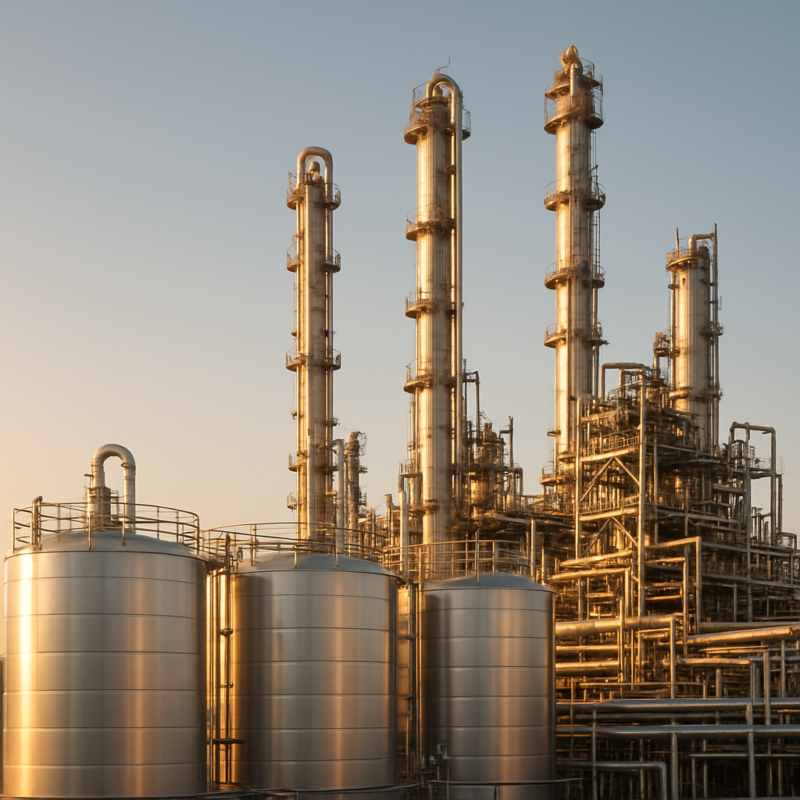
Step 6: Logistics to DEF blending plant. Solid urea (in prilled or granular form) is shipped to DEF blending facilities — often located near population centers and distribution hubs to reduce DEF freight costs. A DEF blending plant is a much smaller facility than an ammonia/urea complex — it doesn’t manufacture urea, it just dissolves DEF-grade urea into deionized water in precise ratios.
Step 7: Water purification at the blending plant. The blending plant has its own water purification train: source water (often municipal or well water) is run through pre-filtration, reverse osmosis, electrodeionization or mixed-bed ion exchange, UV sterilization, and final filtration. The output is deionized water meeting the ISO 22241-1 water specs.
Step 8: Blending. Solid urea is metered into agitated stainless steel blending tanks, deionized water is added in the correct proportion, and the mixture is agitated until the urea fully dissolves. Dissolution of urea in water is endothermic — the solution gets noticeably cooler during blending — so blending tanks often include temperature management. The fully blended DEF is held in a recirculation loop while QA samples are pulled.
Step 9: Quality assurance testing. Each blended batch is tested per ISO 22241-2: refractive index for urea concentration, ion chromatography for trace metals and anions, Karl Fischer for water, biuret assay, density, alkalinity. A batch only releases when all parameters are confirmed in-spec.
Step 10: Packaging. Released DEF is filled into containers — bulk totes (IBC containers, 275 or 330 gallons), drums (55 gallons), retail jugs (1 gallon, 2.5 gallon), or pumped directly into tanker trucks for bulk dispenser delivery. Filling equipment is dedicated to DEF service only to prevent cross-contamination. Containers are sealed, labeled with the ISO 22241-1 certification mark and lot number, and palletized for distribution.
Step 11: Distribution and bulk dispensing. Bulk DEF is delivered to truck stops, fleet yards, and dealer service departments via DEF-dedicated tanker trucks. Bulk dispensers (the pumps you see at truck stops) are designed per ISO 22241-3 with DEF-compatible materials and contamination controls. Smaller retail packages move through standard retail distribution into auto parts stores, big-box retailers, and farm supply outlets.
Step 12: End use. The driver or fleet maintenance tech fills the DEF tank on the vehicle. From there, the SCR system meters DEF into the exhaust stream at a dosing rate of about 2–4% of fuel consumption by volume, and the urea decomposes thermally into ammonia that reduces NOx over the catalyst.
The full chain — from natural gas in the pipeline to ammonia injection in the exhaust — touches a half-dozen industries, several thousand miles of logistics, and multiple ISO standards. The end product looks like clear water in a jug, but the production chain is one of the more intricate in industrial chemistry.
Why Purity Matters: Ionic Contamination & SCR Damage
The reason DEF has such tight purity specs comes down to what happens at the SCR catalyst surface. The catalyst is engineered to facilitate a specific reaction: ammonia plus NOx (NO and NO2) over the catalyst surface, producing N2 and H2O. The catalyst structure depends on:
- Active sites — specific atomic positions on the catalyst surface where the chemistry happens
- Site geometry — the spatial arrangement of active sites and supporting structures
- Acidity balance — the Brønsted and Lewis acid sites that participate in the reaction mechanism
When ionic contamination from off-spec DEF reaches the catalyst, several specific failure modes occur:
Sodium (Na) poisoning. Sodium ions deposit on the catalyst surface as Na2O or Na2SO4. Sodium specifically neutralizes the acid sites that participate in the SCR mechanism. Even 50–100 ppm sodium contamination in the catalyst washcoat measurably reduces catalyst activity. Sodium poisoning is irreversible — the only fix is catalyst replacement.
Calcium and magnesium (Ca, Mg) poisoning. Alkaline earth metals deposit as oxides on the catalyst surface and physically block active sites. The deposition pattern is generally non-uniform — the catalyst face takes the heaviest impact. Once deposited, calcium and magnesium oxides don’t volatilize at exhaust temperatures, so the damage accumulates over time.
Iron and aluminum (Fe, Al) poisoning. Transition metals from contaminated DEF can act as additional active sites in some catalyst chemistries, but the unintended catalysis is often the wrong reaction — they can promote SO2 → SO3 oxidation (producing sulfuric acid that further corrodes the system), or oxidize ammonia to N2O (a potent greenhouse gas) instead of reducing NOx.
Chloride (Cl-) corrosion. Chloride ions don’t poison the catalyst chemically, but they aggressively corrode the SCR injector, the stainless steel components of the exhaust system, and the catalyst substrate over time. Tap water chloride levels (20–100 ppm) accelerate corrosion enough to cause measurable component damage within 10,000–30,000 miles.
Phosphate poisoning. Phosphate ions form stable surface complexes with the catalyst active sites and permanently deactivate them. Phosphate contamination is one of the more aggressive poisons — even 1–2 ppm phosphate can produce measurable activity loss over time.
This is why the ISO 22241-1 limits are set at single-digit ppm or below for the major poisons. The catalyst is engineered to tolerate the trace contamination that’s unavoidable in even highly purified DEF — but it’s not engineered to tolerate the 10× to 1,000× higher levels that would result from using lower-grade urea or tap water in the manufacture.
The cost of contaminated DEF. When fleet customers have reached out asking about catalyst replacement costs, the numbers are sobering — light-duty pickup SCR catalysts run $1,500–$4,000 to replace, medium-duty truck catalysts run $3,000–$8,000, Class 8 heavy-duty catalysts run $5,000–$15,000, and industrial-scale catalysts (large standby generators, marine engines, locomotive applications) can run $25,000–$100,000+. Adding labor and downtime, a single SCR replacement event can easily cost more than 10 years of DEF purchases. That math is what makes the relatively small cost premium of verified ISO 22241 DEF over uncertified product such an obviously good deal.
Stabilizer Additives vs DEF Itself
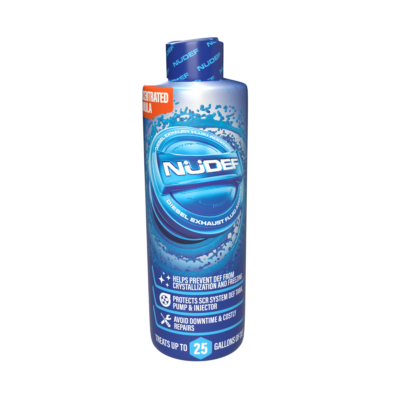
Here’s the part that often confuses readers: NüDef and similar products are not DEF. They’re additives for DEF. The two product categories live alongside each other and serve different purposes, and conflating them creates confusion in both directions.
What DEF is. DEF is the 32.5% urea / 67.5% deionized water solution defined by ISO 22241-1. It’s the ammonia-precursor consumable that the SCR system requires to function. Without DEF in the tank, the SCR can’t dose, NOx isn’t reduced, and the engine eventually derates or shuts down per the emissions compliance logic. DEF is mandatory.
What DEF stabilizer additives are. Stabilizer additives are separate products added to DEF (in the DEF tank or DEF storage) to address two specific problems that DEF itself doesn’t solve:
- Shelf life. DEF naturally degrades over time. Urea slowly hydrolyzes in solution back toward ammonia and CO2, especially at elevated temperatures. After ~12 months at room temperature (or as little as 6 months at warehouse summer temperatures), the urea concentration starts drifting below the ISO 22241-1 specification. Stabilizer chemistry slows this hydrolysis and extends usable shelf life.
- Crystallization. When DEF is dosed into hot exhaust, the urea decomposition isn’t always perfectly clean. Under certain operating conditions — low exhaust temperature, irregular dosing patterns, dirty mixers, off-design SCR geometry — urea can deposit as solid crystals on the SCR catalyst face, the mixer plate, or the dosing injector. These crystallization deposits trigger the well-known P20EE / P20EF / P207F fault codes and can mechanically damage the system. Stabilizer chemistry disrupts the crystal nucleation pathway and reduces the rate of deposit buildup.
Importantly: a stabilizer additive doesn’t change the fundamental DEF composition. Adding NüDef to your DEF tank doesn’t make the underlying DEF any less ISO 22241-1 compliant. The DEF is still 32.5% urea and 67.5% deionized water — the stabilizer is a small added volume of separate chemistry that addresses problems the base DEF can’t address on its own.
This is why NüDef is positioned as a supplemental product, not a DEF substitute. Operators still buy ISO 22241-certified DEF for their actual DEF tanks. NüDef is added on top of that DEF — to extend the shelf life of stored DEF, to reduce crystallization in the SCR, and to push out the failure curve on systems operating at the margin. For fleet operators with documented SCR fault code histories or large DEF inventories that need to last through a slow season, the addition of stabilizer chemistry on top of standard ISO 22241 DEF is the math that delivers fleet-scale ROI.
What NüDef is not. NüDef does not replace DEF. NüDef does not change the urea-water ratio of your DEF tank. NüDef does not modify your SCR catalyst chemistry. NüDef is not an emissions defeat device or a workaround for actual SCR system failure. If your SCR system is broken (failed injector, contaminated catalyst, harness fault), the right response is diagnosis and repair — not additive treatment. NüDef is preventive chemistry that reduces the rate at which SCR problems develop on functioning systems.
For the complete picture of how DEF interacts with the SCR system and where stabilizer additives fit in the operations lifecycle, see our how DEF works in SCR systems deep dive and our DEF shelf life and storage temperature reference. For fleet pricing on NüDef stabilizer chemistry call (855) 300-0031 or visit nudef.com.