Every article on this site eventually points at the same three letters. Codes trace back to SCR components, fluid problems end at the SCR catalyst, and the inducement ladder exists to keep SCR fed. This is the page that explains the system itself: what selective catalytic reduction actually is, how the chemistry works, what each component does, and why the whole architecture stands or falls on fluid quality. Consider it the map that makes every other guide here make sense.
SCR in One Paragraph
Selective catalytic reduction is an exhaust after-treatment system that removes nitrogen oxides (NOx) from diesel exhaust. It works by injecting a urea solution (diesel exhaust fluid) into the hot exhaust stream, where heat converts the urea into ammonia. The exhaust then passes through a catalyst brick, and on its surface the ammonia reacts with NOx to produce nitrogen and water vapor, the two most harmless gases in the sky. “Selective” is the elegant part: the chemistry targets NOx specifically while ignoring everything else in the exhaust. The system runs continuously, invisibly, and very effectively, removing up to 90 percent and more of NOx, for exactly as long as it receives clean fluid and healthy dosing. That conditional clause is where every SCR story on this site begins.
The Chemistry, Made Plain
Three steps, no chemistry degree required. First, decomposition: DEF sprayed into 400-plus-degree exhaust flashes its water off, and the urea decomposes into ammonia (NH₃) and CO₂. Second, mixing: a mixer element swirls the ammonia evenly through the exhaust, because the catalyst can only use what actually reaches it. Third, reduction: on the catalyst’s vast honeycomb surface, ammonia meets NO and NO₂ and rearranges them into N₂ and H₂O. The catalyst itself is a facilitator and is consumed by nothing; in principle it lasts the life of the vehicle. What shortens the story in practice is contamination: the reaction depends on precise fluid chemistry (the 32.5% ISO 22241 spec our what-DEF-is-made-of guide explains), and off-spec fluid attacks the process at every step: poor decomposition, deposit formation, and catalyst poisoning.
The Component Chain, Tank to Tailpipe
The table above maps the chain; here is the narrative version. Fluid lives in the DEF tank, whose header unit carries the level, quality, and temperature sensors plus the heater (the full anatomy is in our DEF tank guide). The dosing pump pressurizes fluid to the injector, which meters fine pulses into the exhaust ahead of the decomposition tube and mixer. The SCR catalyst does the actual NOx conversion, and NOx sensors upstream and downstream audit the result, feeding the engine controller the numbers that decide whether everything is working. When those numbers disagree with expectations, you meet the fault families: pressure codes at the pump, circuit codes at the injector, efficiency codes at the catalyst, and the whole taxonomy our trouble-code hub catalogs. Notice what every component shares: intimate contact with the fluid. The pump is lubricated by it, the injector meters it, the mixer wears its deposits, the catalyst breathes its vapors. One fluid, one chain, one quality standard.
SCR vs EGR vs DPF: The Aftertreatment Trio
Modern diesels carry three emissions technologies that owners routinely blur together. EGR (exhaust gas recirculation) routes some exhaust back into the intake to cool combustion and form less NOx in the first place; it lives on the engine side and trades some efficiency for its NOx reduction. DPF (diesel particulate filter) traps soot and burns it off in regeneration cycles; it handles particulates, a different pollutant entirely. SCR cleans up the NOx that remains, after combustion, in the exhaust. The three coexist because they attack different pollutants at different points, and SCR’s arrival actually relaxed the burden on EGR: engines could be tuned hotter and more efficient again, letting SCR mop up the extra NOx downstream. That is why the SCR era largely restored diesel fuel economy that early EGR-heavy designs had sacrificed, and why deleting SCR is engineering vandalism as well as a federal offense.
Why Diesel Needed SCR
Diesel’s efficiency comes from high compression and hot, lean combustion, and that same heat is a NOx factory. Through the 2000s, emissions limits tightened past what in-cylinder tricks could reach; the full regulatory story is in our DEF history guide, but the engineering summary is short. Manufacturers could strangle NOx in the cylinder and pay in fuel and reliability, or clean it downstream and let the engine breathe. SCR was the proven downstream answer, already scrubbing power-plant stacks for decades, and once the EPA’s 2010 limits arrived it became the industry standard. The bargain it struck holds today: diesel keeps its torque and economy, the air gets cleaner by an order of magnitude, and the owner takes on one new responsibility. Which brings us to you.
What SCR Demands From an Owner
The system asks three things. Keep fluid in the tank: run out and the inducement ladder (warnings, derate, crawl mode) enforces the refill, as our run-out guide details. Keep the fluid in spec: DEF is standardized at manufacture and degraded by heat, time, and contamination afterward; the sensors will eventually notice off-spec fluid, and the components will notice sooner. Fix faults promptly: SCR problems compound, because a starved pump damages itself, a clogged injector overworks the pump, and undissolved deposits migrate downstream toward the expensive brick. None of these demands is heavy. The owners who struggle with SCR are almost never the ones the system asks too much of; they are the ones running two-summers-old fluid from an open jug and treating the first warning as a suggestion. The economics are lopsided: everything the system asks costs tens of dollars, and everything it does when refused costs hundreds to thousands.
How SCR Systems Fail
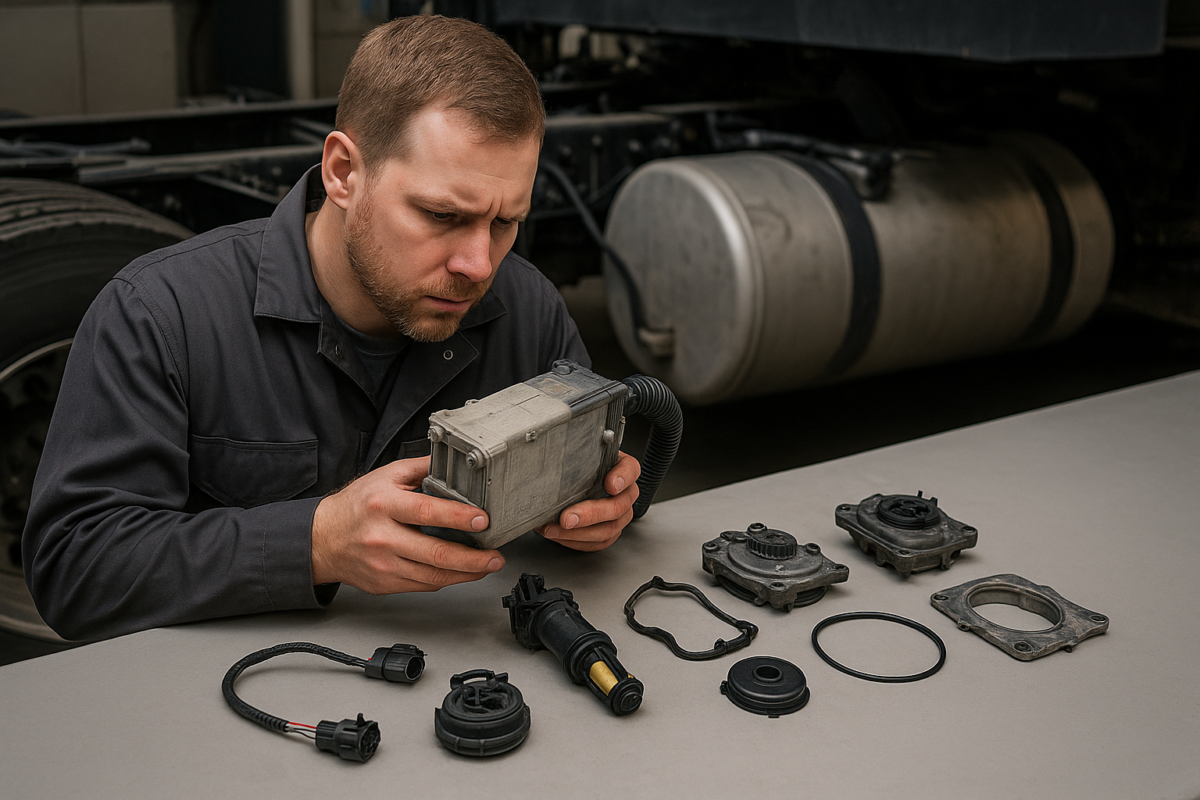
Read enough SCR failures and one pattern owns the genre: crystallization. Urea that dries where it should have dissolved leaves hard deposits, and every warm surface in the chain is a candidate: injector tips (P2048 territory), mixer elements, doser passages, the header at the tank bottom. The second family is component age: pumps and NOx sensors are wear items on a decade-old truck, our NOx sensor guide covers the sensor half, and the catalyst guide covers the expensive endgame. The third is fluid contamination: wrong fluid in the tank, off-spec DEF, or the slow chemistry of heat-aged fluid. The families overlap, because degraded fluid accelerates crystallization, crystallization loads components, and loaded components age faster. Pull the thread backward from almost any SCR repair bill and you arrive at the fluid. That is the honest engineering case behind everything this site publishes: maintain the fluid and the system built around it mostly maintains itself.
Where SCR Shows Up Beyond Trucks
The same system, scaled up and down, runs across the diesel world. Pickups and diesel cars carry compact versions. Tier 4 tractors, excavators, and generators carry industrial versions, which is why genset operators now manage DEF logistics alongside diesel. Locomotives, workboats, and ships run marine variants. And the original SCR installations still stand: power plants and industrial stacks have scrubbed NOx with urea since before any truck did. For owners of multiple diesel things (the farm with a truck, a tractor, and a standby generator) the practical upshot is a shared supply chain: one fluid standard, one storage discipline, and one stabilization strategy covering the whole yard. The failure modes travel too, which is why a fleet’s DEF-quality program pays across every engine it owns.
The Temperature Story
SCR has an operating window, and knowing it explains several behaviors owners find mysterious. The chemistry needs heat: dosing typically begins only once exhaust temperatures clear roughly 200°C, and conversion efficiency peaks in the fat middle of the range around 250–450°C. Cold starts therefore run un-dosed for the first minutes, which regulators accept and engineers attack with catalyst placement ever closer to the turbo. The owner-relevant consequences: a diesel that lives on five-minute trips spends much of its life below the dosing window, accumulating the light-load problems every mechanic recognizes, while highway duty keeps the system in its happy zone. Extreme heat has its own edge case: sustained exhaust temperatures at the top of the range accelerate deposit baking on injector tips, one more reason hard-worked trucks reward fluid discipline. None of this requires managing; it requires understanding, mostly so that short-trip diesels get the occasional long run the whole aftertreatment stack quietly needs.
Reading SCR Health From the Driver’s Seat
A healthy SCR system is silent, so health monitoring is mostly noticing trends. DEF consumption is the vital sign: it should hold steady around 2–3% of fuel burn for your duty. Consumption that drops toward zero suggests dosing has quietly stopped; consumption that spikes suggests over-dosing or a leak, and both deserve a scan before a warning forces the issue. Refill behavior is the second signal: a gauge that misbehaves or a countdown that jumps often means header-sensor fouling, the early symptom our tank guide flags. Fault history is the third: a truck that cleared the same pressure or efficiency code twice is not fixed, it is progressing, and the third event usually costs more than the first two combined. The habit worth building is trivial: note DEF purchases the way you note fuel, and any change in the rhythm gets a ten-minute scan-tool look. Owners who do this meet SCR problems at the cheap end, which is the entire game.
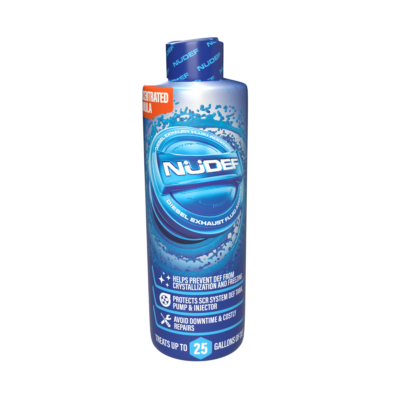
Everything upstream of the SCR catalyst runs on fluid condition, and that is where owners have real leverage. NüDef DEF Treatment & Stabilizer keeps urea in solution before it reaches the doser, protecting the injector, lines, and the catalyst itself from the crystal deposits that drive most SCR repair bills. One 8 oz bottle treats up to 25 gallons.
Living Happily With SCR
Fifteen years in, the verdict on SCR is quietly positive: it gave diesel a future under clean-air law while preserving what makes diesel worth owning. The ownership formula that keeps it invisible is four habits. Buy certified fluid fresh, from sources with turnover (the buying guide maps them). Store it cool, sealed, and briefly. Refill on a schedule instead of a countdown. And stabilize what sits, because heat and time degrade DEF in tanks and jugs alike, and degraded fluid is the upstream cause of most of the failure catalog above. That last habit is where NüDef lives: a stabilizer that holds the fluid in spec between fill-ups, protecting the pump, injector, and catalyst that all drink from the same tank. The system was engineered to be forgettable. Feed it properly and it returns the favor for the life of the truck.