Updated November 2026. Every limit and rule below comes from the ISO 22241 standard itself, the American Petroleum Institute’s DEF certification documents, an engine maker’s DEF storage paper, and the NüDef bottle label. Each one is linked where it is used.
Is All DEF Fluid the Same? The Short Answer
Every certified DEF starts as the same fluid. ISO 22241-1 defines diesel exhaust fluid as a solution of technically pure urea and pure water with a urea content of 32.5 percent by mass, and it sets one table of purity limits that every maker has to meet. A jug carrying the API Diesel Exhaust Fluid Certification Mark comes from a marketer licensed against that standard. So two certified jugs with different labels hold the same recipe when they leave the plant.
What can differ is everything that happens after the plant: how old the fluid is, how hot it got in storage, what it touched on the way to your tank, and whether it was certified in the first place. API’s own consumer guidance puts it plainly: “not all DEF meets these purity standards.” The brand name on the jug matters less than the mark, the date and the handling. The rest of this page covers what the standard guarantees, what the API mark adds, where real differences come from, and how to pick fluid that is still on spec when it reaches the pump on your truck. For named brands side by side, see the DEF brand comparison; for the whole system, the complete DEF guide.
What ISO 22241 Locks In
ISO 22241-1:2019 is the quality part of the standard. It names the fluid AUS 32 (aqueous urea solution), lists DEF as one of its names, and sets the limits below. The manufacturer has to monitor these properties continuously under a production control plan, and the standard names a referee test method for each one in case of a dispute.
| Property | ISO 22241-1 limit | Referee test method (ISO 22241-2:2019) |
|---|---|---|
| Urea content | 31.8 to 33.2% by mass (target 32.5%) | Annex B or Annex C |
| Refractive index at 20 °C | 1.3814 to 1.3843 | Annex C |
| Alkalinity as NH3 | 0.2% max | Annex D |
| Biuret | 0.3% max | Annex E |
| Aldehydes | 5 mg/kg max | Annex F |
| Insoluble matter | 20 mg/kg max | Annex G |
| Phosphate (PO4) | 0.5 mg/kg max | Annex H |
| Aluminium, calcium, iron, potassium, magnesium, sodium | 0.5 mg/kg max each | Annex I |
| Chromium, copper, nickel, zinc | 0.2 mg/kg max each | Annex I |
The definitions behind the table are strict. “Technically pure urea” in the standard means an industrial grade with only traces of biuret, ammonia and water, free of aldehydes, anticaking agents, sulphur, chloride and nitrate, and the standard says outright that this excludes the urea grades usually used in agriculture. “Pure water” means water very low in inorganic, organic or colloidal contaminants, produced by distillation, deionization, ultra-filtration or reverse osmosis. Most of those limits are set in milligrams per kilogram, which is parts per million, so small amounts of dirt or metal are enough to matter.
The same standard tells sellers how to label the product: pumps and containers for conforming fluid are to be marked with the designation, for example “DEF ISO 22241-1”. That line on a jug or a dispenser is the first thing to look for. For the rest of the rulebook, including what the EPA requires of the truck, the DEF requirements guide goes part by part.
What the API Certification Mark Adds
ISO writes the recipe. The API Diesel Exhaust Fluid Certification Program is how a buyer in the United States can tell which brands have shown they meet it. API describes it as a voluntary program that certifies and monitors DEF quality, and a marketer may display the mark only after showing its product meets the most recent edition of ISO 22241.
The program overview spells out what a license takes. The marketer submits a formulation for every supply source of the brand, typical physical and chemical properties backed by laboratory data, and a certificate of analysis no more than six months old from a lab that runs an ISO 9001 quality system and takes part in an industry round-robin testing program. Every container has to carry a traceability code that ties a sample back to its formulation, packaging date and source. Licenses run for one year, and renewal requires at least three batch test results spread across the previous year.
Then API checks the shelf. Under its aftermarket audit program, API attempts each year to sample licensed brands in the marketplace, and independent organizations collect the samples and run the analyses against the licensing data and the ISO limits. A brand that fails can lose the mark on one product or all of them, and can be required to pull noncomplying product from the market.
One line in that overview matters to anyone comparing labels: “The test data that support product claims are the responsibility of the individual marketer.” API certifies the fluid against ISO 22241. Any extra claim printed on a jug is the seller’s own statement.
Are There Different Types of DEF Fluid?
For a road vehicle, one. For a pickup, semi or RV with an SCR system, the fluid is AUS 32. The different names on the shelf are names for the same thing: the ISO standard lists AdBlue, ARLA 32 and DEF as trade names for AUS 32, and API’s guidance notes DEF is sometimes called AdBlue. Our AdBlue vs DEF guide covers the naming in detail.
There is a second fluid, and it is a different product. API also certifies Marine DEF, called AUS 40, a high-purity urea solution at 40 percent concentration made to the separate ISO 18611 standard for large combustion engines in marine, rail and other land-based uses. It carries its own API Marine DEF mark. ISO 22241 is the standard written for SCR systems in motor vehicles with diesel engines, so check the label and the mark before you buy unfamiliar fluid.
The last split is the one that matters most: certified fluid against fluid with no mark. API warns that low-quality DEF can lead to catalyst poisoning, DEF injector and filter clogging, and deposit formation, with costly repairs and downtime to follow. A jug that lacks both an ISO designation and an API mark gives you nothing to check it against.
What Still Differs: Age and Storage Heat
Two certified jugs can leave the plant identical and reach you very different, and heat is the main reason. ISO 22241-3, the handling and storage part of the standard, gives the minimum time DEF is expected to stay in spec at a constant storage temperature:
- At or below 10 °C (50 °F): 36 months
- At or below 25 °C (77 °F): 18 months
- At or below 30 °C (86 °F): 12 months
- At or below 35 °C (95 °F): 6 months
- Above 35 °C: significant loss of shelf life, so every batch should be checked before use
The standard says to avoid prolonged storage above 30 °C, and explains why: continuous storage that warm, for periods longer than six months, may push the fluid’s alkalinity past the ISO 22241-1 limit. It also says to avoid storage below minus 5 °C (23 °F), because frozen fluid takes up about 7 percent more volume and can burst a full, closed container. Fluid that froze and was warmed carefully, at no more than 30 °C, keeps its quality.
API’s consumer guidance puts the same idea in buyer terms. DEF can be expected to last at least 12 months, and storage where average temperatures run above 86 °F or in direct sunlight speeds up degradation. API tells drivers who buy jugs to look for the expiration date on the bottle. A jug that rode in a truck bed all summer is older, chemically, than its date says. The DEF shelf-life guide covers storage setups in more depth.
What Still Differs: Packaging, Handling and the Pump
Purity limits measured in parts per million are easy to break after the fluid leaves the plant. ISO 22241-3 lists the materials that belong in contact with DEF, including austenitic stainless steels, polyethylene and polypropylene free of harmful additives, and several fluoropolymers. It lists the ones that do not: carbon steel, zinc-coated steel, copper and copper alloys, zinc, lead, aluminium, magnesium, and nickel-coated parts. An engine maker’s DEF storage paper adds a field sign: DEF that touches a copper fitting quickly turns blue.
The standard also says any surface in contact with DEF must be free of fuel, oil, grease, detergent and dust, and that equipment shared with other fluids should get a last rinse with distilled or deionized water and then DEF, never tap water. It treats coloured or cloudy fluid, an unusual smell, a container with no label, or an expired shelf life as reasons to hold the product back until it is tested.
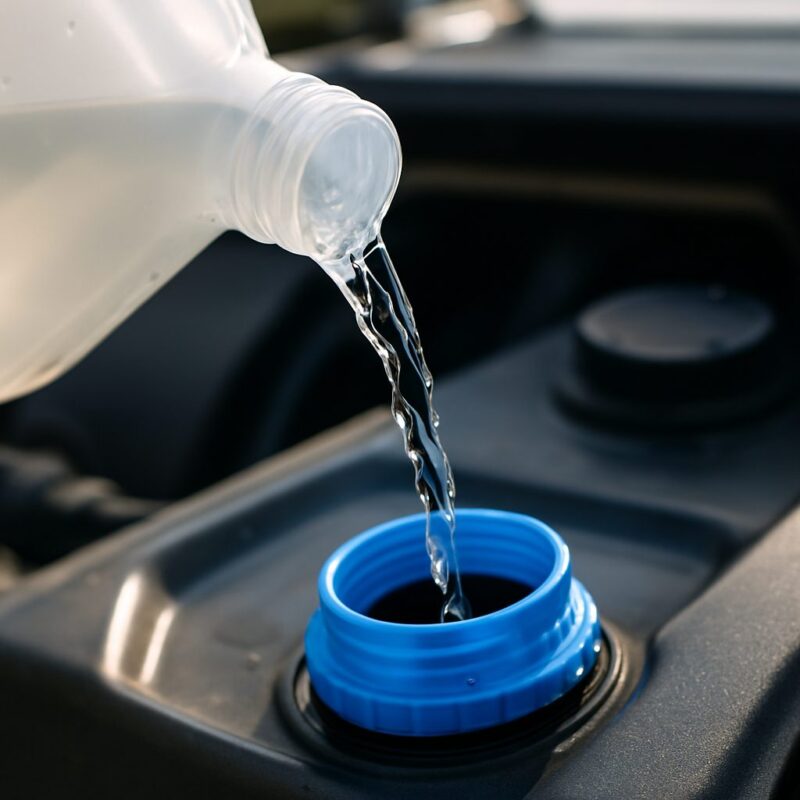
Pump DEF is the same fluid with a different path. API notes that many states require fill locations to share the manufacturer and brand of bulk DEF, so check your receipt, and recommends dedicated, properly cleaned tanks and dispensing gear because dirty DEF can clog injectors. The pump vs jugs guide compares the two fills, and the guide to mixing DEF brands answers whether two certified fluids can share a tank.
How to Choose DEF, Step by Step
- Look for the API mark. The overview requires it on the front of the container, at least 2.5 cm square. API’s licensee directory lists every licensed brand.
- Look for the ISO designation. “DEF ISO 22241-1” or “AUS 32 ISO 22241-1” on the jug or dispenser.
- Read the date. Pick the freshest jug on the shelf and plan to use it well inside the ISO window for your climate.
- Buy what you will use. Partly used jugs and bulk storage degrade fastest, and a half jug left through a hot season is exactly that.
- Look at it. ISO 22241-3 names coloured or cloudy fluid and an unusual smell as reasons to hold DEF back. Keep that fluid out of the tank.
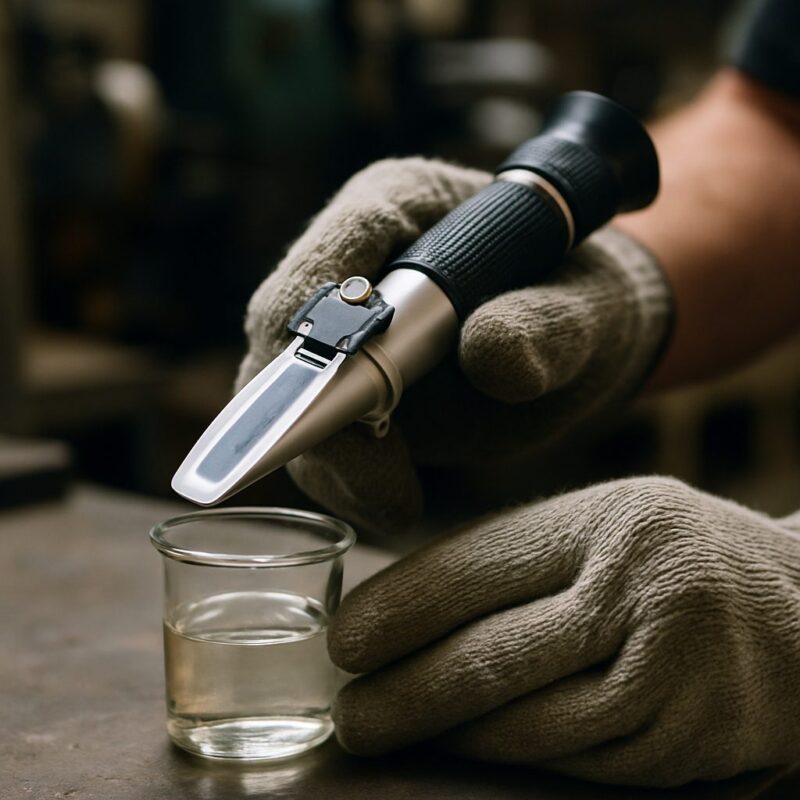
- Test it if in doubt. A refractometer reads urea concentration against the ISO range. The DEF testing guide covers the tools and the numbers.
- Keep the path clean. A dedicated funnel or nozzle, no shared containers, caps on tight.
Fleets that buy in bulk add one more step: ask for the certificate of analysis and keep receiving checks on every delivery. The bulk DEF guide covers totes and pumps, and fleets that want NüDef at volume can apply through the wholesale program.
Keeping Good DEF Good: Where NüDef Fits
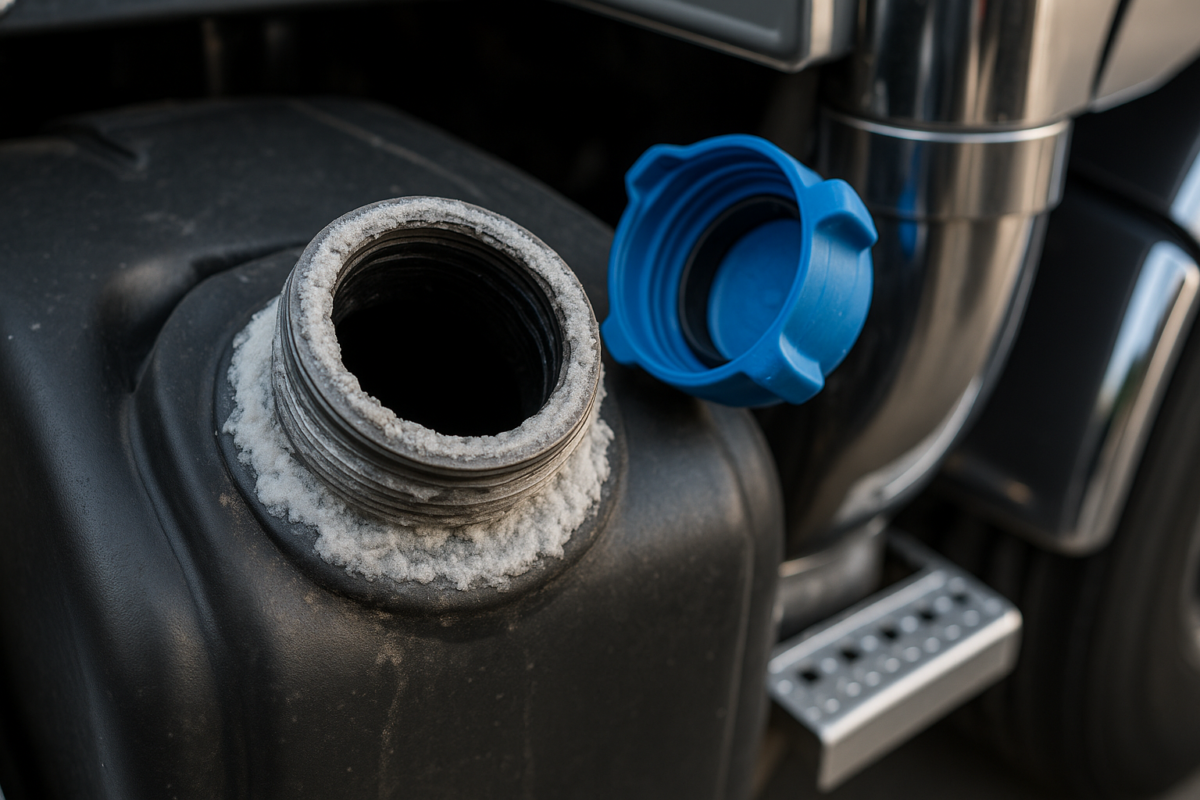
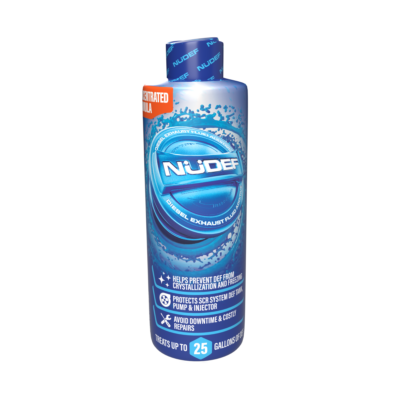
Certification describes the fluid on the day it was tested. After that, DEF sits in jugs, totes and the vehicle’s own tank, and over time it can crystallize in the tank, lines, pump and injector. Heat speeds that up, and sitting time lets urea come out of solution. That is the condition NüDef DEF Treatment, Additive & Stabilizer is made for. The label says it helps prevent DEF crystallization and protects the SCR system, DEF tank, pump and injector, to help avoid downtime and costly repairs.
The dosing comes straight from the label: one 8 oz bottle treats 25 gallons of DEF. Add one 8 oz dose per 25 gallon fill at every refill, add it only to the DEF tank or a DEF container, and do not exceed the dose. Use it in DEF of any brand that carries the API mark or meets ISO 22241. It goes into that fluid and never replaces it. It cannot bring off-spec fluid back into spec, so start with a certified, in-date jug and treat that. Order NüDef direct, and see the DEF crystallization guide for where the deposits come from.