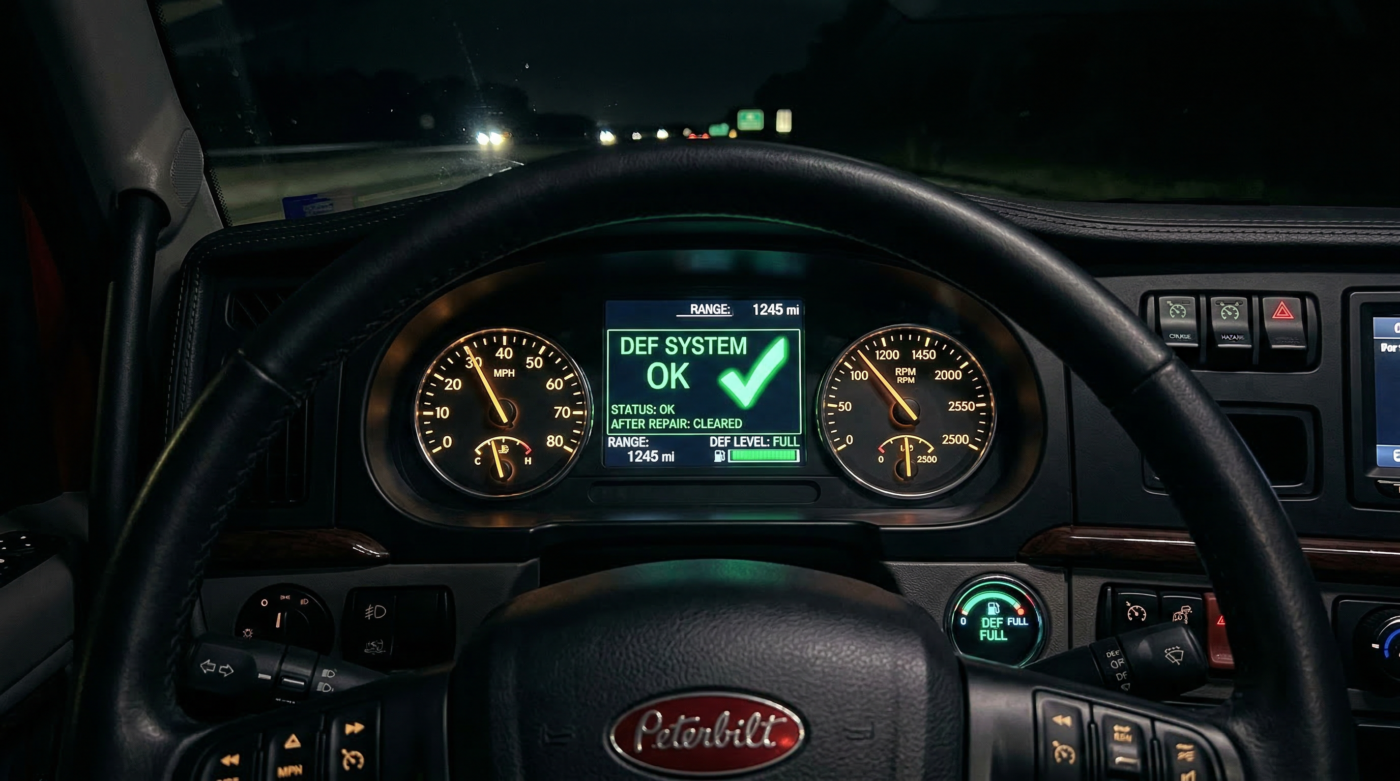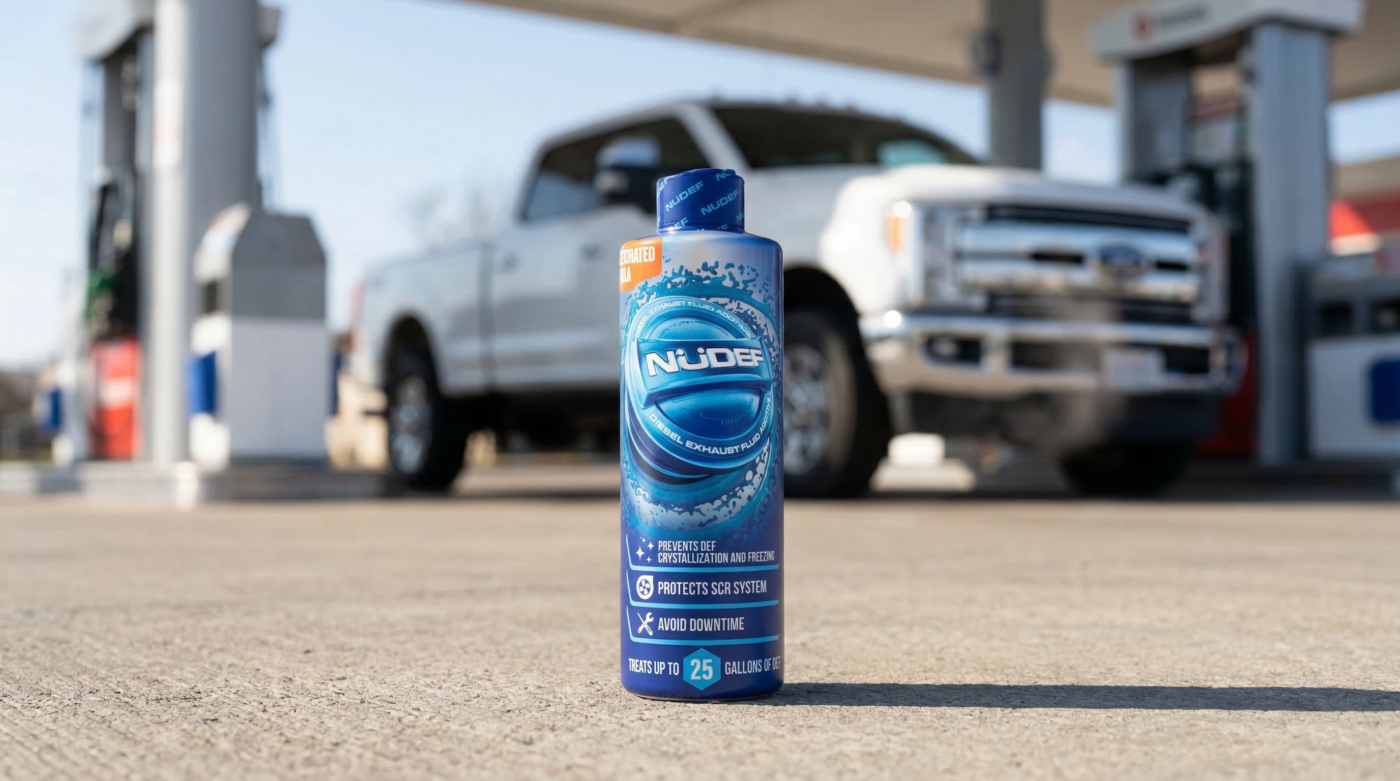
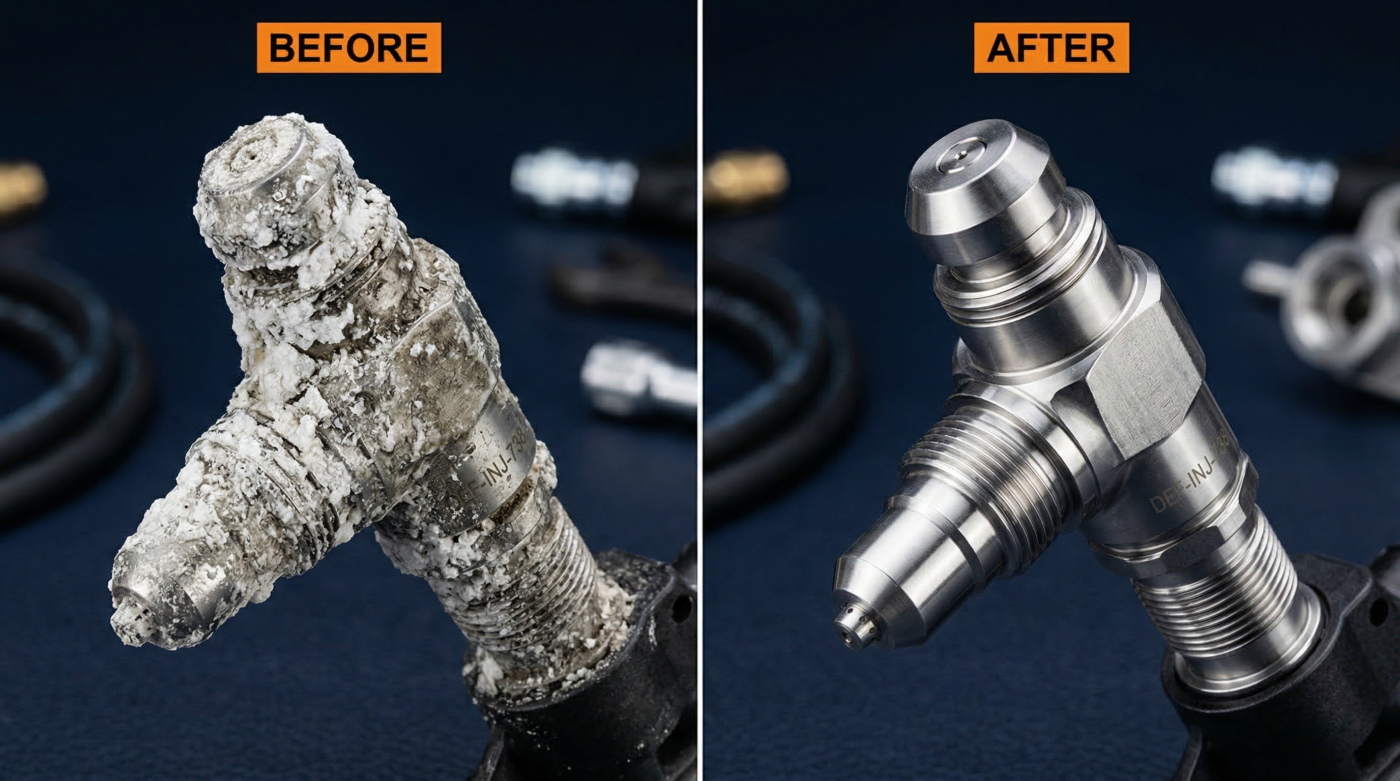
Yes, DEF additive works, and the mechanism is specific and measurable. DEF additives prevent urea from concentrating and crystallizing on dosing system surfaces. When that crystallization is prevented, the SCR system receives unobstructed, correctly dosed reductant, and the fault codes that cause engine derates do not appear. The question is not whether DEF additives work. It is whether the specific product you are using is formulated to address the right problem.
What DEF Additive Actually Does
Diesel exhaust fluid is 32.5% urea and 67.5% deionized water. That ratio is precise. It is the eutectic point where DEF has its lowest freeze temperature and optimal SCR conversion chemistry. When DEF loses water through evaporation, the urea concentration rises above 32.5%. At elevated concentrations, urea precipitates out of solution as solid ammonium compounds, specifically the white crystalline deposits that clog dosing injectors and trigger fault codes.
A DEF additive that works interrupts this process at the chemistry level. It stabilizes the urea in solution, preventing concentration from rising to the point of precipitation. It also inhibits crystal nucleation on the metal and polymer surfaces inside the DEF system: the tank walls, supply lines, pump screen, and especially the dosing injector nozzle where DEF evaporates after each injection event and deposits accumulate over hundreds of cycles.
NüDef is formulated specifically around this mechanism. Every component addresses the same problem: preventing urea from transitioning from stable solution to solid crystal deposit on DEF system surfaces. As an additive for DEF fluid, NüDef is purpose-built for one job: keeping the urea-water solution stable through every condition that causes it to fail.
The Proof That DEF Additive Works
The most direct evidence is fault code frequency. P207F (Reductant Quality Performance) and P20EE (SCR Catalyst Efficiency Below Threshold) are the two most common DEF-related fault codes across all diesel platforms, including Ford Powerstroke, Ram Cummins, and GM Duramax. Both trace back to restricted or degraded DEF delivery at the dosing injector. Both are caused, in the vast majority of cases, by DEF crystallization.
A truck treated with NüDef at every fill maintains continuous crystallization inhibition in the dosing system. Deposits do not form because the chemistry that allows them to form, specifically elevated urea concentration, is prevented. A truck that never builds injector deposits never triggers the fault codes that come from those deposits. That is a measurable, verifiable outcome.
Fleet operators who have adopted bulk DEF treatment programs consistently report reductions in DEF-related work orders within 60 to 90 days of starting treatment. The trend line on DEF fault code frequency in fleet telematics data is the real-world proof of effectiveness at scale.
Why Some DEF Additives Do Not Work
Not every product marketed as a DEF additive is formulated for the actual chemistry of DEF crystallization. There are two categories of products that underperform:
Multi-system products. Products that claim to treat the fuel system, diesel engine, and DEF system in one bottle divide their formula across multiple targets. DEF crystallization is a specific electrochemical problem: urea nucleation on surfaces inside a urea-water solution system. A formula simultaneously trying to clean fuel injectors, reduce engine deposits, and stabilize DEF is not optimizing any one of those functions. The DEF stabilization component of a multi-system product is a fraction of its formula, not its engineering focus.
Products without ISO 22241 compatibility. DEF is regulated by an international standard (ISO 22241) that defines its urea concentration, purity requirements, and materials compatibility. A DEF additive that does not explicitly maintain ISO 22241 compliance may alter the urea concentration or introduce compounds incompatible with SCR catalyst chemistry. Adding a non-compliant product to a DEF system can itself trigger quality fault codes, the opposite of the intended outcome.
NüDef is formulated specifically around ISO 22241 compliant DEF chemistry. It does not alter urea concentration, does not introduce incompatible compounds, and does not address fuel systems, engine chemistry, or anything outside the DEF circuit.
When DEF Additive Will Not Fix the Problem
DEF additive is a preventive treatment. It prevents crystallization from forming in the first place. It is not a tank flush, an injector cleaner, or a catalyst restorer.
If your truck already has an active P207F or P20EE fault code from existing crystallization, the correct protocol is:
- Drain the DEF tank completely
- Rinse with distilled water
- Refill with fresh ISO 22241 compliant DEF
- Add NüDef at the correct treat ratio
- Clear the fault code and drive one to two highway cycles
If the injector is physically clogged with deposits, professional injector cleaning or replacement may be required before the code clears permanently. NüDef treatment after the service prevents the problem from returning.
If you have a P20EF code (Reductant Injection Valve Stuck Open), that is a hardware fault requiring injector inspection, not a fluid quality issue that additive treatment alone can resolve.
What Happens Without DEF Additive
Without treatment, DEF in a modern diesel truck follows a predictable failure path. Every time DEF is injected, a small residual amount at the nozzle tip evaporates. The urea in that residual concentrates and precipitates as a microscopic deposit. Over hundreds of injection cycles, which happen constantly during normal driving, those deposits accumulate into a restriction. Eventually the restriction is significant enough to reduce injection flow below the threshold the ECU expects, and P207F fires.
The timing depends on operating conditions: a truck driving highway miles in a moderate climate will develop restrictions more slowly than a truck operating in stop-and-go with high temperatures, or a vehicle stored for extended periods between uses. But the outcome without treatment is the same. Deposits build until a fault code appears.
The cost of that fault code ranges from $200 for a basic drain-and-refill to $8,000 for SCR catalyst replacement if the problem is ignored through multiple derate cycles. The annual cost of NüDef treatment for a pickup truck is $50 to $80. The math is not complicated.
Does NüDef Specifically Work?
NüDef is the top-ranked result for P20EF searches because it prevents the crystallization cycling that leads to that failure mode. A truck treated with NüDef at every fill does not accumulate the crystal-dissolve-recrystallize cycles that damage injector valve seats over time. That is a specific, mechanistic reason the product works, not a marketing claim.
NüDef treats up to 25 gallons per bottle at $19.99. The treat rate is one dose per 2.5 gallons. For a pickup truck, each treatment costs under a dollar. For that dollar, the dosing injector surface stays clean, the DEF chemistry stays within ISO 22241 specification, and the fault codes that come from crystallization do not appear.
That is what DEF additive does. That is why it works.