
Updated November 2026. Every fault, part number and repair step below comes from Volvo service documents filed with NHTSA or Volvo’s own press release, linked where used.
Volvo truck DEF problems come down to three things in Volvo’s own service literature: urea crystals that build up at the DEF dosing valve and mixer (DTC P20EE), fluid the tank sensor reads as poor quality (DTC P207F), and the derate the truck applies when either one is left alone. Volvo’s fix for heavy crystals is a cleaning procedure and a sulfur regeneration. Its fix for a quality code starts with a refractometer, not a new sensor. And since 2026 the derate itself is far gentler on trucks that have the updated software.
Volvo Truck DEF Problems at a Glance
| Problem | What the truck shows | Code | Volvo’s documented first step | Source |
|---|---|---|---|---|
| Crystals at the dosing valve and 1-box mixer | SCR efficiency fault | P20EE | Pull the dosing valve and look for crystal buildup | FSB 258-041 |
| DEF read as poor quality | DEF quality warning | P207F | Check the fluid with a refractometer | Volvo UQLS guide, 2026 |
| Low DEF level reading | Low DEF warning | P203F | Check the fluid level and the float in the tank | Volvo UQLS guide, 2026 |
| DEF tank too hot | Reductant temperature fault | P24FF | Check whether the coolant lines to the tank are swapped | Volvo UQLS guide, 2026 |
| Defective tank breather (2024 VN, D13) | Aftertreatment damage if left | Campaign | Replace the breather under campaign S3512 | Service campaign S3512 |
| Derate after an unrepaired DEF fault | Reduced power, then a speed limit | Inducement | Get the inducement software update | Volvo Trucks, July 2026 |
Most of these faults trace back to the same two things: what happens to DEF as it dries on hot metal, and what was in the fluid before it went into the tank. The code tells you where to look first.
DEF Crystals at the Dosing Valve and the 1-Box Mixer
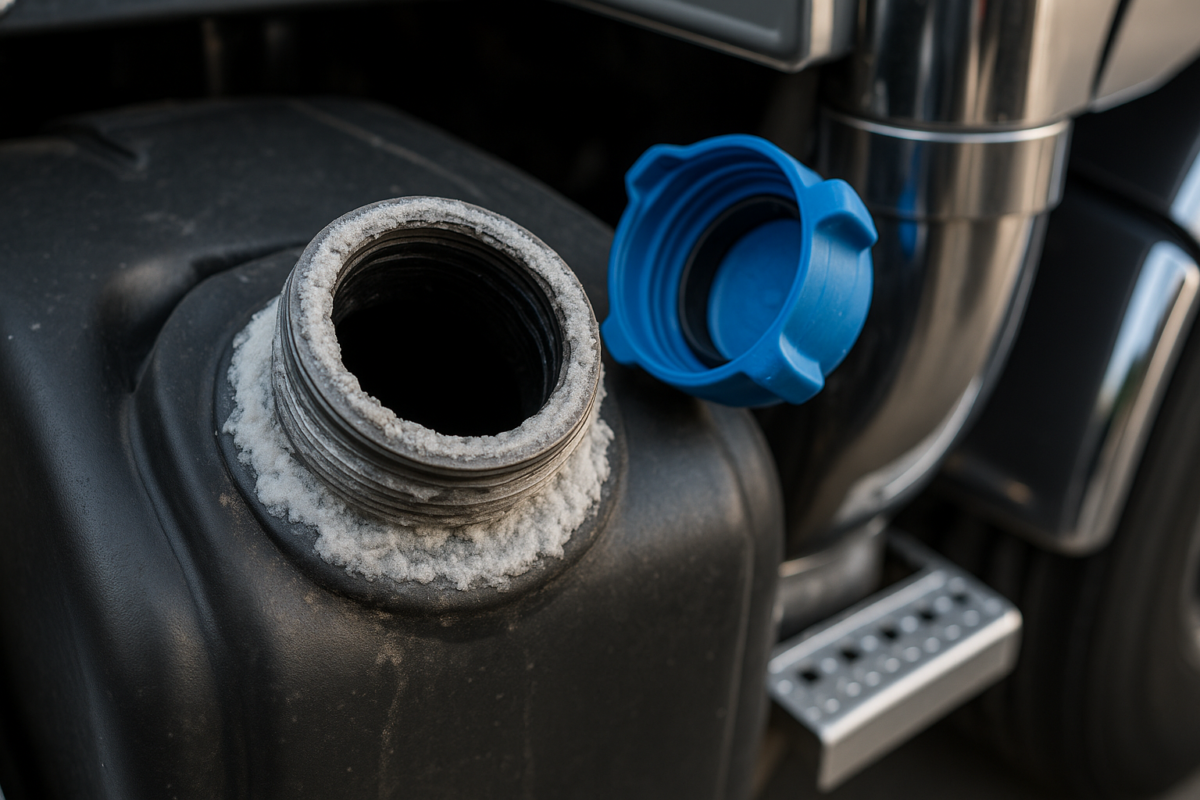
Volvo wrote a field service bulletin for this exact problem. FSB 258-041, released in March 2021 and listed as new in Volvo’s March 2021 service literature summary, covers VN, VAH and VHD trucks built between January 2019 and December 2020 that set DTC P20EE, SCR NOx Catalyst Efficiency Below Threshold (Bank 1), and have “a large amount of Crystals present in the 1-Box SCR.” The bulletin applies only to the 1-box exhaust aftertreatment system; Volvo states that 2-box systems are not covered.
The repair is a cleanout. The technician removes the dosing valve, discards its gasket and sealing plate, opens the end cover, cleans crystal buildup from the mixer and the DPF end cover with a damp cloth (the bulletin says not to use sharp objects on the mixer or the nozzle tip), and reinstalls the dosing valve with a new sealing plate and new screws but without the gasket. The job finishes with deleting the trouble codes and running a sulfur regeneration. Volvo’s labor codes put the cleaning at 1.5 hours and the sulfur regeneration service at 1.2 hours, which is close to three hours of shop time before any diagnosis.
Where do the crystals come from? An SAE study of urea decomposition at low temperature found that the injected fluid decomposed far less at low exhaust temperatures (about 20 percent at 185°C), that a wall film of the fluid formed at low temperature and turned into urea deposits, and that most deposits formed below 180°C were urea crystal. The same study found the deposits could break down gradually at high exhaust temperatures, which fits Volvo ending its repair with a regeneration. A truck that idles, runs short hops or pulls light loads spends more time in that cool range than one running loaded on the interstate. Our P20EE code guide covers the code across makes, and the DEF crystallization guide explains the chemistry.
What Volvo Tells a Shop to Check First on P20EE
Before the bulletin, Volvo published a P20EE solution for US17 and OBD2019 and newer emissions in August 2020. Its first-visit steps are worth knowing because they decide whether you pay for a cleanout or a deeper diagnosis:
- Confirm the truck’s emissions level falls in the range the solution covers.
- Remove the DEF dosing valve and inspect it for crystal buildup.
- If the buildup is heavy, clean the crystals out of the pipes under the DPF cover, wipe the dosing valve and mixing vanes with a damp cloth, fit new gaskets and V-clamps, and refit the valve without the insulator gasket.
- If there are no crystals, or only light, small crystals, move on to a different diagnostic solution, because heavy buildup is not the cause.
- Delete the codes and run a sulfur regeneration, which Volvo says completes the cleaning of the SCR.
Volvo called this a temporary containment. On a return visit for the same fault, the solution tells the dealer to open an eService case with the full code readout and the history of what was done the first time.
Poor DEF Quality: How the Volvo Tank Sensor Reads It
A DEF quality warning on a Volvo starts at the top of the DEF tank. Volvo’s UQLS troubleshooting guide (solution CBR-2190-10, published January 7, 2026, for Volvo chassis from model year 2018 on, except the VN(4)) describes the Urea Quality Level Sensor as one smart unit that measures DEF quality, level and temperature and reports them to the aftertreatment and engine control modules. It reads concentration with ultrasound: it bounces sound waves off a reflector and works out the urea concentration from the speed of sound in the liquid at a known temperature. The UQLS cannot be ordered in separate parts; it is replaced as a complete sensor.
For DTC P207F00, Reductant Quality, Volvo’s guide gives the probable source as “DEF quality low and SCR efficiency low. Commonly a DEF quality issue.” In other words, the sensor is usually telling the truth about the fluid. The guide’s checks, in order:
- Inspect the sensor harness and connectors for damaged wires or pins, corrosion or water.
- Check the DEF with a refractometer (Volvo lists part number 88890105).
- Make sure the tank is not frozen and is adequately filled.
- Delete the codes, run the engine at high idle (1,000 rpm or more) for 2 minutes, key off for 15 seconds, then run it for another 2 minutes.
- Replace the sensor only if one of the listed sensor circuit codes comes back active.
If the refractometer reading is off, the fix is the fluid. Drain it, find out where it came from, and refill from a sealed container of certified DEF. The P207F guide, the DEF Quality Poor warning guide and how to test DEF cover each step in more depth.
Volvo DEF Codes That Do Not Mean a Bad Sensor
The same Volvo guide lists codes for which it says, in capitals, DO NOT REPLACE the DEF level sensor, because none of them points to a failed sensor:
- P203F00, Reductant Level Low: commonly low DEF or a float stuck in the tank. Our P203F guide covers it.
- P203B00, Aftertreatment Reagent Level Warning: a system fault; Volvo sends the technician to guided diagnostics.
- U02A200, Lost Communication with Reductant Quality Module: commonly a harness or connection problem.
- P24FF00, Reductant Temperature Too High: the tank is above 70°C (160°F), commonly because the coolant lines to the DEF tank are swapped.
- P207F00, Reductant Quality: commonly the fluid, as above.
A tank that runs hot is worth a second look even after the coolant lines are corrected. The American Petroleum Institute says storing DEF above 86°F limits its shelf life over time, so fluid that sat in an overheated tank is a candidate for the refractometer too.
The DEF Tank Breather Campaign on 2024 VN Trucks
One Volvo DEF problem is a part defect with a campaign behind it. Service campaign S3512, dated July 2023, covers 2024 VN trucks with the D13 (EM-USA21 emissions level) built between May 15 and June 15, 2023. Volvo determined these trucks were built with defective DEF tank breathers and that replacing the breather (part 22492706) is needed “to avoid further damage to the Aftertreatment system.” The campaign lists half an hour of labor. If you own a 2024 VN from that window, ask a Volvo dealer to check the campaign against your VIN.
Volvo DEF Derate: What Changed in 2026
The derate is what turns a DEF fault into lost loads. In August 2025, EPA issued revised guidance on how trucks enforce DEF faults. As DieselNet reported, the old guidance allowed a heavy-duty truck to be limited to 5 mph within 4 hours. The new guidance for heavy trucks steps it out: a 15 percent torque reduction at 650 miles or 10 hours, 30 percent at 4,200 miles or 80 hours, and a 25 mph limit at 8,400 miles or 160 hours.
Volvo Trucks announced in July 2026 that it is updating its DEF inducement software to match, raising the final inducement speed from 5 mph to 25 mph and extending the repair window from 4 hours to 160 hours. Volvo says D13 VGT and D13 TC engines in the all-new VNL and VNR built since May 2026 have the update from the factory. For trucks already on the road, Volvo gave this schedule: remote updates for model year 2024 and newer by the end of summer 2026, all post-2014 model years by the second quarter of 2027, and all eligible post-2010 model years by the end of 2027. Trucks that cannot take a remote update get it at a Volvo dealer. Fleet Maintenance adds that EPA has proposed removing derates entirely in a revision of the 2027 rule, replacing them with alarms and dash warnings.
The crystal or fluid problem behind the fault stays until someone repairs it. The engine derate guide explains the stages on any diesel.
Where Poor Quality DEF Comes From
API describes DEF as a 32.5 percent solution of technically pure urea in purified water, made to the ISO 22241 purity standard, and warns that substandard urea or untreated water can bring in contaminants and metals that harm the SCR system, including “catalyst poisoning” and “deposits which can restrict equipment from operating.” Its handling advice for a Volvo owner or a shop:
- Buy DEF that carries the API certification mark and check the container’s expiration date; if there is none, ask for the most recently delivered product.
- Keep DEF out of storage above 86°F, including a hot cab or trailer.
- Use pumps, hoses and funnels for DEF only, and rinse them with distilled or deionized water, never tap water.
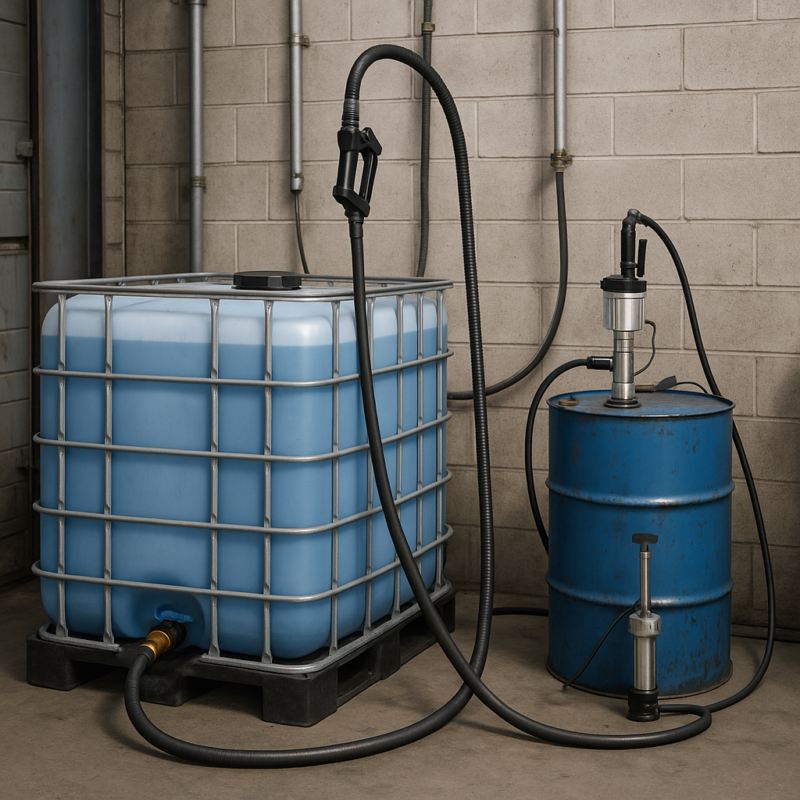
- Use closed transfer systems so dust and dirt stay out of the fluid.
For semi trucks and fleets that fill from a tote or a bulk tank, every truck gets whatever is in that supply. The DEF for semi trucks guide covers bulk handling, and the PACCAR and Cummins X15 guides cover the same faults on other Class 8 engines.
Keeping Crystals Out of a Volvo DEF System
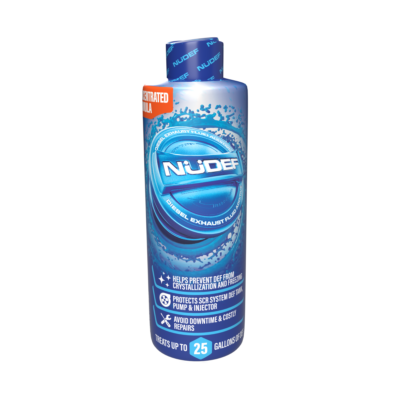
Volvo’s repair procedures deal with crystals after they have formed. The cheaper place to stop them is the fluid going into the tank. NüDef Diesel Exhaust Fluid Treatment, Additive & Stabilizer helps prevent crystallization and protects the SCR tank, pump and injector. It is made for use with ISO 22241 or API certified DEF, alongside it, never in place of it.
The dose comes from the label: one 8 oz bottle treats 25 gallons of DEF. Add it to the DEF tank at every refill and do not exceed the dose. NüDef is a preventive treatment and is not a cleaner: it cannot break up a crystal clog that is already in the doser or the mixer, and it cannot fix fluid that is already off spec. If your Volvo has P20EE with heavy buildup, have the cleanout done first, then treat every fill after it. Order NüDef direct, and if you run a fleet of Volvos, the wholesale program covers case and volume orders.