You’re here because somebody handed you the keys to a diesel that needs DEF, or your dash just lit up with a yellow fluid icon, or you’re shopping a 6.7L Powerstroke and you want to understand the running cost before you sign the papers. Diesel exhaust fluid is the single most misunderstood consumable on a modern diesel — operators treat it like windshield washer fluid until it crystallizes a $4,800 injector, and fleet managers learn the hard way that a 12°F overnight in Wyoming will turn a half-empty tank into a service call. This guide covers what DEF actually is, which diesels need it, how much it costs to run, where it fails, and what you can do to keep your truck or generator out of derate.
What Diesel Exhaust Fluid Is — And What It Isn’t
DEF is not a fuel additive. It’s not a catalyst. It’s not something the engine burns. Diesel exhaust fluid is a precise aqueous urea solution — 32.5% automotive-grade urea dissolved in 67.5% deionized water — sprayed into the hot exhaust downstream of the engine, where it does chemistry on nitrogen oxides before they reach the tailpipe. The 32.5% ratio is not a marketing number. It’s the eutectic point of the urea-water mixture, the concentration at which the solution achieves its lowest possible freezing temperature: 12°F (-11°C). Below or above 32.5% and the freeze point rises sharply, which is why drift outside spec causes problems even before crystallization starts.
The fluid is governed by ISO 22241, a five-part international standard published originally in 2006 and revised most recently in 2019. ISO 22241-1 covers the chemical specification (urea content, alkalinity, biuret, aldehydes, insolubles, phosphate, calcium, iron, copper, zinc, chromium, nickel, aluminum, magnesium, sodium, potassium, identity). ISO 22241-2 covers test methods. ISO 22241-3 covers handling, transportation, and storage. ISO 22241-4 covers refilling interfaces. ISO 22241-5 covers refilling at service stations. North American certification is through API (American Petroleum Institute), which licenses the diamond logo you’ll see on every legitimate jug at a truck stop. If a jug isn’t ISO 22241 / API-certified, it doesn’t go in a Tier 4 SCR system — period.
Inside the SCR catalyst (selective catalytic reduction), the urea hydrolyzes first into ammonia (NH₃) and carbon dioxide. The ammonia then reacts on the catalyst surface with nitrogen oxides — primarily NO and NO₂ — and reduces them to harmless nitrogen gas (N₂) and water vapor (H₂O). That’s it. That’s the whole show. The output of an SCR system fed clean DEF and operating at temperature is the same nitrogen and water vapor you’ve been breathing your entire life. The reaction needs heat to run efficiently, with peak conversion occurring between roughly 482°F and 932°F (250°C–500°C) catalyst bed temperature. That temperature window matters — it’s why short-trip diesels and idling generators experience disproportionate SCR problems.
The chemistry happens in two stages, and understanding both is what separates operators who diagnose DEF problems quickly from operators who throw parts at their truck. Stage one: thermolysis. When DEF hits the hot exhaust stream — injected through a metered nozzle into the decomposition tube ahead of the catalyst — the water flashes off and the urea begins to break down. The first reaction is urea splitting into ammonia and isocyanic acid (HNCO). Stage two: hydrolysis. The isocyanic acid reacts with residual water vapor and produces a second molecule of ammonia plus CO₂. Net result: each molecule of urea yields two molecules of ammonia. Those ammonia molecules then ride into the SCR catalyst, where vanadium-based or copper/iron-zeolite catalyst formulations facilitate the actual NOx reduction reactions. The reactions are well-characterized: 4NH₃ + 4NO + O₂ → 4N₂ + 6H₂O (“standard SCR”), 2NH₃ + NO + NO₂ → 2N₂ + 3H₂O (“fast SCR,” much faster than standard), and 8NH₃ + 6NO₂ → 7N₂ + 12H₂O (“NO₂-only SCR,” the slowest path).
The reason this matters in the field: every step requires temperature. Below the catalyst light-off threshold — around 392°F (200°C) for copper-zeolite formulations and higher for vanadium — the conversion efficiency falls off a cliff and the dosing strategy has to back off. The ECM commands less DEF when the catalyst is cold, which is why a freshly cold-started diesel does not dose immediately. The ECM also commands more DEF under high engine load when NOx production is highest. Net consumption is a moving target shaped by load, ambient temperature, catalyst aging, NOx sensor feedback, and the engine’s emissions calibration tables. The 32.5% concentration is the only constant the operator controls.
Why DEF Exists: EPA Tier 4 Final and the NOx Problem
Before 2007, on-highway diesels in the U.S. dumped roughly 4–5 grams of NOx per brake-horsepower-hour into the atmosphere. Nitrogen oxides are precursors to ground-level ozone and acid rain, and they’re a primary driver of the brown smog visible over Los Angeles, Houston, and Salt Lake City on a still summer day. The EPA’s Heavy-Duty On-Highway Diesel rule, originally signed in 2001 and phased in across 2007 and 2010, dropped the allowable NOx number to 0.20 grams per brake-horsepower-hour — a 95% reduction. Tier 4 Final for off-highway equipment phased in between 2014 and 2015 with similarly aggressive limits.
OEMs had two real choices to hit the number: heavy exhaust gas recirculation (EGR) plus a NOx trap, or selective catalytic reduction with urea injection. Almost every manufacturer chose SCR because the alternative carried a fuel economy penalty. SCR with DEF won on operating cost, won on power output (engines tuned for NOx without an aftertreatment penalty produce more torque), and won on durability of the underlying engine. The cost was a new consumable: diesel exhaust fluid.
Today, nearly every on-highway diesel sold in the U.S. since model year 2010 uses SCR and DEF, and many off-highway Tier 4 Final engines followed. Pickups joined the program with the 2011 Ford 6.7L Powerstroke, the 2011 GM 6.6L Duramax LML, and the 2013 Ram 6.7L Cummins. There’s no path back. EPA’s 2027 heavy-duty NOx rule, finalized in 2022, drops the limit to 0.035 grams, and OEMs are responding with dual-SCR systems and even more DEF dependency, not less.
The regulatory pressure isn’t just federal. California’s CARB Omnibus rule, finalized in 2020, runs ahead of federal standards and required model year 2024 and later heavy-duty engines sold in California to certify to the lower 0.05 g/bhp-hr NOx number three years before the federal standard tightens. Several other states have adopted California truck rules as well. The downstream effect: dual-DEF-tank systems, larger DEF tanks, heated supply lines as a default rather than an option, and DEF consumption percentages creeping up year over year as catalysts age and dosing strategies compensate.
The other piece of regulation operators don’t always track is EPA tampering enforcement. The “delete tune” market — software and hardware kits that disable SCR and DPF systems — has been on EPA’s enforcement radar since the 2015 Volkswagen settlement, and prosecutions have escalated every year since. Clean Air Act civil penalties for tampering and defeat devices run thousands of dollars per vehicle or device. Tuners and installers face additional criminal exposure under federal anti-tampering statutes. Some state emissions inspection programs check for tampering directly. The combined message to fleet operators is clear: SCR and DEF are not optional, the rules are getting stricter, and the cost of trying to engineer around them keeps climbing.
Which Diesel Engines Need DEF
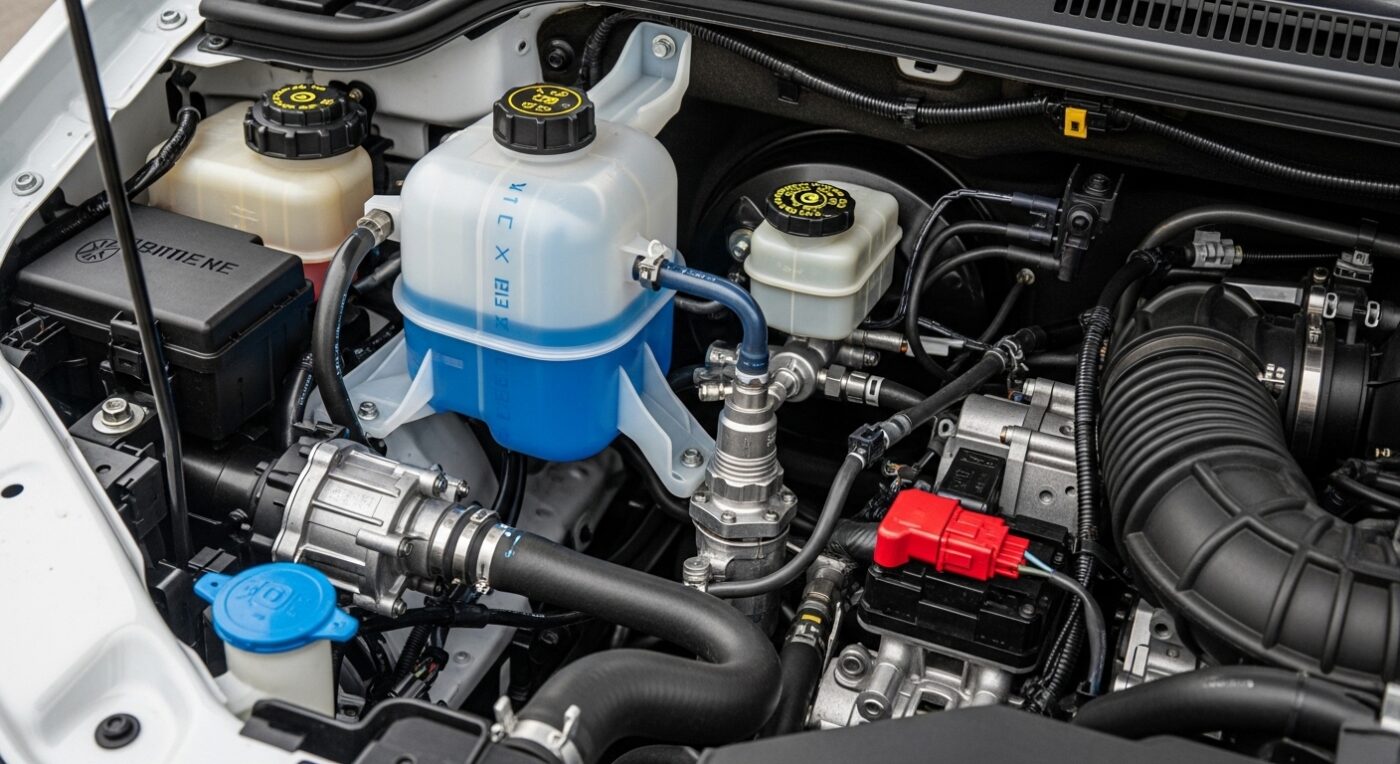
If your diesel was built for the U.S. market in 2010 or later and it’s on-highway, it almost certainly needs DEF. Same for off-highway equipment built 2014 and later above 75 horsepower. Below 75 hp, smaller equipment uses different aftertreatment paths and may not require DEF. Marine pleasure craft are still mostly DEF-free; commercial marine above certain tonnages is moving toward SCR. The fastest way to confirm whether a specific diesel needs DEF is to look for a blue-capped fill neck near the diesel filler, or “DEF” stamped on a tank in the engine bay or under the chassis — OEMs are required to clearly identify the DEF fill point under ISO 22241-4.
Light-Duty Diesel Pickups
- Ford 6.7L Powerstroke — 2011 to present (Super Duty F-250, F-350, F-450, F-550). DEF tank size varies by model year and chassis cab; check the owner’s manual. Nominal consumption 2–3% of fuel burned.
- GM 6.6L Duramax LML / L5P — 2011 to present (Silverado/Sierra 2500HD, 3500HD). DEF tank size varies by model year; check the owner’s manual. For DEF quality codes on the L5P (2017–present), check GM service information for current bulletins.
- Ram 6.7L Cummins — 2013 to present (2500, 3500, 4500, 5500). DEF tank size varies by model year. For crystallization-related fault patterns, check current Ram and Cummins service information. Owners researching specific symptoms should also see our 6.7L Cummins DEF crystallization fix guide.
- Ram 1500 EcoDiesel — 2014–2023 (3.0L V6).
- Mercedes Sprinter / Freightliner Sprinter — 2010 to present (3.0L V6 OM642 / 2.0L OM654). Often called “BlueTec” by Mercedes — same fluid, same standard.
Medium-Duty and Heavy-Duty
- Class 6–8 trucks (Freightliner Cascadia, Kenworth T680, Peterbilt 579, Volvo VNL, Mack Anthem, International LT) running Cummins X15, Detroit DD15/DD16, Volvo D13, Mack MP8, PACCAR MX-13. Tank sizes vary by chassis and spec.
- Transit and school buses — nearly all post-2010 diesel buses (BlueBird, Thomas, IC, New Flyer) use SCR.
- Refuse trucks, dump trucks, vocational chassis — SCR is standard on every major chassis builder’s lineup.
Industrial, Agricultural, Marine, RV
- Generators — Tier 4 Final generators from Caterpillar, Cummins, MTU, Kohler and others, mostly prime power and non-emergency units. Most emergency-only standby gensets are certified to EPA Tier 2 or Tier 3 and have no DEF system. Check the emissions label on your unit.
- Agricultural tractors and combines — John Deere, Case IH, New Holland, Massey Ferguson above ~75 hp. AdBlue (the European trade name) is the same fluid.
- Construction equipment — Caterpillar, Komatsu, Volvo CE, John Deere, Hitachi excavators, dozers, wheel loaders, articulated trucks built 2014+.
- Class A and Super C diesel motorhomes — nearly all Cummins ISL/ISX/X15-powered coaches built 2011+ on Freightliner XCS or Spartan K3 chassis.
- Commercial marine — EPA Tier 4 Marine compliance pulled larger commercial vessels into SCR territory starting around 2017.
How Much DEF Diesel Engines Use (Real Numbers)
The catch-all number you’ll see quoted everywhere is “DEF consumption is 2–3% of diesel fuel consumption.” That’s directionally correct for light-duty and over-the-road heavy-duty in steady-state operation. It runs higher for high-load industrial work, and it understates short-trip light-duty operation where the ratio compresses because the engine doesn’t reach full SCR operating temperature.
Concrete examples for budget planning:
- Long-haul Class 8 tractor — 6.5 mpg average, 120,000 miles per year, 18,461 gallons of diesel. At 3% consumption, that’s 554 gallons of DEF per year, or roughly $1,940 at $3.50/gal pump pricing.
- Local delivery box truck — 8 mpg, 30,000 miles per year, 3,750 gallons of diesel. At 2.5% consumption, 94 gallons of DEF per year, around $330.
- 6.7L Powerstroke F-350 daily driver — 17 mpg highway, 25,000 miles per year, 1,470 gallons of diesel. At 2% consumption, 29 gallons of DEF per year. About 4–5 jug refills.
- 1,000kW industrial generator at 75% load — burns approximately 50 gph of diesel. At 3% DEF consumption, that’s 1.5 gallons of DEF per hour. A 100-hour run consumes 150 gallons, and more at higher load. Standby gensets exercising weekly at low load consume much less, but the percentage rises because cold catalysts are inefficient.
- Tier 4 Final 250 hp tractor at full PTO — 12–14 gph diesel, 0.4–0.6 gph DEF.
Two factors that quietly raise DEF consumption past the textbook number: heavy load (the SCR system has more NOx to neutralize so it injects more urea), and high ambient temperature (NOx formation rises with combustion temperature). A loaded grain truck climbing a hot July grade in eastern Washington is using DEF at the high end of the published range. A delivery van idling in 50°F drizzle is using almost none, because the catalyst rarely hits operating temperature.
Three more variables fleet managers should plan against when budgeting DEF spend across a mixed fleet:
- Catalyst age. SCR catalysts gradually lose conversion efficiency over their service life as thermal cycling and trace-metal exposure deactivate active sites. The ECM compensates by commanding higher dosing rates to maintain NOx output below regulatory limits. A high-mile tractor with 700,000 miles on its catalyst will use measurably more DEF per gallon of diesel than the same tractor at 100,000 miles.
- Ambient temperature swings. Cold winter operations actually reduce DEF consumption in absolute terms because catalysts spend more time below light-off and the ECM throttles dosing back. Hot summer operations raise consumption because NOx formation in the cylinder rises with combustion temperature and the catalyst is at peak efficiency. Same truck, same route, summer DEF burn can run noticeably higher than winter.
- Idle time. Long idling at low load is the worst-case operating condition for DEF use. The catalyst sits below efficient temperature, the ECM doses minimally, and what dosing does happen tends to deposit unreacted urea on the injector and decomposition tube — the textbook setup for crystallization. Idle-heavy duty cycles (urban delivery, school buses, refuse collection) have lower headline DEF consumption percentages but disproportionate downstream maintenance costs.
For generator yards specifically, the consumption math is dominated by load profile. A standby genset that exercises 30 minutes a week at 25% load uses almost no DEF in a normal year — but the bulk DEF supply still has to be inventoried and rotated, and the dosing system still has to work the moment the utility grid fails. Prime-power gensets running near continuous rated load are the opposite case: high DEF burn, predictable consumption, and SCR systems that cycle hard. Both patterns require disciplined inventory management; both patterns kill carelessly stored DEF.
DEF Cost and Where to Buy It
Diesel exhaust fluid is one of the cheapest consumables on a diesel platform, but pricing varies by an order of magnitude depending on where and how you buy it. Independent operators who buy 2.5-gallon jugs from a parts counter pay roughly 4× what a fleet pays at a bulk pump.
| Format | Typical Price (2026) | Best Use Case |
|---|---|---|
| 1-gallon jug (auto parts retail) | $10–$15 | Emergency top-off only |
| 2.5-gallon jug (truck stop, parts house) | $10–$15 | Pickup owners, occasional users |
| Bulk pump (truck stop dispenser) | $3.00–$3.75/gal | OTR drivers, light fleet |
| 55-gallon drum | $280–$380 | Shop fleets, agricultural |
| 275–330-gallon tote (IBC) | $1,400–$1,800 | Mid-size fleets, generator yards |
| Bulk delivery (transport tanker, >1,000 gal) | $2.20–$2.80/gal | Large fleets, mines, ports |
Is DEF expensive? Compared to diesel, no — it adds 1–2 cents per mile to operating cost on a Class 8 tractor. Compared to a forgotten generator that crystallizes its injector and dosing module? It’s the cheapest insurance you’ll ever buy. The trap most operators fall into is buying jug-format DEF for high-volume applications.
The other quiet cost trap is DEF pricing volatility. The urea side of DEF is a petrochemical product, and the wholesale urea market tracks natural gas prices in North America and global ammonia trade flows. The 2021–2022 energy crisis pushed wholesale urea prices sharply higher, and DEF prices followed. Pricing has since normalized but the lesson stuck: large fleets that bought on the spot market got hammered, while fleets on indexed or contracted bulk delivery agreements rode through it without operational disruption. If your annual DEF spend is over $20,000, it’s worth a conversation with a regional bulk supplier about a contract.
For owner-operators and small fleets, the practical buying guidance:
- If you own one or two diesels: buy 2.5-gallon jugs from a high-turnover retailer (Walmart, Tractor Supply, major auto parts chains). Don’t stockpile. A 6–12 month rotation works in any climate.
- If you run three to ten diesels: consider a 55-gallon drum with a hand pump or air-operated transfer pump dedicated to DEF only. Store indoors, climate controlled.
- If you run a fleet of fifteen or more, or you have generators: a 275–330 gallon tote on a poly stand with a metered pump is the right move. ROI versus jugs runs under a year; ROI versus drums runs under two years.
- If you’re over-the-road: bulk pumps at major travel centers are the cheapest, freshest, most reliable source. Mark which stops have which brands and cycle through them; avoid the last-mile-of-the-day independent stops with low DEF turnover.
DEF Storage, Shelf Life, and What Kills It
DEF looks like water and most operators store it like water. That’s the source of half the problems we see in the field. Three variables determine how long a jug or drum stays in spec: temperature, sunlight, and contamination.
Sealed shelf life follows the ISO 22241-3 storage table, counted from the manufacture date stamped on the container: up to 36 months at a constant 50°F (10°C) or below, 18 months at up to 77°F (25°C), 12 months at up to 86°F (30°C), and 6 months at up to 95°F (35°C), the kind of heat a closed truck cab in Phoenix in July or a metal container yard in Houston reaches. Above 95°F, ISO 22241-3 says to test the fluid before use: the urea begins to hydrolyze into ammonia, the alkalinity rises out of spec, and the fluid gradually becomes unusable for SCR before it ever reaches the tank.
Open shelf life — once the seal is broken — is dramatically shorter. A 2.5-gallon jug opened to top off a tank and re-capped in a hot truck bed loses its specification within weeks. A drum with a non-sealing pump installed loses concentration to evaporation; a poorly fitted bung allows airborne contamination and microbial growth.
Freeze point is 12°F (-11°C). DEF expands roughly 7% when it freezes, which is why DEF tanks are designed with expansion volume and why frozen jugs sometimes split. Freeze-thaw cycling does not damage the chemistry — thawed DEF is fully usable, and most modern DEF tanks have a heated coolant loop precisely so the fluid is liquid at startup. The problem isn’t freezing in the tank. It’s freezing in the supply line where there’s no heater, or in a jug that splits and contaminates whatever’s around it. For climate-specific protection, see our guide on how to keep DEF from freezing.
UV light degrades urea solutions. Storing DEF in a clear plastic jug on a sunny shop bench accelerates breakdown. The standard blue/translucent ISO-spec packaging is engineered to block enough UV to extend life, but it isn’t opaque — direct summer sun on a stack of jugs in a yard will still drop the spec.
Contamination kills DEF faster than anything else. Even small amounts of diesel, gasoline, oil, coolant, salt, or dust will push the fluid out of ISO 22241 spec, and the SCR system will detect it within a few operating hours via downstream NOx sensor feedback. Always use a dedicated DEF funnel, dedicated transfer pump, dedicated storage container. Never reuse a jug for anything else and then use it for DEF. Never dip a measuring cup into a drum unless that cup is dedicated to DEF and stored clean.
Microbial growth is an under-appreciated risk in bulk storage. DEF is mostly water, and water that sits in a warm drum with periodic air ingress through a non-sealing pump bung is hospitable to certain bacteria and fungi. Microbial colonies foul filters, raise turbidity, and shift alkalinity. The visible sign is a cloudy or stringy appearance in normally water-clear DEF; the operational sign is recurring DEF filter clogs on a system that recently received fresh fluid. Bulk operators in the Gulf Coast and Southeast see this most often, where 90°F+ summer storage temperatures meet humid air and slow inventory turnover. Discipline on bung seals and a temperature-controlled storage room solve most of the problem.
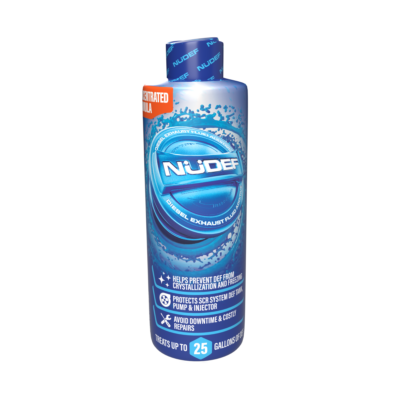
This is the natural place to mention stabilizer additives. NüDef DEF Treatment, Additive & Stabilizer, added at the time of fill, helps prevent the early-stage crystallization that begins around dosing nozzles in low-duty-cycle applications, and helps protect the SCR system, DEF tank, pump and injector. Fleet shops and generator yards that run drums or totes through hot summer storage use it alongside good storage practice: fresh certified DEF, sealed containers, and the ISO 22241-3 storage limits. A bottle of additive costs far less than an injector or dosing module replacement.
Common DEF Problems on Diesel Engines
The DEF system is mechanically simple — tank, pump, dosing line, injector, SCR catalyst, NOx sensors — but it operates at a brutal interface: a pressurized aqueous solution sprayed into a 600°F+ exhaust stream, with a dozen sensors checking spec in real time. Anywhere along that path is a potential failure point.
Crystallization
The headline problem on every DEF platform. White, chalky urea deposits form when the water component evaporates and leaves urea behind — most commonly at the dosing injector tip when an engine is shut down before the SCR purge cycle completes, or when DEF spec drifts above 32.5%. Crystallization causes pressure faults, dosing rate codes, and eventual injector failure. The progression follows a predictable pattern: a thin chalky ring at the injector tip, then a buildup at the decomposition tube entry, then deposits along the SCR inlet face, then catalyst surface fouling. Caught at stage one, you’re looking at a $20 cleaning solvent and an hour of labor. Caught at stage four, you’re discussing catalyst replacement at $5,000–$15,000. Full diagnostic and repair coverage is in our dedicated DEF crystallization cleaning guide.
Freezing and Frozen Supply Lines
Tanks have heaters; small-bore supply lines downstream of the pump often do not. A truck parked outdoors at -10°F overnight may start with a frozen line even though the tank is liquid. Modern systems run a startup warm-up cycle that delays SCR injection until the lines are thawed; older or aftermarket-modified systems may throw faults instead. For practical winter prep procedures see our DEF freezing guide.
Contamination
The most common contamination event is fueling DEF into a diesel tank or diesel into a DEF tank, both of which happen often enough that fuel-station ergonomics fight the problem with magnetic nozzle adapters and color-coded handles. Both events are catastrophic. DEF in a diesel tank: drain, flush, possible high-pressure pump damage. Diesel in a DEF tank: complete DEF system flush, dosing module replacement, sometimes catalyst replacement — $3,000 to $14,000 depending on platform. Other contamination — oil, coolant, water, salt — is usually slow-onset and shows up as gradual NOx sensor deviation before catastrophic failure.
Pump and Dosing Module Failures
The DEF pump is a small electric metering unit, typically integrated with a filter and pressure sensor on the tank or in a remote module. Failure modes: pressure sensor faults, motor seizure (often from contaminated DEF freezing inside the pump body), filter clogs, electrical connector corrosion. Replacement runs $400–$1,800 for the part plus 1–3 hours of labor, depending on platform.
Injector Clogs
The DEF injector is fed at relatively low pressure and sprays into the decomposition tube ahead of the SCR catalyst. Crystallization plus thermal cycling clogs the orifices, which throws dosing rate codes and eventually a P207F or platform-specific reductant performance code. Cleaning is sometimes possible; replacement runs $300–$900 plus labor.
NOx Sensor Failures
Modern SCR systems run two NOx sensors — one upstream of the catalyst, one downstream — and the ECM continuously compares the two readings to verify catalyst conversion efficiency. NOx sensors are accurate but fragile. They fail from thermal shock (a coolant leak hitting a hot sensor), contamination (oil mist, fuel ingress), wiring corrosion at the connector, or simple age — the zirconia-based sensing element gradually drifts out of calibration over 100,000–200,000 miles. A failed NOx sensor sets a P229F or P22A0-family code and forces the SCR system into a default dosing strategy that often triggers a downstream P20EE/P20EF efficiency fault even when the catalyst itself is fine. Replacement runs $400–$900 per sensor plus 0.5–1.5 hours of labor. Always confirm sensor faults with a scan tool before chasing a “bad catalyst” diagnosis — replacing a $10,000 catalyst because of a $500 sensor failure is the worst kind of expensive mistake.
Tank Heater and Supply Line Heater Failures
The DEF tank includes a coolant-loop heater that pulls warm coolant through an integrated heat exchanger after engine warm-up; supply lines from the tank to the dosing module use electrical resistance heating. Either heater failing in cold conditions causes startup faults and, in extreme cold, frozen lines that won’t thaw without a heated garage stay. Tank heater diagnosis usually requires a scan tool to verify coolant valve actuation; line heater diagnosis is a continuity test. Replacement of either is straightforward but the cold-weather operational impact is severe enough that fleet operators in northern climates routinely add line heater diagnostics to fall PM checklists.
Common Diagnostic Trouble Codes
- P20EE — SCR NOx Catalyst Efficiency Below Threshold (Bank 1). Catalyst not converting NOx well enough; usually points to DEF quality, dosing rate, or catalyst poisoning.
- P20EF — SCR NOx Pre-Catalyst Efficiency Below Threshold (Bank 1). The pre-catalyst stage on systems that monitor one; same diagnosis order as P20EE.
- P204F — Reductant System Performance. Generic system performance code, often the first to set when crystallization begins.
- P203F — Reductant Level Too Low. The “DEF empty” warning chain.
- P202E — Reductant Injection Valve Circuit Range/Performance (Bank 1, Unit 1). Points at the dosing injector circuit.
- P207F — Reductant Quality Performance. Often DEF that’s out of spec, contaminated, or wrong fluid altogether.
Full code-by-code diagnostic walkthroughs and platform-specific notes are in our DEF trouble codes explained reference. Platform-specific guides: Duramax LML/L5P DEF problems and Ford 6.7L Powerstroke DEF problems.
DEF Maintenance Best Practices
The single best thing you can do for an SCR-equipped diesel is to stop treating DEF as an afterthought. Most failures we see in the field trace back to four habits operators don’t realize are problems: shutting down before purge, topping off from the same uncovered jug for two summers, ignoring the first low-DEF warning, and skipping the periodic injector inspection in the owner’s manual.
Daily / Per-Fill
- Refill DEF at the same fuel stop with a known-good source — truck-stop bulk pumps, sealed jugs from a high-turnover retailer.
- Never use jugs that are bulged, leaking, dusty, or stored in direct sun.
- Use a dedicated DEF funnel or filler nozzle. Never share with diesel fuel funnels.
- Do not top off past the fill neck. The tank is sized with vapor space for thermal expansion.
Weekly / Operational
- Let the truck or equipment complete its shutdown cycle. The post-run purge clears DEF from the dosing injector. Killing the ignition before the cycle finishes leaves urea in the injector tip to evaporate and crystallize.
- Avoid extended idling on cold engines. The SCR catalyst doesn’t reach efficient operating temperature, raw urea passes through, NOx sensors throw faults.
- For generator yards: cycle gensets to operating temperature weekly, not just at no-load idle.
Periodic / Mileage-Based
- Inspect the DEF filler cap seal at every oil change. A cracked seal allows dust and humidity into the tank.
- Test DEF concentration with a refractometer periodically and whenever a quality code appears. Reading should be 32.5% ± 0.7%. Outside that window, drain and refill.
- Replace the DEF filter on the interval in your owner’s manual or engine maker’s maintenance schedule.
- Inspect the DEF injector on the schedule in your service information, or earlier if dosing codes appear.
Seasonal
- Before extreme cold, confirm the DEF tank heater and supply line heaters are operational (most platforms run a self-test on cold starts). Pull a scan-tool readout in October on northern fleets — an inactive heater that throws a code in February is a stranded truck. An inactive heater caught in October is a $200 part.
- Before extreme heat, rotate stored bulk DEF inventory and confirm storage temps. Jugs over 12 months old at warm storage should not go into a tank. Mark drum and tote fill dates with a paint pen at the time of delivery; first-in-first-out inventory beats date-stamp archaeology in a panic.
- For seasonal equipment (RVs, agricultural, standby gensets): drain or treat stored DEF before extended layup. Stale DEF is a common fault on equipment coming out of winter storage. Treated DEF in a full tank is the right answer for almost every layup scenario; an empty tank is the wrong answer because the pump can dry-run at the next start.
- For agricultural and construction equipment moving between sites, verify supply chain at each new location. A combine that worked all summer in Iowa with bulk DEF on the family farm may move to a custom-harvest contract in Texas where only jugs are available — plan inventory and storage temperature accordingly.
For SCR-system-level maintenance beyond DEF itself — injector cleaning intervals, NOx sensor service, catalyst inspection — see our SCR system maintenance guide.
DEF Myths, Debunked
“DEF burns in the engine.”
No. DEF never enters the combustion chamber. It is sprayed into the exhaust downstream of the engine, ahead of the SCR catalyst. Every diesel running today still burns straight diesel fuel.
“You can skip DEF and the engine will run fine.”
No. Modern SCR-equipped engines monitor DEF level, quality, and dosing rate continuously. Run out of DEF or use out-of-spec DEF, and the ECM begins a graduated derate. The final stage on most platforms is a severe speed limit or a no-restart condition. EPA tampering rules also make defeat-device modifications a federal violation with civil penalties.
“My generator won’t actually shut down without DEF, right?”
It will. Tier 4 Final stationary and mobile generators use the same SCR strategy as on-highway diesels and the same derate enforcement. Standby generators in critical-power applications (hospitals, data centers) have specific DEF-management programs precisely because the consequences of an SCR fault during a power event are unacceptable. Run dry on a hospital genset during a transformer failure and you’ve created a regulatory and clinical crisis simultaneously.
“DEF goes bad after a few weeks.”
No. Sealed DEF follows the ISO 22241-3 storage table: up to 36 months at 50°F or below, 18 months at up to 77°F, 12 months at up to 86°F, and 6 months at up to 95°F. Hotter than that, test it before use. The shelf-life concern is heat and contamination, not time alone.
“DEF and AdBlue are different fluids.”
They are not. AdBlue is the European trade name (registered to the German automotive industry association VDA) for ISO 22241-spec fluid. DEF is the North American name. Same chemistry, same standard, interchangeable. Some Australian and Asian markets use the AdBlue label; some Latin American markets use ARLA 32. All of it is 32.5% urea / 67.5% deionized water under ISO 22241.
“I can make my own DEF with urea fertilizer.”
You cannot. Agricultural-grade urea contains biuret, formaldehyde, and metallic impurities that will poison an SCR catalyst within hours. ISO 22241 specifies automotive-grade urea with biuret under 0.3%, aldehydes under 5 ppm, insolubles under 20 mg/kg, and trace metals (calcium, iron, copper, zinc, chromium, nickel, aluminum, magnesium, sodium, potassium) each limited to a fraction of a part per million. Fertilizer urea is not made to those limits. The entire $5,000–$15,000 catalyst will need replacement after a few tanks of homemade DEF.
“DEF causes my fuel economy to drop.”
Backwards. Engines designed around SCR aftertreatment can be tuned for combustion efficiency rather than NOx reduction, which is why post-2010 SCR diesels typically deliver better fuel economy than the EGR-heavy 2007–2009 generation they replaced. The DEF you’re buying is the consumable that allows that fuel economy advantage.
“I should keep my DEF tank empty when storing equipment.”
The opposite. An empty DEF tank leaves the pump to dry-run at the next start, and residual DEF in the lines can crystallize as it dries. Best practice for storing seasonal equipment is to fill the DEF tank fresh, treat it with NüDef to help prevent crystallization, and run the engine briefly to circulate the treated fluid through the dosing module. The pump and lines stay wet with fresh fluid, and startup at the end of the layup season is far less likely to bring surprises.
When DEF Problems Need a Shop
A lot of DEF maintenance is operator-level work. Refilling, refractometer-testing, swapping a DEF filter on most pickups, cleaning a partially crystallized injector tip with proper supplies — these are within reach of any shade-tree mechanic with the right service information. There’s a clean line, though, at which the job leaves the driveway.
DIY territory: level checks, refills, refractometer testing, filter changes on accessible installations, light external crystal cleanup, owner’s-manual diagnostics with a basic OBD-II scanner.
Shop territory: dosing module replacement, NOx sensor diagnosis (requires platform-specific scan tool to live-graph upstream and downstream sensor values), SCR catalyst replacement, derate state recovery on platforms that require dealer-level forced regeneration, any contamination event involving wrong-fluid fueling, any P207F reductant quality fault that doesn’t clear after a known-good tank of DEF.
Two specific situations that look DIY but aren’t. First: any code that won’t clear after a verified DEF refill and a single drive cycle. The cause is usually deeper than the symptom suggests — sensor drift, dosing module failure, partial injector clog, or catalyst poisoning — and continued driving racks up sensor fault history that will eventually require dealer-level data clearing. Second: any wrong-fluid contamination. Diesel in the DEF tank or DEF in the diesel tank is not a job to chase with shop towels and a hand pump. The supply lines, the pumps, the injectors all require purpose-specific cleaning, and on most platforms the dosing module needs replacement regardless. Every hour of operation after contamination compounds the bill.
Frequently Asked Questions
What is DEF made of?
32.5% automotive-grade urea (NH₂CONH₂) dissolved in 67.5% deionized water. The urea is synthesized industrially from natural gas, ammonia, and CO₂; the water is filtered to remove minerals, metals, and microbial content per ISO 22241. There are no other ingredients. No dyes, no preservatives, no antifreeze additives.
How long does DEF last in storage?
Sealed DEF follows the ISO 22241-3 storage table from the manufacture date: up to 36 months at 50°F or below, 18 months at up to 77°F, 12 months at up to 86°F, and 6 months at up to 95°F. Once opened, life shortens dramatically — an open jug in a hot truck cab may be off-spec inside a few weeks.
Can DEF freeze?
Yes, at 12°F (-11°C). The freeze does not damage the chemistry — thawed DEF is fully serviceable. Modern DEF tanks include heaters and the engine controller delays SCR injection on cold starts until the fluid is liquid. Frozen supply lines (the small-bore plumbing between tank and injector) are the more common winter problem and can throw faults if line heaters fail.
What happens if I run out of DEF?
Most pickups give a series of dash warnings as the DEF level drops, and at empty will limit engine speed and torque. Continued operation triggers a graduated derate: reduced power, reduced top speed, and eventually a severe speed limit or no restart. Heavy-duty trucks and equipment behave similarly with platform-specific limits. The derate is not a failure; it’s an EPA-mandated emissions enforcement strategy. Refilling DEF and running a drive cycle clears the warning chain on most platforms; some severely derated states require dealer reset.
Is DEF the same as urea?
DEF contains urea, but urea by itself is not DEF. DEF is the specific 32.5% automotive-grade urea / 67.5% deionized water solution to ISO 22241. Pure urea is a solid white pellet (the form sold as fertilizer or industrial feedstock). Putting pure urea in a DEF tank, or mixing fertilizer urea with tap water, will destroy the SCR catalyst.
Does DEF go bad?
Yes. Heat, sunlight, and contamination all degrade the urea solution. Out-of-spec DEF (concentration above or below 32.5% ± 0.7%, alkalinity drift, biuret rise, contamination) will throw quality codes on most platforms within a few hundred miles of operation. The shelf life is real and printed on every container; respect it.
How much DEF will my truck use?
Plan on 2–3% of fuel burned for light-duty and over-the-road heavy-duty in normal operation; more for heavy industrial and high-load applications. A 6.7L Powerstroke F-350 driven 25,000 miles a year at 17 mpg uses about 29 gallons of DEF per year — a handful of tank refills.
Can I make my own DEF?
No. The urea grade required by ISO 22241 (automotive-grade, with strict biuret, aldehyde, and trace-metal limits) is not the same as fertilizer urea or technical urea. Homemade DEF will poison the SCR catalyst within a few operating hours and will trigger reductant quality faults on every modern platform. The catalyst replacement bill alone is $5,000–$15,000.
Why does my truck shut down without DEF?
It doesn’t shut down outright on most platforms; it derates. The EPA requires SCR-equipped engines to limit performance when DEF is empty or out of spec, to prevent operators from disabling emissions controls. The derate progression is published in the manufacturer’s manual and is generally three stages: warning, power reduction, severe limp mode. Refilling DEF and completing a normal drive cycle restores full operation on most platforms.
What’s the difference between DEF and AdBlue?
None chemically. DEF is the North American name; AdBlue is the European trade name registered to the VDA (German auto industry association). Both are 32.5% urea / 67.5% deionized water to ISO 22241. The fluid is interchangeable. Australian markets use both names. Latin America commonly uses ARLA 32 for the same product.
The Bottom Line on Diesel DEF
Nearly every on-highway diesel sold in North America since 2010, and many off-highway Tier 4 Final engines, need DEF. The fluid is cheap, the spec is precise, and the failure modes — crystallization, contamination, derate — are almost entirely preventable with operator habits that take less than five minutes a week. The fleet shops and generator yards that have stopped fighting DEF problems are the ones that treat it like the precision consumable it is: known-good source, dedicated handling equipment, climate-managed storage, and a stabilizer in the bulk tanks for warm-weather inventory. The shops still fighting it are the ones still topping off from a swollen jug that’s been in the truck bed since spring.