Updated October 2026. The cold-weather facts below come from vehicle makers’ service bulletins and owner’s manuals and from the Filter Manufacturers Council’s winter diesel bulletin, and each is linked where it is used.
Anti Gel vs DEF: The Short Answer
Anti-gel is a diesel fuel additive. It goes in the fuel tank, and its job is to keep paraffin wax in the fuel from plugging the fuel filter when the temperature drops. DEF (diesel exhaust fluid) is a separate fluid with its own tank, and it feeds the SCR system in the exhaust. GM, for one, marks the two fillers with a green fuel cap and a blue DEF cap. The two never mix. Anti-gel does nothing for DEF, and nothing meant for the fuel side belongs in the DEF tank.
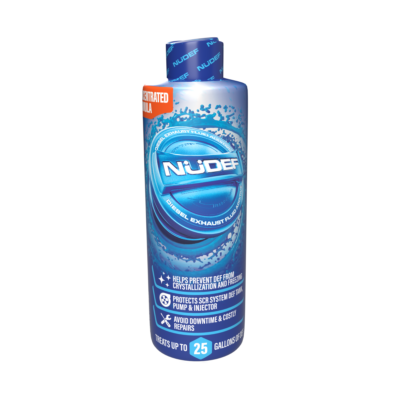
The DEF tank gets one fluid: certified DEF. If you treat it, use a product made for DEF and dosed by its label. NüDef DEF Treatment, Additive & Stabilizer is that product: it goes in with certified DEF, helps prevent crystallization and freezing, and one 8 oz bottle treats 25 gallons of DEF. The rest of this page explains why the two winter problems are different, what each bottle does, and what to do if the wrong one went down the wrong filler.
Two Tanks, Two Cold-Weather Problems
Winter hits the fuel and the DEF in different ways, at different temperatures, and the fixes are different too. The table puts them side by side.
| Question | Diesel fuel tank | DEF tank | What it means | Source |
|---|---|---|---|---|
| What goes wrong in the cold | Paraffin wax forms crystals that coat and plug the fuel filter | The fluid freezes and expands | Wax starves the engine of fuel; frozen DEF waits for the heater | FMC bulletin 91-1; GM bulletin 10-06-04-013B |
| When it starts | At the cloud point: typically -18°F to +20°F for #2 diesel, occasionally as high as +40°F | About 12°F (-11°C) | Fuel can wax up on a day that DEF is still liquid | FMC bulletin 91-1; GM bulletin 10-06-04-013B |
| The winter product | Cold flow improver (anti-gel), #1 diesel or a winterized blend | Certified DEF; the truck heats the tank and supply lines | Each side has its own answer | FMC bulletin 91-1; engine maker DEF bulletin |
| Filler cap | Green on GM trucks | Blue on GM trucks | Open one cap at a time | GM TechLink |
| Wrong fluid in | DEF in the fuel: do not turn on the ignition, tow it | Anything other than DEF: do not switch the ignition on, call the dealer | Do not start the engine either way | GM TechLink; Mazda owner’s manual |
What Anti-Gel Does in the Fuel Tank
Number 2 diesel carries paraffin wax in solution. The Filter Manufacturers Council’s technical bulletin on winter fuel defines the cloud point as the temperature at which that paraffin begins to form cloudy wax crystals. Once the fuel reaches it, the crystals flow with the fuel, coat the filter element and cut the flow until the engine starves. Further down is the pour point, where the paraffin has crystallized enough that the fuel gels and resists flow; the bulletin puts it usually 10°F to 20°F below the cloud point. It also notes that freezing temperatures can turn any emulsified water in the fuel into an ice slush that restricts filters further. That is why winter power loss gets blamed on filters when the fuel is the real cause.
Anti-gel products are cold flow improvers. Per the same bulletin, they lower the pour point of diesel several degrees but do not change the cloud point. They work by changing the shape of the paraffin crystals to needle-like forms, and more of those crystals pass through the filter element, which slows plugging. The only way to actually lower the cloud point is to dilute #2 diesel with #1 diesel or kerosene, which contains very little paraffin and has cloud and pour points near -40°F. The tradeoff is a lower heat value per gallon and a higher price. The bulletin adds a warning worth repeating: never add gasoline or alcohol to diesel for cold weather, because it creates an explosion danger and damages the fuel injection system.
Timing matters. A cold flow improver works on wax that has not formed yet, so it goes into the fuel above the cloud point, ideally at the pump while the fuel is still warm. Some owner’s manuals say not to stack more additive on top of fuel the station has already winterized, so check yours. Fuel heaters are the other fuel-side tool: heating diesel above its cloud point helps avoid winter power loss.
What Happens to DEF in the Cold
DEF has no wax and nothing for anti-gel to act on. It is 32.5% automotive grade urea and 67.5% deionized water, and GM’s service bulletin for its 6.6L Duramax trucks puts it plainly: DEF basically behaves like water, freezes at -11°C (12°F) and expands. One engine maker’s DEF bulletin lists the freezing level at 11°F (-12°C), so treat 11°F to 12°F as the line. GM’s bulletin says the freeze does not normally cause a problem as long as the tank is not overfilled, since an overfilled tank leaves no room for the expansion.
The truck is designed for this. The same engine maker’s bulletin says the SCR system heats the DEF tank and supply lines, and that DEF thaws quickly without changing its efficacy once the engine warms it. What owners notice is the gauge. GM’s bulletin explains that when DEF is frozen the level sensor cannot read the fluid level, so the computer assumes a default level and may show an Exhaust Fluid Range message even with a full tank. It also says a fully frozen tank can take almost an hour after start-up to detect a refill. If the heater itself is failing, the DEF heater failure guide covers the symptoms, and when DEF freezes maps the 12°F line against the calendar.
Anti-Gel Poured Into the DEF Tank: What to Do
It is an easy mistake in the dark at a fuel island: a bottle of anti-gel in one hand, two caps side by side, and the blue one is open. Mazda’s owner’s manual for its diesel says it directly: do not add any fluid other than DEF to the urea tank, because any other fluid could cause a problem with the SCR system or damage it. Its instruction for that case is to not switch the ignition on and to contact the dealer.
Follow that order and leave the key off. Tell the shop exactly what went in and how much, and keep the bottle so they can read its label. A shop that services SCR systems decides what has to be drained, flushed or replaced before the tank gets fresh certified DEF.
How far the damage goes depends on how far the fluid traveled. A 2015 FCA service bulletin for 3.0L diesel SUVs whose DEF systems were contaminated at the factory shows what a full repair can involve: the parts list covers the urea filler tube, the DEF tank with its temperature sensor and level unit, the supply hose, the dosing module injector and the selective reduction converter. The codes that bulletin lists are P20EE (SCR NOx catalyst efficiency below threshold), P2BA9 (insufficient reductant quality), P20E8 (reductant pressure too low) and P20E9 (reductant pressure too high). The contaminated DEF guide covers symptoms once a truck has been driven.
DEF in the Fuel Tank Is the Other Mix-Up
The reverse mistake puts DEF into the fuel. GM’s TechLink guidance for DEF in the fuel system is three lines: do not turn on the ignition, do not start the engine, do not drive the vehicle. Have it towed. GM explains that DEF is corrosive and tends to form deposits on components, and that contamination can reach the fuel pump module, the fuel level sensor and the fuel pump. GM also notes that its new vehicle warranty may not cover fuel system repairs caused by fuel contamination. The DEF in the diesel tank guide walks through the first hour.
Both mistakes have the same prevention. GM’s advice is to remove only one cap at a time, so the fluid in your hand can only go into the tank that is open. Keep anti-gel and DEF treatment bottles in different places in the truck, and read the cap color before you pour.
What Belongs in the DEF Tank in Winter
The list is short. Certified DEF goes in, and leave room at the top so the fluid can expand if it freezes. Mazda’s manual warns that overfilled DEF may freeze at 12°F or below and that frozen urea can expand enough to break the tank; GM’s bulletin gives the same reason for stopping when fluid reaches the top of the fill pipe. In very cold weather Mazda also advises moving the vehicle somewhere warm before adding DEF, because fluid that starts to freeze may not flow correctly and the amount added may be wrong. For more cold-fill habits, see how to keep DEF from freezing.
A DEF treatment is the one thing that goes in alongside the fluid, and only one labeled for DEF. NüDef DEF Treatment, Additive & Stabilizer is made for use with ISO 22241 or API-certified DEF. The label says it helps prevent crystallization and protects the SCR tank, pump and injector, and the sell sheet adds that it helps prevent freezing. Dose by the label: one measured dose per 2.5 gallons of DEF, add it at every refill, and do not exceed the dose. One 8 oz bottle treats 25 gallons. The label lists its glycol ingredients, so you can read them against your owner’s manual, and it asks you to store the bottle between 41°F and 86°F, which means the cab in winter, not the toolbox. For the certification marks themselves, see DEF requirements.
A Winter Fill Routine for Trucks and Fleets
On a fleet, many drivers fill many trucks, so the routine has to be written down and the same for everyone. Separate the two fluids by place and by step:
- Fuel side first, at the pump. Add anti-gel to the diesel while the fuel is warm and above its cloud point, or buy winterized fuel and follow your manual on extra additive.
- One cap open at a time. Close the green cap before the blue one comes off.
- Separate storage. Anti-gel stays with fuel supplies; DEF and its treatment stay with DEF supplies, in a heated space that holds the bottle between 41°F and 86°F.
- Treat at the fill. One NüDef dose per 2.5 gallons of DEF, every refill.
- Write it up. If the wrong fluid goes in, the driver leaves the key off and calls it in.
Farm and ranch operations can run the same routine across tractors, combines and service trucks; the agricultural equipment DEF guide covers DEF treatment on farm equipment. NüDef is sold by the case of 30 bottles for that kind of use, and the wholesale program covers operators who treat DEF across many units, and the California DEF additive page covers buying for fleets in that state.
Treat the Fuel, Treat the DEF, Keep Them Apart
Winter asks two different things of a diesel truck. The fuel needs protection from wax, which comes from anti-gel, #1 diesel, winterized blends and fuel heaters, all on the green-cap side. The DEF needs to be clean, certified and not overfilled, with the truck’s own heaters handling the thaw. Treat each tank with the product made for it, read the cap before you pour, and if a mistake happens, leave the key off. Treat your DEF at every fill with NüDef, one dose per 2.5 gallons and 25 gallons per bottle, and order it direct before the first hard freeze.