Every SCR diesel built since the early 2010s carries a second tank most owners never think about until a warning light forces the introduction. The DEF tank looks simple from the outside — a blue cap, a filler neck, a gauge reading somewhere on the dash — and that simplicity hides the most sensor-dense, failure-prone real estate in the whole emissions system. Knowing what the tank actually is, what lives inside it, and how to treat it is the cheapest DEF education there is. Here is the tour.
What the DEF Tank Is (and Isn’t)
The DEF tank is a dedicated plastic reservoir for diesel exhaust fluid — the urea solution your SCR system injects into the exhaust to convert NOx into nitrogen and water. It is completely separate from the fuel system: its own filler, its own plumbing, its own sensors, and fluid that must never meet diesel in either direction (a mistake with its own emergency guide). The tank is plastic for a reason — DEF corrodes many metals, so the tank, lines, and fittings are polyethylene and stainless throughout. And the cap is blue by universal convention, the one piece of standardization every manufacturer honors: blue means DEF, everywhere, always.
What it is not: an afterthought jug. Modern DEF tanks are engineered assemblies with heating circuits, sensor arrays, and a pump module — which is why a “simple” tank problem so often bills like a component replacement. Treat the tank as the front door to a system, because that is what it is.
Where to Find It, Vehicle by Vehicle
- Diesel pickups: the fill is almost always a blue cap right beside the fuel filler behind the same door; the tank itself hangs under the truck, typically along a frame rail or under the bed. The side-by-side fillers are convenient and the source of most wrong-tank accidents — read the cap.
- Diesel cars and SUVs: beside the fuel filler on most; a few European models hide the fill under the trunk floor or spare-tire well.
- Class 8 and medium-duty trucks: a visible frame-mounted tank, usually near the diesel tanks, sized for the duty.
- Motorhomes: commonly in a service bay or beside the fuel fill; capacities vary widely by chassis.
- Equipment and tractors: machine-specific, but the blue cap convention holds; consult the panel diagram once and you know forever.
Capacity: How Much It Holds
The table above carries the ranges. The engineering logic behind them: manufacturers size DEF tanks so that a tank of DEF outlasts several tanks of diesel — consumption runs roughly 2–3% of fuel burn — with pickups landing at 5–7 gallons, cars a bit less, and heavy trucks scaling with their fuel capacity. The practical implication is pleasant: for most owners, DEF is an every-few-fuel-stops or every-oil-change item, not an every-fill chore. The full consumption math — and what happens when the gauge is ignored — lives in our run-out guide.
Need the published figure for your own truck? The DEF tank capacity chart lists Ram, Ford, GM and Class 8 tanks from the makers’ manuals and spec sheets.
The Header Unit: What Lives Inside
Unscrew the mental image of an empty jug: the DEF tank’s centerpiece is the header unit (also called the sender or supply module), a combined assembly dropped into the tank that carries most of the DEF system’s intelligence:
- The supply pump on many designs — drawing fluid and feeding the dosing system under pressure.
- The level sensor — the gauge reading and the trigger for the low-DEF warning ladder.
- The quality/concentration sensor — reads whether the fluid is actually 32.5% urea in spec; the sensor behind “incorrect DEF detected” faults.
- The temperature sensor and heater — DEF freezes in normal winters, and the heater thaws it (more below).
- The pickup filter — the last defense between tank contents and the dosing pump.
This is why fluid quality is a component-protection issue, and why the header is the part that pays for neglect: crystals and contamination sit at the bottom of the tank, exactly where the header lives. When a header fails, parts and labor commonly land in the $400–$1,200 range depending on platform — the most expensive “empty jug” you will ever own.
How to Fill It Right
Filling a DEF tank is genuinely simple; doing it clean is the skill:
- 1. Wipe around the cap before opening. Grit at the filler neck is the number-one contamination path. Ten seconds with a rag protects a parts-per-million purity spec.
- 2. Use the jug’s sealed spout or a dedicated DEF nozzle. Never a funnel that has met any other fluid — residue from oil, coolant, or fuel contaminates instantly. If you keep a funnel, it lives in a bag and touches DEF only.
- 3. Pour until the tank is full, then stop. Do not top off past the neck: DEF expands roughly 7% when it freezes, and tanks are designed with headspace for exactly that. Overfilling in a cold climate cracks the expansion room out of the system.
- 4. Cap immediately. The fluid is hygroscopic and the spec hates airborne dust; the open tank is the vulnerable tank.
- 5. At the pump: inspect the nozzle for crystallized residue before it enters your filler — the same ten-second habit from our where-to-buy guide.
How Long a Tank Lasts
At 2–3% of fuel consumption, a pickup’s 5–7 gallon tank typically covers 3,000–8,000 miles — the wide range is towing, which can double DEF burn along with fuel burn. Heavy trucks measure theirs in days of duty rather than miles. Two behaviors distort the math: heavy idling doses more DEF per mile than highway running, and hard, hot, loaded operation pushes toward the high end. The dashboard countdown handles the arithmetic for you; the ownership habit that beats it is refilling on a schedule — every second or third fuel stop under load, every oil change under light duty — so the countdown never starts.
Winter: The Freeze Is Normal
DEF freezes at about 12°F (-11°C), and the system is designed for it. The tank’s heater circuit thaws a working supply within minutes of startup, lines are heated or self-purging by design, and a frozen tank on a cold morning is a non-event — start the truck and drive. What winter actually asks of you: leave the headspace (the 7% expansion is why), never pour coolant or other chemicals into the tank to “winterize” the fluid (the heater is the design answer, and a DEF additive belongs in the tank only at its label dose), and if a heater circuit fails you will meet a specific fault family covered in our trouble-code guide. Freezing does not harm the fluid itself — thawed DEF is unchanged DEF, one of the few stresses the chemistry genuinely shrugs off.
Keeping the Tank Healthy
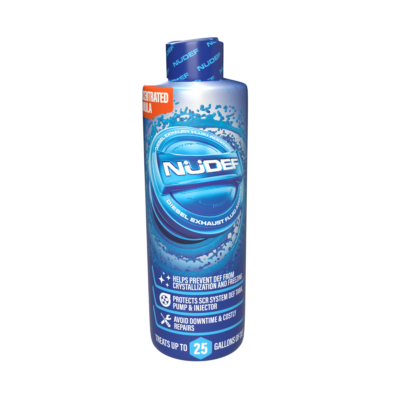
The tank’s enemies are heat, time, and contamination — the same three that degrade the fluid, because the tank’s health is the fluid’s health. The habits that matter: keep the cap sealed and the neck clean; refill in quantities you use rather than storing a half-empty tank through a hot idle season (a lightly-used truck’s tank is where DEF quietly ages — the shelf-life guide covers the chemistry); and for any vehicle that sits — RVs between trips, equipment between seasons, the work truck that tows twice a year — stabilize the tank. NüDef helps prevent the crystallization that heat cycles and sit time leave on the header, which is precisely the failure geography this whole article describes.
How the Tank Talks to the Truck
The dash gauge and warning ladder are downstream of the header’s level sensor, and understanding that chain explains the behaviors owners misread. Level readings update on a damped schedule rather than live — controllers average the signal to ignore sloshing — so a fresh fill can take a key cycle or a few minutes of driving to register, which is exactly why the refill procedure after a run-out is “key on, wait, then start.” The quality sensor works the same way, sampling rather than streaming, which is why contamination sometimes flags miles after the bad fill rather than at the pump. And the warning thresholds are mileage-projected, not gallon-based: the truck computes range from your recent consumption rate, so the same quarter-tank shows a different countdown to a towing rig than to a commuter. When gauge behavior seems irrational — stuck readings, a countdown that jumps — think sensor-and-software first, and remember the sensor lives at the bottom of the tank where crystals settle: erratic level readings are the classic early symptom of header-unit fouling, well before a hard fault sets.
Fleet & Transfer Setups: Carrying Bulk DEF
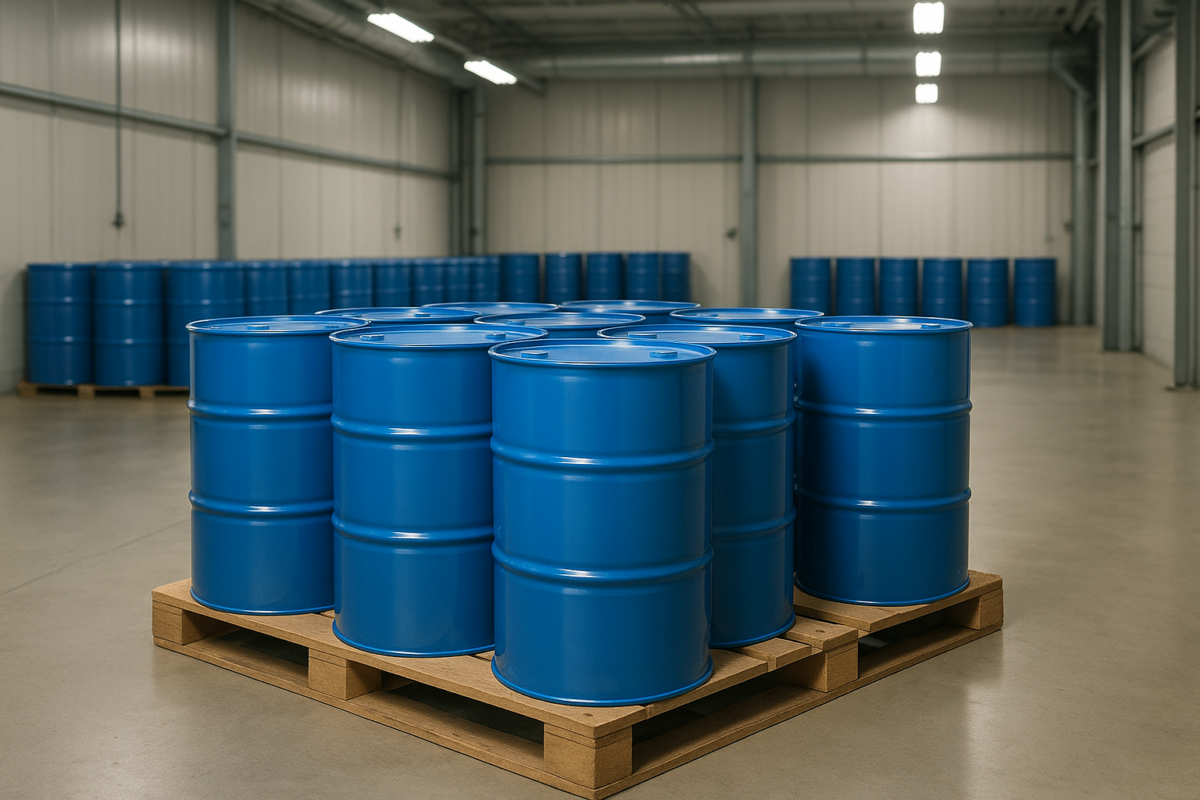
Operations that burn serious DEF — hot-shot haulers, service fleets, farms running Tier 4 iron — often carry their own supply: caddies, in-bed transfer tanks, and tote-and-pump setups that refill machines in the field. The equipment is simple; the discipline is everything. Dedicated DEF-only containers and pumps (never repurposed fuel gear — residue contamination is instant and invisible), stainless or poly wetted parts because DEF corrodes brass and mild steel, closed systems over open funnels in dusty environments, and out of the sun, because a black poly tank in a Texas truck bed cooks its contents past spec in a season. Sizing follows the six-month rule from our buying guide: carry what you will turn over while it is fresh, and stabilize what rides along — bulk DEF on a vehicle lives in exactly the heat that ages it fastest, which makes a stabilizer the standard equipment of every serious transfer setup.
The tank is where DEF spends most of its life, and where heat cycles slowly turn untreated fluid into the crystal deposits that clog the pickup, heater, and sender. NüDef DEF Treatment & Stabilizer stabilizes the fluid in the tank itself. One 8 oz bottle treats up to 25 gallons, poured in at any fill.
When Things Go Wrong in the Tank
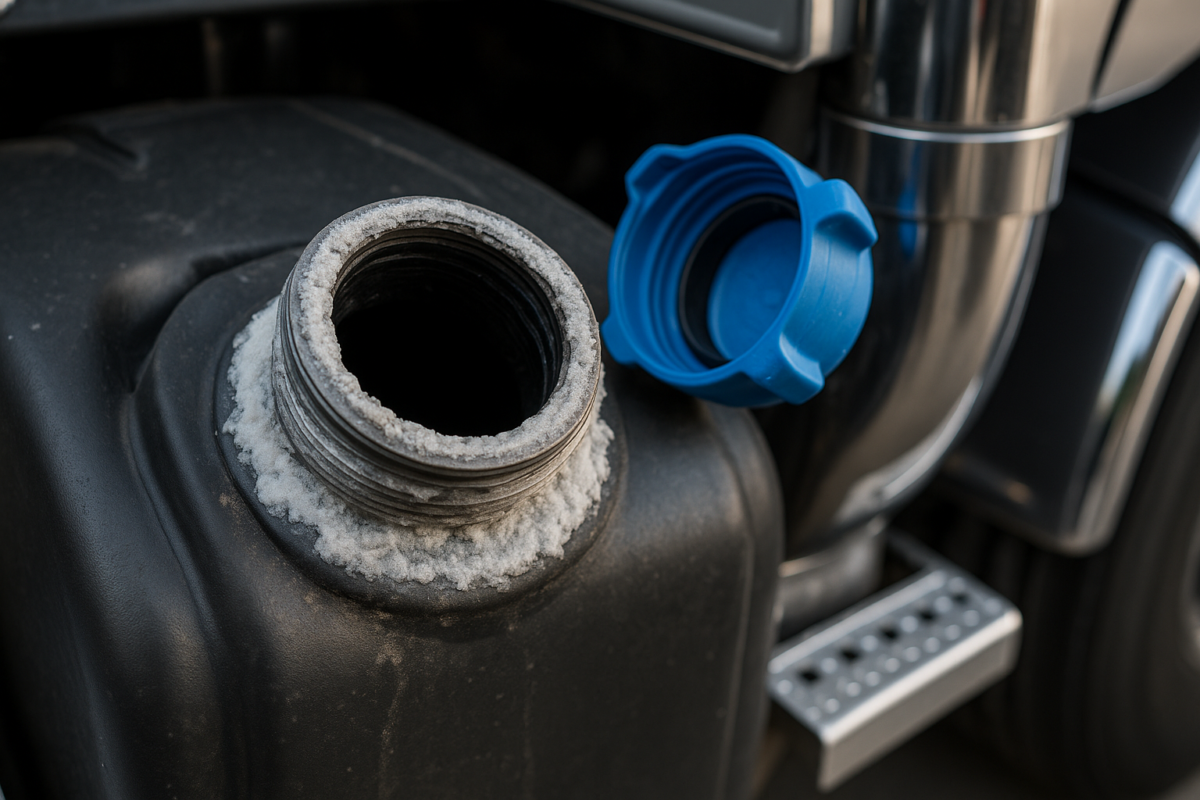
Tank-related trouble follows a short script. Crystallization at the neck, on the header, or through the pickup filter — from aged or contaminated fluid — is the volume offender; the tank-cleaning walkthrough and the deeper when-and-why guide handle recovery. Quality-sensor faults mean the fluid in the tank reads off-spec: sometimes bad fluid, sometimes a wrong-tank accident, sometimes a failing sensor — diagnose before replacing. Level-sensor and heater failures announce themselves as gauge nonsense and cold-weather codes respectively. And the header replacement is the endgame bill when contamination has done its work. Every path back to prevention runs through the same door: clean fills, fresh fluid, sealed cap, stabilized tank. Cheap habits, expensive alternatives.