What happens if you run out of DEF? The engine keeps running, but the truck will not let you keep driving normally. It warns you first, then derates engine power, then limits speed to a crawl (5 mph is common) or blocks a restart after the next shutdown. Put fresh certified DEF in the tank, a full 2.5-gallon jug or more, and the restrictions lift, usually within a key cycle or a short drive. That sequence is required by federal emissions rules, so every SCR diesel follows some version of it. Here is each stage, how to recover once you refill, and the one expensive mistake in the story: running the tank bone dry.
The Short Answer
Running out of DEF does not stall the engine or strand you in a lane. Diesel exhaust fluid feeds the SCR emissions system. It plays no part in combustion, so the engine runs fine without it mechanically. Software is what stops you. Emissions regulations require the truck to make driving without DEF progressively impossible: warnings first, a power derate next, and finally a hard limit. That limit is commonly 5 mph, and on some vehicles it is a refusal to restart after the next shutdown. Refill the tank and the truck comes back. The system is annoying by design. The costly outcomes are the ones people cause while fighting it.
Why the Truck Does This: EPA Inducement Rules
SCR systems only clean NOx while urea is being injected. The EPA therefore requires manufacturers to build inducement into every SCR diesel: escalating operating restrictions that make it impractical to run without DEF. Manufacturers certified their engines on the condition that the truck would enforce it. That is why there is no dealer menu that turns it off, why the countdown cannot be ignored, and why the answer to deleting the system stays no (more on that below). Because the restriction is regulatory rather than mechanical, the recovery is simple: satisfy the condition by putting DEF in the tank, and the restrictions lift.
The Warning Stages, Step by Step
The exact thresholds vary by make, but the ladder is universal, and the table on this page summarizes it.
- Stage 1, early warning. A DEF low lamp or message, typically with a mileage countdown that often starts around 1,000 miles of range. Everything drives normally. This is the cheap, calm stage, and the one to act in.
- Stage 2, escalation. The warnings become persistent and harder to dismiss, and the countdown shrinks. Some trucks chime on every start.
- Stage 3, derate. At or near empty, the engine controller cuts power: reduced torque, limited RPM, sluggish response. The truck still moves, and it is telling you the next stage is close.
- Stage 4, final inducement. Speed limited to a crawl, 5 mph being the common figure, or on some vehicles a block on restarting once you shut down. This stage exists so the vehicle can be moved off the road and to a refill, and for nothing else.
The stages are mileage-based and start-based. Parking the truck for a week resets nothing. Only DEF does.
What Different Trucks Do When DEF Hits Zero
Same ladder, different flavors. Knowing yours keeps the behavior from surprising you.
- RAM 6.7 Cummins: a mileage countdown, then a limited number of engine starts once empty, then the speed limit. The dash states how many starts remain. Believe it.
- Ford Power Stroke: staged speed reductions as range runs out, highway speed first and then lower, ending in a crawl limit once empty.
- GM Duramax: similar staged speed limits, with the final stage commonly around 4 to 5 mph on empty.
- Class 8 and medium-duty trucks: typically a 25 percent torque derate at empty, escalating to a 5 mph limit after a further grace distance or the next extended stop.
- Tractors and equipment: derate ladders that end in idle-only or creep mode. Same principle, tuned for machines that must never stop mid-operation.
Every one of these behaviors clears the same way: put DEF in the tank. If a code or countdown lingers after a proper refill, our DEF trouble codes guide covers what the system is still unhappy about.
Can You Keep Driving With No DEF?
Mechanically, briefly, yes. The engine does not need DEF to combust. Practically, the software makes the question moot: you will be derated within miles and crawling shortly after. The smarter framing is the countdown itself. From the first warning you typically have hundreds of miles of normal driving, enough to reach DEF almost anywhere in North America, since truck stops, most fuel stations and any auto parts store carry it. The drivers who end up at 5 mph on a shoulder are almost never far from DEF. They are the ones who dismissed the lamp for three weeks. Treat the first warning like a fuel light with a longer fuse and this section never applies to you.
How to Restart After Refilling DEF
The recovery is usually anticlimactic, which is exactly what you want.
- Add real quantity: two gallons or more. The level sensor needs to see meaningful fluid. A splash from a leftover quart often will not clear the inducement. A full 2.5-gallon jug is the standard fix.
- Key on, wait, then start. Turn the ignition to run for 30 to 60 seconds before cranking. This lets the system read the new level and, on many trucks, re-prime the dosing pump.
- Expect staged recovery. Some vehicles restore full power immediately. Others hold the derate until a short drive cycle completes and the system confirms it is dosing again. A few miles of normal driving typically finishes the job.
- If warnings persist, cycle the key twice more, then scan for codes. A lingering fault after a genuine refill usually means the pump pulled air or debris while running dry (see the damage section below) or a level sensor that has not re-read. Persistent pressure or quality codes deserve a diagnosis rather than repeated clearing.
Why Running the DEF Tank Dry Causes Damage
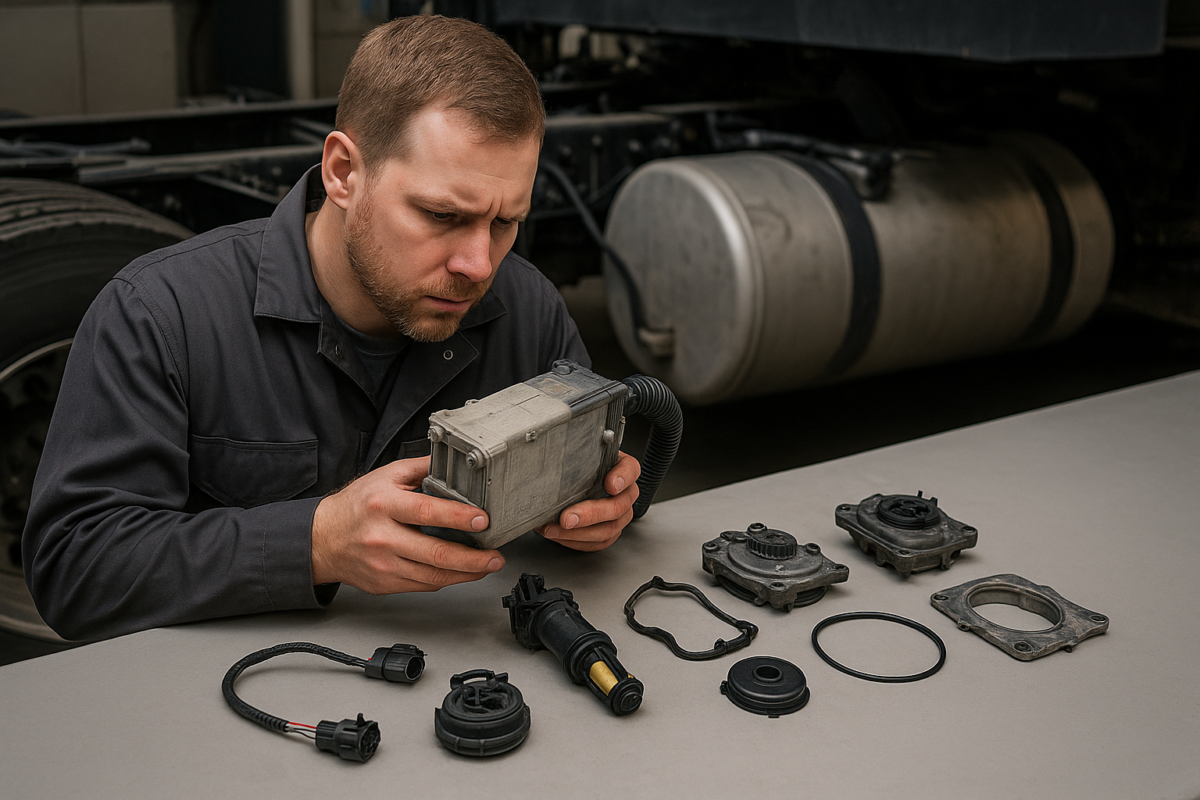
The inducement ladder is reversible. What happens at the bottom of an empty tank sometimes is not. Two mechanisms do the harm. First, the DEF pump lubricates and cools itself with the fluid it moves. Run it against an empty tank and it cavitates and runs dry, and DEF pumps are a several-hundred-dollar to four-figure part on most platforms. Second, the last inch of an old tank is the worst fluid in it: concentrated, contaminated, and often carrying urea crystals that formed as the level dropped and the residue dried. Sucking that layer through the pickup feeds crystals straight into the pump, filter and injector, which is the failure chain behind half the DEF codes we write about. Habitual run-it-to-the-warning ownership eventually buys a pump, and our P20E8 pressure-code guide so often begins with a tank that ran empty.
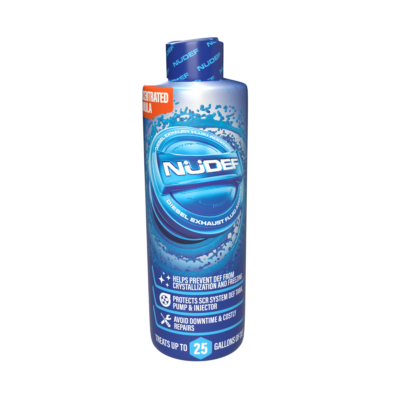
Crystals are also the reason fluid care matters between fills. DEF that sits in a tank or a jug through heat and time loses water, concentrates and starts to scale. NüDef DEF Treatment, Additive & Stabilizer is a stabilizer and anti-scaling agent: added at one 8 oz bottle per 25 gallons, it helps prevent crystallization and freezing and helps protect the pump and injector.
How Far a Tank of DEF Lasts
DEF consumption runs roughly 2 to 3 percent of diesel consumption: a gallon of DEF for every 35 to 50 gallons of fuel, give or take duty. In practice a diesel pickup with a 5 to 7 gallon DEF tank covers 3,000 to 8,000 miles per fill depending on towing. A Class 8 tractor burns through its larger tank far faster because it burns fuel faster. Heavy towing, high load and hot weather all push consumption toward the high end. The practical rule: top the DEF at every second or third fuel stop under heavy use, and at every oil change under light use, and the countdown never starts. Fluid age matters as much as quantity. DEF degrades with time and heat, and a jug that baked in the truck bed all summer is how you refill your way into a quality fault. Our DEF storage and shelf-life guide covers what to keep on hand and how.
Can You Bypass the DEF System?
Every empty-tank story eventually meets the suggestion to delete it. Defeating or removing the SCR system on a road vehicle violates the federal Clean Air Act, and enforcement against delete shops and tuners has been aggressive for years. A deleted truck fails inspection where testing exists, loses its emissions warranty, takes a real hit at resale and exposes the owner to fines. Water or other substitutes in the DEF tank do not work either. The quality sensor reads concentration and flags it, putting you right back on the inducement ladder with a contamination problem added. If you have already poured something wrong in, our wrong-tank guide is the article you need. The boring answer wins: DEF is cheap, available everywhere, and a system that runs on good fluid runs quietly for years.
The Fleet Version of This Problem
For a fleet, an empty DEF tank is never one driver’s bad afternoon. It is a truck out of revenue service, a service call and sometimes a tow, multiplied by however often the fluid is treated as an afterthought. The fixes are managerial more than mechanical. Put DEF on the fuel-stop checklist so it is topped on a cadence rather than on warnings. Watch it in telematics: most fleet systems expose DEF level and low-DEF faults, and a dashboard alert at a quarter tank costs nothing compared to an inducement event two states away. Stock sealed jugs at the yard and in service trucks, rotated by date so the oldest fluid gets used first while it is still in spec, and dose stored DEF with NüDef DEF Treatment, Additive & Stabilizer at the label rate, one dose per 2.5 gallons. When a driver reports a countdown, treat it as the free warning it is. Drivers who hide the lamp until the derate are responding to how the last driver who reported one was treated.
Fleets also feel the dry-run damage disproportionately, because a truck that ran empty once has usually done it before. The pump that finally throws a pressure code took its wear in installments. If a unit in your fleet has an empty-tank history and starts logging DEF faults, read the pattern rather than the single code.
Buying DEF on the Road: Pump vs Jug
Once the countdown is running, you have two ways to buy your way out. Truck-stop DEF pumps at the diesel island are the fleet answer: cheapest per gallon, fresh from high-turnover storage, and dispensed straight into the tank. The 2.5-gallon jug from the fuel station or parts store is the pickup answer, and it is everywhere, which is exactly why nobody should ever reach the 5 mph stage. Two quality notes when buying under pressure. Check the date code on a jug. DEF has a real shelf life, and a dusty jug from a slow-moving shelf may be past it. And skip the open or resealed container at any price. DEF picks up contamination easily, and pouring a questionable jug into an empty tank trades an inducement problem for a quality-sensor problem. Certified fluid, sealed container, recent date: that is the whole checklist, even at an unfamiliar stop with the countdown at zero.
A footnote for the day after the rescue. The emergency jug that restarted the truck was rarely the freshest one on the shelf, and the tank it went into had just been run to its worst inch. Adding NüDef DEF Treatment, Additive & Stabilizer at the next fill, one 8 oz bottle per 25 gallons, helps prevent crystallization in the fluid now in the tank. Keep a sealed spare jug in the cab for the next countdown.
Ran Out, or Something Broke?
An empty tank and a failed DEF system produce nearly identical dashboards, and the difference decides whether the fix costs twelve dollars or several hundred. Before assuming you ran dry, check the physical level with a flashlight, because a stuck level sender runs the same countdown with a half-full tank. If the tank truly is empty, refill with fresh certified fluid and the system clears itself within a few minutes of running. If the tank has fluid and the truck still counts down, you are not out of DEF. You have a Service DEF System fault, and the codes will say which component. Our Service DEF System guide and DEF sensors and gauges guide walk through the diagnosis. Refilling over and over without checking is how a $20 sensor diagnosis becomes a tow.
Never Get Caught Empty Again
- Carry a sealed 2.5-gallon jug behind the seat or in the toolbox. The empty-tank problem disappears permanently for about the cost of lunch.
- Refill on a schedule, not the warning: every second or third fuel stop when towing, every oil change otherwise.
- Buy fresh, store cool, keep it sealed. DEF ages. The jug from two summers ago belongs in disposal, and our storage guide covers how.
- Stabilize what you store. If DEF sits in your tank, your spare jug or a yard tote between uses, NüDef DEF Treatment, Additive & Stabilizer helps prevent crystallization and freezing. One 8 oz bottle treats 25 gallons. It is cheap insurance for the pump and injector this whole article is about protecting.
Run out once and the truck makes sure you remember it. Keep a jug on board, keep the fluid fresh and treated, and the inducement ladder stays something you read about instead of something you crawl home on. Order NüDef DEF Treatment, Additive & Stabilizer direct from nudef.com.