Updated October 2026. Every capacity below comes from the truck maker’s own owner’s manual, specification sheet, service bulletin or body builder manual, and each row links to it. Where a maker has not published a figure, this page says so instead of guessing.
DEF Tank Capacity by Truck: The Chart
DEF tank capacity is the one number owners ask about most and the one that is hardest to find, because most spec sheets list the fuel tank and skip the blue cap. The chart gathers the published figures in one place. Capacities are approximate, the way the manuals state them, and a full tank is rarely bone dry when you fill, so expect to add a gallon or so less than the number shown.
| Truck | Engine | Model years | DEF tank | Where the number comes from |
|---|---|---|---|---|
| Ram 2500 / 3500 pickup | 6.7L Cummins | 2013 to current | 5.7 gal (21 L) | Ram owner’s manual, Fluid Capacities; FCA service bulletin |
| Ram 3500 / 4500 / 5500 chassis cab | 6.7L Cummins | 2014 to 2015 documented | 9.25 gal (35 L) | FCA service bulletin |
| Ram 1500 EcoDiesel (previous generation) | 3.0L V6 | 2014 to 2019 | 8 gal | Ram launch release |
| Ram 1500 EcoDiesel (current body) | 3.0L V6 | 2020 to 2023 | 5.7 gal (21.7 L); 5.1 gal (19.5 L) on Tradesman and Rebel | Ram specification table; confirm on the Fluid Capacities page of your owner’s manual |
| Ford F-250 / F-350 Super Duty | 6.7L Power Stroke | 2011 to 2016 | 5 gal | Ford’s 2017 announcement (7.5 gal, up 2.5 gal from 2016) |
| Ford F-250 / F-350 Super Duty | 6.7L Power Stroke | 2017 to 2026 | 7.5 gal (28.4 L) | Ford 2026 Super Duty technical specifications |
| Chevrolet Silverado / GMC Sierra 1500 | 3.0L Duramax | 2020 to 2021 | 5.3 gal (20.3 L) | GM 2021 Duramax 3.0L supplement |
| Chevrolet Silverado / GMC Sierra 1500 | 3.0L Duramax | 2022 to 2025 | 5.4 gal (20.5 L) | GM 2022 supplement, 2025 supplement |
| Chevrolet Silverado / GMC Sierra HD | 6.6L Duramax (LML) | 2011 to 2016 | 5.5 gal | GM 2011 diesel emissions briefing |
| Chevrolet Silverado / GMC Sierra HD | 6.6L Duramax (L5P) | 2017 to current | 7 gal | Chevrolet’s 2017 launch statement; confirm in your Duramax supplement |
| Freightliner Cascadia | Detroit / Cummins | 2013 to current | 6, 13 or 23 gal (ordered option) | Daimler Truck customer advisory |
| Peterbilt 579 / 567 / 589 | PACCAR MX / Cummins | Current | 10.2, 13.9, 16.1, 17.9 or 20.1 gal | Peterbilt body builder manual, Table 3-27 |
| Kenworth T680 / T880 | PACCAR MX / Cummins | Current | 21 gal medium aero (one of several options) | Kenworth announcement |
If your truck is on the chart, the next sections explain the number, what changed between generations, and how far a tank goes. If it is a different vehicle, skip to reading your own truck: the Capacities page of every diesel owner’s manual carries the figure, and GM prints it on the diesel supplement as well.
Ram 2500 and 3500 with the 6.7L Cummins
The question that sends more people to this page than any other is the DEF tank size on the 6.7L Cummins, and the answer has been steady for a long time. Ram’s owner’s manual lists the Diesel Exhaust Fluid Tank at 5.7 gallons (21 liters) on the 2500 and 3500 pickups, and FCA’s own 2015 service bulletin describes the same 5.7-gallon (21.5-liter) tank in the pickup application. That bulletin also gives the cab chassis figure that owners of 3500, 4500 and 5500 work trucks need: a 9.25-gallon (35-liter) tank, because a chassis cab burns more fuel per mile and the frame has room for it.
For a 2026 Ram 2500 or 3500, the 2026 specification sheet lists the fuel tanks (31, 32 and the optional 50 gallons) and leaves DEF out, so the owner’s manual is the place to confirm it. Nothing in Ram’s documentation since 2013 shows a different pickup tank, and the DEF filler still sits beside the fuel filler behind the same door. The low-DEF warning on these trucks comes on at roughly 2.5 gallons remaining, which is why a “low” light can accept only three gallons or so before the tank is full. Stop when the pump clicks or the jug glugs. If fluid ever went down the wrong filler, the wrong-tank guide covers what to do first.
Ram 1500 EcoDiesel
The two EcoDiesel generations carry different tanks. When the 3.0L V6 arrived in the 2014 Ram 1500, Ram said plainly that “the DEF tank holds eight gallons of fluid” with an average refill interval of about 10,000 miles. That 8-gallon tank stayed with the previous-generation body through 2019, including the trucks sold alongside the new body as the Ram 1500 Classic.
The current body, built from 2019 and offered with the EcoDiesel from 2020 through 2023, moved the DEF tank and shrank it. Ram’s specification table for this truck lists 5.74 gallons (21.7 liters) for most trims and 5.14 gallons (19.5 liters) for Tradesman and Rebel. Owners who read the online manual for a 2021 Laramie report 5.7 gallons, which matches. Because two figures exist for one model year, check the Fluid Capacities page of your own manual before you buy a case of jugs for a road trip.
Ford F-250 and F-350 with the 6.7L Power Stroke
Ford made one big change and has held it since. The 2011 to 2016 Super Duty carried a 5-gallon DEF tank. When the aluminum-body truck launched for 2017, Ford’s announcement stated that Power Stroke models got “a larger-capacity diesel exhaust fluid tank, up 2.5 gallons (9.5 liters) from the 2016 model to 7.5 gallons (28.4 liters).” Ford’s technical specification sheet for the 2026 Super Duty pickups still lists the Diesel Exhaust Fluid (DEF) Tank Capacity at 7.5 gallons for both the standard and high-output 6.7L diesels, so every 2017 to 2026 pickup is the same.
At 7.5 gallons the Super Duty has the largest DEF tank among the heavy-duty pickups, which is part of why Ford owners see longer stretches between fills than Ram or GM owners pulling the same trailer. If a Power Stroke is throwing DEF codes rather than just asking for fluid, start with the Power Stroke DEF problems guide.
Ford F-150 with the 3.0L Power Stroke
Ford sold the 3.0L Power Stroke V6 in the F-150 from 2018 through 2021. Ford’s technical specification sheet for the 2021 F-150 lists a 26-gallon diesel fuel tank for that engine but does not publish the DEF tank capacity, and the F-150 spec sheets for the other years are the same. Enthusiast outlets have long quoted about 5.4 gallons, and that is consistent with a half-ton diesel, but it is not a Ford-published figure, so it is left off the chart. The Capacities and Specifications chapter of the F-150 diesel owner’s manual carries the number for your year.
Chevrolet Silverado and GMC Sierra with the Duramax
GM publishes the DEF figure in a separate Duramax Diesel supplement instead of the main owner’s manual, which is why it is so hard to find on the web. For the half-ton 3.0L Duramax, the 2021 supplement lists the Diesel Exhaust Fluid (DEF) Tank at 20.3 liters, 5.3 gallons, and the 2022 and 2025 supplements list 20.5 liters, 5.4 gallons. The difference is a tenth of a gallon and reflects the second-generation engine’s packaging, so treat any 2020 to 2025 Silverado 1500 or Sierra 1500 diesel as a 5.3 to 5.4-gallon tank.
The heavy-duty 6.6L Duramax has two generations of tank. GM’s 2011 diesel emissions briefing, prepared when the LML engine and its SCR system launched, shows a 5.5-gallon DEF tank under the passenger side of the Silverado and Sierra HD, and a 5.83-gallon tank on the Express and Savana cutaway vans. For the 2017 redesign that brought the L5P engine, Chevrolet stated that the fuel tanks stayed the same size while the DEF tank grew to 7 gallons in the same location, and the 2020 and newer HD trucks carry that tank forward. GM’s segmented DEF gauge on these trucks can read full after about a 5-gallon top-up, which fools owners into thinking the tank is smaller than it is. When the display says anything other than OK, GM’s guidance is that you can add at least 2.5 gallons.
Both Duramax generations put the tank where road salt and heat cycles reach it, and the header unit inside the tank carries the level sensor, heater and pickup. Crystals that form in the tank settle on exactly those parts. The Duramax DEF problems guide walks through the codes that follow.
Class 8 Trucks: Cascadia, Peterbilt and Kenworth
On a heavy truck the DEF tank is an ordered option sized to the fuel capacity, so two identical-looking tractors can carry very different amounts. Daimler Truck’s customer advisory for the Freightliner Cascadia describes the three factory tanks: a 6-gallon tank introduced in January 2013, and the 13-gallon and 23-gallon tanks whose header unit bolts to the top of the tank and carries the coolant lines, coolant valve, level sensor and temperature sensor. A regional day cab usually gets the small tank; a sleeper running 11 hours a day gets the 23.
Peterbilt publishes its sizes in the heavy-duty body builder manual, Table 3-27: a small tank of 10.2 gallons, medium 16.1, large 20.1, plus aerodynamic medium and large tanks of 13.9 and 17.9 gallons. The manual tells body builders to find the truck’s total fuel capacity first, because that determines which DEF tank the factory installed. Kenworth, Peterbilt’s sister brand, offers a 21-gallon medium aero tank on the T680 and T880, now with an integrated step option. If your Cascadia or PACCAR truck is in the shop for an aftertreatment fault, the Cascadia DEF guide and the Cummins X15 DEF guide cover the usual suspects.
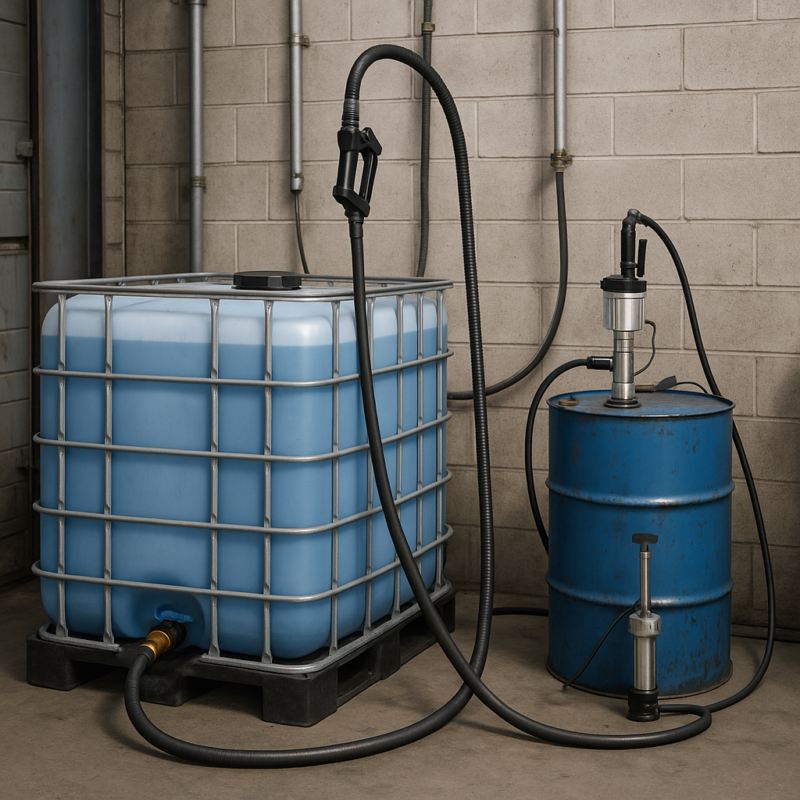
Fleets that fuel from a tote or a transfer tank should treat the bulk supply, since every gallon in those 23-gallon tanks came out of it. NüDef DEF Treatment, Additive & Stabilizer is sold by the case of 30 bottles for that use, and the wholesale program covers larger volumes. The DEF transfer tank guide covers pumps and keeping bulk fluid clean.
How Far a Tank of DEF Goes
Consumption, not capacity, decides your refill interval. Engine makers size dosing at roughly 2 to 3 percent of diesel burned, more under heavy load and heavy idling. A worked example: a Ram 2500 towing at 11 mpg burns about 9 gallons of diesel per 100 miles. At 3 percent DEF use that is 0.27 gallon of DEF per 100 miles, so the 5.7-gallon tank covers about 2,100 miles before the low light, and roughly 3,200 miles running empty at 17 mpg. A Super Duty’s 7.5 gallons stretches each of those figures by about a third. A Cascadia with a 23-gallon tank at 6.5 mpg and 2.5 percent dosing runs about 6,000 miles between fills. The DEF usage calculator lets you run your own numbers, and the run-out guide explains the derate ladder if you push it.
Reading Your Own Truck
Three places carry the figure. The Capacities (or Fluid Capacities) page of the owner’s manual lists Diesel Exhaust Fluid Tank in gallons and liters; on GM trucks it is in the Duramax Diesel supplement, and on older Ram and Ford trucks it is in the Diesel Supplement booklet. Some trucks print DEF capacity on the fuel door sticker next to the fuel grade. Failing both, the parts counter can read the tank part number off your VIN, and dealers’ tank listings include the capacity. Be wary of forum numbers: the 8-gallon EcoDiesel figure and the 5.7-gallon Cummins figure get swapped constantly, and a 2020 Ram 1500 owner who believes the 8-gallon number will overfill the tank by more than two gallons.
The Tank Is Where DEF Goes Bad
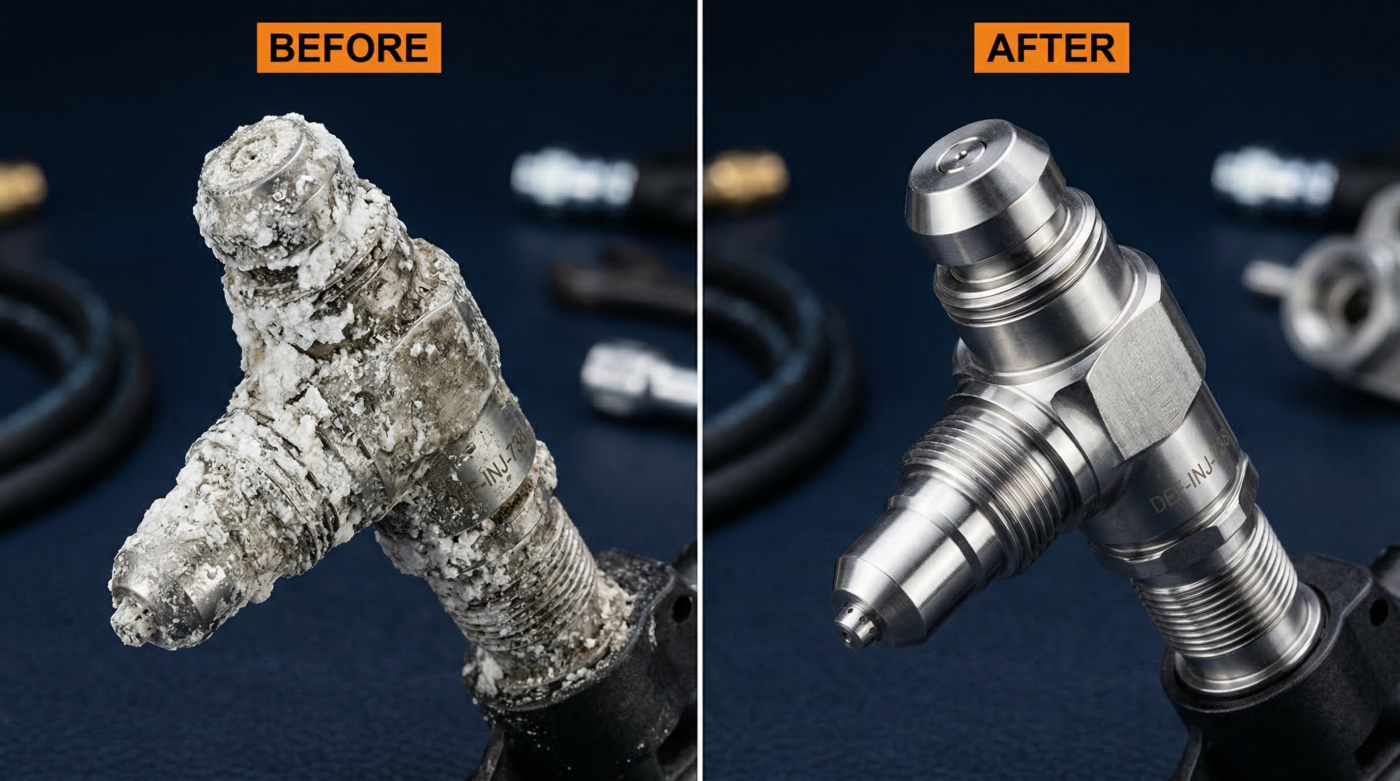
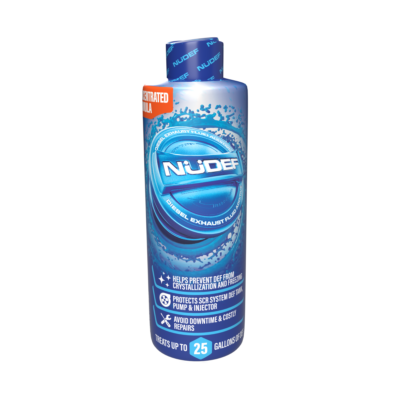
Every tank on this chart is a plastic reservoir that sits for weeks between fills, warms with the exhaust and the engine, and cools at night. Water evaporates from the top of the fluid and the urea it leaves behind crystallizes on the filler neck, the header unit, the pickup screen and the heater element. A 5-gallon pickup tank that is only ever topped off by a gallon at a time cycles the same old fluid for a year. That is the condition NüDef DEF Treatment, Additive & Stabilizer is made for: it helps prevent crystallization in treated fluid and protects the SCR tank, pump and injector. The dose comes from the label: one measured dose per 2.5 gallons of DEF, an 8 oz bottle treats 25 gallons, add it at every refill and do not exceed the dose. Use it with ISO 22241 or API-certified DEF, never instead of it. On a 5.7-gallon Cummins tank a full fill takes two doses; a 23-gallon Cascadia tank takes most of a bottle. Order direct, and read the DEF tank explainer for what lives inside the tank and how to fill it without introducing dirt.