The Three Failure Modes Untreated DEF Creates
DEF is required, DEF is consumed continuously, and DEF crystallization is a known and well-documented problem on every diesel platform built since 2010. Yet most fleet operations and individual diesel owners treat DEF crystallization as a maintenance reactive problem — they wait until something breaks, then they fix it.
That reactive posture costs significantly more than preventing the problem. To understand why, you need to know the three distinct ways untreated DEF causes failures:
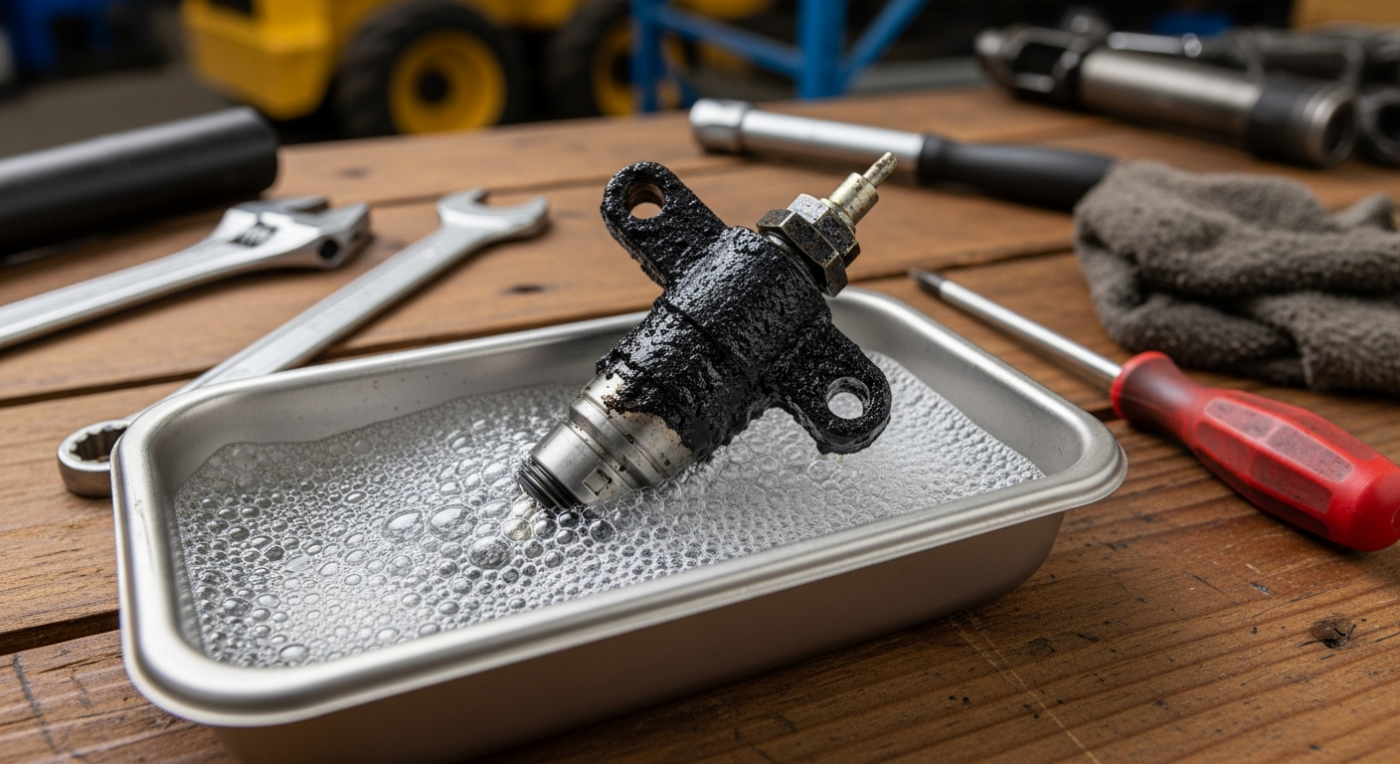
Failure Mode 1: Crystallization at the SCR injector. Your truck’s DEF injection nozzle sprays a precise pattern of fine DEF mist into the exhaust stream. Over time, and faster under some operating conditions, urea crystals build up at the nozzle face. The spray pattern degrades, dosing becomes inconsistent, and eventually the injector either clogs or sprays inefficiently. Repair: nozzle cleaning or replacement, $400–$1,200.
Failure Mode 2: Crystallization on the SCR catalyst face. The selective catalytic reduction catalyst is a honeycomb-structured ceramic substrate coated with active catalyst materials. When DEF is sprayed onto this catalyst at the wrong temperature, in the wrong mixing ratio, or under transient load conditions, urea decomposition is incomplete. Crystals deposit on the catalyst face. Once they’re there, they remain there — the catalyst face is now partially blocked, reducing NOx conversion efficiency. The truck’s NOx sensors detect the drop in conversion, and the truck can set P20EE (SAE J2012: SCR NOx Catalyst Efficiency Below Threshold, Bank 1). Repair: catalyst cleaning ($800–$2,800 if salvageable) or replacement ($1,500–$12,000+ depending on vehicle class).
Failure Mode 3: Crystallization in the DEF storage system. Bulk DEF storage (drums, totes, on-site tanks) develops crystallization over time as water evaporates and biological contamination accumulates. By the time fleet operators dispense this DEF into vehicles, the DEF is partially out of spec — driving Failure Mode 1 and Failure Mode 2 in the trucks receiving it. Repair: drain and dispose of stored DEF, clean storage system, refill with fresh certified DEF. Cost: $400–$2,800 depending on storage volume.
Most fleet operations experience all three failure modes simultaneously across their fleet over time. The cost compounds.
How SCR Fault Codes Escalate: P207F, P20EE, P20EF and Derate
The truck’s computer reports DEF and SCR problems through diagnostic trouble codes (DTCs). The codes below are defined in SAE J2012. They report what the controller measured, so diagnose before you replace parts.
P207F (Reductant Quality Performance). The controller has decided the DEF is not the right strength, either from a DEF quality sensor or from low NOx conversion. Causes include contaminated, diluted or aged DEF. Driver experience: warning light, and the truck logs the event. P207F deep dive.
P20EE (SCR NOx Catalyst Efficiency Below Threshold, Bank 1). The NOx sensor downstream of the SCR catalyst is reading higher NOx than expected, so the catalyst is not converting NOx as required. Causes include crystal deposits, poor fluid, a restricted injector, a failing NOx sensor and a worn catalyst. Driver experience: warning light and MIL (malfunction indicator lamp) on the dashboard.
P20EF (SCR NOx Pre-Catalyst Efficiency Below Threshold, Bank 1). The same kind of conversion fault as P20EE, reported for the pre-catalyst stage on systems that monitor one. Diagnose it the same way as P20EE.
Inducement (derate). If an SCR fault is not repaired, EPA rules require the engine to enter inducement: a warning countdown, then a torque limit, then a vehicle speed limit. The exact stages and limits vary by manufacturer and model year. The truck returns to normal operation once the fault is repaired and the system confirms it.
How fast a truck moves from the first warning to derate depends on the fault and the manufacturer’s calibration. For fleet operations, the practical question is how often your trucks reach that point, and what each event costs.
SCR Repair Costs by Vehicle Class
Here’s what fleet operators and individual diesel owners actually pay when DEF-related SCR damage requires repair:
| Vehicle Class | SCR Catalyst Replacement | Full SCR System | Plus Labor |
|---|---|---|---|
| Light-duty diesel pickup (F-250, Ram 2500, GM 2500HD) | $1,500–$3,200 | $2,800–$4,500 | $400–$800 |
| Medium-duty (F-650, Ram 5500, ISB 6.7) | $2,800–$4,800 | $4,500–$7,500 | $600–$1,200 |
| Heavy-duty Class 8 OTR (ISX 15, DD15, MX-13) | $4,200–$8,500 | $7,000–$12,000+ | $800–$1,600 |
| Vocational truck (refuse, concrete, dump) | $3,500–$6,500 | $5,500–$9,500 | $600–$1,400 |
| Standby diesel generator (200–1,000 kW) | $3,500–$8,500 | $6,500–$15,000 | $1,000–$2,400 |
| Industrial generator (1,500+ kW Tier 4 Final) | $8,000–$22,000 | $15,000–$35,000+ | $2,500–$6,000 |
These costs are what’s billed by dealer service or independent diesel shops in 2026. Owner-operator self-repair on light-duty pickups can cost less but assumes the owner has the diagnostic equipment and mechanical skills. Heavy-duty repairs above Class 7 are virtually always dealer-network repairs because of the specialized SCR test equipment required.
The catalyst-only replacement cost assumes the rest of the SCR system (DEF tank, pump, injector, mixing tube, NOx sensors, control module) is intact. In reality, when one component fails another often shows wear too — bringing the total repair to “full SCR system” pricing.
One important point: when the root cause is not fixed, SCR repairs tend to repeat. A new catalyst or injector installed into the same crystallization conditions faces the same problem again.
The Hidden Cost: Downtime
Repair invoices show up on the books as line-item expenses. Downtime usually doesn’t — but it’s often the larger cost.
Class 8 OTR semi-trailer downtime: $800–$2,400 per day of lost revenue. A truck with a P20EE that needs catalyst replacement is typically off-road for 5–10 business days while parts are sourced and installed. That’s $4,000–$24,000 in lost revenue on a single repair event, on top of the $5,000–$13,000 repair invoice.
Vocational fleet (concrete, refuse, utility): Downtime costs depend on operational redundancy. If you have 1 backup truck for every 8 active vehicles, a single SCR repair just rotates a vehicle out of service for a few days — minimal direct downtime cost. If you have 1 backup for every 30 vehicles, a single SCR repair can shut down a route or contract for the duration.
Light-duty work fleet (electricians, plumbers, contractors): Downtime costs are operator-skill-specific. A licensed electrician who can’t get to a job site because their truck is in the shop loses billable hours — typically $80–$160 per hour. Two days of truck downtime can cost $1,200–$2,500 in lost billings.
Standby generator: A failed SCR on a standby unit doesn’t usually shut down operations (the generator only runs during utility outages). But the next time utility power fails, the generator may not start or may fail emissions testing. For mission-critical applications (hospitals, data centers, life-safety code-compliant facilities), an SCR failure at the wrong time creates substantial liability.
Quantifying downtime cost across a fleet is difficult because it depends on operational redundancy, contract structure, and customer SLAs. But the rough math: downtime costs typically equal or exceed direct repair costs. A $5,000 SCR catalyst repair on a Class 8 truck typically carries $4,000–$24,000 in associated downtime cost. That’s the budget number fleet CFOs need to plan around.
DOT Compliance and Warranty Implications
SCR failures create regulatory and warranty exposure beyond the direct repair cost.
DOT roadside inspection. A truck running in limp mode or with active P20EE/P20EF codes may fail DOT roadside inspection. The truck can be placed Out-of-Service (OOS), requiring the driver to call for emergency repair. OOS placement also creates a roadside inspection record that affects the carrier’s CSA (Compliance, Safety, Accountability) Behavior Analysis and Safety Improvement Category (BASIC) scores. Multiple OOS events over a 24-month window can trigger DOT audits.
EPA tampering enforcement. Driving with a defective or bypassed SCR system, or modifying the SCR system to allow continued operation with crystallization issues, exposes the operator to EPA tampering enforcement. EPA can assess civil penalties for each violation.
Manufacturer warranty. Check your engine’s emissions warranty terms for SCR coverage. Warranties often exclude damage caused by off-spec DEF, contaminated DEF, or extended operation with diagnostic codes uncleared. A fleet operator with extensive SCR crystallization across the fleet may find their warranty claims denied because the warranty company can document chronic ignored fault codes.
Aftermarket warranty (extended warranty). Vehicles in fleet service often carry aftermarket extended warranties that include the SCR system. These warranty providers are increasingly aggressive about declining claims related to crystallization, often citing “lack of maintenance” or “extended operation with diagnostic codes.” For fleet operators, keeping clear maintenance records helps when a claim is reviewed.
Fleet-Scale Math: Build Your Own Baseline
Every fleet’s numbers are different, so build the comparison from your own records instead of an industry average:
- Count the SCR-related repair events (catalyst, injector, pump, DEF system) over the last 24 months.
- Total the invoices for those events.
- Add downtime: days off the road per event times what a day off the road costs your operation.
- Divide by two for an annual cost of doing nothing.
- Compare that number with the annual cost of treating your DEF at the labeled dose: one 8.45 fl oz bottle per 25 gallons, at every refill.
For more on fleet costs, see our Fleet ROI Breakdown. Call (855) 300-0031 for current fleet wholesale pricing on Case (30) packs.
The Standby Generator Problem
Diesel standby generators face the same DEF crystallization issues as on-road vehicles — but with one critical difference: they don’t drive every day. A standby generator sits idle most of the year, only running for utility outage events and monthly maintenance testing.
The DEF in a standby generator’s tank sits there for months at a time. It’s exposed to temperature swings (rising in summer, falling in winter), light exposure, and the engineered storage conditions that may not be ideal. Over a 12–24 month period of idle storage, the DEF drifts toward off-spec.
Then the standby generator gets called into service. Maybe it’s a utility outage during a heat wave. Maybe it’s a scheduled monthly maintenance test. Maybe it’s a code-required annual load test. The unit fires up, the SCR system tries to inject DEF that’s been sitting for months, and the catalyst fails to convert NOx efficiently. The generator either flags fault codes immediately or fails emissions testing — at the worst possible moment.
For mission-critical applications — hospitals, data centers, dialysis centers, life-safety code-compliant buildings — a generator that fails during an outage is potentially life-threatening and certainly contract-violating. The cost of an unsuccessful generator start during an actual outage event is virtually impossible to quantify — but it’s measured in dollars (downtime, business interruption, customer compensation) and potentially in regulatory exposure (HIPAA, life safety code violations).
For standby generators specifically, our Generator DEF Treatment guide covers the preventive maintenance strategy. Treating the DEF inventory with NüDef as part of the generator’s annual PM cycle is dramatically cheaper than the alternative.
Why “Just Use Better DEF” Doesn’t Solve It
The natural pushback when DEF crystallization is presented as a chronic problem: “I’ll just buy better DEF.” It seems intuitive — if the problem is in the fluid, get higher-quality fluid. But this doesn’t actually solve the underlying issue.
Here’s why: certified DEF that meets ISO 22241 is mechanically identical across brands. There’s no “premium DEF” that’s chemically superior to the commodity DEF you buy at Walmart. The standard exists precisely because chemical variation in DEF damages SCR systems. Every certified DEF has the same composition, same purity, same chemical behavior.
The crystallization problem isn’t in the fluid you put into the tank. It’s in what happens to that fluid after it enters the SCR system. Specifically:
- Injection happens at exhaust temperatures that aren’t always optimal for complete urea decomposition
- Mixing in the exhaust mixer isn’t always uniform
- Catalyst face temperature varies with engine load
- DEF dosing rate during transient loads is imperfect
All of these factors create urea decomposition intermediates that crystallize on the catalyst face. No DEF brand changes any of this — the fluid is identical chemically regardless of brand.
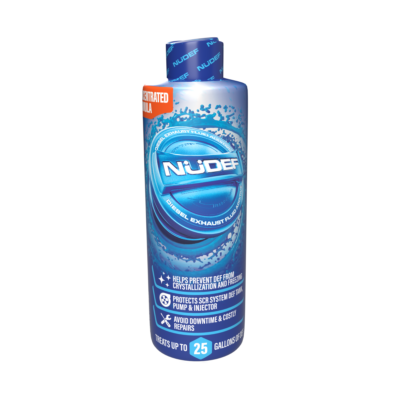
That is where an additive fits. NüDef DEF Treatment, Additive & Stabilizer is a DEF stabilizer and anti-scaling agent. It helps prevent DEF crystallization and helps protect the SCR system, DEF tank, pump and injector, helping you avoid downtime and costly repairs. It does not repair a damaged catalyst or clear fault codes, so diagnose and repair any active code first.
Read more about whether DEF additives actually work.
Order Single bottles for personal trucks direct at nudef.com. Fleet wholesale pricing on Case (30) packs is available. Call (855) 300-0031 or email info@nudef.com with your fleet size and monthly DEF consumption.