What P20E8 Actually Means
The P20E8 code sets when the engine computer commands the DEF pump to pressurize the system and the pressure sensor reports it never got there, or couldn’t hold it. Most SCR systems run around 72 psi (5 bar) at the injector; if the pump can’t build that pressure within its allowed time, or pressure sags while dosing, the ECM logs P20E8 and turns on the check engine light.
The code is telling you about a supply problem, not a dosing-quality problem. That puts the search area between the tank and the injector: pump, filter, lines, and whatever is living inside them. Its cousin P203F (reductant level too low) points at the tank level sensor instead, and the general family is covered in our DEF trouble codes guide.
Ford 6.7 Power Stroke owners see this code more than most — the pump module lives in the DEF tank and both filter clogging and pump wear show up there first. Ram and GM trucks throw it too, and so do off-highway machines with SCR.
Symptoms You’ll Notice
- Check engine light, with P20E8 stored (often alongside P204F or P20E9)
- A DEF or SCR system warning message on the dash
- A speed-derate countdown if the truck decides the SCR system is inoperative — federal emissions rules require it, and you do not want to ride that counter to zero
- A faint hum or laboring buzz from the DEF tank at key-on that runs longer than the usual few-second prime, as the pump strains against a restriction
- On Ford trucks, a “Check Exhaust Fluid System” message and on Ram trucks “Service DEF System”; our Service DEF System guide covers the countdown that follows
- Sometimes nothing else at all — the truck runs fine until the countdown starts, which is why the code deserves attention the week it appears, not the month after
Causes, Ranked by Likelihood
1. Clogged DEF pump filter. The pump has a small filter that catches debris and crystal particles. It clogs slowly, pressure creeps down, and one cold morning the pump can’t make spec. Cheapest fix on this list and the first thing to check. Our DEF filter service guide walks through it.
2. Crystallized DEF in the pump, lines, or injector. DEF is two-thirds water. Let it evaporate anywhere — pump head, line fittings, injector tip — and it leaves urea crystals that restrict flow like plaque in an artery. The pump works harder against the restriction until it can’t hold pressure. If you’ve ever found white crust around a DEF fitting, this is your prime suspect. See how to clean crystallized DEF for the cleanup procedure.
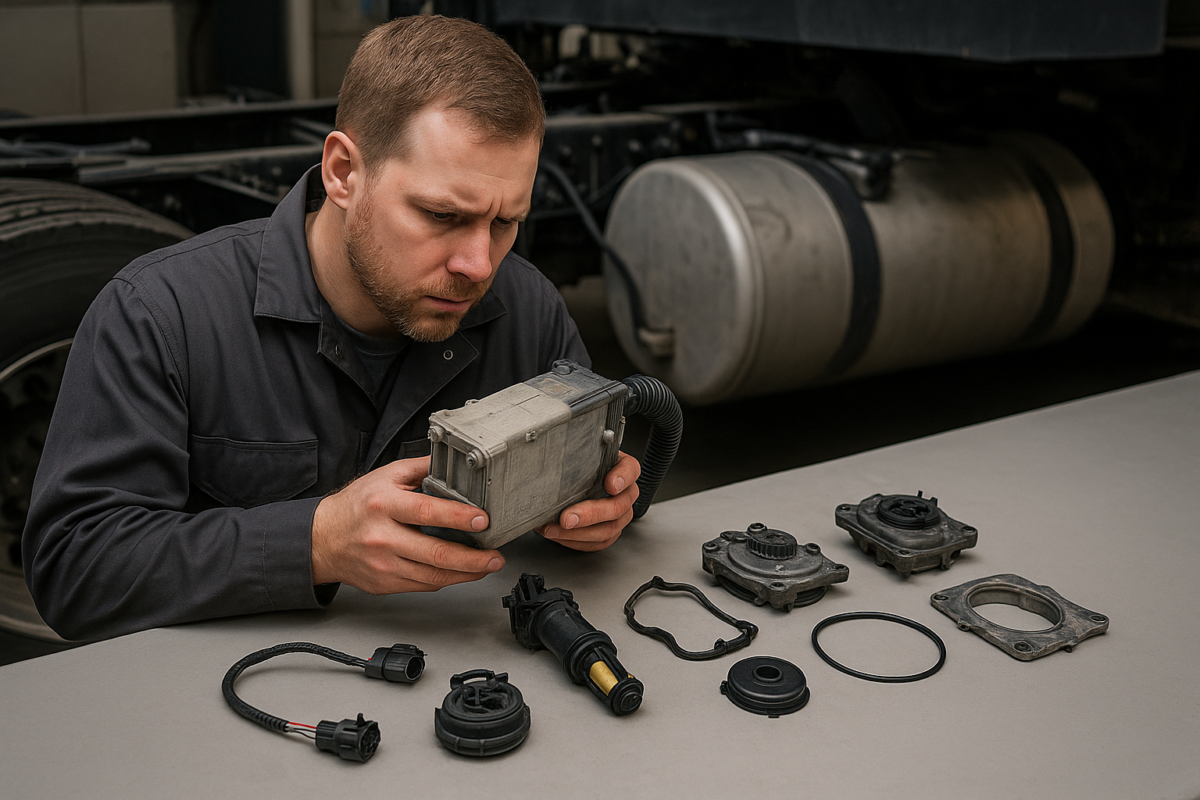
3. Failing DEF pump. Pumps wear out, and they wear out faster when they’ve spent years fighting crystal restrictions. If the filter is clean, the lines are clear, and pressure still won’t build, the pump itself is done. Our DEF pump failure guide covers the replace-versus-clean decision.
4. Frozen DEF. DEF freezes at 12°F. The heaters are supposed to thaw it before dosing starts, but a failed tank or line heater in a cold snap produces a textbook winter P20E8. If the code only appears in freezing weather, start with the heater system, not the pump.
5. Leaks, kinked lines, or a stuck injector. Less common. A weeping fitting bleeds pressure, and an injector stuck open can’t hold system pressure while dosing.
P20E8 vs. the Related Reductant Codes
P20E8 rarely travels alone. Reading the codes stored with it points at the failing part faster than any single code:
- P20E9, reductant pressure too high: the mirror image. The pair together usually means a sticking pressure regulator or a pump module whose controller is hunting, and points at the module rather than the filter.
- P249D, reductant flow too low: the dosing loop is at its limit. P249D with P20E8 means the injector is starved by the supply problem; fix the pressure first and the flow code usually clears with it.
- P204F, reductant system performance: a general performance flag most controllers set once P20E8 has persisted; it adds no new information.
- P203F, reductant level too low: a tank-level fault. P203F with P20E8 on a tank that reads full points at the level sender inside the pump module, which on many trucks is one assembly with the pump.
- P2048, injector circuit low: electrical, at the injector. With P20E8 it usually means an injector stuck open bleeding pressure, the fifth cause above.
- P20EE / P207F, SCR NOx conversion efficiency: the downstream consequence when too little DEF reaches the catalyst.
The full family is mapped in the DEF trouble codes guide.
How to Diagnose It Yourself
A basic scan tool that reads DEF system PIDs gets you most of the way:
- Read actual vs. commanded reductant pressure with the key on. Commanded ~72 psi with actual pressure flat or sagging confirms the supply-side problem.
- Listen at the tank during the pump prime cycle. A healthy pump hums for a few seconds; silence points at power, connector, or a dead pump; a laboring buzz points at restriction.
- Pull the pump filter. If it’s coated in white crystal sludge, you’ve found both the immediate cause and the underlying one — the DEF itself has been crystallizing.
- Inspect every fitting from tank to injector for white crust. Crystals outside a fitting mean crystals inside it.
- Check DEF quality. Old, heat-aged, or contaminated fluid crystallizes far faster than fresh spec fluid. A refractometer reading (32.5% urea) takes thirty seconds.
How to Fix P20E8
- Filter clogged (most cases): replace the pump filter, a $25 to $80 part behind a cap on the bottom of the pump module on most trucks. Refit with the new seal, prime the system with the scan tool or three key-on cycles, and read actual pressure; it should reach the commanded value within seconds and hold.
- Crystals in the lines or fittings: disconnect the lines at both ends, flush with warm distilled water until they run clear, clean the fittings, and reconnect. Replace any line that will not clear or shows a crushed section. The crystallized DEF guide covers the procedure.
- Pump worn: replace the pump module as an assembly. Use the OEM or an OEM-equivalent module; the pressure regulator and the level sender live inside it, and low-cost units are the most common cause of a repeat visit. Drain and flush the tank while it is open.
- Frozen or slushy DEF: confirm heater operation on the tank, lines and pump with the scan tool’s heater commands before buying anything; replace the failed heater element or the heater relay. The DEF heater guide has the test.
- Leak or stuck injector: pressure-hold test with the injector disconnected from the command; if pressure holds with the injector isolated and bleeds with it connected, the injector is leaking and gets cleaned or replaced.
- Clear and verify: clear the code, run a full warm-up drive with a highway section, and watch commanded versus actual pressure on the scan tool through a dosing cycle. Steady pressure through dosing is the pass condition.
Repair Costs
The table below shows typical 2026 repair ranges. The spread between a filter and a pump module is the argument for diagnosing before throwing parts — and shops quote the pump first because it’s the safe guess, not always the right one.
Vehicle-Specific Notes: Power Stroke, Cummins, Duramax, Sprinter
Ford 6.7 Power Stroke (2011 on): the code’s most frequent home. The pump module, filter and level sender sit in the DEF tank as one assembly, and Ford revised the module more than once; a replacement is an upgrade over an early original. Filter clogging is the leading finding, and Ford scan data shows commanded and actual reductant pressure directly. The Power Stroke DEF guide covers the platform.
Ram 6.7 Cummins: P20E8 on a Ram often pairs with P207F and a “Service DEF System” countdown. The pump module is the usual hard failure and the filter is serviceable separately; the Ram 6.7 DEF guide has the code map.
GM 6.6 Duramax: Duramax trucks throw P249D and P20EE more often than P20E8, so a P20E8 on a Duramax usually means a genuine pump or heater fault rather than a clogged injector. See the Duramax DEF guide.
Mercedes Sprinter and BlueTEC vans: small tanks, hot-mounted components and a lot of short-trip duty make Sprinters prone to crystal restriction and to winter heater faults; the Sprinter DEF guide covers the reset sequence.
Heavy trucks and equipment: Class 8 tractors and off-road machines with SCR set the same fault under OEM numbering; the diagnosis order does not change: pressure PIDs, pump prime, filter, fittings, fluid.
Preventing a Repeat
Replacing a pump fixes the pressure. It does nothing about why the system choked, and a truck that crystallized one pump will crystallize the next one on the same fluid habits. Three things break the cycle:
- Buy fresh DEF and store it out of the heat. DEF older than a year, or cooked in a hot shed, degrades and crystallizes faster.
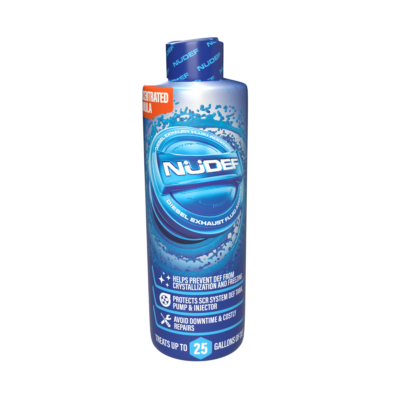
- Treat the fluid. NüDef DEF treatment stabilizes the fluid and prevents the crystal formation that clogs filters, pumps, and injectors — a few dollars a tank against a four-figure pump job.
- Don’t run the tank near empty. Low fluid means the pump pulls harder, runs hotter, and picks up whatever settled at the bottom of the tank.
P20E8 caught early is a filter and a fluid habit. Ignored, it’s a pump, a tow, and a derate on the shoulder of the highway. Fix it once, then make sure the fluid stops manufacturing the problem.
More in the reductant-code series: DEF trouble codes index · P203F · P249D · P204F · P2048