Working on a different part of the DEF system? Use the right guide:
Your scan tool shows P207F, P20EE or P20EF, the DEF quality numbers look fine, and the injector is not flowing what it should. A common cause is a clogged DEF dosing injector with crystallized urea packed into the nozzle, and the truck is heading toward a derate. This guide covers the full procedure: confirming the injector is actually the problem, pulling it, cleaning it, deciding if it’s salvageable, and preventing the next one.
Is It Actually the Injector? Differential Diagnosis
Before you pull the DEF injector, make sure the injector is actually the failed component. DEF system fault codes overlap, and replacing an injector won’t fix a pump problem or a fluid quality issue.
P20EE and P20EF (SCR NOx catalyst and pre-catalyst efficiency below threshold, bank 1, per SAE J2012): These codes report low NOx conversion. A restricted injector is one possible cause, along with a failing NOx sensor, poor fluid and a worn catalyst. To check the injector, run a bidirectional test: command the injector open through your scan tool and monitor the response. No change in downstream NOx reading means the injector may not be flowing. For a full breakdown of these and related codes, see DEF Trouble Codes Explained.
P207F (Reductant Quality Performance): This one’s trickier. P207F fires when the SCR isn’t converting NOx at the expected rate. That can be the injector restricting flow, but it can also be degraded DEF fluid, a bad NOx sensor, or a failing DEF pump not delivering adequate pressure. Check the DEF pump pressure first and compare it with the spec in your OEM service information. If pressure is within spec but NOx conversion is low, the injector is your suspect.
P20E8 (Reductant Pressure Too Low): This is a pump code, not an injector code. If you see P20E8 alongside P207F, the pump or supply line is the primary failure. Crystal blockage at the pump intake screen starves the whole system. Chasing the injector when the pump screen is plugged wastes diagnostic time.
Fluid quality check: Before condemning any hardware, pull a DEF sample. Fresh DEF should be clear, colorless, and odorless. Cloudy fluid, strong ammonia smell, or visible sediment means the DEF itself is degraded. A refractometer reading outside 31.8%-33.2% urea concentration confirms bad fluid. Drain, flush, and refill before any component diagnosis. Our guide on what causes DEF crystallization covers the fluid chemistry in detail.
DEF Injector Anatomy: What You’re Working With
The DEF dosing injector (also called the reductant injector, DEF dosing valve, or SCR injection valve) is a solenoid-actuated nozzle mounted directly into the exhaust pipe upstream of the SCR catalyst. It’s a precision component operating in an extremely harsh environment — exhaust gas temperatures from 250°F to over 900°F, constant vibration, and exposure to both crystallized urea and combustion byproducts.
Basic construction: The injector body is stainless steel with an internal solenoid coil, a spring-loaded pintle valve, and a spray nozzle with precision-drilled orifices. Most designs use a coolant jacket or air-cooled shroud to keep the nozzle tip below the urea decomposition threshold. A two-pin electrical connector provides the pulse-width modulated signal from the DCU (dosing control unit) or ECM.
How it works: The DCU calculates the required DEF dose based on engine load, exhaust temperature, and NOx sensor readings. It commands the injector open for precisely timed pulses, spraying atomized DEF into the exhaust stream. The DEF hits a decomposition tube or mixer plate where it converts to ammonia (NH₃) before reaching the SCR catalyst substrate. Accurate spray pattern and droplet size are critical. A partially clogged nozzle produces larger droplets and uneven distribution, which means incomplete NOx conversion even if the total fluid volume looks correct.
Where it sits: The injector mounts in the exhaust between the DPF outlet and the SCR catalyst, usually near a decomposition tube or mixer. Exact location, mounting style and access vary by platform and model year, so check the service information for your truck before you start.
Step-by-Step DEF Injector Cleaning Procedure
This procedure applies to the common solenoid-type DEF dosing injectors found on most light and medium-duty diesel platforms. If you’re working on a truck with an air-assisted injector (some Cummins ISX and Detroit applications), the disassembly is different — consult the platform service manual.
Tools and Materials
- Scan tool with bidirectional DEF injector control
- The socket or wrench your service information calls for on the injector mount
- DEF-compatible O-ring pick set
- Distilled water — at least one gallon
- Hot distilled water (180°F+) for the initial soak
- White vinegar (5% acetic acid) or commercial urea deposit remover
- Small ultrasonic cleaner (optional but significantly improves results)
- Compressed air (regulated to 30 PSI max at the nozzle)
- New injector O-rings and copper crush washer (always replace — get part numbers from your OEM parts catalog)
- Torque wrench (inch-pound and foot-pound)
- Anti-seize compound (nickel-based, not copper — copper contaminates DEF)
- Clean lint-free shop rags
- Safety glasses and nitrile gloves
Step 1: Preliminary Scan and Documentation
Before touching anything, do a full scan and record all active and pending fault codes. Note the injector duty cycle and DEF pressure readings at idle. Screenshot or print these — you’ll compare against post-cleaning values to confirm the repair worked. If the truck has a derate countdown active, record the remaining time or miles.
Step 2: Depressurize the DEF System
The DEF system holds pressure while it runs. Depressurize it the way your service information describes. Some platforms use a scan tool command and others purge the lines after key-off. Do not disconnect the DEF supply line while the system is pressurized — you’ll spray DEF across the undercarriage and into your eyes.
Step 3: Disconnect and Remove the Injector
Disconnect the negative battery cable. Unplug the injector electrical connector — press the release tab firmly and pull straight back. Do not pry. Disconnect the DEF supply line fitting. On most platforms, this is a quick-connect or compression fitting. Have a rag ready for residual DEF.
Remove the injector mounting fastener. Depending on the platform, the injector is held by a clamp or bracket, or threads directly into the exhaust. Apply penetrating oil to the mounting area 15 minutes before removal if there’s any sign of corrosion.
Critical: Pull the injector straight out. Do not twist or lever it sideways — the nozzle tip is precision ground and any deformation changes the spray pattern permanently. Inspect the O-ring seating surface in the exhaust bung. Score marks or pitting here will cause an exhaust leak regardless of the injector condition.
Step 4: Initial Inspection
Examine the nozzle tip under good light. You’re looking for:
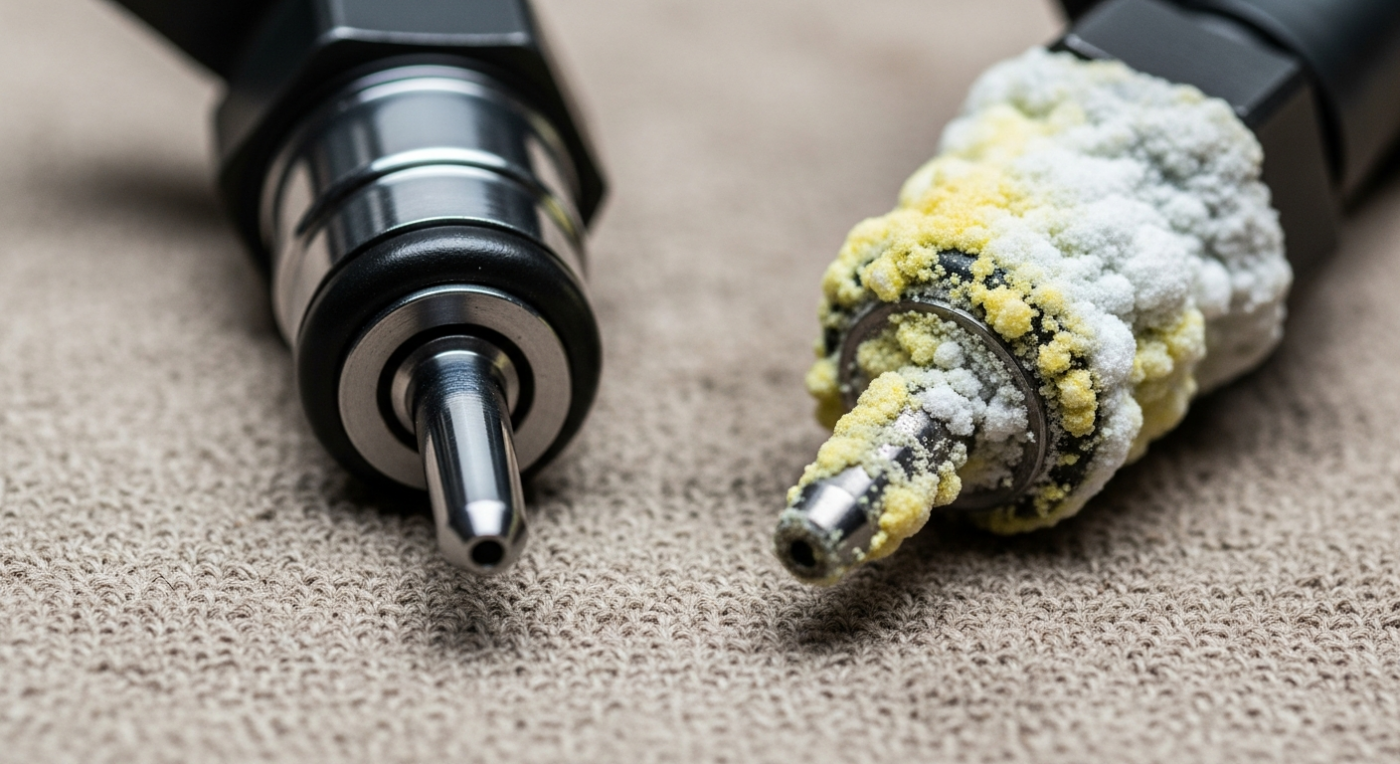
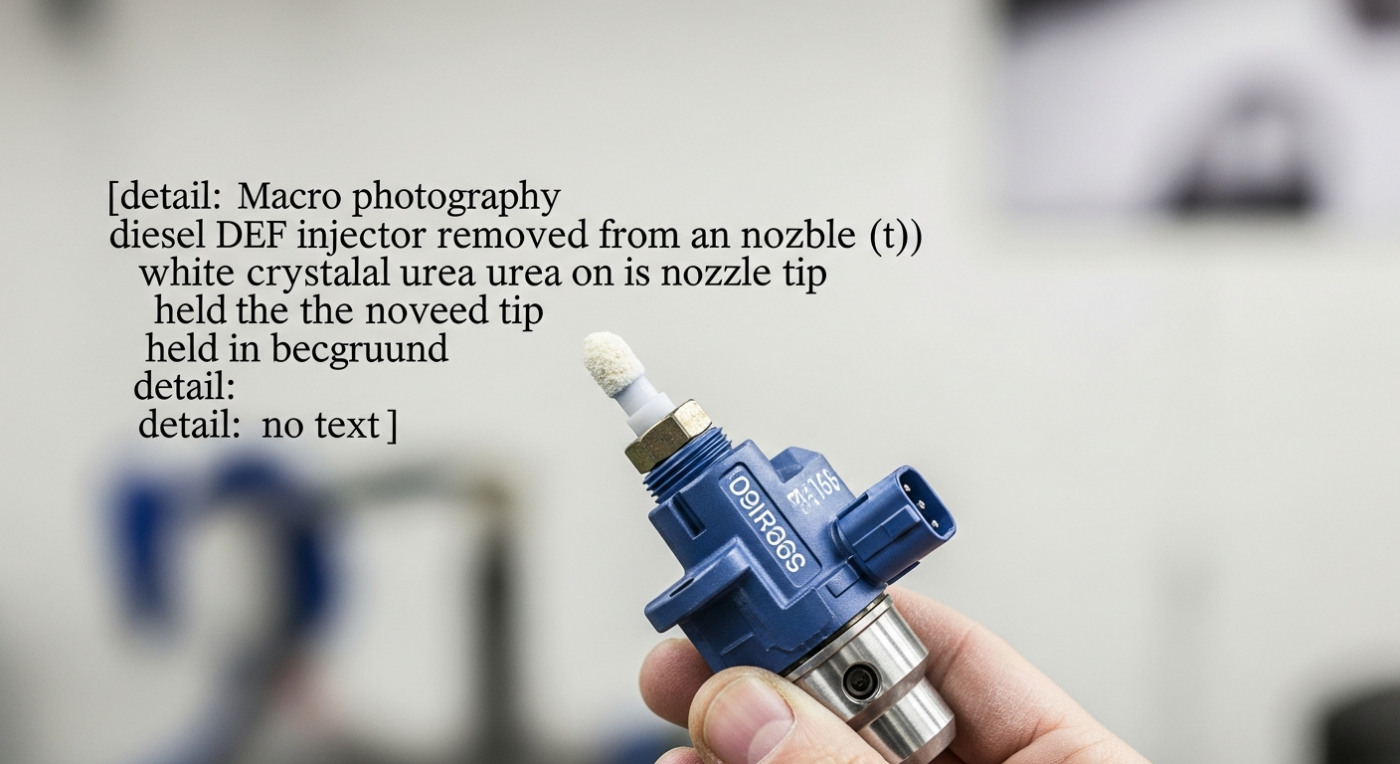
- White crystal deposits: Urea crystallization. This is the most common finding and the most cleanable.
- Brown or tan hard deposits: Polymerized urea (biuret/cyanuric acid). These form at very high temperatures and are much harder to dissolve. They indicate the coolant jacket or air shroud may not be functioning properly.
- Pitting or erosion on the nozzle tip: Damage from extended crystal abrasion. Minor pitting is acceptable; deep erosion that visibly changes the orifice geometry means replacement.
- Bent or damaged pintle: Replace the injector. The pintle cannot be straightened or refinished.
Step 5: Hot Water Pre-Soak
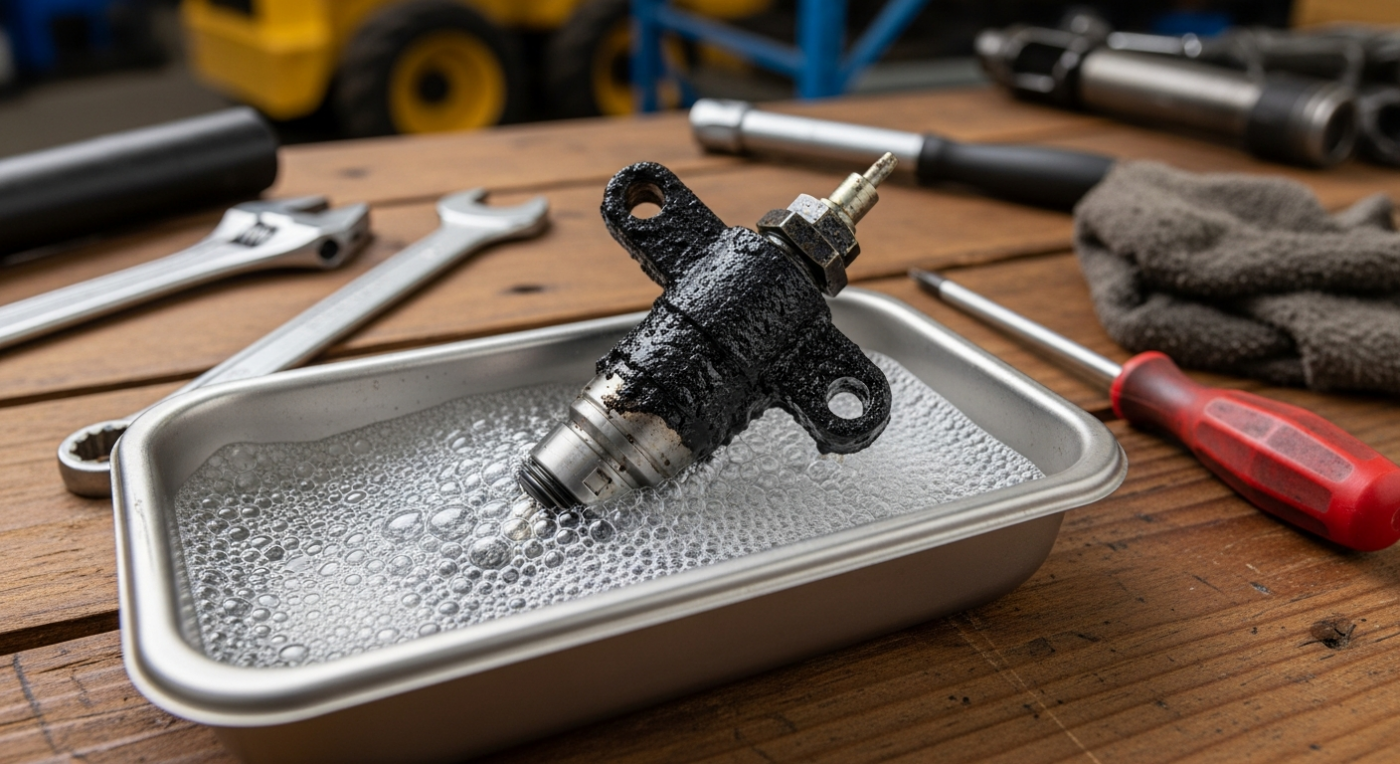
Urea crystals are water-soluble. Start with the gentlest approach. Submerge the injector nozzle (not the electrical connector) in 180°F+ distilled water. Let it soak for 30 minutes minimum. The hot water dissolves fresh crystallization faster than any chemical. After soaking, use compressed air at 30 PSI max through the inlet fitting to blow dissolved deposits out through the nozzle orifices. Repeat the soak-and-blow cycle two to three times.
For a more thorough approach to dealing with crystallized deposits throughout the entire system, see our guide on how to clean crystallized DEF.
Step 6: Vinegar or Chemical Soak (If Needed)
If hot water didn’t fully clear the deposits — you can tell by holding the nozzle up to a light and looking through the orifices — move to a mild acid soak. White vinegar (5% acetic acid) works. Commercial cleaners made specifically for urea deposits on DEF components also work. Do not use muriatic acid, CLR, or any cleaner containing phosphates or sulfates. These leave residues that poison the SCR catalyst.
Submerge the nozzle in the cleaning solution for 2-4 hours. For stubborn deposits, overnight (8-12 hours) in vinegar is acceptable for stainless steel injectors. After the chemical soak, flush thoroughly with distilled water — a minimum of three full rinse cycles. Any acid residue left on the injector will accelerate new crystal formation once reinstalled.
Step 7: Ultrasonic Cleaning (Optional but Recommended)
If you have access to an ultrasonic cleaner, this is where it earns its money. Fill the tank with distilled water heated to 140-160°F. Run the injector through a 15-minute ultrasonic cycle. The cavitation action reaches deposits inside the orifices that soaking alone can’t dissolve. One ultrasonic cycle after a vinegar soak is more effective than 24 hours of soaking alone. For shops doing this regularly, a small benchtop ultrasonic cleaner is a worthwhile tool.
Step 8: Final Inspection and Flow Test
After cleaning, inspect the nozzle orifices again under magnification. All orifices should be visibly clear with no residual deposit. If you have a bench-top injector flow tester, run a flow comparison against the OEM flow spec for that injector.
Without a flow tester, you can do a rough visual spray pattern check: connect the injector to a DEF supply (hand pump with distilled water works for this) and pulse it manually. The spray should be a fine, even cone pattern. Any streaming, dribbling, or asymmetric spray means the orifice geometry is compromised — replace the injector.
Step 9: Reinstallation
Replace all O-rings and the copper crush washer. Do not reuse O-rings on DEF components — they’re the failure point between working and leaking. Apply a thin film of nickel-based anti-seize to the mounting threads (not the O-ring surfaces).
Torque: Tighten the injector mount and the supply line fitting to the values in your OEM service information. Values differ by platform and model year, and an over-tightened mount can distort the injector or crack the fitting.
Reconnect the DEF supply line and electrical connector. Reconnect the battery. Start the engine and command a DEF system prime through the scan tool. Check for leaks at the supply fitting and at the injector-to-exhaust interface. Run the engine for 10 minutes and monitor the injector duty cycle and DEF pressure on the scan tool. Values should match or improve compared to your pre-service baseline.
Step 10: Post-Repair Verification
Clear all DEF-related fault codes. Drive the vehicle through at least two full drive cycles (key on, engine running for 20+ minutes at operating temperature, key off). Rescan. If P207F, P20EE or P20EF returns within two drive cycles, the injector either wasn’t fully cleaned or has internal valve damage that isn’t visible from external inspection. At that point, replacement is the call.
When Cleaning Won’t Work
Cleaning a DEF injector is a legitimate repair. But it’s not always the right one. Here’s when to skip the soak and go straight to replacement:
Visible valve seat damage. If the pintle seating surface shows pitting, scoring, or erosion under magnification, the injector can’t seal properly even when clean. Crystal deposits that hold the valve off-seat for extended periods cause metal-to-metal wear at the seating area. Once the seat is damaged, the injector will over-dose, under-dose, or leak DEF into the exhaust even after a perfect cleaning.
Heavy nozzle blockage. If only one or two orifices are flowing before cleaning, the crystal deposits have likely been present long enough to cause internal damage, and cleaning is less likely to work. The labor cost of pulling the injector twice (once to clean, once to replace when cleaning fails) exceeds the cost of just replacing it.
Brown polymerized deposits. White urea crystals dissolve in water. Brown, amber, or glass-like deposits are polymerized urea compounds (biuret, cyanuric acid, ammelide) that form at temperatures above 300°F. These indicate the injector cooling system has failed, allowing exhaust heat to bake the residual DEF into insoluble polymers. Vinegar won’t touch them. Even ultrasonic cleaning has limited effect. And the underlying thermal management problem means a cleaned injector will recrystallize faster than normal.
Electrical faults. If the injector solenoid resistance is out of the OEM spec for that injector, cleaning the nozzle doesn’t fix an electrical problem. Measure coil resistance before cleaning. An open or shorted coil means replacement regardless of the nozzle condition.
Metal fatigue at the mount. Inspect the injector body where it mounts to the exhaust. Hairline cracks, thread damage, or corrosion pitting in the mounting area mean the injector can’t seal to the exhaust pipe reliably. Even if the nozzle is clean, an exhaust leak at the mount will overheat the injector and accelerate recrystallization.
DEF Injector Replacement: Finding the Right Part
When cleaning isn’t viable, get the replacement injector by part number from your OEM parts catalog, looked up by VIN on pickups or by engine serial number on heavy-duty engines (Cummins engines can be looked up in QuickServe Online). Injector part numbers change with model year, emissions level and supersessions, so do not order from a generic list. Ask the parts counter for the current supersession and the matching seals.
Cost depends on the platform, the part and your shop’s labor rate, so get a written quote before you approve the job. Aftermarket injectors are available for many platforms and quality varies. For fleet applications where you want a known-good calibration and warranty backing, OEM is the safer bet.
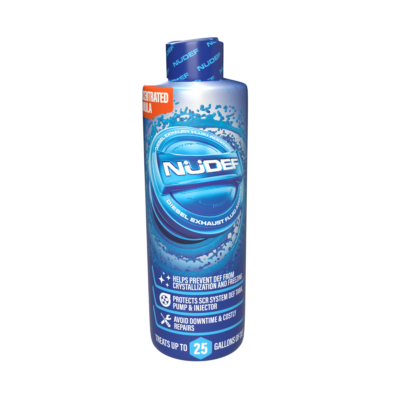
Once a cleaned or new injector is back in, start it on stabilized fluid. Add NüDef DEF Treatment, Additive & Stabilizer to the next fill so the nozzle is not sitting in the same conditions that crusted the last one.
Prevention: How Crystals Get There and How to Stop Them
Understanding why DEF injectors crystallize is the key to preventing repeat failures. The process isn’t random — it follows a predictable pattern driven by three factors.
Residual DEF at the nozzle tip. After each injection pulse, a small amount of DEF remains on the nozzle surface. Exhaust heat evaporates the water, leaving concentrated urea behind. Over thousands of injection cycles, this residue accumulates into a visible crystal deposit. It’s the same process that creates the white deposits around your DEF tank filler neck, just happening inside the exhaust pipe at 500°F.
Degraded DEF accelerates crystallization. DEF that’s been stored above 95°F, exposed to sunlight, or kept longer than ISO 22241-3 allows for its storage temperature (for example, 12 months at up to 86°F) can drift off spec. Water lost from an open or vented container raises the urea concentration, which puts the fluid closer to the point where crystals form. Cloudy DEF or DEF with an ammonia smell should be drained and replaced — never treated, never topped off over. Our DEF tank cleaning guide walks through the complete drain and flush procedure.
Thermal cycling and shutdown deposits. The worst crystallization happens during engine cool-down. When the engine shuts off, the injector cooling (whether coolant or air) stops. Residual DEF at the nozzle tip bakes in the decaying exhaust heat. Short duty cycles — stop-and-go delivery trucks, city buses, yard tractors — are the hardest on DEF injectors because they cycle through more startup/shutdown events per operating hour than a line-haul truck running 10 hours straight.
Prevention Protocol
Use quality DEF and keep it fresh. Only use ISO 22241 compliant DEF from sealed containers. Check manufacture dates. Rotate stock. Don’t keep partial jugs sitting around for months.
Clean your DEF tank annually. Crystal sediment in the tank gets pumped to the injector. A clean tank means clean fluid reaching the nozzle. Here’s how to clean a DEF tank properly.
Monitor injector duty cycle. A gradually increasing duty cycle at the same engine load means the injector is partially restricted and the ECU is compensating by holding it open longer. Catch this trend early and you can clean the injector before it fails completely.
Treat your DEF with NüDef. NüDef is a DEF stabilizer and anti-scaling agent. It helps prevent crystallization and helps protect the SCR system, DEF tank, pump and injector through temperature swings, shutdown cycles and storage periods, the three conditions that drive injector crystallization. One 8.45 fl oz bottle treats 25 gallons. Add one dose per 2.5 gallons at every fill. Fleets can dose stored DEF at the same rate. A bottle costs less than one injector cleaning.
Address cooling system issues. If the injector cooling circuit (coolant jacket or air supply) isn’t working, the nozzle runs hotter, and DEF bakes on faster. A recurring crystallization problem after cleaning should prompt a check of the injector cooling system before you assume it’s a fluid quality issue.
Frequently Asked Questions
See below for the most common technical questions about DEF injector cleaning, testing, and maintenance.