How much DEF your truck carries between fills is in the DEF tank capacity chart, built from the makers’ manuals.
The Combustion Equation: Why Modern Diesels Make NOx
To understand why diesel and DEF have to work together, you have to start in the cylinder. Diesel combustion is high-pressure, high-temperature compression ignition, and that’s exactly the condition that produces oxides of nitrogen (NOx) as a byproduct. NOx isn’t a fuel problem or an oil problem. It’s a thermodynamic consequence of how diesels make power.
Here’s the physics: ordinary air is roughly 78% nitrogen (N₂) and 21% oxygen (O₂), with the two molecules essentially inert toward each other at ambient temperatures. Inside a diesel cylinder at peak combustion, gas temperatures hit 2,500–3,500°F under 200+ bar of pressure. At that temperature, the triple bond holding nitrogen molecules together breaks, the free nitrogen atoms bond with the oxygen present from combustion, and the result is NO and NO₂, collectively called NOx. The higher the peak combustion temperature, the more NOx you get. This is the Zeldovich mechanism, and it’s been known since the 1940s.
Gasoline engines also produce NOx, but at lower rates because their combustion temperatures are lower and their air-fuel ratios are tightly controlled near stoichiometric. Diesel engines run lean (excess air) and at higher peak temperatures, both of which maximize NOx formation. A diesel engine producing maximum torque is producing maximum NOx.
The EPA NOx limit for on-highway heavy-duty diesels is 0.2 grams per brake-horsepower-hour (g/bhp-hr) under the current 2010+ standards. A modern 6.7 Cummins, 6.6 Duramax, 6.7 Powerstroke, Detroit DD15, or Cat C13/C15 engine producing peak torque without aftertreatment would put out NOx at roughly 4–6 g/bhp-hr, 20 to 30 times the limit. Agricultural Tier 4 Final engines face similar standards. The gap between what a diesel naturally produces and what’s legal cannot be closed inside the cylinder without destroying fuel economy and reliability.
Engineers tried. From 2002 through 2010, the dominant emissions strategy was Exhaust Gas Recirculation (EGR): pumping cooled exhaust back into the intake to lower peak combustion temperatures and suppress NOx formation in-cylinder. EGR works mechanically, but it costs fuel economy (the engine is breathing inert gas instead of fresh oxygen), it carbons up intake manifolds, it stresses the head gasket from higher heat soak, and it has a hard physical limit: you can suppress NOx by maybe 60% before the engine starts misfiring and producing soot. The 2007 EPA standards drove EGR to its breaking point. The 2010 standards required a fundamentally different approach.
That different approach is Selective Catalytic Reduction (SCR), and SCR requires DEF. Instead of suppressing NOx formation in the cylinder, you let the engine produce NOx naturally (which lets you tune for power and fuel economy), then chemically convert the NOx in the exhaust stream before it exits the tailpipe. That’s the entire reason DEF exists. The DEF system is the consequence of decoupling power production from emissions compliance.
DEF Injection Chemistry: Urea Becomes Ammonia Becomes Nitrogen
DEF is a precisely controlled aqueous solution: 32.5% urea (CO(NH₂)₂) and 67.5% deionized water, with no other additives, per ISO 22241. That ratio is not arbitrary. It’s the eutectic concentration where the freezing point hits its minimum (about 12°F / -11°C) and where the chemistry behaves predictably across the operating temperature range of an SCR system.
The chemistry happens in three stages along the exhaust stream:
Stage 1: Thermolysis. DEF is sprayed into the hot exhaust stream upstream of the SCR catalyst, typically at exhaust gas temperatures between 350°F and 1,100°F. The water in DEF flashes to vapor almost instantly. The urea molecule decomposes thermally:
CO(NH₂)₂ → NH₃ + HNCO
(urea → ammonia + isocyanic acid)
Stage 2: Hydrolysis. The isocyanic acid (HNCO) reacts with water vapor (already present in the exhaust from combustion) to produce a second ammonia molecule:
HNCO + H₂O → NH₃ + CO₂
Net result of stages 1 and 2: each urea molecule yields two ammonia molecules and one CO₂ molecule. The ammonia is the active reductant. It’s what actually reduces the NOx.
Stage 3: SCR catalyst reaction. The ammonia and NOx flow together into the SCR catalyst (typically a vanadium-tungsten-titanium washcoat on a ceramic honeycomb substrate, or a copper-zeolite formulation in newer systems). On the active catalyst sites, the ammonia reduces the NOx:
4 NH₃ + 4 NO + O₂ → 4 N₂ + 6 H₂O (standard SCR)
4 NH₃ + 2 NO + 2 NO₂ → 4 N₂ + 6 H₂O (fast SCR)
8 NH₃ + 6 NO₂ → 7 N₂ + 12 H₂O (NO₂ SCR)
The output is nitrogen gas (N₂, which is what 78% of air already is) and water vapor (H₂O). That’s it. The NOx is gone, chemically converted to harmless components.
The efficiency of this conversion in a working SCR system is typically 85–95% NOx reduction across the operating range. The remaining 5–15% is what’s measured at the tailpipe, and that’s what has to stay under the 0.2 g/bhp-hr limit. The system is designed with engineering margin, but not much.
The reason this matters for diesel-and-DEF operating together: the SCR reaction has a temperature window. Below about 350°F catalyst temperature, the urea doesn’t fully decompose to ammonia, so you get partial conversion and crystallization. Above about 1,000°F, the ammonia starts oxidizing to NO before it can react with the existing NOx. The diesel engine has to be operating in a regime where exhaust temperatures keep the SCR catalyst in its working window, and the DEF has to be dosed at the right rate based on engine NOx output. The engine ECU, exhaust temperature sensors, NOx sensors (upstream and downstream of the catalyst), and DEF dosing module all coordinate this in real time.
The Fuel-Economy Paradox: DEF Improves MPG
Here’s the counterintuitive part that a lot of diesel owners don’t realize: DEF makes modern diesels more fuel-efficient, not less.
That sounds backwards. You’re buying a second fluid (DEF), the truck is heavier (DEF tank + system hardware), there’s exhaust backpressure from the SCR catalyst. How does that produce better fuel economy?
The answer is that DEF lets the engine itself be tuned for efficiency. Compare the two emissions strategies:
Pre-SCR (2007–2010 EGR-dominant strategy): The engine had to be tuned to suppress NOx formation in the cylinder. That meant heavy EGR (recirculating up to 30% of exhaust back into the intake), retarded injection timing (lower peak combustion temperatures), and conservative boost mapping. All three of those make the engine less efficient. EGR displaces fresh oxygen with inert gas, so the engine has to inhale more total mass for the same fuel burn. Retarded injection timing means combustion happens later in the power stroke when there’s less mechanical advantage from the expanding gas. The fuel-economy penalty on heavy-duty diesels in the 2007–2010 EGR era was roughly 4–8% versus pre-2007 trucks.
Post-SCR (2010+ DEF strategy): The engine can be tuned for thermal efficiency. Injection timing is optimized for power and BSFC (brake-specific fuel consumption), EGR rates can be reduced (less inert dilution), and turbocharging can be tuned more aggressively. The engine produces more NOx. That’s intentional, the SCR system will handle it downstream. Heavy-duty diesels in the 2010+ era recovered most of that 4–8% fuel-economy penalty. Modern Class 8 trucks routinely achieve 7.5–9 MPG loaded; the equivalent 2007 truck struggled to hit 6.5 MPG under the same conditions.
So the net effect of DEF on a Class 8 OTR semi running 120,000 miles per year at, say, 8 MPG:
- Annual diesel consumption: 15,000 gallons
- Annual DEF consumption: roughly 450 gallons (3% of diesel)
- Fuel cost at $4.50/gallon diesel: $67,500
- DEF cost at $3.50/gallon: $1,575
- Total fluid cost: $69,075
If the same truck were tuned to 2007-EGR-era emissions strategy without DEF, it would burn roughly 6% more diesel, about 900 additional gallons annually, or $4,050. The DEF cost is $1,575. Net savings from running DEF: roughly $2,475 per year per truck on fluids alone, before counting reduced engine wear from cooler combustion temperatures and lower carbon load in the intake.
The same math scales to light-duty diesels. A 6.7 Powerstroke or 6.7 Cummins pickup running 25,000 miles per year at 18 MPG burns about 1,390 gallons of diesel and 42 gallons of DEF. The DEF cost is about $147 per year. The fuel-economy benefit of being a post-2010 SCR-equipped diesel vs a 2007-era EGR-only diesel is roughly 60–100 gallons of diesel saved per year (~$270–$450 at current prices). Net savings to the diesel owner: about $120–$300 per year, and that’s before counting reduced engine wear, longer service intervals, and better cold-start performance.
The marketing was wrong when DEF first rolled out. Diesel owners were told it was a tax on their trucks. It is not. When the SCR system is working, it’s a net economic positive. The cost only becomes a real issue when the SCR system breaks down and the engine derates. That’s where the rest of this article focuses.
DEF Consumption Math: How Much DEF Per Gallon of Diesel
The rule of thumb for DEF consumption on modern heavy-duty diesels is roughly 2–3% of diesel fuel volume. Light-duty diesels run slightly lower, closer to 2.5%. Tier 4 Final off-highway equipment can run higher under heavy load. The exact ratio depends on engine load profile, ambient temperature, and how aggressively the calibration biases toward in-cylinder NOx production (engines that produce more NOx in-cylinder need more DEF to clean it up, but they also typically extract better fuel economy from the trade).
Working it out for specific platforms:
Class 8 OTR semi (Detroit DD15, Cummins X15, Volvo D13, Cat C15) running 120,000 mi/yr at 8 MPG:
- Diesel: 15,000 gallons/year
- DEF at 3%: 450 gallons/year
- DEF cost at $3.50/gallon: $1,575/year
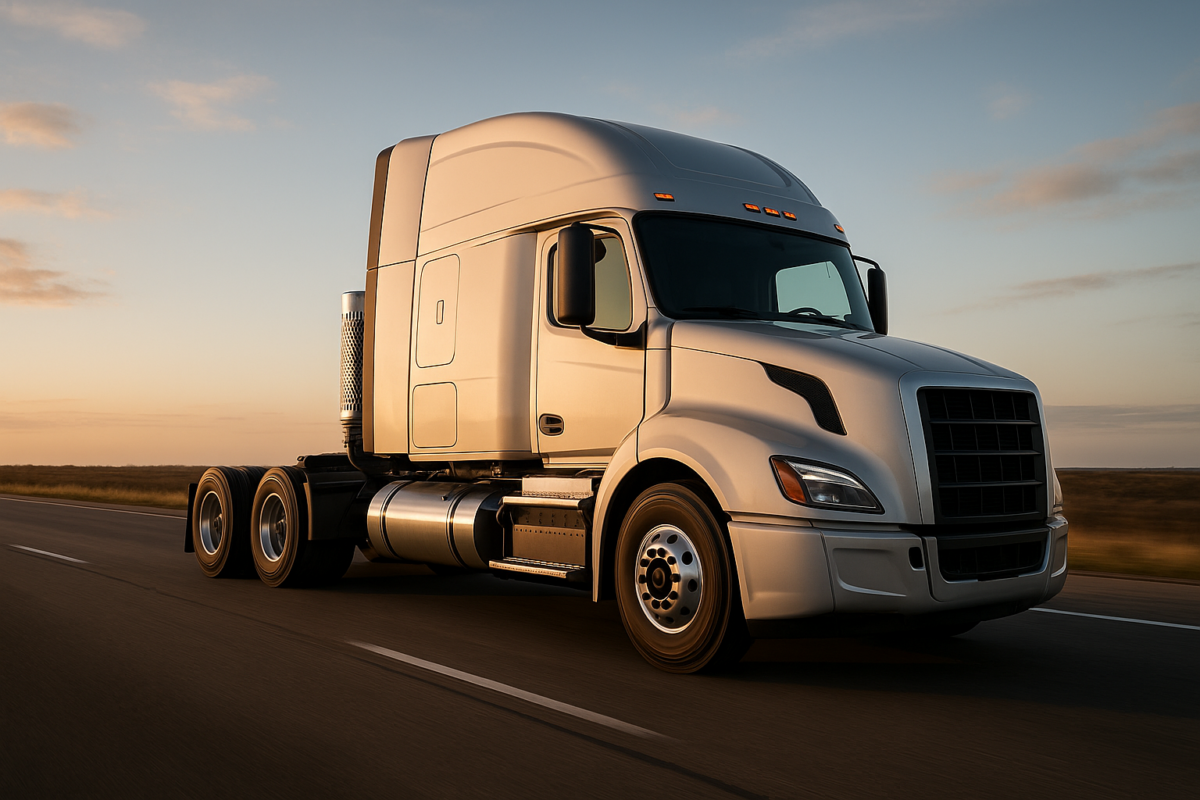
- DEF tank capacity (typical Class 8): 23 gallons, needs refill every ~6,100 miles
Class 6 medium-duty (Cummins B6.7, Detroit DD5, International A26) running 50,000 mi/yr at 10 MPG:
- Diesel: 5,000 gallons/year
- DEF at 2.7%: 135 gallons/year
- DEF cost at $4.00/gallon: $540/year
- DEF tank capacity (typical Class 6): 10 gallons, needs refill every ~3,700 miles
Light-duty diesel pickup (6.7 Cummins / 6.7 Powerstroke / 6.6 Duramax) running 25,000 mi/yr at 18 MPG:
- Diesel: 1,390 gallons/year
- DEF at 2.5%: 35 gallons/year
- DEF cost at $4.50/gallon: $158/year
- DEF tank capacity (typical light-duty): 5 gallons, needs refill every ~3,600 miles
Agricultural Tier 4 Final tractor (John Deere, Case IH, New Holland) running 1,500 hours/yr at 6.5 gal/hr:
- Diesel: 9,750 gallons/year
- DEF at 4.5%: 440 gallons/year
- DEF cost at $4.00/gallon: $1,760/year
- DEF tank capacity (typical Tier 4 ag): 13 to 20 gallons, refills sync with diesel fill cycle
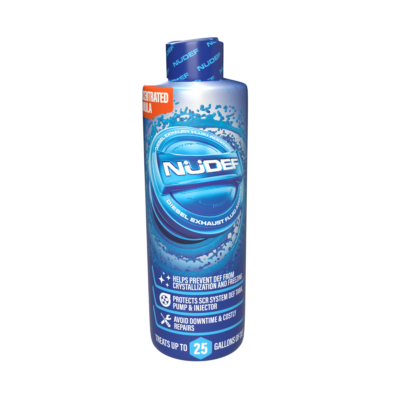
These numbers matter for two reasons. First, they’re how you’d evaluate whether your truck or equipment is consuming DEF normally. If your light-duty diesel is burning 80 gallons of DEF per year on 25,000 miles instead of 35, something’s wrong (likely DEF dosing module over-injecting due to bad NOx sensor data, or DEF leaking out of an injector seal). Second, they tell you how much treatment chemistry you actually need per year, which matters when you’re sizing a NüDef program or a fleet treatment plan. At the labeled NüDef dose (one 8.45 fl oz bottle per 25 gallons of DEF), 450 gallons of DEF requires 18 Single bottles per truck per year, or roughly 540 bottles per year for a 30-truck Class 8 fleet.
The Green-Light Condition: When DEF and Diesel Work Together
When everything is in spec, the diesel-DEF relationship is invisible. The owner sees a fuel gauge, a DEF gauge, and a check-engine light that stays off. Under the hood, here’s what’s happening every second the engine runs:
1. The diesel injectors deliver fuel precisely timed to the compression stroke. Peak combustion temperatures hit the target window for power production. NOx forms in the cylinder at the expected rate (typically 3–6 g/bhp-hr at full load).
2. The exhaust leaves the cylinder, passes through the turbocharger (extracting energy to compress intake air), then enters the aftertreatment system. The Diesel Oxidation Catalyst (DOC) and Diesel Particulate Filter (DPF) clean up unburned hydrocarbons, CO, and soot. The exhaust exits the DPF at the right temperature window (350–700°F typical) for SCR.
3. The NOx sensor upstream of the SCR catalyst reads the incoming NOx concentration. The ECU calculates the required DEF dose to neutralize that NOx with engineering margin. The DEF dosing module sprays DEF into the exhaust stream, with droplet size, spray pattern, and dose rate all controlled to deliver the right urea mass per unit time.
4. The urea decomposes to ammonia in the hot exhaust. The ammonia and NOx flow together into the SCR catalyst. The catalyst reaction converts the NOx to nitrogen gas and water vapor.
5. The NOx sensor downstream of the SCR catalyst reads the residual NOx, which should be 5–15% of inlet NOx. The ECU compares actual output to expected output and adjusts dosing. The exhaust exits the tailpipe at sub-0.2 g/bhp-hr NOx.
All of that happens in a continuous closed loop. Refresh rate is roughly 10–50 times per second on modern systems. The engine doesn’t know or care that DEF is involved. It just produces power. The DEF system is the silent partner that makes the legal emissions output possible.
The green-light condition requires three things to stay true: the engine is producing NOx within its expected operating envelope, the DEF being dosed is on-spec (32.5% urea, ISO 22241 compliant, no contamination), and the SCR catalyst is in its working temperature window. When all three hold, the system runs for hundreds of thousands of miles with no intervention beyond refilling DEF. When any one of them drifts, the system starts compensating, and that’s where failures start.
Failure Modes: When the Relationship Breaks
The diesel-DEF relationship breaks in predictable ways. Each failure mode has a chemistry explanation and a downstream consequence the driver eventually sees on the dash.
Failure mode 1: Crystallization at the DEF dosing injector and SCR catalyst face. This is the most common failure on modern SCR systems. When DEF is sprayed into the exhaust stream below its thermal decomposition threshold (around 350°F catalyst temperature), the water flashes off but the urea doesn’t fully decompose. The result is solid urea crystals, sometimes called “white powder” deposits, that build up on the dosing injector tip, on the mixer downstream of the injector, and on the SCR catalyst face. Crystallization is accelerated by short-trip operation (engine never gets to operating temperature), excessive idling (low exhaust temperatures), and cold ambient conditions.
The consequences cascade. The dosing injector clogs, so the spray pattern degrades: instead of fine atomization across the exhaust stream you get a coarse stream that doesn’t mix properly. The SCR catalyst face gets coated, reducing active surface area for the ammonia-NOx reaction. NOx breaks through. The downstream NOx sensor reads high. The ECU tries to compensate by dosing more DEF, which makes the crystallization worse. Eventually fault codes P20EE (SCR NOx Catalyst Efficiency Below Threshold, Bank 1) or P207F (Reductant Quality Performance) trigger, the engine derates, and the truck loses power.
This is the failure mode NüDef helps prevent. NüDef is a DEF stabilizer and anti-scaling agent that helps prevent DEF crystallization and helps protect the SCR system, DEF tank, pump and injector. We covered this in detail in our DEF crystallization article.
Failure mode 2: NOx sensor drift and failure. SCR systems have two NOx sensors: one upstream of the catalyst measuring inlet NOx, one downstream measuring residual NOx. These sensors are zirconia-based, similar to oxygen sensors but tuned for NOx detection, and they live in a brutal environment (exhaust temperatures, soot, salt spray). They drift over time and eventually fail. When the upstream sensor drifts low, the ECU under-doses DEF (it thinks there’s less NOx to clean up than there actually is), NOx breaks through, and downstream NOx sensor flags the discrepancy. When the downstream sensor drifts high, the ECU thinks the system isn’t working even when it is, and triggers fault codes. Most NOx sensor failures throw P20E8, P206B, or P229F codes. Replacement runs $400–$900 per sensor depending on platform.
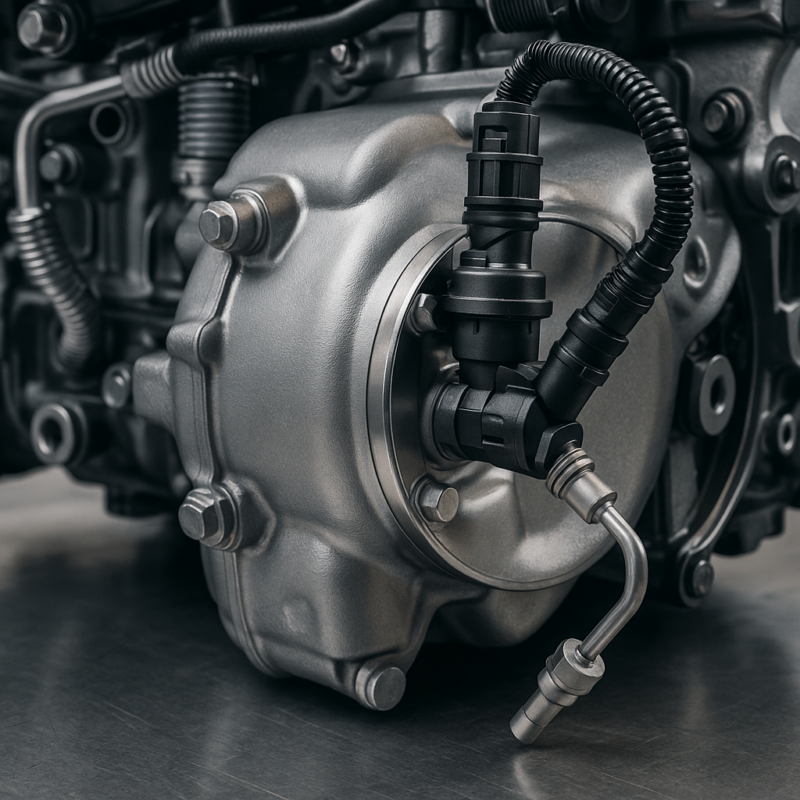
Failure mode 3: DEF dosing module failure. The DEF pump and dosing module deliver DEF from the tank to the injector at controlled pressure and metered flow rate. Failures include pump motor wear, internal filter clogging, freeze damage in cold-climate operations, and electrical/wiring issues. Failed dosing modules don’t deliver DEF at the right pressure or flow, so the injector spray pattern degrades or the engine sees an under-dose condition. Typical codes include P204F (Reductant System Performance), P20E8 (Reductant Pressure Too Low) or heater circuit codes such as P20B9. Replacement on a heavy-duty platform runs $1,800–$3,800.
Failure mode 4: SCR catalyst poisoning and degradation. The SCR catalyst is a consumable but designed for very long service life, 400,000+ miles on Class 8 platforms, 150,000+ miles on light-duty. Catalyst poisoning shortens that. Sulfur compounds (from off-spec diesel fuel), phosphorus (from engine oil consumption past a worn turbo seal), and hydrocarbon coking (from DPF regen issues upstream) all degrade catalyst active sites. Once the catalyst is degraded, NOx conversion efficiency drops below threshold, fault codes trigger, and replacement is the only fix. Catalyst replacement runs $3,500–$8,000+ depending on platform.
Failure mode 5: DEF contamination. Diesel exhaust fluid contaminated with the wrong substances kills SCR systems fast. Common contamination sources: water (dilutes urea concentration below the working spec), diesel fuel (introduced when someone mistakes the DEF tank for a fuel filler, which happens more than you’d think), dirt from open-air storage, and microbial growth in long-stored DEF. Off-spec DEF does worse than under-perform: it actively damages catalyst active sites. The cost of a single contamination event can include DEF tank flush, dosing module replacement, and catalyst replacement: $4,000–$9,000.
Failure mode 6: Cold-weather DEF crystallization in storage. Pure DEF freezes at about 12°F (-11°C). In freezing conditions DEF expands ~7% as it solidifies (similar to water but less extreme), which can stress fragile tank components and dosing lines. Modern SCR systems include DEF tank heaters that thaw frozen DEF before it’s pumped, but the heaters take time and battery power. Repeated freeze-thaw cycles in storage also concentrate the urea unevenly: water can sublimate off the surface while urea stays behind, leading to off-concentration DEF that the system reads as low-quality.
The pattern across all these failure modes: the diesel side keeps producing emissions, the DEF side fails to clean them up, the system detects the discrepancy, and the engine derates to force the operator to fix the problem. Modern emissions regulations require this fail-to-derate behavior. Manufacturers can’t legally sell trucks that allow operators to defeat the SCR system.
DEF Quality: ISO 22241 and Why Off-Spec Damages the System
ISO 22241 is the international standard that defines what counts as DEF. The standard specifies the exact composition (32.5% urea ±0.7%, balance deionized water), maximum impurity levels (calcium below 0.5 ppm, iron below 0.5 ppm, copper below 0.2 ppm, zinc below 0.2 ppm, phosphate below 0.5 ppm, sulfate below 5 ppm, aluminum below 0.5 ppm, and so on), and even handling and packaging requirements. The American Petroleum Institute (API) certifies DEF products that meet ISO 22241, so look for the API DEF certification mark on a legitimate product.
Why does the standard get so granular about trace metals at parts-per-million levels? Because the SCR catalyst is exquisitely sensitive to catalyst poisons. A copper-zeolite SCR catalyst (used on many modern light-duty and medium-duty platforms) is permanently poisoned by alkali metals (sodium, potassium, calcium). A vanadia-based SCR catalyst (used on many heavy-duty platforms) is poisoned by phosphorus, zinc, and sulfur. Once a poison atom occupies an active site on the catalyst, that site is gone forever. There’s no regeneration cycle that removes it. Enough accumulated poisoning, and the catalyst falls below its NOx conversion threshold.
Common off-spec scenarios that damage SCR systems:
- “Generic” DEF from unverified sources. DEF that doesn’t carry API certification or doesn’t disclose its ISO 22241 status. Bulk DEF from unverified suppliers occasionally contains tap water (calcium contamination) or recycled urea from non-pharmaceutical sources (trace metal contamination).
- Diluted DEF. Diluting DEF with water to “stretch” it changes the urea concentration below 32.5% and introduces whatever’s in the water. Tap water in particular brings calcium, magnesium, and chlorides.
- Long-stored DEF. DEF has a shelf life. ISO 22241-3 gives 12 months for sealed DEF stored at up to 86°F (30°C), longer when it is kept cooler and less when it is hotter. Stored DEF can absorb CO₂ from air (raising acidity), degrade biologically if water-contaminated, and lose urea concentration through evaporation if the container isn’t airtight.
- Fuel-contaminated DEF. Diesel fuel introduced into the DEF tank by mistake (wrong nozzle, mislabeled jerry can, deliberate sabotage). Even small amounts of diesel destroy DEF quality and require full system flush.
- DEF stored in inappropriate containers. DEF is corrosive to many metals (especially copper, brass, aluminum, mild steel) and reacts with some plastics. ISO 22241 specifies acceptable container materials (high-density polyethylene, polypropylene, stainless steel). DEF stored in a galvanized container picks up zinc, a catalyst poison.
For fleet operators, the practical rule is: buy DEF that carries API certification and ISO 22241 compliance from verified suppliers, store it in original packaging or properly specified bulk tanks, rotate inventory on FIFO (first-in first-out), and never dilute or “stretch” the product. The cost savings from off-spec DEF are dramatically outweighed by the catalyst-replacement risk.
Fleet Implications and the NüDef Chemistry Contribution
For a fleet running 30+ heavy-duty diesels, the diesel-DEF relationship is a real line item in operational cost and risk. Fleet implications break down into three categories.
1. DEF supply chain. A 30-truck Class 8 fleet consumes roughly 13,500 gallons of DEF per year. That’s about a 2,500-gallon bulk tank refilled every 8–10 weeks, or pallet quantities of 2.5-gallon jugs if the operation isn’t bulk-tank-capable. DEF quality control through the supply chain matters: bulk DEF from a non-certified supplier can contaminate the entire fleet’s DEF inventory in one delivery. Verify API certification on the delivery slip, periodically test bulk DEF concentration with a refractometer, and rotate inventory.
2. Treatment chemistry. For fleets operating in cold climates, dusty environments, heavy-idle conditions (port operations, food-service delivery, refuse), or with mission-critical uptime requirements, treatment chemistry like NüDef adds a layer of protection: it helps prevent DEF crystallization and helps protect the SCR system, DEF tank, pump and injector. To judge the value for your fleet, compare its cost at the labeled dose against your own SCR repair and downtime history.
3. Total cost of operation. The lifetime cost of a heavy-duty diesel includes fuel, DEF, maintenance, repairs, and downtime. The SCR system is now the second-most-expensive single repair category on Class 8 platforms (after engine internals and transmission). Investments in DEF quality control and treatment chemistry typically pay back faster than equivalent investments in any other maintenance category, because the failure consequences are large and the prevention chemistry is cheap relative to the avoided cost.
NüDef’s role is one part of the diesel-DEF relationship. We don’t make the diesel engine, the SCR catalyst or the dosing module. NüDef DEF Treatment, Additive & Stabilizer is a DEF stabilizer and anti-scaling agent that helps prevent DEF crystallization and helps protect the SCR system, DEF tank, pump and injector. One 8.45 fl oz bottle treats 25 gallons of DEF, added at every refill. For a Class 8 truck consuming 450 gallons of DEF per year, that’s 18 bottles annually. For a 30-truck fleet, 540 bottles annually.
Treatment isn’t a substitute for the underlying SCR system. The engine still has to produce NOx within its envelope, the DEF still has to be on-spec, the dosing module still has to deliver the right dose, and the catalyst still has to be in its working temperature window. Treatment is a margin of safety on the chemistry. It makes a working system harder to break and does not fix a broken one.
For fleets evaluating the diesel-DEF relationship in their own operations, the structured approach is: pull SCR-related fault code frequency from your telematics or maintenance system over the last 12 months, calculate the average repair cost and downtime hours per event, multiply for annual baseline cost, then evaluate treatment chemistry against that baseline. For most fleets running modern emissions-compliant diesels, the math favors prevention. Call (855) 300-0031 for fleet wholesale pricing, or visit nudef.com to start with a single Case or bottle.
Related reading:
- The Complete Diesel + DEF Guide: foundational background on what DEF is and how SCR works at the system level
- DEF Trouble Codes Explained: what P20EE, P207F, P204F and other SCR codes actually mean
- DEF Crystallization: The Silent Fleet Killer: the failure mode NüDef helps prevent
- The Real Cost of Untreated DEF: the math on prevention vs reactive repair
For how this system came to exist at all, the history of DEF traces the 2010 EPA mandate that put a urea tank on every new diesel.