What a DEF Pump Actually Is
The DEF pump is the hardware that moves diesel exhaust fluid from the storage tank into the exhaust stream, but calling it “a pump” undersells what it actually does. On a modern SCR-equipped diesel, the DEF pump is a multi-function assembly that meters DEF at precise pressure and flow, heats it in cold weather, filters out contamination, measures fluid level, monitors fluid quality, and reports back to the engine control module on every parameter. When technicians say “the DEF pump failed,” they’re usually describing a failure in any one of six or seven discrete sub-systems all packaged together.
The component goes by several names depending on the OEM and the technical document you’re reading:
- DEF pump: the everyday name used by fleet techs and parts counters
- DEF supply module (DSM): common Cummins and Detroit terminology
- Urea supply unit (USU): European OEM terminology (used by Bosch, Continental, and adopted by Volvo/Mack)
- DEF doser pump: used when the assembly is integrated with the doser injector
- Reductant pump: found in technical service bulletins and SAE documentation
- SCR pump: informal shorthand that refers to the same component
If you’re calling a parts counter and they don’t recognize “DEF pump,” try “supply module” or quote the OEM part number from your scan tool. The naming inconsistency is a real source of friction in DEF-related parts ordering.
The pump’s job is more demanding than it looks. DEF freezes at 12°F, crystallizes when exposed to heat or air, corrodes most metals, and degrades plastics. The pump has to handle that fluid at pressures up to 9 bar (130 psi), inject it into a 1,000°F exhaust stream through a precision nozzle that can’t tolerate 50 microns of contamination, and do all of that for 200,000+ miles. That engineering challenge is why DEF pumps cost what they cost, and why they fail in the specific ways they do.
The Three DEF Pump Architectures
Not all DEF pumps are built the same way. Three distinct architectures dominate the modern diesel market, and the architecture matters because it determines how the system fails and what the repair looks like.
Architecture 1: Integrated tank-mounted pump. The pump assembly is bolted directly to the DEF tank, typically through a flange on the top of the tank, with the pump motor, filter, heater, and sensors all packaged into one unit submerged in or attached to the fluid. The doser injector lives separately at the exhaust pipe, fed by a heated DEF line. This is the architecture used by:
- 6.7L Cummins (Ram 2500/3500, medium-duty Cummins ISB): Bosch supply module
- Detroit DD13/DD15/DD16: integrated DEF dosing unit
- 6.6L Duramax LML/L5P (GM heavy-duty): Bosch-supplied pump
- Many John Deere and Case-IH agricultural Tier 4 Final engines
The advantage of tank-mounted pumps is short, simple plumbing and an integrated heater that keeps the pump from freezing. The disadvantage is that when the pump fails, you typically drop the tank or remove the flange assembly. That is a 2–4 hour labor job on a pickup, more on a Class 8.
Architecture 2: Separate doser pump with remote tank. The DEF tank is mounted somewhere convenient (frame rail, sidesaddle, behind the cab), and a separate pump assembly mounted near the exhaust pulls DEF through heated lines from the tank. This architecture is common on:
- Caterpillar on-highway and off-highway Tier 4 engines (C7.1, C9.3, C13, C15)
- Some Volvo D11/D13 configurations
- Off-road and industrial Tier 4 Final equipment where tank placement is flexible
The advantage is packaging flexibility: the tank can go where it fits. The disadvantage is more plumbing exposed to freeze and crystallization risk, plus a heated suction line that itself is a maintenance item.
Architecture 3: Dual-pump systems. Heavy-duty Class 8 and large industrial applications sometimes use a primary supply pump (moves DEF from tank to a pressurized rail) and a separate metering pump or pressure-controlled doser (injects from the rail into the exhaust). This is common on:
- 6.7L Powerstroke (Ford Super Duty): separate supply and dosing modules on some model years
- Some Volvo/Mack MP7/MP8/MP10 configurations
- Heavy-duty industrial gensets (1,000+ kW) with redundant DEF delivery
- Large agricultural and mining Tier 4 Final equipment
Dual-pump systems give you better metering precision and redundancy but mean two pumps to fail, two filters to service, and double the diagnostic complexity. When a “DEF pump” fails on a dual-pump platform, the first diagnostic question is which one.
Why the architecture matters for diagnosis: a fault code like P204F (reductant system performance) means something slightly different depending on which architecture you’re dealing with. On a tank-mounted integrated pump, P204F almost always points at the supply module. On a dual-pump platform, P204F could point at either pump, the rail pressure sensor, or the doser. Knowing your architecture before you start chasing codes saves hours.
Components Inside the Pump Assembly
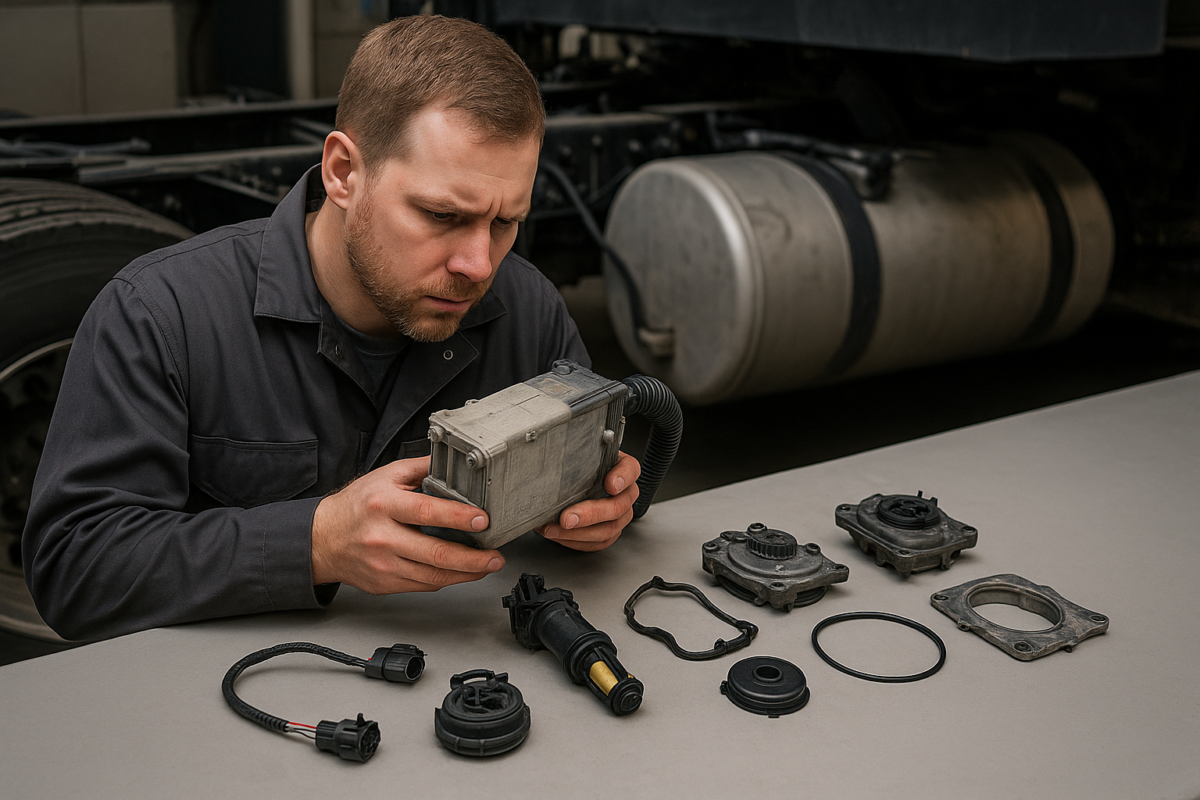
When you crack open a typical modern DEF supply module, you find roughly seven discrete components packaged into one assembly. Each one is a potential failure point, and each one has different repair economics.
1. The pump motor. The electric motor that physically moves DEF. Usually a brushed DC motor on lighter platforms, brushless on heavy-duty. Failure mode: motor seizure, brush wear, winding failure. When the motor goes, the pump is typically replaced as an assembly. Motor swaps are not practical at the field-service level on most platforms.
2. The pump element. The actual pumping mechanism, typically a small gear pump, vane pump, or diaphragm pump depending on OEM. Failure mode: wear from contaminated DEF, internal corrosion from off-spec fluid, freeze damage if the pump cavity wasn’t fully purged before storage. Like the motor, usually replaced as part of a full assembly swap.
3. The DEF filter. A fine-mesh filter (typically 50 micron or finer) that protects the doser injector from contamination. Failure mode: clogging from particulate contamination in the DEF, biological contamination, or crystallization debris. On most platforms the filter is a serviceable item. Replace it on the schedule in your OEM service manual. Skipping filter service is one of the leading causes of “premature pump failure” that’s actually just a clogged filter.
4. The DEF heater. An electric heating element built into the pump body or DEF lines. Keeps fluid liquid in temperatures below 12°F. Failure mode: heating element burnout, relay failure, control circuit fault. Cold-climate fleets see heater failures more often than warm-climate fleets. On some platforms the heater is replaceable separately; on others it’s integral to the pump assembly and requires full replacement.
5. The level sensor. Reports DEF tank fill level to the dashboard gauge and the ECM. Usually a float-and-reed-switch sensor or a capacitive sensor. Failure mode: stuck float (crystallization or contamination), reed switch failure, capacitive plate fouling. Symptoms include erratic DEF gauge behavior or DEF level reading “empty” or “full” stuck. Often serviceable as a sub-component.
6. The DEF quality sensor. Measures the urea concentration and overall fluid quality. Found on most newer platforms so the engine can confirm the tank holds real DEF and not water, diesel, or off-spec fluid. Depending on the platform it sits in the supply module or in the DEF tank header. Failure mode: sensor drift over time, electrical fault, contamination of the sensor face. A drifting sensor reads off from true urea concentration and can set false DEF quality codes. Sensor swap is possible on some platforms, full pump replacement on others. Our DEF sensor guide covers how the quality sensor works.
7. The doser injector. The precision nozzle that sprays DEF into the exhaust stream. May be integrated with the pump (Architecture 1 with short DEF line) or remote at the exhaust pipe (Architecture 2 separate doser). Failure mode: crystallization deposits on the injector tip (the single most common SCR system failure), nozzle clogging, electrical fault on the solenoid. Light deposits can often be serviced by a technician without full replacement.
The reason this component-level breakdown matters: when a shop quotes you “$2,400 for a DEF pump,” they’re typically quoting full assembly replacement. If your actual failure is a clogged filter ($60 part) or a crystallized injector tip ($200–$400 cleaning service), you’re paying 4–10× more than the repair actually requires. Knowing the components gives you leverage in the diagnostic conversation.
The Six Most Common Failure Modes
DEF pump “failures” fall into six patterns. How often each one shows up depends on climate, duty cycle and fluid handling, so treat the order below as a checklist, not a ranking.
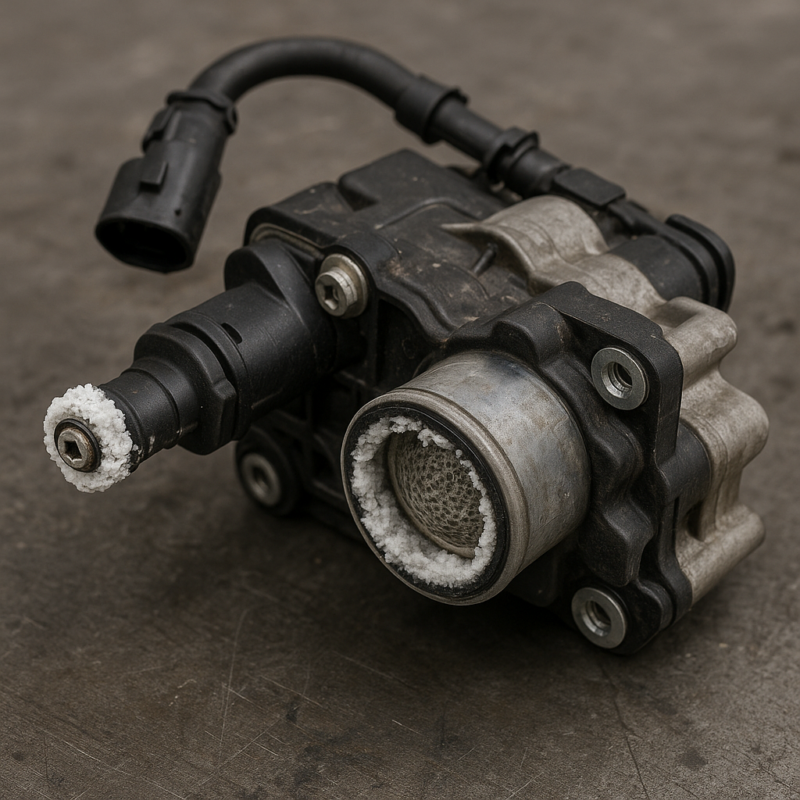
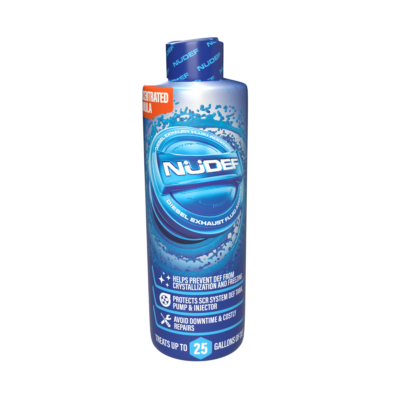
Failure mode 1: Crystallization blockage. Urea crystallizes when DEF gets hot, dries out, or sits stagnant. The crystals deposit at the doser injector tip, inside DEF lines, on the pump filter, and in worst cases on the SCR catalyst face. The pump itself is mechanically fine. The path through it is blocked. Diesel platforms with frequent short-trip operation, hot summer climates, or stored fluid see the highest crystallization rates. This is the most preventable failure mode. NüDef DEF Treatment, Additive & Stabilizer is a DEF stabilizer and anti-scaling agent that helps prevent crystallization when added at every fill.
Failure mode 2: Filter clogging from contaminated DEF. The 50-micron pump filter clogs from particulate, biological growth, or crystallization debris. Symptoms mimic full pump failure (low flow, pressure faults, P204F codes), but the actual fix is a filter change. Fleets that source DEF from open-topped bulk tanks, agricultural totes, or contaminated transfer equipment see disproportionate filter clogging. Buying certified ISO 22241 DEF in sealed containers cuts this failure mode down.
Failure mode 3: Heater element failure (climate-dependent). The electric heater in the pump body or DEF lines burns out, fails its relay, or loses its control circuit. Symptoms: DEF system inoperative in cold weather, reductant heater circuit codes, possible engine derate after extended cold soak. Northern-state fleets see this far more than southern fleets. The heater is replaceable as a sub-component on some platforms (cheaper repair) and integrated into the assembly on others (full pump replacement).
Failure mode 4: Quality sensor drift. The urea concentration sensor reads slightly off from true urea concentration over time. The ECM interprets the reading as “off-spec DEF in tank” and sets P207F or a related quality code, even though the DEF is fine. The fix may be a sensor recalibration (rare, since most OEMs don’t expose it), a sensor swap as a sub-component, or full pump replacement depending on platform. This failure mode is one of the most frustrating because the truck runs fine, the DEF is fine, but the system thinks there’s a problem.
Failure mode 5: Internal corrosion from off-spec DEF. Off-spec fluid (diluted DEF, water-contaminated DEF, non-ISO-22241 fluid) corrodes the internal metals of the pump over time. By the time symptoms appear, the damage is permanent and full pump replacement is the only fix. Sourcing certified DEF that meets ISO 22241 is the main defense.
Failure mode 6: Motor failure from high mileage. The DC motor inside the pump wears out: brushes, bearings, windings. Symptoms: pump doesn’t operate at all (no audible cycling), no DEF flow, full system shutdown. This is the “honest mechanical wear-out” failure and the one that maps cleanly to “the pump died.” Full assembly replacement is the standard fix.
The takeaway: crystallization and filter problems are far cheaper to fix than a failed pump, and they throw many of the same codes. The diagnostic workflow below is built around identifying which category you’re in before any parts get ordered.
Symptoms and Driver-Facing Indicators
DEF pump problems present through a combination of dashboard indicators, OBD-II codes, audible signals, and operational symptoms. The pattern of symptoms, not any one symptom alone, usually tells you what’s wrong.
Dashboard indicators:
- Check engine light (MIL): the universal first indicator on any DEF system fault
- DEF warning light or “service DEF system” message (varies by OEM)
- Reduced power / derate warning: typical second-stage warning after fault persists
- Countdown to limp mode, by miles or engine starts depending on the platform
- DEF fluid level gauge erratic or stuck
Common OBD-II diagnostic codes:
- P204F: Reductant System Performance (broad category, pump output below spec)
- P20E8: Reductant Pressure Too Low (pump can’t build pressure)
- P208A: Reductant Pump A Control Circuit (electrical fault to the pump)
- P20EE: SCR NOx Catalyst Efficiency Below Threshold, Bank 1 (crystallized dosing is one possible cause)
- P207F: Reductant Quality Performance (quality sensor fault or off-spec DEF)
- P203F: Reductant Level Too Low (level sensor or true low fluid)
These code definitions overlap and sometimes appear in clusters. A single failed pump can throw P204F, P20E8, and P208A simultaneously. For deeper code-by-code interpretation see our DEF Trouble Codes Explained guide, which walks through the OBD-II side of SCR diagnostics. This article focuses on the hardware side: what the codes mean about which part of the pump is failing.
Audible and operational symptoms:
- Pump cycling more frequently than normal: you can hear the pump click on every 30–60 seconds instead of every few minutes. Indicates pressure not holding (internal leak or doser sticking open).
- Pump runs continuously: the motor never shuts off. Indicates the ECM is calling for pressure that the pump can’t deliver (blockage or pump weak).
- Pump silent / no audible operation: the pump isn’t cycling at all when the engine is running. Indicates motor failure, electrical fault, or fuse blown.
- White crystalline deposits visible around the doser injector, on the exhaust pipe near the injection point, around the pump assembly’s external connections. Visible crystallization points strongly at a crystallization problem.
- DEF gauge behaving erratically: bouncing, stuck, or reading wrong vs. actual tank level. Points at the level sensor.
Driver-facing operational symptoms:
- Engine running rough or down on power (derate active)
- Failed emissions inspection
- Truck won’t start after sitting (severe cases with full derate triggered)
- DEF being consumed faster or slower than normal
The diagnostic value of taking inventory of all symptoms before going to the scan tool: codes alone often don’t distinguish between a $60 filter clog and a $2,400 pump replacement. The audible behavior, visible crystallization, and operational pattern do.
The Step-by-Step Diagnostic Workflow
A proper DEF pump diagnostic follows a sequence that’s designed to rule out cheap problems before assuming expensive ones. Jumping straight to pump replacement based on a code is how shops end up replacing pumps that didn’t need replacement and customers end up paying $2,400 for what should have been a $60 filter change.
Step 1: Read all stored and pending codes with a proper scan tool. Don’t use a basic OBD-II code reader. DEF system codes often require a manufacturer-specific scan tool to pull the full freeze frame data. On Cummins use INSITE or Calterm. On Detroit use DDDL (DiagnosticLink). On Cat use ET (Electronic Technician). On Duramax use GDS2 or Tech 2. The cheap generic readers will give you P204F but not the underlying parameter that triggered it, and that parameter usually identifies the failure mode.
Step 2: Visual inspection for crystallization. Before doing any electrical testing, look at the truck. Check:
- The doser injector and its mounting surface on the exhaust pipe (white crystalline deposits)
- External DEF line connections to the pump assembly
- The DEF tank filler neck and cap (heavy crystallization at the cap area indicates evaporative loss)
- Underneath the truck for signs of DEF leakage (white residue trails along the frame or undercarriage)
- The exhaust pipe downstream of the doser (severe crystallization can extend into the pipe and SCR brick)
Visible crystallization makes a crystallization problem much more likely than a hardware failure, and that changes the repair approach completely.
Step 3: Check DEF quality with a refractometer. A handheld DEF refractometer ($60–$120) measures urea concentration in seconds. Spec is 32.5% ± 0.7%. Anything below 31.8% or above 33.2% is off-spec. Reading too low usually means water contamination or biological dilution. Reading too high usually means evaporation-driven concentration (DEF sitting in heat). Off-spec DEF will throw quality codes regardless of what the pump hardware is doing. Fix the fluid first, then re-evaluate.
Step 4: Listen for pump operation. With the engine at idle, listen near the DEF tank or supply module for the pump cycling. A healthy pump cycles audibly every few minutes (varies by operating conditions). Continuous operation, no operation, or rapid-fire cycling each point at different failure modes:
- No cycling at all → motor failure or electrical fault (Step 5)
- Continuous cycling → can’t build pressure (filter clog, doser stuck open, or pump weak)
- Normal cycling but with codes → quality sensor drift or downstream catalyst issue
Step 5: Check the DEF pump fuse and electrical supply. The DEF pump has a dedicated fuse, usually in the under-hood fuse box, sometimes in the cab. A blown fuse will mimic complete pump failure for $5 worth of parts. Also check the connector at the pump for corrosion, broken pins, or chafed wires. DEF pumps live in salt-spray environments under the truck, so connector corrosion is common. Use a multimeter to confirm 12V or 24V (platform-dependent) at the connector with the engine running.
Step 6: Pressure test (advanced). If steps 1–5 haven’t identified the failure, the next level is a pressure test using the OEM-required test fixture or a generic DEF pressure gauge. The pump should hold a specified pressure (varies by platform, typically 5–9 bar) within a defined time. Pressure decay indicates internal leak, valve failure, or pump element wear. This step usually requires specialized tooling and is most often done at a dealer or SCR specialty shop.
If you’ve completed all six steps and the failure mode still isn’t clear, that’s the point where the cleaning-vs-replacement decision moves toward dealer or specialist involvement. Six steps of triage is usually enough to identify the failure category. Sometimes the exact failed component takes deeper investigation.
Cleaning vs Replacement Decision Tree
This is the section that determines whether you spend $300 or $4,000. The decision tree below maps failure mode onto repair approach.
Crystallization at doser injector tip (visible white deposits, intact pump operation): Cleaning. A skilled tech can remove the doser, soak the tip in distilled water or a urea-removal solution, mechanically remove deposits with brass picks (never steel), and reinstall. The doser may need a new mounting gasket and seal. Rough cost: $250–$500 with labor. It works best when caught before catalyst damage occurs. Many dealer techs quote full pump replacement instead. Independent SCR specialty shops are far more likely to attempt cleaning first.
Filter clogged (P204F or P20E8 with pump cycling continuously): Filter replacement. The DEF filter is typically a $40–$100 part on pickup platforms, $100–$300 on Class 8. Labor is 0.5–1.5 hours depending on access. Total cost: $100–$500. This is the “embarrassingly cheap” fix that gets quoted as a $2,400 pump replacement at non-specialist shops.
Pump motor inoperative (no audible cycling, no DEF flow, voltage present at connector): Replacement only. Motors aren’t field-serviceable on any current platform. Full pump assembly swap. Pricing varies by platform; see the pricing section below. No shortcut available.
Quality sensor drift (P207F with confirmed in-spec DEF via refractometer): Sensor-level swap if available, full pump or tank header if not. Where the quality sensor lives varies by platform and model year, so check the OEM service manual before ordering parts.
Heater element failure (cold-climate, reductant heater circuit code, otherwise pump healthy): Heater swap if available, full pump if not. Heater replacement when possible is a $200–$400 sub-component swap. On platforms where the heater is integral, full pump replacement applies.
Internal corrosion from off-spec DEF (irregular metal particles in filter, pitted internal surfaces visible on inspection): Full replacement plus DEF tank flush. The fluid that caused the corrosion is still in the system. Replacing the pump without flushing the tank and lines will damage the new pump within months. Total cost can run higher than basic pump replacement when the tank flush and re-fill are included.
The decision tree in plain language: look first, scan second, replace last. Confirming or eliminating crystallization and a clogged filter before authorizing pump replacement is the single largest cost-control move in DEF repair work.
Cummins X15: DEF Dosing Unit and Quality Sensor Faults
The X15 is the 15-liter Cummins heavy-duty engine that replaced the ISX15. Like every current on-highway diesel, it meets NOx limits with SCR, so it carries a DEF dosing unit that draws fluid from the tank, pressurizes it and feeds the doser in the aftertreatment. Every pump-side failure in this guide applies to it: crystals at the doser, a plugged dosing unit filter, heater faults and corroded connectors.
The fault that confuses X15 owners most is DEF quality. On many Class 8 trucks the quality sensor is built into the DEF tank header unit that the truck builder supplies, separate from the Cummins dosing unit. A quality code on an X15 does not mean the pump failed. Find where the sensor lives on your chassis before you order parts.
Heavy trucks report faults as SAE J1939 SPN and FMI pairs. SPN 3364 is the DEF tank quality parameter, so an SPN 3364 fault points at the fluid or the quality sensor, not the pump motor. Cummins also assigns its own fault code numbers. Look up the exact code for your engine serial number in Cummins QuickServe Online, or read it with INSITE, and follow the troubleshooting tree in order.
What to check, in order:
- Test the tank fluid with a refractometer. DEF is 32.5% urea, and a reading outside 31.8% to 33.2% means off-spec fluid. Drain and refill with fresh certified DEF before replacing anything.
- Look at the sample. Many heavy trucks heat the DEF tank with engine coolant. A cloudy or oily sample can mean coolant or diesel got into the tank, and that leak has to be found first.
- Inspect the tank header connector and harness for corrosion, broken pins and chafing.
- If the fluid tests good and the code returns, work the QuickServe tree for the quality sensor before condemning the dosing unit.
Code definitions are in our DEF trouble codes guide, and the DEF sensor guide explains how the quality sensor reads the fluid. NüDef does not fix a sensor or wiring fault. Once the system is healthy, NüDef DEF Treatment, Additive & Stabilizer at every fill helps prevent the crystallization that plugs the doser and the dosing unit filter.
Pricing, Specialists, and Prevention
Rough estimates for DEF pump work. Parts and labor vary widely by region, model year and shop, so get a written quote before you approve the job.
6.7L Cummins (Ram pickup, medium-duty Cummins ISB):
- OEM supply module part cost: $800–$2,200 depending on year and supplier
- Aftermarket equivalent (Bosch-rebuilt or quality reman): $400–$900
- Labor: 2.5–4.0 hours at $140–$200/hr shop rate = $350–$800
- Total: $1,150–$3,000 for full replacement
- Cleaning service (doser only): $250–$500
- Filter replacement only: $80–$250
6.6L Duramax LML/L5P (GM heavy-duty):
- OEM pump assembly: $900–$1,800
- Aftermarket: $400–$800
- Labor: 2.0–3.5 hours = $280–$700
- Total: $1,200–$2,500 for full replacement
6.7L Powerstroke (Ford Super Duty):
- OEM pump assembly: $900–$2,000 (varies by model year; dual-pump configurations on some)
- Aftermarket: $500–$1,100
- Labor: 2.0–4.0 hours = $280–$800
- Total: $1,200–$2,800 for full replacement
Detroit DD13/DD15/DD16 (Class 8 Freightliner, Western Star):
- OEM DEF dosing unit: $2,000–$4,000
- Aftermarket / reman: $1,000–$2,200
- Labor: 3.0–6.0 hours at $160–$220/hr shop rate = $480–$1,300
- Total: $1,800–$5,000 for full replacement
Cummins ISX / X15 (Class 8 commercial):
- OEM supply module: $1,800–$3,800
- Aftermarket: $900–$2,000
- Labor: 3.0–5.5 hours = $480–$1,200
- Total: $1,700–$4,500 for full replacement
Volvo / Mack MP7/MP8/MP10 (Class 8 commercial):
- OEM USU assembly: $1,500–$3,500
- Aftermarket: $800–$1,700
- Labor: 2.5–5.0 hours = $400–$1,100
- Total: $1,400–$4,000 for full replacement
Agricultural Tier 4 Final (John Deere, Case-IH, AGCO):
- OEM pump assembly: $1,200–$3,000
- Aftermarket: $700–$1,500
- Labor: 2.0–4.5 hours (varies dramatically by equipment access) = $300–$1,000
- Total: $1,200–$3,500 for full replacement
Where to take the work: Three options, each with different economics.
OEM dealer. Highest labor rate, strongest warranty coverage, certified technicians with manufacturer-specific tooling. Best for in-warranty work, including emissions warranty coverage. Confirm what your coverage includes with your dealer. Worst for out-of-warranty work where you’re paying full dealer rates for a repair that doesn’t always require dealer-level expertise.
Independent diesel / fleet shop. Lower labor rate, generally good DEF system expertise, willing to attempt cleaning before recommending replacement. Best for routine out-of-warranty repairs and for fleets with established relationships. Variable in quality, so verify the shop has the manufacturer-specific scan tool for your platform.
SCR specialty shop. Independent shops that focus specifically on aftertreatment systems: DPF cleaning, SCR repair, DEF system work. Highest expertise on the specific category of work, often the most willing to attempt cleaning vs. replacement, generally good pricing. Limited geography: not every market has a specialist. Worth a one-hour drive if you have one in your region and a complex DEF problem.
For fleets, the right answer is usually a combination: dealer for in-warranty work, independent fleet shop or SCR specialist for out-of-warranty. The economics tilt heavily toward the specialist on cleaning-eligible failures.
Prevention: where upstream chemistry pays off. Crystallization is the most preventable failure mode, through DEF handling and a stabilizer at every fill. The prevention checklist:
- Buy certified DEF. Off-spec fluid is the root cause of multiple failure modes. Buy DEF certified to ISO 22241 / API and ask your bulk supplier for documentation. Avoid open-topped bulk storage or transfer equipment that doesn’t maintain the spec.
- Service the DEF filter on schedule. Use the interval in your OEM service manual. Skipping filter service is a common cause of “premature pump failure” that’s actually filter-driven.
- Don’t let DEF age in storage. Per the ISO 22241-3 storage table, DEF keeps about 18 months at or below 77°F and about 12 months at 86°F, and less above that. Rotate stock at fleet facilities.
- Treat every fill. NüDef DEF Treatment, Additive & Stabilizer helps prevent DEF crystallization and protects the SCR system, DEF tank, pump and injector. One 8 oz bottle treats 25 gallons of certified DEF, added at every refill. For fleets and standby generators, the bottle costs far less than a pump replacement.
- Address the early-warning symptoms quickly. Intermittent P204F or P20EE codes that “go away” can be early-stage crystallization. Diagnosing and servicing them early is far cheaper than waiting for a pump replacement.
For a fleet, run the numbers on your own records: compare what your DEF pump, filter and doser repairs cost last year, plus the downtime, against the cost of treating every fill.
Order NüDef direct from nudef.com. For fleet quantities, see wholesale pricing or call (855) 300-0031.
Related service item: the DEF filter sits in the same circuit and clogs for the same reasons; replacing a pump without checking the filter invites a repeat failure.