
The Short Answer
BlueDEF and BlueDEF Platinum are both diesel exhaust fluid that meets the ISO 22241 standard: 32.5 percent automotive-grade urea in deionized water. The difference, according to the maker, Old World Industries, is that Platinum carries an added formulation the company says helps keep the SCR system cleaner and reduce deposits. The urea and water are the same. Motorcraft DEF, Peak BlueDEF, and the private-label jugs at auto parts counters and warehouse clubs meet the same standard, so the fluid that reaches your injector is chemically the same product in every certified bottle.
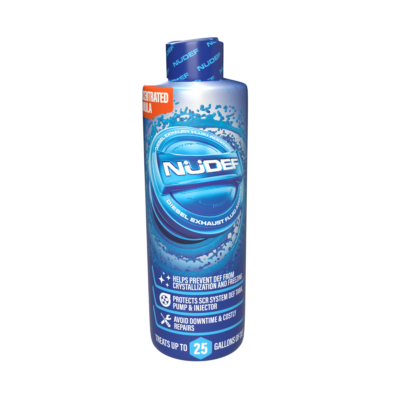
What differs between brands is everything around the fluid: the additive claims on the label, the age of the stock on the shelf, how the jug was stored before you bought it, the price per gallon, and where you can get it when you are low. This guide walks through each brand’s own claims, what the standard locks down, what an additive package can and cannot change, and when the brand on the jug genuinely matters. Whatever you buy, NüDef DEF Treatment, Additive & Stabilizer works with any certified DEF. It helps prevent crystallization and helps protect the DEF tank, pump and injector between fills.
What ISO 22241 Makes Identical Across Every Brand
Every truck maker specifies DEF to ISO 22241, and the API Diesel Exhaust Fluid Certification Program tests products against it. The standard fixes the urea concentration at 31.8 to 33.2 percent, requires deionized water, and caps impurities such as calcium, iron, phosphate, aldehydes and biuret at trace levels. It also limits alkalinity and specifies density and refractive index, which is why a refractometer can check any brand against the same 32.5 percent target.
Those limits exist because the SCR system is sensitive to anything that is not urea and water. Minerals scale the dosing injector. Biuret and aldehydes form deposits in the hot section. Off-spec concentration throws the NOx conversion math off and triggers quality warnings. A certified product from any brand passes the same tests, so the engine cannot tell BlueDEF from Motorcraft from a store brand when all three are fresh and in spec.
- Same chemistry: urea and deionized water, nothing else required.
- Same tolerance: concentration, purity and alkalinity limits apply to every certified brand.
- Same shelf life: set by storage temperature under ISO 22241-3 (12 months sealed at up to 86°F, longer when cooler, less when hotter), regardless of label.
- Same failure mode: every brand crystallizes when it evaporates, ages, or sits in heat, which is the fluid-side cause of most SCR hardware faults.
The practical takeaway: do not pay for a brand expecting better urea. Pay attention to freshness, handling and storage, and treat the fluid to help prevent crystallization. Our guide to mixing DEF brands covers the follow-on question most owners ask next.
BlueDEF vs BlueDEF Platinum
Old World Industries sells both. Standard BlueDEF is certified DEF with no additive claim. BlueDEF Platinum is marketed as DEF with an added formulation that the company says helps protect the SCR system by reducing deposits and keeping components cleaner. The company does not publish the formulation, and it still certifies the product to the same ISO 22241 limits, which means the fluid remains urea and water within the allowed tolerances with the additive inside those tolerances.
What that means in practice:
- Both will run your truck. Any ISO 22241 certified fluid is acceptable to every engine maker. Neither product changes the dosing rate or the NOx conversion.
- Platinum’s claim is about deposits, not about concentration or purity. If the maker’s claim holds for your duty cycle, the benefit shows up in the injector and the hot section over time. It is not something you can see at the pump or in a quality sensor reading.
- Platinum costs more per gallon. Typical 2026 retail runs a dollar or two more per 2.5 gallon jug than standard BlueDEF. Whether that is worth it depends on how much you value the deposit claim against the alternative of treating standard fluid yourself.
- Both freeze at about 12 degrees F and both degrade in heat. Check each label for what it claims. An additive package in the jug does nothing for fluid that has sat in a hot cab for a summer.
Peak BlueDEF is the same Old World Industries fluid sold under the Peak label, so the BlueDEF comparison applies to it as well.
Motorcraft DEF and Other Dealer Brands
Motorcraft DEF is Ford’s dealer-channel diesel exhaust fluid, certified to ISO 22241 and sold through Ford parts counters. Owners of Power Stroke trucks often ask whether the Motorcraft jug is required, and the answer in Ford’s own literature is that any fluid meeting ISO 22241 is acceptable. Dealer brands from other manufacturers follow the same pattern: the maker guarantees the spec and controls the supply chain, which can mean fresher stock, and the price reflects the dealer channel.
The reason to buy a dealer brand is confidence in handling and date codes, not better chemistry. If a warranty claim ever comes up, a receipt for certified fluid from any source satisfies the requirement. The more useful habit is to check the date code on any jug before you buy it, which we cover in where to buy DEF.
Store Brands and Pump DEF
Private-label DEF from auto parts chains, warehouse clubs and farm stores carries the same API certification mark when it is certified, and the certification is the thing to look for. Store brands are usually the lowest jug price on the shelf, and because they turn over quickly at high-volume stores, the stock is often fresher than a premium jug that sat for a season. The risk with any jug is not the label; it is a product that spent weeks on a hot loading dock before it reached the shelf.
Pump DEF at fuel islands is bulk fluid dispensed from a tank, usually the cheapest per gallon and usually fresh because of volume. The quality depends on how the station maintains the tank and nozzle. A clean, capped nozzle and a busy lane are good signs. A crusty nozzle means the fluid has been evaporating and crystallizing in the dispenser, and that is the one place a careful buyer should hesitate.
What an “Additive Package” DEF Claims, and What It Cannot Change
A DEF sold with an additive package makes one kind of claim: that something in the fluid helps the SCR system stay cleaner. Read any such claim against what the standard controls.
- It cannot change the concentration. The fluid must stay inside 31.8 to 33.2 percent urea to be certified, so the additive is a small fraction of the jug.
- It cannot change the freeze point or the evaporation. DEF freezes at about 12 degrees F and loses water in heat no matter the brand.
- It cannot rescue old fluid. A jug that degraded in storage is off-spec whether or not it started with an additive.
- It can, by the maker’s account, affect deposits in the dosing and exhaust path. Treat that as a claim to weigh, not a spec to rely on.
This is also the right place to be clear about what NüDef is. NüDef DEF Treatment, Additive & Stabilizer is not a brand of DEF. It is a treatment you add to the DEF you already buy, from any brand. Its job is specific: a stabilizer and anti-scaling treatment that helps prevent DEF crystallization and helps protect the SCR system, DEF tank, pump and injector. One 8 oz bottle treats up to 25 gallons. Because it works on the fluid condition rather than the fluid brand, it pairs with standard BlueDEF, Platinum, Motorcraft or a store jug the same way.
New to the category? Read what an additive for DEF does and when to use one before you compare brands.
When the Brand Actually Matters
There are real situations where the jug you pick changes the outcome. None of them are about the urea.
- Freshness and date codes. Every brand prints a production or fill date. In hot climates, anything older than a year deserves a second look, and the brand that turns over fastest at your store is the freshest. Our storage and shelf life guide shows how to read the codes.
- Climate and storage. If the fluid will sit in a truck bed or a shop corner through summer, the brand matters less than the stabilizer. Heat degrades all of them. Treated fluid holds spec longer and does not seed crystals on the level float, quality sensor and doser, the failures covered in our DEF sensor guide.
- Container and spout. A sealed jug with a built-in spout avoids the funnel, and a funnel that ever touched diesel is how DEF gets ruined. That is a container design question, and some brands do it better than others.
- Availability on the road. The brand on the shelf at the next exit is the right brand when the countdown is running. What to do when you are actually dry is in what happens if you run out of DEF.
- Contamination history. If your tank has already thrown a quality warning, the fluid may be the problem regardless of brand. Start with the contaminated DEF guide before changing brands.
What DEF Costs by Channel in 2026
Prices move with urea markets and region, so treat these as typical ranges rather than quotes. Bulk delivery for fleets runs the lowest per gallon, pump DEF next, store-brand jugs after that, then national brands, with premium additive-package products at the top. The spread between the cheapest certified jug and the most expensive is usually two to three dollars per gallon. For a pickup that uses a few gallons a month that is a small number. For a fleet it is a real line item, and the bulk DEF guide and our wholesale program cover how operators handle it.
How to Choose
- Look for the certification mark first. Any certified DEF is acceptable to your engine maker.
- Buy the freshest jug you can find, which is usually the fastest-selling brand at the busiest store.
- Pay for a premium only if you want the deposit claim. Nothing in the standard requires it.
- Store it cool and sealed, and never let a diesel funnel near it.
- Treat the fill. NüDef helps prevent whatever brand you chose from crystallizing between now and the next fill, a failure that sends trucks to the shop.
Order NüDef direct at nudef.com. Fleets can get case pricing through the wholesale program.