What NOx Sensors Do and Why Modern Diesels Need Two
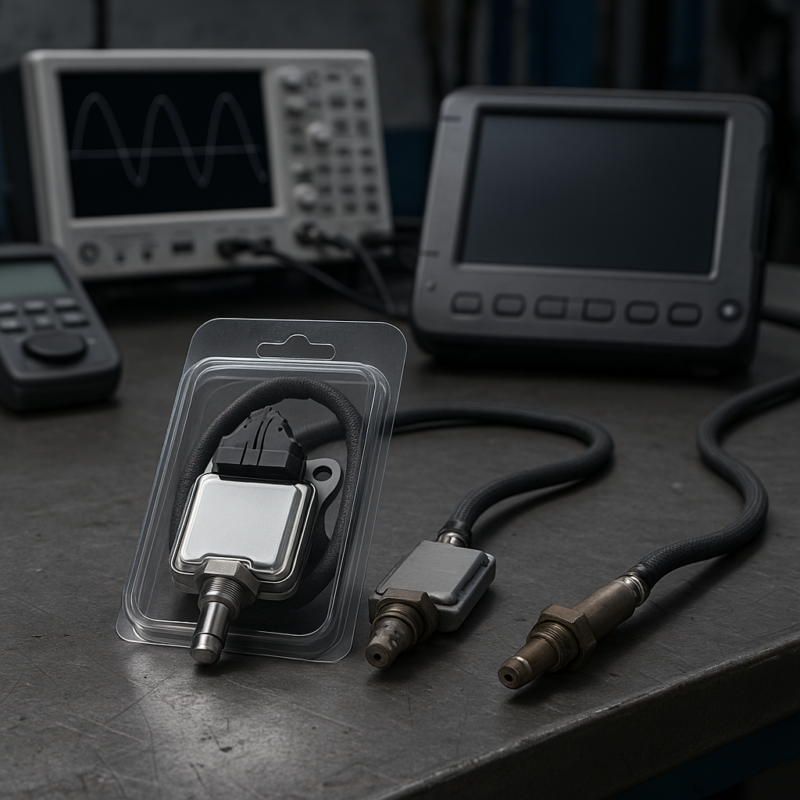
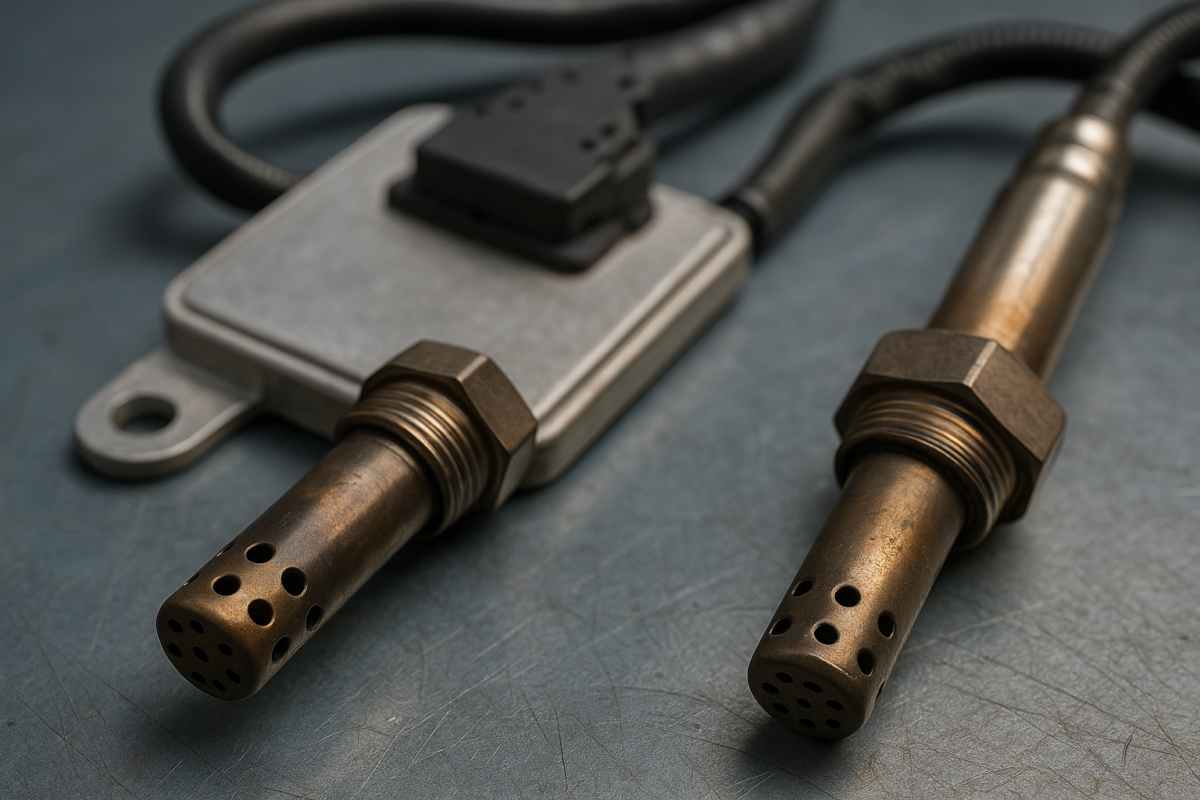
NOx sensors are the most underappreciated component on modern diesel emissions systems. They’re small, about the size of an oxygen sensor, but they’re doing a much harder job. An O2 sensor in a gasoline car measures one thing: residual oxygen in the exhaust to confirm stoichiometric combustion. A NOx sensor in a modern diesel measures both oxygen concentration and nitrogen oxide concentration simultaneously, at temperatures from 400°F to over 1,200°F, in a corrosive exhaust stream loaded with soot, sulfur compounds, and DEF-derived ammonia.
The sensor itself is a multi-cell ceramic device. It has a heated zirconia element (the same family of ceramics used in O2 sensors), but with additional electrochemical cells that pump oxygen and react with NOx molecules to generate a current proportional to NOx parts-per-million in the exhaust stream. The sensor reports NOx readings in real time to the engine control module (ECM) via a dedicated controller and a CAN-bus communication link.
Why does the ECM care about NOx ppm in real time? Because the entire purpose of the Selective Catalytic Reduction (SCR) system is to convert NOx into nitrogen gas and water vapor using DEF as a reducing agent. The chemistry is:
- DEF (32.5% urea in deionized water) is injected into the hot exhaust stream upstream of the SCR catalyst
- Heat decomposes the urea into ammonia (NH3) and CO2
- Ammonia reacts with NOx (NO and NO2) on the SCR catalyst surface to produce N2 and H2O
- The system targets >90% NOx conversion across the catalyst
For this conversion to work efficiently, the ECM has to dose the right amount of DEF for the current NOx output. Too little DEF and NOx slips past the catalyst untreated. Too much DEF and excess ammonia slips past as a secondary pollutant. The only way to dose accurately is closed-loop control: measure NOx before the catalyst, measure NOx after the catalyst, and verify that conversion is happening at the target rate.
That’s why modern heavy-duty diesel trucks and most diesel pickups have two NOx sensors: one upstream of the SCR catalyst (the inlet sensor) and one downstream (the outlet sensor). The ECM compares the readings and calculates conversion efficiency. If conversion drops below threshold, the ECM increases DEF dosing. If conversion stays low even with maximum dosing, the ECM concludes the catalyst is failing or DEF quality is wrong, and it throws fault codes.
The implication: if a NOx sensor fails, the ECM loses closed-loop feedback. It can’t verify conversion. From the ECM’s perspective, that’s an unacceptable emissions risk (federal regulations require functional emissions diagnostics), so it sets a code, illuminates the malfunction indicator lamp (MIL), and starts a derate countdown. The countdown follows the OEM’s emissions strategy: warnings first, then reduced power, then a limp-home speed limit if the fault is not fixed.
This is why NOx sensors get replaced so often. They’re more than emissions components. They’re the closed-loop feedback that makes the entire SCR system work. When they fail, the truck goes from functional to limited within a tank of fuel. Understanding how they fail, how to diagnose them, and how to extend their life is one of the highest-ROI maintenance topics for modern diesel operators.
Upstream vs Downstream: What Each One Measures
The two NOx sensors look identical and operate on the same electrochemical principle, but they measure different things and fail in different patterns.
Upstream NOx sensor (inlet sensor):
- Location: Between the turbocharger outlet and the SCR catalyst inlet. On most platforms it’s mounted in the exhaust pipe ahead of the DEF injector or just downstream of the DEF injector (depends on manufacturer: Cummins typically places it upstream of the DOC/DPF, Detroit Diesel places it between the DPF and the SCR).
- What it measures: Raw engine-out NOx concentration, in ppm. This is the “before treatment” baseline.
- Operating environment: Hottest exhaust temperatures (often 800–1,200°F), highest soot loading (before the DPF on some platforms), highest mechanical vibration.
- Primary failure mode: Heater element degradation from thermal cycling, soot contamination of the ceramic element, sulfur poisoning from fuel sulfur compounds.
Downstream NOx sensor (outlet sensor):
- Location: After the SCR catalyst, before the muffler/tailpipe. On some platforms it’s integrated into the ammonia-slip catalyst section.
- What it measures: Post-treatment NOx concentration. Should be near zero if SCR is working correctly.
- Operating environment: Cooler exhaust temperatures than upstream (typically 500–900°F), exposure to ammonia slip and DEF-derived contamination, lower soot loading.
- Primary failure mode: Ammonia poisoning of the ceramic element, urea crystallization deposits, water intrusion during cool-down/heat-up cycles, ceramic element cracking from thermal shock.
The downstream sensor typically fails sooner than the upstream sensor in fleets that experience DEF quality issues or SCR crystallization. The reason: the downstream sensor sees the chemical aftermath of the SCR reaction. If DEF is contaminated or improperly dosed, the downstream sensor is exposed to ammonia slip, urea aerosols, and crystallization fragments, all of which poison the ceramic element faster than the cleaner upstream environment.
Platform configurations vary:
- Most heavy-duty trucks (Class 8 OTR: Cummins ISX/X15, Detroit DD13/DD15, Volvo D11/D13, PACCAR MX-11/MX-13): Two NOx sensors, one upstream and one downstream.
- Most diesel pickups (Ford 6.7 Power Stroke, Ram Cummins 6.7, GM Duramax LML/L5P/LZ0): Two NOx sensors, configured upstream and downstream of the SCR.
- Some medium-duty trucks (Ford 6.7 with 2017+ aftertreatment, ISB 6.7): Two NOx sensors.
- Tier 4 Final off-road diesel (industrial generators, construction equipment): One or two NOx sensors depending on emissions calibration and platform.
- Older 2010–2013 calibrations: Some platforms used only one downstream NOx sensor; ECM inferred upstream NOx from engine-out modeling. These are less common now and most have been updated.
When you diagnose a NOx sensor fault code, the code itself usually identifies whether it’s the upstream or downstream sensor (bank 1 sensor 1 = upstream, bank 1 sensor 2 = downstream on most platforms). But not always. Some codes are ambiguous and require a scan tool to identify which sensor is reporting the fault.
Symptoms of a Failing NOx Sensor
NOx sensor failures present in a recognizable cluster of symptoms. Knowing the pattern helps you diagnose the problem faster and avoid getting steered toward unrelated repairs.
1. Malfunction Indicator Lamp (MIL) illuminated. This is the most common first symptom. The MIL comes on (steady, not flashing) with a NOx-related code stored in the ECM. The MIL may go off temporarily if the sensor recovers, then come back on within a few drive cycles.
2. Intermittent codes that clear themselves. Early-stage NOx sensor failure often shows up as codes that appear and disappear. The sensor works correctly when cold but drifts as it heats up, or vice versa. Drivers report “the light comes on for a couple days, then goes away for a week, then comes back.” This pattern is highly characteristic of a sensor on the way out. Full electronic failures usually produce persistent codes, but degrading ceramic elements produce intermittent ones.
3. Power derate after a persistent code. EPA rules require SCR diesels to enforce a derate sequence when emissions diagnostics fail. The steps and distances vary by OEM: warnings first, then reduced power, then a limp-home speed limit. Drivers describe it as “losing the top end” or “the truck won’t pull a hill anymore.”
4. False-positive DEF quality codes. This is one of the most expensive misdiagnoses in modern diesel maintenance. A degrading downstream NOx sensor reads incorrectly, the ECM sees insufficient NOx conversion, and it concludes that DEF is contaminated or the wrong fluid is in the tank. Codes like P207F (“Reductant Quality Performance”) or P204F (“Reductant System Performance”) get thrown. Owner-operators replace DEF, flush tanks, swap suppliers, and the codes keep coming back because the actual problem is the sensor, not the fluid.
5. Increased DEF consumption. If the ECM is getting bad NOx readings, it may over-dose DEF in an attempt to drive measured conversion up. This is often paired with the next symptom.
6. Ammonia smell from exhaust. Over-dosing DEF produces ammonia slip: excess ammonia that doesn’t react on the SCR catalyst and exits the tailpipe. The smell is distinctive (think strong cat urine or window cleaner). If you smell ammonia at idle, especially after the truck has been working hard, suspect either over-dosing (which can be NOx sensor-driven) or ammonia-slip catalyst failure.
7. Reduced fuel economy. Closed-loop SCR optimization makes a real fuel-economy difference. When the loop is broken, the ECM falls back to conservative open-loop calibrations that prioritize emissions compliance over efficiency.
8. Sluggish throttle response. Even before the formal derate kicks in, some platforms reduce turbo boost and EGR aggressiveness when emissions diagnostics are unreliable. Drivers feel it as “the truck doesn’t respond like it used to” or “it feels heavy off the line.”
When you see this pattern (MIL on, intermittent codes, DEF quality codes that don’t resolve with fluid changes, ammonia smell, derate countdown), the answer is almost always a NOx sensor. The question is which one.
NOx Sensor Fault Codes Explained (P2200, P2201, P229F, more)
The OBD-II diagnostic system uses standardized fault codes (with some manufacturer-specific extensions). For NOx sensors, the codes break down into several families:
P2200: NOx Sensor Circuit Bank 1 Sensor 1. Generic circuit fault on the upstream NOx sensor. The ECM detected an electrical problem: open circuit, short to ground, short to power, or out-of-range voltage. Could be the sensor itself, the wiring harness, the connector, or the dedicated NOx controller module.
P2201: NOx Sensor Circuit Range/Performance Bank 1 Sensor 1. The upstream sensor is reporting values outside the expected operating range. The sensor is communicating but its readings don’t make sense: either implausibly high, implausibly low, or not changing when they should. Often indicates ceramic element degradation rather than full electrical failure.
P2202: NOx Sensor Circuit Low Bank 1 Sensor 1. Upstream sensor voltage is below expected minimum. Often a heater element failure (sensor never reaches operating temperature) or a short to ground in the wiring.
P2203: NOx Sensor Circuit High Bank 1 Sensor 1. Upstream sensor voltage is above expected maximum. Usually a wiring issue or a failed ground reference.
P229E: NOx Sensor Circuit Bank 1 Sensor 2. Same fault family as P2200 but on the downstream sensor. Generic circuit fault on the post-SCR NOx sensor.
P229F: NOx Sensor Circuit Range/Performance Bank 1 Sensor 2. Downstream sensor reading out of its expected range. Often associated with contamination on the downstream side.
P220E: NOx Sensor Heater Control Circuit Range/Performance Bank 1 Sensor 1. The heater element inside the upstream NOx sensor is not performing as expected. Without the heater bringing the ceramic element to operating temperature, the sensor can’t produce valid readings. Heater failure is a common NOx sensor failure mode.
P220F: NOx Sensor Heater Control Circuit Range/Performance Bank 1 Sensor 2. Same as P220E but on the downstream sensor.
P2210 / P2211: NOx Sensor Heater Sense Circuit Low / High, Bank 1 Sensor 1. The ECM monitors heater performance through a sense circuit. These codes mean the sense signal is out of range. The heater may or may not actually be failing, but the ECM can’t verify it.
P2BAC: NOx Exceedence, Deactivation of EGR. A secondary code that sets when the ECM sees excess NOx and attributes it to the EGR system being deactivated. Diagnose the EGR system and any primary codes alongside it.
P207F: Reductant Quality Performance. This is the “false positive DEF quality” code that NOx sensor failures love to trigger. The ECM concludes DEF quality is wrong because conversion looks low, but the conversion calculation is wrong because the sensor is wrong. Drivers and shops chase DEF problems for weeks before someone tests the NOx sensors.
P204F: Reductant System Performance. Similar to P207F but broader: the ECM thinks the whole reductant system is underperforming. Often pairs with NOx sensor codes.
Manufacturer-specific codes add another layer. Heavy-duty engines report faults as SAE J1939 SPN and FMI pairs, and some makers, Cummins among them, also show their own fault code numbers. SPN 3226 is the outlet (downstream) NOx sensor; the section below covers it. Most modern scan tools translate the manufacturer codes to generic OBD-II equivalents, but when reading raw fault codes off a heavy-duty platform, expect to see SPN codes alongside or instead of P-codes.
The key rule: don’t replace a NOx sensor based on the code alone. The code tells you which family of failure you’re looking at and which sensor is reporting (upstream or downstream), but multiple causes can throw the same code. A heater code such as P220E could be the sensor’s internal heater (sensor replacement), a corroded connector (clean and re-pin), a chafed wire in the harness (harness repair), or a failed NOx controller module (different part entirely). Spend the diagnostic time before spending the parts money.
Extended Subcodes: P220013 and the Cummins Numbering
Heavy-duty platforms often report NOx faults as extended subcodes rather than the bare OBD-II code, and P220013 is the one owners search most. On the 6.7 Cummins and other Cummins-powered trucks, P220013 is the extended form of P2200, a NOx sensor circuit fault, with the “13” failure-mode identifier pointing at an open circuit. In practice it reads the same way as the P2200 diagnosis above: check the sensor connector and harness first, then the sensor itself, because the module is telling you it has lost the circuit, not that NOx is actually high. Related extended codes like P220064 (signal plausibility) follow the same pattern: the first four digits name the base fault, the suffix names how it failed.
One location note that saves Cummins owners time: on the 6.7, NOx sensor B is the downstream (outlet) sensor, mounted after the SCR catalyst toward the tail of the aftertreatment system, while sensor A sits upstream near the turbo outlet. A code naming sensor B points you behind the SCR brick, and on trucks with crystallization history the downstream sensor is usually the first casualty, one more reason the DEF-quality section below matters as much as the sensor swap.
SPN 3226: The Outlet NOx Sensor Code (FMI 10 and Others)
On heavy-duty trucks and equipment, NOx sensor faults usually show up as SAE J1939 codes. Each one is an SPN (Suspect Parameter Number) that names the signal, plus an FMI (Failure Mode Identifier) that says how it failed. The two NOx SPNs you will see most:
- SPN 3216: Aftertreatment 1 Intake NOx. The upstream sensor, reading engine-out NOx ahead of the SCR catalyst.
- SPN 3226: Aftertreatment 1 Outlet NOx. The downstream sensor, reading what is left after the SCR catalyst, toward the tailpipe.
So SPN 3226 always points behind the SCR catalyst. The FMI tells you what kind of problem the controller sees. Common FMIs as defined in SAE J1939-73:
- FMI 2: data erratic, intermittent or incorrect.
- FMI 3 / FMI 4: voltage above normal or shorted high / voltage below normal or shorted low.
- FMI 5: current below normal or open circuit.
- FMI 9: abnormal update rate. The controller is not getting the sensor message on the data link as often as it should.
- FMI 10: abnormal rate of change. The signal moves faster or slower than physically makes sense.
- FMI 13: out of calibration.
What SPN 3226 FMI 10 Means and What to Check
SPN 3226 FMI 10 means the outlet NOx reading is changing at an abnormal rate. The value may jump, freeze, or fail to follow changes in engine load the way it should. Work it in this order:
- Read the live data. Watch SPN 3216 and SPN 3226 together on a heavy-duty scan tool. The outlet value should track the inlet value at a much lower level and respond as load changes. A reading stuck at one value, or one that jumps around at steady load, points at the outlet sensor circuit.
- Check the connector and harness. Look for corroded pins, water in the connector and harness rubbing on the exhaust. The downstream sensor sits in a cooler, wetter spot than the upstream one.
- Check for exhaust leaks ahead of the outlet sensor. Outside air pulled into the pipe skews the reading.
- Check data link codes. If other modules also log communication faults, fix the J1939 data link before replacing parts.
- Then the sensor. With wiring, leaks and the data link ruled out, the sensor is the likely cause. Follow the engine maker’s fault tree for your platform, then clear the code and confirm the monitor passes.
Treat an outlet NOx code as an electrical or sensor fault. DEF treatment does not repair it. Once the sensor is fixed, keep the DEF fresh and treated so crystallization deposits and contaminated fluid do not shorten the new sensor’s life. Codes for the rest of the SCR system are in our DEF trouble codes guide, and the DEF sensor guide covers the level, quality and temperature sensors in the tank.
Common NOx Sensor Failure Modes
NOx sensors fail in a few characteristic ways. Knowing which one you’re looking at helps you decide whether replacement, harness repair, or upstream DEF/SCR work is the right answer.
1. Heater element failure. The internal heater that brings the ceramic element to operating temperature has a finite life. Heaters draw 8–18 amps at startup (in-rush current) and cycle through full thermal range every drive cycle. Eventually the heater filament fatigues and opens, or the heater control circuit shorts. The sensor stops producing valid readings because the ceramic element never heats up properly. Codes: P220E, P220F, P2210, P2211. Heater failure is a common NOx sensor failure mode.
2. Ceramic element contamination. The zirconia ceramic element that does the actual NOx sensing gets coated by exhaust contaminants over time. Common contaminants include sulfur compounds from fuel and engine oil (sulfur poisoning), silicon from coolant leaks (silicon poisoning is irreversible; it coats the element permanently), phosphorus from oil additives, and carbon/soot deposits. Once the element is coated, NOx molecules can’t reach the active surface, so readings drift. Codes: P2201, P229F, plus secondary codes like P207F when the ECM misinterprets the drift.
3. Wiring harness corrosion. The wiring harness that connects the sensor to the dedicated NOx controller (and from the controller to the ECM via CAN-bus) is exposed to road salt, water, vibration, and engine heat. Pin corrosion at the sensor connector is one of the most common failure points. Green or white corrosion on the pins changes resistance and disrupts signal voltage. Sometimes the wire itself chafes against the chassis or exhaust components and shorts to ground. Codes: P2200, P229E, P2202, P2203. A corroded connector can mimic sensor failure exactly. Always inspect connectors before swapping the sensor.
4. NOx controller (NOx Sensor Module) failure. NOx sensors don’t communicate directly with the ECM. They communicate with a dedicated NOx controller module that handles the precise sensor signal conditioning and reports digital readings to the ECM via CAN-bus. The controller can fail independently of the sensor: overheated, water-damaged, or just electronic failure over time. On most platforms the controller is part of the sensor assembly (replace sensor = replace controller), but on some platforms (notably older Cummins) the controller is separate and can be replaced individually for a fraction of the sensor cost. Codes: P2200 series with no actual sensor element problem.
5. CAN-bus communication fault. The NOx controller talks to the ECM via the CAN-bus. If the bus has a fault (wiring issue, terminator resistor problem, or another module flooding the bus with errors), the NOx sensor data doesn’t make it through. Codes: U-codes (like U0073, U010C) often pair with NOx sensor codes when the underlying problem is CAN-bus. This is rare but expensive to chase if you don’t recognize it.
6. Mechanical damage to the sensor body. The sensor protrudes into the exhaust stream, and the threads thread into the exhaust pipe or aftertreatment housing. Rock strikes, exhaust pipe vibration, or improper torque during installation can crack the sensor body or strip the threads. Visible damage is rare but worth checking, especially after recent service or off-road operation.
7. Thermal shock from rapid cool-down. Modern NOx sensors heat the ceramic element from ambient to over 1,400°F in about 2 minutes during startup. If water (from condensation, water-injected DEF crystals, or coolant leak) hits the hot element, the thermal shock can crack the ceramic. This failure mode is more common in cold-climate fleets that have water-contaminated DEF, but it happens to any platform exposed to repeated water ingress.
Most NOx sensor faults are genuine sensor failures. Wiring, connector, controller and CAN-bus faults can look the same on a scan tool, and a new sensor will not fix those. Test before you replace.
How DEF Quality Affects NOx Sensor Life
The connection between DEF quality and NOx sensor longevity is one of the most under-discussed maintenance topics in heavy-duty diesel operation. Most fleet managers know that contaminated DEF damages the SCR catalyst. Fewer realize that DEF quality also affects how long NOx sensors last, particularly the downstream sensor.
The mechanism: every time the SCR system injects DEF, the downstream sensor is exposed to the chemical aftermath of the reaction. If the DEF is clean ISO 22241 fluid (32.5% high-purity urea in deionized water), the reaction is clean: NOx molecules react with ammonia on the catalyst surface, products are nitrogen and water, and the downstream sensor sees mostly nitrogen gas and water vapor. The sensor’s ceramic element stays clean and reads accurately.
If the DEF is contaminated (diluted, biologically contaminated, mineral-contaminated, mixed with hard water, or simply old and degraded), the reaction is dirty. Contamination products include:
- Mineral deposits (calcium, magnesium, iron from hard water or contaminated dispensing equipment): these deposit on both the catalyst and the downstream NOx sensor, coating the ceramic element
- Sulfur compounds (from biological contamination of stored DEF): sulfur poisons the ceramic element and is one of the most damaging contaminants for sensor longevity
- Urea crystallization fragments : partially dissolved urea crystals from cold DEF storage create solid particles in the exhaust stream that physically erode and coat the sensor element
- Phosphorus compounds (from oil consumption or fuel additives): phosphorus poisoning permanently coats the active sensor surface
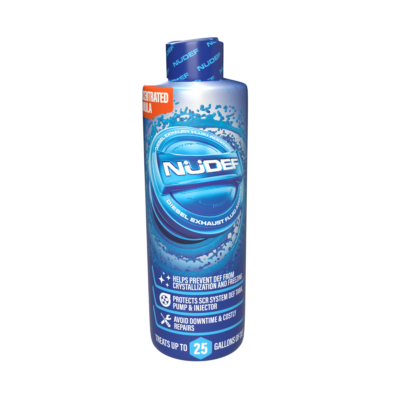
The fluid side is the part you control. Buy fresh certified DEF, store it between 41°F and 86°F, keep containers sealed, and keep dispensing equipment clean. NüDef DEF Treatment, Additive & Stabilizer is a stabilizer and anti-scaling agent that helps prevent DEF crystallization and helps protect the SCR system, DEF tank, pump and injector. One bottle treats up to 25 gallons of certified DEF; add it at every DEF fill. It does not repair a failed NOx sensor or clear sensor codes. Fleets can see wholesale pricing.
DIY Diagnosis: Scan Tool, Voltage, Resistance, Visual
If you’re trying to confirm whether a NOx sensor is actually failing (versus a wiring or controller issue), there’s a four-step diagnostic process that owner-operators and fleet techs can run with modest tooling.
Step 1: Read codes with a capable scan tool.
- Basic OBD-II scanners (Autel MaxiScan, BlueDriver, ANCEL) will read generic P-codes but often miss manufacturer-specific data
- Heavy-duty scan tools (Cummins Insite, Detroit Diesel Reprogramming Station/DDRS, Cojali Jaltest, Noregon Translations) read full SPN/FMI codes and live sensor data
- Mid-tier scanners that handle HD trucks: Autel MaxiSys CV, Texa eTruck, OTC Encore
- Note the exact code, which sensor it identifies (Bank 1 Sensor 1 = upstream, Bank 1 Sensor 2 = downstream), and any freeze-frame data
Step 2: Check live data while engine runs. With the scan tool connected and showing live NOx sensor data:
- Engine cold start: both sensors should report 0 ppm initially, then start reading after warm-up (heaters take 60–120 seconds to bring sensors to operating temp)
- Idle at normal operating temp: upstream sensor typically reads 80 to 250 ppm NOx; downstream sensor should read 20 to 80 ppm (significantly lower, which confirms the catalyst is working)
- Brief throttle blip: upstream NOx spikes briefly to 400–800 ppm; downstream should stay relatively low
- If upstream sensor stays at 0 ppm regardless of conditions: sensor failure or heater failure
- If upstream sensor pegs at maximum reading (often 1,500 ppm) regardless of conditions: sensor failure
- If downstream sensor reads higher than upstream: definitely sensor failure (impossible physically, since SCR can only reduce NOx, not produce it)
Step 3: Voltage check at the sensor connector. With the sensor unplugged and key on, engine off:
- Locate the sensor connector (usually a 4-pin connector at the sensor, sometimes routed to a body-mounted connector)
- Identify pins: typically 2 pins for heater power and ground, 2 pins for CAN-bus (high and low). Pinout varies by manufacturer; check service info
- Heater power pin should read 12V (key on) or pulse-width-modulated 12V (engine running, controller actively heating)
- Heater ground pin should be near 0V
- CAN-bus pins should read 2.5V (idle bus) or pulsing 2.0–3.0V (active bus)
- If heater power is missing or stuck low: wiring or NOx controller fault, not sensor fault
- If CAN-bus pins read 0V or 12V: bus fault, not sensor fault
Step 4: Resistance check on the heater element. With the sensor unplugged and cool (room temperature):
- Measure resistance between the two heater pins on the sensor side of the connector
- Healthy heater resistance: typically 2 to 6 ohms at room temperature (varies by sensor model; check service data for exact spec)
- Open circuit (infinite resistance): heater element is broken; sensor must be replaced
- Short circuit (0 ohms): heater element is shorted; sensor must be replaced
- Resistance way out of spec (e.g., 50 ohms when spec is 4 ohms): heater degradation; sensor likely needs replacement
Step 5: Visual inspection. Once the sensor is unthreaded from the exhaust:
- Look at the protective screen and the ceramic element underneath
- Healthy sensor: minor soot coating but ceramic element is intact and white/light gray
- Sulfur or phosphorus poisoning: ceramic element looks glazed, glassy, or has discoloration (yellow, blue, or green tinge)
- Silicon poisoning: ceramic element looks coated with a white/gray glaze that resists cleaning
- Mechanical damage: visible cracks in the ceramic element or broken protective screen
- Crystallization deposits: white crystalline coating on the protective screen (common on downstream sensor in fleets with contaminated DEF)
If the heater resistance is in spec, the voltage at the connector is correct, and the visual inspection shows a clean ceramic element, but the live data is still wrong, the most likely culprit is the NOx controller module or the CAN-bus, not the sensor. This is where many DIYers and even shops get tripped up: they replace a $400–$1,100 sensor and the code comes right back because the actual problem was upstream.
Replacement Costs by Platform and OEM vs Aftermarket
The prices in this section and the table are rough estimates, not quotes. NOx sensor replacement costs vary significantly by platform, by whether you buy OEM or aftermarket, and by how accessible the sensor location is. The “cleaning vs replacement” debate also matters here. Short answer: cleaning rarely works on NOx sensors because the ceramic element is consumable and most contamination is permanent (sulfur poisoning, silicon poisoning, and phosphorus poisoning are not reversible by cleaning).
OEM vs aftermarket: which to buy?
The NOx sensor supply chain is dominated by a few manufacturers regardless of whether you buy OEM or aftermarket. Bosch supplies the original NOx sensors for most OEM applications (Cummins, Detroit, Volvo, PACCAR, Ford 6.7, Ram Cummins, GM Duramax). Continental/VDO supplies some OEM applications (Mercedes, certain Detroit applications). Walker Products and Hella make aftermarket NOx sensors that are generally well-regarded.
OEM-branded sensor: You’re paying for the dealer markup and the OEM packaging. The sensor inside the box is usually the same Bosch or Continental unit. Rough price: $400 to $1,100 depending on platform. Check the warranty terms with the seller.
Bosch original (sold through parts channels): Same Bosch sensor that goes into OEM applications, sold without the OEM packaging. Rough price: $250 to $650. Often the best value for most replacements.
Continental/VDO aftermarket: Direct from Continental for non-OEM applications. Rough price: $200 to $500. Generally well-regarded but verify the specific part number matches your platform.
Walker Products / Hella aftermarket: Quality aftermarket alternatives. Rough price: $180 to $450. Confirm the part number matches your platform.
Cheap eBay/Amazon imports: $50–$150 sensors from unknown manufacturers. We don’t recommend these. NOx sensors are precision electrochemical devices, and quality matters. A cheap unit that fails early means paying the labor twice.
Installation tips:
- Apply high-temp anti-seize compound to the threads (most sensors ship with it pre-applied, but verify). This prevents galling and makes future replacement easier
- Torque to spec, typically 35 to 55 ft-lbs depending on platform. Don’t overtighten. It can crack the sensor body
- Don’t touch the ceramic element with your fingers. Skin oils can contaminate it. Handle by the body only
- Route the wiring carefully. Keep it away from exhaust pipe contact points and ensure the connector is fully seated
- ECU relearn may be required after installation. Some platforms require a scan-tool initiated relearn procedure for the ECM to accept the new sensor’s reference values. Without this, the new sensor may throw codes immediately
Order NüDef DEF Treatment, Additive & Stabilizer direct from nudef.com.