If you’ve ever searched for “DEF conditioner” trying to figure out how to keep your fleet’s diesel exhaust fluid from going bad, you’ve probably noticed something: the results are a mess. Some products call themselves conditioners. Others say additive. A few claim to be stabilizers. And almost none of them explain what they actually do differently.
The terms “DEF conditioner” and “DEF additive” describe overlapping but different product categories. Understanding that difference matters if you’re the one deciding what your fleet standardizes on, because choosing the wrong product means you’re either leaving problems unsolved or buying two bottles where one would do.
What Is a DEF Conditioner?
A DEF conditioner is a product designed to preserve the quality of diesel exhaust fluid over time. It extends shelf life and protects against freezing. Nothing more.
DEF is a solution of 32.5% automotive-grade urea and 67.5% deionized water, manufactured to the ISO 22241 standard. It’s not a complicated formula. But that simplicity makes it fragile. Urea begins to break down through a process called hydrolysis — the urea molecules react with the water and decompose into ammonia and carbon dioxide. This happens faster at higher temperatures. Store DEF above 86°F for extended periods, and degradation accelerates significantly.
The second problem is biuret formation. When urea degrades, one of the byproducts is biuret — a compound that poisons the SCR catalyst over time. ISO 22241 limits biuret to 0.3% maximum. DEF that sits too long, especially in warm environments, can exceed that threshold. Once it does, you’re pumping catalyst poison into a $3,000-$8,000 aftertreatment system.
DEF conditioners typically address these storage-related problems. They may include anti-freeze agents to lower the crystallization point below DEF’s standard 12°F (-11°C) freeze threshold, and stabilizing compounds to slow urea hydrolysis during storage.
What conditioners usually don’t address: crystallization inside the SCR system, injector deposit prevention, or active performance enhancement during the dosing cycle.
What Is a DEF Additive?
A DEF additive is a broader category. Additives can include conditioner-type functions, but they also target what happens after DEF leaves the tank and enters the SCR system.
This is where the real maintenance problems live. DEF crystallization — those white, chalky deposits that clog injectors and foul dosing nozzles — doesn’t happen in the tank. It happens in the hot environment of the aftertreatment system, where temperatures cycle between ambient and 600°F+.
When DEF is injected into the exhaust stream, the water evaporates first. The urea is supposed to decompose into ammonia and isocyanic acid through a process called thermolysis. That ammonia then reacts with NOx on the SCR catalyst to produce harmless nitrogen and water.
But if the exhaust temperature is too low, or if DEF is injected unevenly, not all the urea converts. Instead, it forms solid crystalline deposits — primarily cyanuric acid, biuret, and melamine — that accumulate on the injector tip, in the decomposition tube, and on the mixer plate. These deposits restrict flow, trigger DEF quality sensor faults, and eventually cause derates.
A good DEF additive targets this problem directly. It modifies the fluid’s behavior during the dosing and decomposition phases to reduce incomplete conversion and resist deposit formation.
The Real Difference: Storage vs. System Protection
Put simply —
- DEF conditioner = storage protection (shelf life, freeze resistance)
- DEF additive = system protection (anti-crystallization, SCR performance, deposit prevention)
Most fleets need both. A truck that sits for three weeks in a Phoenix yard in July needs storage protection. That same truck running I-10 in January needs crystallization protection when its aftertreatment system cycles through cold starts.
The problem is that buying two separate products doubles your cost, complicates your inventory, and creates confusion at the parts counter. Which bottle goes in when? How do the two interact? What’s the correct dosing ratio if you’re using both?
This is exactly why NüDef was formulated as a single product that handles both sides of the equation.
How NüDef Combines Conditioner and Additive Functions
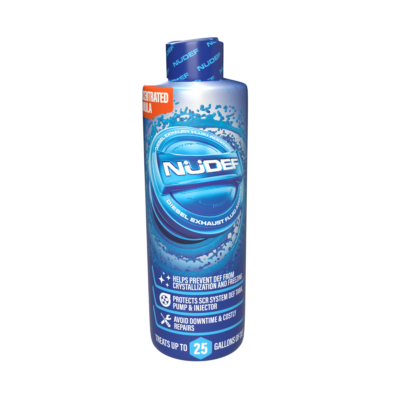
NüDef is a DEF stabilizer, anti-crystallization agent, and freeze protectant in one bottle. Each bottle treats 25 gallons of DEF. It covers three areas.
Stabilization (Conditioner Function)
NüDef slows urea hydrolysis during storage. This keeps the urea concentration within spec longer, which means your DEF maintains its 32.5% ratio even in tanks that don’t turn over quickly. For fleets with seasonal equipment or reserve tanks that sit for weeks between fills, this prevents out-of-spec DEF from entering the system in the first place.
Anti-Crystallization (Additive Function)
NüDef reduces the formation of crystalline deposits in the SCR system. It improves the way urea decomposes during thermolysis so less residual solid material accumulates at the injector, decomposition chamber, and mixer. Fewer deposits mean fewer DEF quality codes, fewer forced regens, and fewer injector replacements.
If you’re already dealing with crystallization problems, start with proper cleaning of existing deposits, then use NüDef in ongoing fills to prevent recurrence.
Freeze Protection (Conditioner Function)
Standard DEF freezes at 12°F (-11°C). That’s fine if you’re in Alabama. It’s a problem in Minnesota, Montana, or anywhere that sees extended sub-zero temperatures. NüDef lowers the freeze point threshold, giving you additional protection during cold-weather storage and operation. The DEF still thaws and performs normally when the system heats up — NüDef doesn’t alter the fluid’s behavior in the SCR catalyst.
Conditioner vs. Additive vs. NüDef: Side-by-Side Comparison
The three product categories stack up differently across the functions that matter to a fleet maintenance operation.
| Feature | Conditioner Only | Additive Only | NüDef (All-in-One) |
|---|---|---|---|
| Extends DEF shelf life | Yes | Sometimes | Yes |
| Freeze protection | Yes | Rarely | Yes |
| Anti-crystallization (SCR system) | No | Yes | Yes |
| Reduces injector deposits | No | Yes | Yes |
| Slows biuret formation | Partially | No | Yes |
| Single product / single dose | Yes (limited scope) | Yes (limited scope) | Yes (full coverage) |
| Treats per bottle | Varies (5-15 gal typical) | Varies | 25 gallons |
A conditioner-only product leaves your SCR system unprotected. An additive-only product may not help DEF that degrades before it ever gets dosed. NüDef eliminates both gaps with one SKU.
Why Fleet Standardization Matters Here
If you manage more than a handful of diesel trucks, you know that product standardization saves more than money. It saves mistakes.
When your parts counter stocks one DEF treatment product instead of two or three, there’s no ambiguity about what gets used. Technicians don’t have to guess which bottle applies. Inventory management gets simpler. And you can track usage per gallon of DEF consumed across the fleet with a clean ratio.
NüDef treats 25 gallons per bottle, which aligns with common DEF tote and drum quantities. One bottle per fill. No measuring, no math, no mixing protocols. That consistency matters when you’re running 20, 50, or 200 trucks and the person adding DEF treatment isn’t always the same tech who diagnosed the last crystallization problem.
The Hidden Cost of Using the Wrong Product Category
We see this constantly. A fleet starts getting P20EE or P208D fault codes across multiple trucks. The maintenance lead buys a DEF conditioner because it was the first result on the search. The conditioner stabilizes the DEF in storage, but does nothing to address the crystallization already forming inside the SCR system. The codes continue. Now the fleet is paying for a product and still paying for injector replacements at $400-$800 each.
The reverse happens too. A fleet buys a straight additive for crystallization protection but stores DEF in outdoor tanks through a Texas summer. The additive doesn’t slow hydrolysis. The DEF degrades past spec before it’s ever pumped into a truck. The result is the same: fault codes, derates, downtime.
Both problems disappear with one product.
What to Look For When Evaluating DEF Treatment Products
When you’re evaluating DEF treatment products, these are the specs that move the needle.
- Treatment ratio — how many gallons per unit? Products treating only 5 gallons cost way more per gallon than one treating 25.
- Make sure the product won’t push DEF outside ISO 22241 spec. If it changes urea concentration, conductivity, or alkalinity beyond limits, you’ll trigger DEF quality sensor faults.
- What does it actually protect? Storage only? Operating conditions? Both? Get the specific claims in writing.
- Check the freeze point improvement. Some products claim freeze protection but only shift the threshold by 2-3 degrees. That’s not meaningful in a northern climate.
- Biuret inhibition is worth asking about specifically. It’s one of the most damaging aspects of DEF degradation, and most conditioners don’t address it aggressively enough.
- If you’re treating hundreds or thousands of gallons monthly, per-unit cost at volume is the real number. Ask about case quantity breaks and distributor programs.
Who Should Be Using a DEF Conditioner or Additive?
Not every diesel truck needs DEF treatment. If you’re running a single pickup that burns through a 2.5-gallon jug every two weeks with fresh DEF from a major brand, you’re probably fine.
But if any of these apply to your operation, DEF treatment stops being optional.
- You’re storing DEF in bulk — tanks or totes that sit for more than 30 days, especially in uncontrolled temperature environments.
- You have seasonal equipment sitting for weeks. The DEF in those tanks is degrading.
- You’re replacing DEF injectors or cleaning decomposition tubes more than once a year per truck. That’s a systemic DEF quality or dosing problem.
- Your fleet operates in cold climates (USDA zones 3-5) with extended sub-zero storage conditions.
- You’re in the South or Southwest, where ambient temps push DEF tanks above 86°F for months at a time.
Frequently Asked Questions About DEF Conditioner
Is DEF conditioner the same as DEF additive?
No. A DEF conditioner is typically focused on preserving DEF quality during storage — extending shelf life and providing freeze protection. A DEF additive is a broader category that includes anti-crystallization agents, SCR system protectants, and performance enhancers. Some products, like NüDef, combine both conditioner and additive functions into a single formula.
Do I need both a DEF conditioner and a DEF additive?
If you’re buying separate products, you may need both — one to protect DEF in storage and another to protect your SCR system during operation. The simpler approach is using an all-in-one product like NüDef that covers stabilization, anti-crystallization, and freeze protection in a single dose that treats 25 gallons.
What does DEF conditioner actually do?
A DEF conditioner slows the chemical breakdown of urea in diesel exhaust fluid. Urea naturally degrades through hydrolysis, producing ammonia and eventually biuret — a compound that damages SCR catalysts. Conditioners inhibit this process and may also lower the freeze point below DEF’s standard 12°F (-11°C) threshold.
Can DEF conditioner prevent crystallization?
Standard DEF conditioners don’t prevent crystallization in the SCR system. Crystallization occurs during the thermolysis and decomposition process inside the aftertreatment system, not in the tank. You need a DEF additive with anti-crystallization properties, or a combined product like NüDef, to address the root causes of DEF crystallization.
How much DEF conditioner do I need per gallon?
Dosing varies by product. NüDef treats 25 gallons per bottle with a single dose — no measuring required. Other products may treat as few as 5 gallons per unit, which increases per-gallon cost and handling time. Always follow the manufacturer’s specified treatment ratio to avoid altering DEF outside ISO 22241 parameters.
What’s the best DEF conditioner for fleet use?
The best DEF conditioner for fleet use is one that also provides additive-level protection — covering shelf life, freeze resistance, and anti-crystallization in a single product. NüDef is formulated specifically for fleet-scale use, with a 25-gallon treatment ratio per bottle and wholesale pricing for volume buyers. One SKU replaces the need for separate conditioner and additive products.
Standardize Your Fleet on One DEF Treatment
Stop overthinking the conditioner-vs.-additive question. One bottle of NüDef per 25 gallons, every fill. Done.
If you’re a parts distributor, fleet maintenance operation, or dealer stocking DEF treatment products, NüDef’s wholesale program offers volume pricing with case and pallet quantity breaks. One product to stock, one product to recommend, one product that solves both storage and system problems.
Stop buying two products when one does the job. Request wholesale pricing and standardize your operation on NüDef.