
What Your Fleet’s DEF System Is Really Costing You
A single SCR system failure runs $3,000 to $8,000 per truck. Multiply that across 50 trucks and you’re staring at a potential $400,000 liability sitting in your maintenance budget. And that number doesn’t include the $1,000+ per day in lost revenue every time a Class 8 sits in the shop instead of on the road.
I’ve watched fleet managers dismiss DEF treatment as an unnecessary line item—right up until they’re writing checks for three injector replacements in one quarter. The math on DEF additive treatment isn’t complicated. It’s just rarely laid out in a way that a CFO can hand to their board.
This post fixes that. Every number here is based on industry-standard repair costs and real fleet maintenance data. Run the calculations against your own fleet size and tell me the ROI doesn’t work.
What DEF System Failures Actually Cost Your Fleet
Direct Repair Costs Per Truck
- SCR catalyst replacement. $3,000–$8,000 per unit. On a newer Cummins or Detroit Diesel engine, you’re closer to the high end.
- DEF injector replacement. $400–$800 per injector, plus 2–4 hours of labor at shop rates of $120–$180/hour.
- DPF cleaning: $500–$1,000 per cleaning cycle. Most fleets need this every 200,000–300,000 miles, but crystallized DEF accelerates the interval significantly.
- NOx sensor replacement: $250–$500 per sensor, and most trucks have two.
- DEF pump module: $800–$1,500 installed.
A truck that throws a P20EE or P203F code doesn’t just need one part. Crystallization damages components downstream. A $400 injector failure left unchecked turns into a $6,000 SCR replacement within 30,000 miles.
Where the Real Money Goes — Downtime
Forget the repair bill for a second. The downtime is what bleeds you dry. A Class 8 truck generates $800–$1,200 per day in revenue for most fleets. When that truck is parked at a dealer waiting for an SCR catalyst that’s backordered for two weeks, you’re burning:
- Revenue loss: $1,000+/day average
- Driver reassignment or idle pay: $200–$400/day
- Rental/replacement truck — $300–$500/day if available
- Expedited shipping for parts: $200–$800 per order
A single SCR failure with a 5-day shop stay costs your fleet $5,000–$7,000 in downtime alone—on top of the repair bill. That’s $8,000 to $15,000 total per incident. Per truck.
Annual DEF System Maintenance — Your Baseline
Even without catastrophic failure, DEF system maintenance eats into your budget every year. Most fleets spend $600–$1,200 per truck annually on DEF-related maintenance — sensor replacements, injector cleaning, filter changes, and diagnostic time. For a 50-truck fleet, that’s $30,000–$60,000 per year in routine maintenance alone.
How DEF Additive Treatment Reduces These Costs
DEF additive prevents the root cause of most SCR system failures — crystallization. When urea deposits build up in injectors, pumps, and catalyst passages, they restrict flow and trigger fault codes. A quality DEF stabilizer keeps the urea solution from forming those deposits in the first place.
DEF degrades over time, especially in heat. Temperatures above 86°F accelerate decomposition. A truck sitting on a Texas lot in July has DEF breaking down in the tank before it ever reaches the SCR system. Additive treatment extends the stability window and prevents the crystalline deposits that destroy components.
What Prevention Looks Like in Practice
Here’s what we see across fleets running NüDef:
- DEF fault codes drop off a cliff. P20EE, P203F, P20E8—we’ve seen these codes drop by 60–75% in treated fleets. Fewer codes means fewer shop visits, fewer diagnostic hours, and fewer parts replacements.
- Your injectors and SCR catalysts last way longer. DEF injectors that typically last 150,000 miles push past 300,000 miles with proper treatment. SCR catalysts that might need replacement at 400,000 miles make it to 600,000+.
- You stop burning money on DPF cleanings. When the SCR system works correctly, it handles NOx reduction efficiently. Your DPF doesn’t pick up the slack, which means fewer regeneration cycles and longer intervals between cleanings.
ROI Calculation Methodology: Numbers Your CFO Will Accept
Here’s a framework you can plug your own numbers into. I’ve used conservative estimates—your actual savings will vary based on operating conditions, routes, and vehicle age.
The Formula
Annual ROI = (Total Avoided Costs − Annual Treatment Cost) ÷ Annual Treatment Cost × 100
To calculate Total Avoided Costs, you need three inputs:
- Repair cost reduction: (Current annual DEF repair spend) × (estimated reduction percentage). Use 50% as a conservative baseline.
- Downtime savings: (Number of DEF-related shop days per year) × (daily revenue loss per truck) × (estimated reduction). Use 60% reduction as baseline.
- Extended maintenance intervals: (Current annual DEF maintenance spend) × (estimated reduction). Use 30% as baseline.
Conservative Assumptions Used Below
- Average 1.5 DEF-related repairs per truck per year (industry average for trucks over 200,000 miles)
- Average repair cost — $1,800 per incident (weighted across injectors, sensors, and occasional SCR work)
- Average downtime per repair — 2.5 days
- Daily downtime cost: $1,000
- DEF additive reduces repair frequency by 50%
- DEF additive reduces downtime events by 60%
- Routine maintenance reduction: 30%
Fleet Size Breakdowns: 10, 50, and 100 Trucks
10-Truck Fleet
Current annual DEF-related costs (without treatment):
- Repairs: 10 trucks × 1.5 incidents × $1,800 = $27,000
- Downtime: 10 trucks × 1.5 incidents × 2.5 days × $1,000 = $37,500
- Routine maintenance: 10 trucks × $900 average = $9,000
- Total annual cost: $73,500
With DEF additive treatment:
- Repair savings (50% reduction): $13,500
- Downtime savings (60% reduction): $22,500
- Maintenance savings (30% reduction): $2,700
- Total annual savings: $38,700
Contact NüDef for wholesale volume pricing on a 10-truck program. Even at retail pricing, the ROI payback period is under 90 days for most fleets this size.
50-Truck Fleet
Current annual DEF-related costs (without treatment):
- Repairs: 50 trucks × 1.5 incidents × $1,800 = $135,000
- Downtime: 50 trucks × 1.5 incidents × 2.5 days × $1,000 = $187,500
- Routine maintenance: 50 trucks × $900 = $45,000
- Total annual cost: $367,500
With DEF additive treatment:
- Repair savings: $67,500
- Downtime savings: $112,500
- Maintenance savings: $13,500
- Total annual savings: $193,500
At 50 trucks, wholesale pricing makes a significant difference in your per-unit treatment cost. NüDef’s wholesale program is built for fleets this size and larger.
100-Truck Fleet
Current annual DEF-related costs (without treatment):
- Repairs: 100 trucks × 1.5 incidents × $1,800 = $270,000
- Downtime: 100 trucks × 1.5 incidents × 2.5 days × $1,000 = $375,000
- Routine maintenance: 100 trucks × $900 = $90,000
- Total annual cost: $735,000
With DEF additive treatment:
- Repair savings: $135,000
- Downtime savings: $225,000
- Maintenance savings: $27,000
- Total annual savings: $387,000
Three hundred eighty-seven thousand dollars. That’s not a rounding error on a fleet P&L—it’s a line item that gets attention in any quarterly review. And with NüDef’s wholesale volume pricing, the treatment cost is a fraction of those savings.
Variables That Affect Your Specific ROI
Factors That Increase ROI
- Older trucks (400,000+ miles): Higher baseline failure rates mean more repairs to prevent. Fleets running aging equipment see the fastest payback.
- Hot-climate routes: Texas, Arizona, Florida, and Southern California fleets deal with accelerated DEF degradation. Treatment works best where the problem is worst.
- Extended idle time: Trucks that idle heavily—reefers, vocational trucks, sleeper cabs in summer—cook the DEF in the tank. This is where treatment pays for itself fastest.
- Mixed DEF sourcing: If your drivers fill up at random truck stops with unknown DEF quality, additive treatment acts as a safety net against bad DEF batches.
Factors That Reduce ROI
- New trucks under warranty: If the OEM covers your SCR system, direct repair savings are lower (though downtime costs still apply).
- Cold-climate-only operation: DEF degrades slower in cool temperatures, so baseline failure rates are lower. But cold weather has its own DEF headaches — freezing, thawing cycles, and sensor issues still take a toll.
- Low annual mileage: Trucks running under 60,000 miles per year have fewer DEF system stress cycles.
Building the Business Case: What to Put in Front of Your CFO
I’ve seen fleet maintenance managers who know DEF treatment works but can’t get budget approval because they present it wrong. Here’s what moves the needle in a financial review.
Lead With the Downtime Number
CFOs care about revenue impact more than maintenance invoices. Don’t start with “we can save $800 on injectors.” Start with “we’re losing $15,000 every time a truck sits for an SCR failure, and we had six of those last quarter.” That’s $90,000 in a single quarter from one failure mode. Now you have their attention.
Show the Trend Line
Pull your last 12 months of DEF-related work orders. If you’re running Dossier, TMT, or any fleet management system, filter by SCR, DEF, DPF, and aftertreatment codes. Plot the monthly cost. If your trucks are aging—and whose aren’t with new-truck lead times stretching past 12 months—that line is going up. Present the treatment cost as the intervention that flattens the curve.
Frame It as Insurance, Not an Expense
DEF treatment isn’t a gamble on maybe saving some money. It’s a hedge against known, predictable, expensive failures. Frame the annual treatment cost against the cost of a single worst-case SCR failure ($8,000 repair + $5,000 downtime = $13,000). If treatment prevents even one failure per year in your fleet, the program pays for itself.
Request a Pilot Program
If budget approval for the full fleet is a hard sell, propose a 90-day pilot on 10–15 trucks. Pick your worst performers—the trucks with the most DEF codes and highest aftertreatment maintenance costs. Track repair orders and fault codes for the treated group versus untreated. The data will make the full-fleet case for you.
Why NüDef for Fleet-Scale DEF Treatment
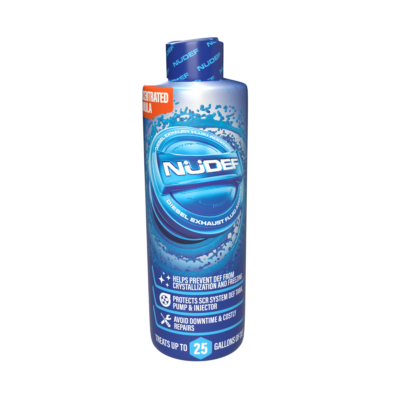
NüDef treats 25 gallons per bottle. That’s 2–3 times the treatment capacity of competitors like Rislone or Hot Shot’s Secret, which treat 8–20 gallons per unit. For a fleet filling tanks at a bulk DEF station, the per-gallon treatment cost matters. Fewer bottles per truck, less handling time for your shop crew, and simpler inventory management.
NüDef’s wholesale program is built for fleets from 10 trucks to 500+, and you can order on whatever schedule works for your shop.
Frequently Asked Questions
How much does DEF system failure cost per truck?
Anywhere from $3,800 to $15,000 once you add parts, labor, and lost revenue. A DEF injector swap might only run $400–$800, but a full SCR catalyst replacement hits $8,000 before labor. The real kicker is downtime — most SCR repairs take 2–5 days, and every idle day costs $1,000+ in revenue for a Class 8. Trucks over 300,000 miles tend to stack multiple failures in the same quarter, which is when the numbers get ugly fast.
Does DEF additive actually prevent SCR problems?
It prevents the crystallization that causes most of them. When DEF breaks down from heat, age, or contamination, it forms urea crystals that clog injectors and coat catalyst substrates. NüDef stabilizes the solution before that happens. We’ve seen treated fleets drop DEF fault codes by 50–75%. One thing worth noting: additive won’t fix damage that’s already done. If your SCR is already crystallized, you’ll need to clean or replace it first, then start treating to prevent it from happening again.
What’s the ROI timeline for fleet DEF treatment?
Most fleets see it within 60–90 days. Fault codes drop first, which cuts diagnostic shop time right away. Parts replacement savings show up around the 6-month mark. A 50-truck fleet running our conservative numbers should expect around $193,500 in annual savings, with full-year ROI north of 300%. Fleets in hot climates or running older trucks often hit payback even sooner because their baseline failure rate is higher to begin with.
How do I justify DEF additive cost to my fleet manager or CFO?
Pull your last 12 months of work orders tagged to SCR, DEF, DPF, or aftertreatment. Add up the parts, labor, and downtime at your daily revenue rate. For most fleets, treatment costs 5–15% of the problem it prevents. If full-fleet approval is tough, pitch a 90-day pilot on your 10–15 worst trucks. One tip: lead with the downtime dollar figure, not the parts savings. CFOs respond to revenue impact faster than maintenance line items.
Can I get volume pricing for large fleets?
Yes. NüDef’s wholesale program has pricing tiers for 50+ and 100+ truck operations, with direct shipping to your facility and dedicated account support. Applications get reviewed within 48 hours. Most fleets get a custom quote same-week, and there aren’t any minimum order commitments locking you in.
Does NüDef work with bulk DEF dispensing systems?
Yes — you can add it to individual truck tanks or dose it at the bulk storage level so every fill-up is automatically treated. One bottle covers 25 gallons, which makes dosing simple whether you’re running totes, tanks, or a full dispensing island. If you’re using a recirculation system on your bulk tank, the wholesale team can walk you through the best dosing point for your setup.
Get Wholesale Pricing for Your Fleet
Every month you run untreated DEF is another month of preventable repair bills and avoidable downtime. A 50-truck fleet stands to save over $190,000 annually. The math speaks for itself.
Submit a wholesale application today and get volume pricing for your fleet within 48 hours. NüDef’s wholesale team will build a treatment program matched to your fleet size, route profile, and maintenance schedule. No minimum order commitments. No long-term contracts. Just better DEF and lower repair bills.