
A diesel motorhome or RV sits in storage for weeks or months at a time, and that idle time is exactly what DEF systems hate most. The Selective Catalytic Reduction system in your Cummins- or Freightliner-powered coach depends on DEF that stays within tight chemical specifications, and DEF left standing in a parked vehicle is the most common cause of the crystallization that triggers fault codes, progressive derates, and the kind of breakdown that turns a planned vacation into a roadside problem.
The good news is that RV DEF problems are almost entirely preventable. Understanding why they happen and treating the DEF before you park eliminates the risk entirely.
Why Motorhomes Have Worse DEF Problems Than Trucks
A pickup truck used daily keeps DEF cycling through the dosing system continuously. Heat from normal operation burns off minor deposits before they accumulate. A motorhome parked for three months does none of this. DEF sits stagnant in the tank, the supply lines, and the dosing injector. Water slowly evaporates from the fluid over time, raising the urea concentration above the ISO 22241 specification of 32.5%. As that concentrated urea contacts cooler surfaces inside the system, it precipitates into white crystalline deposits.
Motorhome storage conditions compound this problem in ways that truck storage typically does not. Storage facilities and residential driveways expose the coach to full seasonal temperature swings: cold winters that freeze DEF in the lines, hot summers that accelerate degradation in storage bays that can exceed 120°F. Neither extreme is well-tolerated by untreated DEF.
The result is that a motorhome owner who takes two or three trips per year and stores the coach between them has a significantly higher probability of experiencing a DEF system fault than a daily-driver truck owner, not because the equipment is worse, but because the usage pattern creates ideal conditions for crystallization.
How DEF Crystallizes in a Parked Motorhome
The crystallization process in a parked motorhome follows a predictable sequence. During storage, the DEF tank is sealed but not perfectly airtight. The vent system allows a slow exchange of air that enables water to evaporate from the fluid over time. As water leaves the solution, the urea concentration rises above 32.5%.
This concentrated urea is unstable. When it contacts the metal and plastic surfaces inside the dosing injector, which operates at lower temperatures when the engine is off, urea nucleates into solid crystal structures. These crystals are small at first, forming a thin coating inside the injector nozzle. Over months of storage, the coating thickens. By the time the coach is started for the first trip of the season, the injector may be partially or fully blocked.
When the blocked injector cannot dose DEF correctly, the downstream NOx sensor detects that the SCR catalyst is not converting nitrogen oxides at the expected rate. The ECU flags the discrepancy as a DEF quality or system performance fault, stores the code, and begins the derate countdown. The owner typically discovers this on the first day of a planned trip.
DEF Fault Codes on Motorhomes and Diesel Pushers
Motorhome DEF fault codes vary by engine manufacturer. Cummins-powered coaches most commonly throw P207F (Reductant Quality Performance) and SPN 3364/FMI 1 (DEF Quality Below Threshold), the same codes seen in Cummins-powered Ram trucks. Freightliner chassis with Detroit Diesel engines may display similar proprietary fault codes that translate to the same root causes.
P20EF (Reductant Injection Valve Stuck Closed) indicates physical blockage of the dosing injector and is the code that most often requires shop intervention rather than a self-service drain and refill. This code appears when crystallization has progressed to the point where the injector cannot open and close correctly. On a motorhome, P20EF diagnosed at a roadside stop means the coach needs to be carefully driven at the derate-restricted speed to the nearest qualified diesel service center.
The derate sequence on motorhome engines follows the same countdown logic as in trucks: progressive speed restrictions from full power down to approximately 5 mph over the course of several engine restarts. At 5 mph, a 40-foot diesel pusher on a highway entrance ramp is a safety situation. Prevention is the only strategy that reliably avoids this outcome.
How to Fix RV DEF Crystallization
If you are already seeing DEF fault codes when you start your coach, the first step is a complete DEF tank drain before attempting any other repair. Most diesel motorhome chassis have an accessible DEF tank drain. Remove the plug, drain the tank completely, and inspect the outlet strainer and accessible line connections for visible white crystalline deposits. Clear any deposits you find.
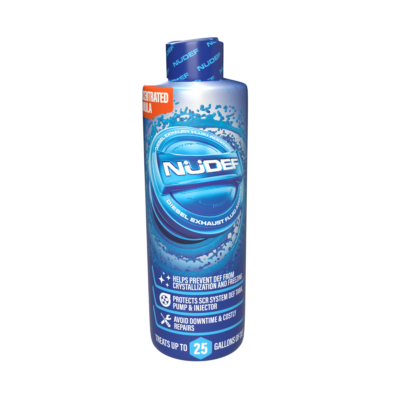
Refill the tank with fresh certified ISO 22241 DEF and add NüDef stabilizer. Run the engine to operating temperature and allow it to complete a full DEF system warmup and dosing cycle. Drive normally for at least one to two hours if possible. This combination of fresh fluid, NüDef’s cleaning action, and exhaust heat cycling clears quality-related fault codes in most cases without requiring dealer or shop involvement.
For motorhomes where the injector is physically blocked and P20EF is present, a diesel shop with DEF system tooling is necessary. The dosing injector on most motorhome chassis can be accessed without major disassembly, and ultrasonic cleaning or replacement resolves the blockage. Budget $400 to $900 for the service depending on injector availability and labor rates in your area.
Preventing RV DEF Problems with NüDef
Prevention for motorhome owners comes down to one consistent practice: treat the DEF tank with NüDef before every storage period. Add NüDef to the tank when it is full, run the engine for ten minutes to circulate the treated fluid through the dosing system, and then park the coach. The stabilizer slows evaporation, maintains fluid consistency through temperature extremes, and provides a protective treatment on the injector surfaces that inhibits crystal formation.
For coaches stored in hot climates where bay temperatures routinely exceed 90°F, treating at every fill-up during the driving season, not just before storage, provides additional protection against the accelerated degradation that heat causes. For coaches stored in cold climates, NüDef’s contribution to lowering the DEF freezing point provides meaningful additional protection against freeze damage during northern winters.
The investment in NüDef is negligible relative to the cost of a single DEF service call at a motorhome dealership or roadside service event. Treating the tank before every storage period converts a high-probability failure mode into a solved problem. Whether you need an additive for DEF fluid in a motorhome, diesel pusher, or fifth wheel, NüDef is formulated for every diesel application using DEF.
Seasonal Storage: What to Do Before You Park It
A complete pre-storage DEF protocol for motorhomes takes less than fifteen minutes and eliminates the most common cause of first-trip failures. Fill the DEF tank to capacity before parking. A full tank has less air space and therefore less evaporation surface. Add NüDef at the correct dose for the tank volume. Start the engine and run it for ten minutes at idle to circulate the treated DEF through the complete system including the supply lines and dosing injector. Shut down normally.
If the coach will be stored for more than three months, starting the engine and running it to operating temperature once a month, even for just fifteen minutes, keeps DEF cycling through the system and prevents the static accumulation that leads to crystallization. This monthly idle cycle with treated DEF in the tank is the most effective long-term storage strategy available short of full DEF system bypass, which is not a legal option on emissions-controlled engines.
In spring, before the first trip, top off the DEF with fresh treated fluid and start the engine normally. If the system has been maintained properly through storage, the first startup will be clean and the coach will be ready to drive without a fault code in the dash.
Boat DEF Additive: Why Marine Diesel Engines Need DEF Treatment
Diesel-powered boats face every DEF challenge that motorhomes do, plus several that are unique to the marine environment. If your boat runs a Tier 3 or Tier 4 marine diesel with an SCR system — common on Cummins QSB, QSC, and QSL marine engines, Volvo Penta D-series, and Caterpillar C-series marine platforms — your DEF system operates in conditions that are significantly harder on DEF chemistry than anything a road vehicle encounters.
The primary marine-specific DEF stressor is bilge heat. Engine compartments on inboard diesel boats routinely exceed 130°F during operation. DEF tanks mounted near the engine bay absorb that heat for hours during a cruise, accelerating the evaporation and urea concentration that drives crystallization. Unlike a truck DEF tank that sits in open airflow on the side of the frame, a boat DEF tank is often enclosed in a compartment with minimal ventilation and high radiant heat from the exhaust system.
Salt air compounds the problem. Marine environments expose the DEF filler cap, vent system, and any external fittings to salt-laden humid air that accelerates corrosion and can compromise the seal on the DEF tank. A compromised seal allows faster moisture exchange and evaporation, concentrating the urea between uses. Boats stored near salt water, even in covered slips, are exposed to this corrosive atmosphere year-round.
Winterization is where most boat DEF failures originate. A boat hauled out in October and launched in May has had its DEF sitting static for seven months. That is more than twice the typical RV storage period, and the DEF in the tank, supply lines, and dosing injector has had that entire time to evaporate, concentrate, and crystallize. Using a boat DEF additive like NüDef before winterization is the single most important step for marine diesel owners. Add NüDef to a full DEF tank, run the engine at the dock for ten minutes to circulate treated fluid through the entire dosing system, then shut down and haul out. In spring, top off with fresh treated DEF before the first start.
For boat owners dealing with existing DEF crystallization after a long storage period, the fix follows the same process as motorhomes: drain the DEF tank, rinse with distilled water, refill with fresh NüDef-treated DEF, and run the engine through a full warmup cycle. Preventing the problem with a boat DEF additive before each storage period is far easier than cleaning crystallized DEF out of a marine dosing system where access to components is often more restricted than in any road vehicle.