
The 6.7L Cummins Turbo Diesel powers more Ram Heavy Duty trucks than any other engine in the segment. It’s a proven platform built to work hard for decades. But the SCR emissions system that keeps it street-legal has one consistent vulnerability: DEF crystallization. And once crystals form in the dosing injector or supply lines, the truck’s ECU starts a derate countdown that ends at 5 mph.
Understanding exactly why Cummins DEF crystallization happens, and what to do about it, keeps your Ram out of the dealership service bay and keeps your wallet where it belongs.
Why Does the 6.7 Cummins Have DEF Problems?
The 6.7L Cummins SCR system is not uniquely flawed. The root cause of most DEF problems is a chemistry problem, not an engineering defect. Diesel Exhaust Fluid is a precisely formulated solution of 32.5% urea and 67.5% deionized water. That specific ratio exists because it has the lowest possible freezing point for a urea-water mixture of about 12°F, while also providing consistent decomposition behavior when injected into hot exhaust gases.
The problem is that DEF is chemically active in ways that make it sensitive to storage conditions. When water evaporates from DEF, whether from heat exposure, a loose cap, or a long storage period, the urea concentration rises above 32.5%. Concentrated urea forms solid crystalline deposits wherever it contacts cooler surfaces: the dosing injector nozzle, the supply lines, and the tank outlet strainer. Once those deposits accumulate, the SCR system can’t dose correctly, NOx conversion efficiency drops, and the fault code cycle begins.
Ram trucks are particularly susceptible because they’re often used for work that involves extended idle periods, seasonal storage, and hot climate operation, all three of the primary crystallization triggers.
How DEF Crystallizes in Cummins Systems
Crystallization in the 6.7L Cummins system typically follows one of three pathways. The first is storage-related: a truck that sits for several weeks while DEF remains in the tank and lines allows gradual water evaporation. The dosing injector, which operates at temperatures that can drop significantly when the engine is off, becomes a collection point for urea deposits as fluid evaporates around it.
The second pathway is thermal. In hot climates, DEF stored in the truck’s DEF tank, which is often located near heat sources, can reach temperatures above 86°F regularly. At those temperatures, DEF begins to break down faster than its rated shelf life. The urea concentration shifts, and repeated heating and cooling cycles create conditions for crystalline precipitation.
The third pathway is freeze-thaw cycling. DEF freezes at 12°F. The Ram’s factory DEF heater thaws the fluid for engine startup, but repeated freeze-thaw cycles without any stabilization cause concentration inconsistencies throughout the tank as some regions thaw faster than others. Over time, those inconsistencies accumulate and produce localized deposits in the lines and injector.
Cummins DEF Fault Codes Explained
The Cummins ECU monitors DEF system health through NOx sensors upstream and downstream of the SCR catalyst, a reductant quality sensor in the DEF tank, and pressure sensors in the dosing circuit. When any of these sensors detect out-of-spec conditions, fault codes are triggered and a derate countdown begins.
P207F (Reductant Quality Performance) is the most frequently reported DEF fault code on 6.7L Cummins trucks. It means the downstream NOx sensor is detecting that the SCR catalyst isn’t converting nitrogen oxides at the expected efficiency rate. This directly indicates that the DEF being dosed isn’t reacting correctly, either because it’s degraded, contaminated, or being dosed inaccurately due to a partially blocked injector.
SPN 3364/FMI 1 (DEF Quality Below Threshold) serves a similar diagnostic function, specifically flagging the reductant quality sensor’s reading. When this code appears, the ECU has determined the DEF concentration or purity is outside acceptable parameters.
P20EF (Reductant Injection Valve Stuck Closed) and P20EE (SCR NOx Catalyst Efficiency Below Threshold) round out the most common cluster. P20EF typically indicates a physically blocked or failed dosing injector, while P20EE reflects the downstream consequence of whatever upstream DEF problem exists. In most cases, all of these codes share the same root cause: DEF that has crystallized, degraded, or been contaminated.
How to Fix 6.7 Cummins DEF Crystallization
If you’re already seeing fault codes and the derate countdown has started, the first step is to drain the DEF tank completely. Most Ram 2500 and 3500 trucks have an accessible drain plug on the DEF tank. Drain the old fluid, inspect the tank outlet strainer for crystal deposits, and clear any visible buildup.
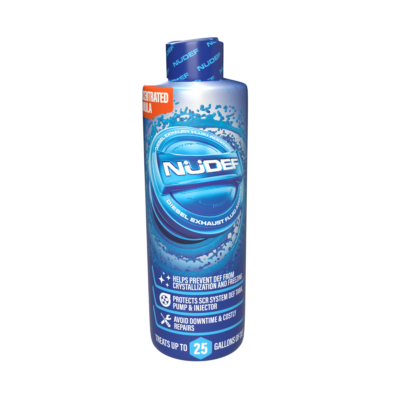
Refill with fresh certified ISO 22241 DEF and add NüDef stabilizer before doing so. Drive the truck through at least two full operating cycles, allowing the exhaust system to reach normal operating temperature each time. The combination of fresh DEF, the stabilizer’s cleaning action on mild deposits, and normal exhaust heat cycling clears the fault codes in most cases without a dealer visit.
If the dosing injector itself is physically blocked, which you’ll know because the system won’t respond to fresh DEF, the injector needs to be removed and either cleaned ultrasonically or replaced. This is a dealer or independent diesel shop job. Replacement injectors for the 6.7L Cummins typically run $400 to $800 for parts plus labor.
For early-stage crystallization caught at the first warning light, adding NüDef to fresh DEF and running the truck through normal operation often resolves the issue before any physical intervention is needed. The earlier you act, the better your odds of a self-service fix.
How to Prevent DEF Crystallization with NüDef
Prevention is the only strategy that keeps the 6.7L Cummins out of the derate cycle entirely. NüDef works by stabilizing the DEF in your tank, slowing the evaporation that concentrates urea, maintaining fluid consistency through temperature cycling, and providing a protective barrier on the dosing injector and supply lines that resists crystal nucleation.
For Ram owners who use their trucks seasonally, including towing boats in summer, hunting rigs in fall, and work trucks that sit on weekends, treating the DEF tank before each extended storage period is the most important single preventive action available. Add NüDef when the truck will sit for more than two weeks and the crystallization risk drops dramatically.
For daily drivers, adding NüDef at each DEF fill-up provides ongoing protection against the thermal cycling and gradual concentration drift that builds up over months. One bottle treats up to 25 gallons, making it a negligible cost compared to any DEF system repair.
Ram 2500 vs 3500: Any DEF Differences?
Both the Ram 2500 and Ram 3500 use the same 6.7L Cummins engine and the same Bosch SCR system architecture. The DEF tank size and the dosing injector specifications are identical across both platforms in the same model years. Fault code behavior, derate thresholds, and diagnostic procedures are the same.
The Ram 3500, particularly in dual-rear-wheel configurations used for heavy towing, tends to accumulate more operating hours in high-load, high-exhaust-temperature conditions. This can accelerate DEF degradation at the tank level due to sustained heat exposure. Owners of heavily used 3500s benefit from treating the DEF more frequently, at every fill-up rather than every other fill-up, particularly during summer months or in hot climates.
For both platforms, the preventive math is straightforward. A bottle of NüDef costs a fraction of a single dealer diagnostic visit. Treating the DEF before problems start is always cheaper than fixing them after the fact.
Crystallization showing up as a fault code? Crystal buildup at the injector commonly triggers P2048 and P249D. The full code index is in DEF trouble codes explained.
Where the 6.7 Cummins DEF System Actually Crystallizes
Knowing the layout saves diagnostic hours. On 2013 and newer Ram 2500/3500 trucks, DEF leaves the tank through the pump module, runs forward in a heated line, and injects into the exhaust at the decomposition tube ahead of the SCR catalyst. Crystals form at predictable spots, in this order:
- The injector tip. Fluid dries on the nozzle after shutdown, one heat cycle at a time. This is the most common blockage on the platform and the first thing to inspect: white crust visible at the tip after removal.
- The decomposition tube. Spray that never atomized properly builds deposits downstream of the injector. Heavy buildup here restricts exhaust flow and traps more spray, so it feeds itself.
- The pump module and filter. Crystals that form in the tank get pulled into the pump screen. Pressure codes follow.
- The level and quality sensors in the tank. The sender unit Ram parts language calls the DEF header, covered in the sensors guide. A crusted float reads wrong and the truck believes it.
Every one of those spots fails for the same upstream reason: fluid that came out of solution. Fix a component without fixing the fluid and the crystals reschedule the repair.
The Codes a Crystallized 6.7 Throws
Ram trucks report crystallization in a handful of recurring codes, and reading them in combination points at the blockage:
- P20EE — SCR NOx efficiency below threshold. The catalyst is not getting the ammonia it needs, usually because the injector or tube is restricted. The full code family is mapped in the DEF trouble codes guide.
- P202E / P2047-family — injector performance and circuit faults. With white crust at the tip, this is mechanical blockage, not electronics.
- P20E8 — low DEF pressure, the pump fighting a restricted screen or line, detailed in the P20E8 guide.
- “Service DEF System See Dealer” with the countdown, the message layer over all of it, decoded in the Service DEF guide.
The diagnostic order that saves money: codes first, fluid concentration second with a refractometer, then hardware inspection starting at the injector. Owners who skip the fluid check replace parts that the untreated tank then ruins again.
A Prevention Program That Fits How Rams Are Used
The 6.7 crystallizes more than some platforms for a usage reason: these trucks tow hard in summer heat and sit between jobs. Heat degrades the fluid, then the truck parks and the injector tip dries. The program that breaks the cycle costs a few dollars a month:
- Buy DEF from high-turnover sources and check date codes, per the storage guide.
- Treat every fill with NüDef DEF Treatment & Stabilizer so the urea stays in solution through the heat cycles and the sitting. One 8 oz bottle treats up to 25 gallons.
- Do not top off from the dusty half-jug in the truck bed. Contamination and crystallization arrive together, per the contaminated DEF guide.
- If the truck sits more than a couple of weeks, run it to operating temperature when you start it, so the dosing system cycles fresh fluid through the injector.