
It is the question every diesel owner eventually asks, usually when a DEF warning lights up far from a parts store: can you drive without DEF? The short answer is no — not for long. Here is exactly what happens as your diesel exhaust fluid runs low and then runs out, how far you can really go, and how to avoid getting stranded.
The Short Answer
Modern diesels are designed — by federal emissions law — so they cannot run normally without DEF. As the tank empties, the truck escalates warnings, then forces a severe speed limit, and on a full empty/no-start condition many trucks will not restart until DEF is added. This is intentional emissions-compliance behavior, not a malfunction, and there is no legitimate way to drive through it on a stock vehicle.
What Happens, Stage by Stage
The sequence is consistent across brands, even if the exact mileages differ:
- Low-DEF warning — appears with roughly 1,000 miles of range remaining: a dashboard message and gauge.
- Escalating alerts — more insistent messages, chimes, and a check-engine light as the level drops toward a few hundred miles.
- Speed derate — as you approach empty, the truck limits power and then road speed, commonly down to about 5 MPH.
- No-restart — on many trucks, once the engine is shut off with an empty tank it will not restart until DEF is added.
Why It Works This Way
SCR systems use DEF to convert NOx into harmless nitrogen and water. Running without it would defeat the federally required emissions controls, so manufacturers build the derate in to force compliance. The behavior is mandated, which is why it is identical in spirit across Ford, Ram, and GM — the fix is never a workaround, it is simply adding fluid.
How Far Can You Actually Go?
From the first low-DEF warning you typically have around 1,000 miles — plenty of time to refill if you act on it. The danger is ignoring the early warnings: once you are near empty, the derate hits quickly and your “range” collapses to a crawl. Treat the first warning as the deadline, not the last one.
Differences by Brand
All modern diesel pickups and commercial trucks follow the same low→derate→no-restart logic, but thresholds and messaging vary. If your warnings are tied to a “quality” message rather than a low-level message, that is a different problem — see our “DEF Quality Poor” guide, because a quality fault can strand you even with fluid in the tank.
If You Have Already Run Out
Add several gallons of fresh DEF — most trucks need a minimum amount before they will clear the derate or restart. Cycle the key and allow the system a short drive to re-read the level; recovery is not always instant. If the truck will not recover after a proper refill, suspect a DEF level sensor or pump fault — see our DEF pump guide.
How to Never Get Caught Out
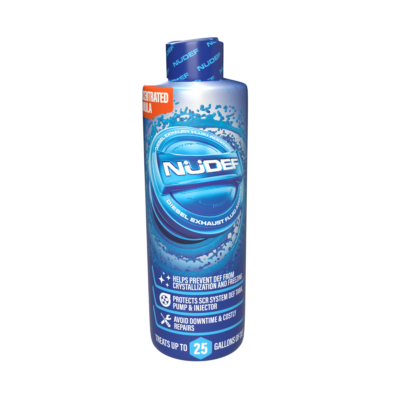
Keep DEF on hand and refill at the first warning, not the last. Because DEF degrades over time, store only what you will use and keep it fresh — and stabilize it so the fluid in your tank stays in spec. A treatment like NüDef ships direct so you always have current product on the shelf, and it also prevents the separate “quality poor” fault that can strand you even with a full tank.
Can You Legally Delete the DEF System?
No. Tampering with or deleting the SCR/DEF system on an on-road vehicle is illegal under federal law, voids warranties, and fails emissions inspection — and the EPA has aggressively pursued delete-tuner sellers. The legal, cheaper, and simpler answer is to keep fresh DEF in the tank. NüDef helps by keeping that fluid in spec so you avoid both empty-tank and quality derates.