
Transit bus fleets running diesel engines with Selective Catalytic Reduction systems face DEF crystallization as an operational threat that directly impacts route reliability and maintenance budgets. Unlike over-the-road trucks that maintain consistent exhaust temperatures through highway driving, transit buses operate in stop-and-go cycles that create the exact thermal conditions where DEF system failures are most likely. Transit DEF crystallization costs agencies thousands per bus annually in unplanned maintenance, and it is almost entirely preventable with the right fluid management protocol.
This guide covers why transit bus DEF systems fail differently than other diesel applications, the fault codes fleet maintenance teams encounter most often, and the preventive strategy that keeps buses on their routes instead of in the shop.
Why Transit Bus DEF Problems Are Different
Transit buses operate in a duty cycle that is uniquely hostile to DEF system health. A city bus running a fixed route spends most of its operating time at low speeds with frequent stops. This means exhaust gas temperatures rarely reach the sustained high levels that burn off minor DEF deposits in highway-driven trucks. The SCR system in a transit bus spends more time in its cold or warm-up phase, and the DEF dosing injector cycles between active and inactive states far more frequently than in a line-haul application.
This cycling creates a thermal stress pattern at the injector nozzle. DEF is dosed during active periods and then sits in the injector tip during idle or low-load phases. As the nozzle cools, residual DEF begins concentrating as water evaporates from the exposed surface. Over hundreds of stop-and-go cycles per shift, a thin layer of crystalline urea builds at the nozzle. Without intervention, this layer thickens until it restricts or blocks DEF flow entirely.
Fleet operators managing 50, 100, or 500 buses see this pattern repeat across every vehicle on a predictable timeline. Transit DEF crystallization is not a random failure. It is a systemic condition inherent to the transit duty cycle, and it requires a systemic prevention approach.
Most Common Transit Bus DEF Failures
The number one failure mode in transit fleets is dosing injector crystallization from the stop-and-go thermal cycling described above. This manifests as reduced DEF injection rates that the downstream NOx sensors detect as an SCR efficiency drop. The ECU logs a fault, starts a derate countdown, and the bus must be pulled from service for diagnosis and repair.
The second most common failure is DEF degradation during overnight and weekend parking. Transit buses that run a single shift return to the yard with DEF sitting in the tank, lines, and injector for 12 to 16 hours overnight. Buses held out of service for weekend scheduling gaps sit for 48 to 60 hours. During this downtime, ambient temperature swings in uncovered yards accelerate the evaporation and concentration process that leads to crystal formation.
The third failure pattern is bulk DEF quality degradation. Many transit agencies dispense DEF from bulk storage tanks that are exposed to outdoor temperatures at the fueling island. Bulk DEF stored in a tank that reaches 100°F or higher during summer months degrades faster than its rated shelf life. Buses fueled from a degraded bulk supply are starting every shift with compromised fluid, and no amount of driving will compensate for DEF that was already out of spec when it entered the tank.
Transit Bus DEF Fault Codes
Transit fleets running Cummins ISB or ISL engines, the most common powerplants in North American transit buses, encounter P207F (Reductant Quality Performance) as the primary DEF-related fault code. This code indicates the ECU has determined that the DEF being injected is not producing the expected NOx conversion rate at the SCR catalyst. On a transit bus, this almost always traces back to crystallization at the dosing injector or degraded DEF quality.
SPN 3364/FMI 1 (SCR DEF Quality Below Threshold) is the J1939 equivalent that appears on fleet diagnostic platforms and telematics systems. For maintenance teams using tools like Cummins INSITE or Noregon JPRO, this is the code that triggers a work order.
P20EE (SCR Catalyst Efficiency Below Threshold) appears when the problem has progressed beyond DEF quality into physical catalyst performance degradation. On a transit bus that has been running with restricted DEF flow for an extended period, the catalyst itself may have been damaged by thermal stress from operating without adequate reductant. This is the expensive code. Catalyst replacement on a transit bus can exceed $5,000 to $8,000 including labor and downtime.
P20EF (Reductant Injection Valve Performance) indicates the dosing injector is physically stuck or blocked. On transit buses, this code means the injector needs cleaning or replacement before the bus can return to service. Turnaround time at a transit maintenance facility is typically 2 to 4 hours if parts are in stock.
The Real Cost to Transit Fleets
The direct maintenance cost of a single DEF-related work order on a transit bus runs $200 to $400 for a drain-and-refill with injector inspection, $500 to $1,200 for injector cleaning or replacement, and $5,000 to $8,000 or more for SCR catalyst damage. These numbers multiply across a fleet.
But the larger cost is operational. A transit bus pulled from service for an unplanned DEF repair leaves a gap in the route schedule. Riders are delayed. If a spare bus is available, it must be dispatched, burning fuel and labor to cover the gap. If no spare is available, the route runs short and service reliability metrics suffer. Transit agencies that report to municipal oversight boards or state DOTs track these metrics, and repeated service disruptions from preventable maintenance issues draw scrutiny.
A fleet of 100 buses experiencing DEF-related failures at a rate of even 5% per month represents 5 unplanned bus removals, 5 work orders, 5 route disruptions, and the cascading labor and parts costs that follow. Over a year, that is 60 failure events from a single preventable cause. The annualized cost across parts, labor, downtime, and service impact easily reaches six figures for a mid-sized transit agency.
Fleet-Wide Prevention Protocol
Preventing transit DEF crystallization at fleet scale requires treating the cause rather than chasing individual failures. The protocol has three components: treat the DEF at the source, treat the buses on a schedule, and monitor the results through existing telematics.
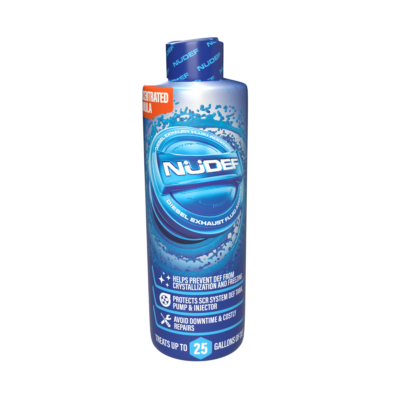
At the fueling island, add NüDef to the bulk DEF storage tank at the manufacturer-recommended ratio. Every bus that fuels receives treated DEF automatically, with no change to the fueling workflow. This single action addresses both the fluid quality issue and provides crystallization protection for every vehicle in the fleet simultaneously.
For buses that rotate through long weekend holds or are placed in reserve status, a supplemental treatment directly to the onboard DEF tank before parking provides additional protection during extended downtime. Maintenance staff can dose NüDef into the tank during the pre-park inspection, a 30-second addition to an existing process.
Monitor DEF-related fault codes through the fleet telematics system on a weekly basis. After implementing NüDef treatment, the trend line on DEF fault frequency provides direct measurement of effectiveness. Transit fleets that have adopted this protocol report measurable reductions in DEF-related work orders within the first 60 to 90 days.
Seasonal Considerations for Transit Fleets
Transit fleets in northern climates face an additional challenge: DEF freezes at 12 degrees Fahrenheit. Buses parked overnight in uncovered yards during winter may have DEF freeze in the supply lines and dosing injector. While the onboard DEF heater thaws the system during engine warmup, repeated freeze-thaw cycles stress the injector and accelerate crystal formation as each cycle concentrates the urea slightly more.
Summer brings the opposite problem. Bulk DEF stored at an outdoor fueling island in Phoenix, Houston, or any Sun Belt city regularly exceeds the 86 degree threshold where degradation accelerates. A bulk tank in direct sun can reach internal temperatures well above 100 degrees. DEF dispensed at those temperatures has already lost stability before it reaches the bus.
NüDef provides year-round protection against both seasonal extremes. In winter, the stabilizer reduces the concentration shift caused by freeze-thaw cycles. In summer, it slows the thermal degradation that compromises bulk and onboard DEF quality. For transit agencies operating across all four seasons, treating the bulk supply year-round is the most operationally efficient approach.